Albertonectes
Albertonectes vanderveldei
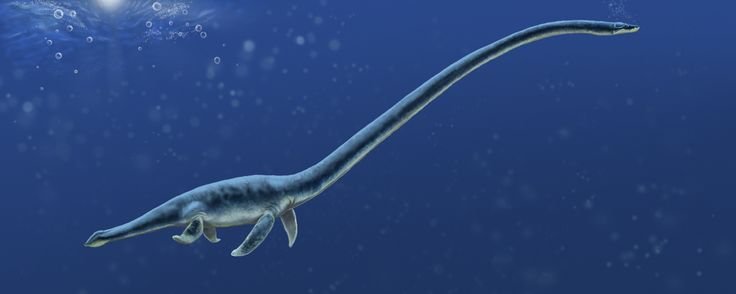
Image: Image sourced via web search (Fair use / Educational)
About Albertonectes
Albertonectes vanderveldei was a colossal marine reptile belonging to the elasmosaurid family of plesiosaurs, distinguished by its extraordinarily long neck. It navigated the shallow waters of the Western Interior Seaway in what is now Alberta, Canada, during the Late Cretaceous period, approximately 74 to 70 million years ago. Its discovery is paleontologically significant for representing one of the last and longest-necked plesiosaurs known, providing crucial insights into the diversity and anatomy of marine reptiles just before the end-Cretaceous mass extinction event.
Albertonectes was a truly immense animal, with an estimated total body length of around 11.6 meters (approximately 38 feet). For comparison, this is longer than a modern school bus and rivals the size of many large predatory whales today, such as the orca. A significant portion of this length was its remarkable neck, which measured an astonishing 7 meters (23 feet). This neck was composed of 76 cervical vertebrae, a record number for any known vertebrate, surpassing even its close relative Elasmosaurus, which had 72. The individual vertebrae were relatively short, suggesting that while the neck was incredibly long, it may have been less flexible than popularly imagined, likely moving in broad, sweeping arcs rather than snake-like coils. The skull of Albertonectes was relatively small, estimated to be about 83.5 cm long, and possessed a battery of long, slender, interlocking teeth ideal for snaring small, fast-moving prey. Its body was streamlined and barrel-shaped, propelled by four large, powerful flippers that it would have used to 'fly' through the water in a manner analogous to modern sea turtles or penguins. Weight estimates are difficult, but an animal of this size likely weighed several metric tons.
As a carnivore, the paleobiology of Albertonectes was centered around its unique feeding apparatus. Its long, sharp teeth indicate a diet primarily consisting of small fish and cephalopods like squid and belemnites. The extreme length of its neck has been a subject of considerable study regarding its hunting strategy. One prominent hypothesis suggests that Albertonectes was an ambush predator, using its small head and long neck to stealthily approach schools of fish from below. The animal could keep its large, conspicuous body hidden in the murkier depths while extending its head into shallower, well-lit waters to snatch unsuspecting prey. This 'stalk-and-strike' method would have been highly effective in the productive waters of the Western Interior Seaway. Locomotion was achieved through powerful, coordinated strokes of its four flippers, a method known as subaqueous flight. This would have allowed for efficient, graceful, and potentially swift movement over long distances, though it was likely not a high-speed pursuit predator. Gastroliths, or stomach stones, have been found in association with the holotype specimen, suggesting they were intentionally swallowed to aid in buoyancy control or digestion, a common feature in many plesiosaurs. Social behavior remains speculative, but like many large marine animals today, it may have been a solitary hunter.
Albertonectes lived during the Campanian and early Maastrichtian stages of the Late Cretaceous, a time when the globe was warmer than today and sea levels were significantly higher. Its habitat was the Western Interior Seaway, a vast, shallow epicontinental sea that split North America into two landmasses, Laramidia to the west and Appalachia to the east. This seaway was a thriving, complex marine ecosystem teeming with life. Albertonectes shared this environment with a diverse array of fauna. It would have hunted alongside other large marine reptiles, including the formidable mosasaurs like Prognathodon and Mosasaurus, which were the apex predators of the seaway and likely posed a threat to Albertonectes, especially juveniles. Other plesiosaurs, such as polycotylids, also inhabited these waters. The seaway was rich with its prey: numerous species of fish, ammonites, belemnites, and other invertebrates. Overhead, pterosaurs like Pteranodon would have soared, and on the nearby coastlines of Laramidia, dinosaurs such as hadrosaurs, ceratopsians, and the fearsome tyrannosaurids, including Albertosaurus, roamed. As a large predator, Albertonectes occupied a high trophic level, likely just below the giant mosasaurs, playing a crucial role in regulating the populations of smaller marine animals.
The discovery of Albertonectes is a story of commercial enterprise meeting scientific importance. The holotype specimen, TMP 2007.011.0001, was unearthed in September 2007 by Korite International, a company that commercially mines ammolite, an iridescent gemstone formed from the fossilized shells of ammonites. The fossil was found near the St. Mary River, south of Lethbridge, Alberta, within the Bearpaw Formation. Miners operating heavy machinery to excavate for ammolite stumbled upon the remarkably complete and articulated postcranial skeleton. Recognizing the scientific value of the find, Korite International collaborated with the Royal Tyrrell Museum of Palaeontology. The fossil was carefully excavated and prepared by museum staff over several years. In 2012, paleontologists Tai Kubo, Mark Mitchell, and Donald Henderson formally described the specimen, naming it Albertonectes vanderveldei. The genus name combines 'Alberta' with 'nectes,' Greek for 'swimmer.' The species name, 'vanderveldei,' honors Rene Vandervelde, the founder of Korite International, for his role in ensuring the fossil was preserved for science rather than being discarded during mining operations. The holotype remains the only known specimen of this genus.
Albertonectes holds a significant place in the evolutionary history of plesiosaurs. It belongs to the family Elasmosauridae, a group of plesiosaurs that evolved during the Cretaceous and are characterized by their extreme neck elongation. Within this family, Albertonectes is considered a derived member, representing the culmination of the evolutionary trend towards an ever-increasing number of cervical vertebrae. Its record-breaking 76 neck vertebrae provide a key data point for understanding the anatomical limits and developmental plasticity of the vertebrate spinal column. Elasmosaurids like Albertonectes do not have any direct modern descendants, as they, along with all non-avian dinosaurs and other large marine reptiles, went extinct at the end of the Cretaceous period 66 million years ago. Their closest living relatives are modern reptiles, but the relationship is distant. The study of Albertonectes helps scientists trace the diversification of marine reptiles during the Mesozoic and understand how different lineages adapted to specialized predatory niches, with elasmosaurids perfecting the long-necked ambush strategy. Its existence so late in the Cretaceous demonstrates that this specialized body plan remained successful for millions of years, right up until the final extinction event.
While the classification of Albertonectes as an elasmosaurid is firm, scientific discussion continues regarding the precise function of its incredibly long neck. Early paleontological reconstructions depicted plesiosaurs with swan-like, highly flexible necks held high out of the water, an idea now largely discredited. Biomechanical studies, including those by Kubo, Mitchell, and Henderson in their 2012 description, suggest the neck was held relatively straight and was stiff, with limited vertical flexibility but greater horizontal range of motion. This supports the 'ambush from below' feeding hypothesis. Another area of debate centers on the role of the numerous gastroliths found with the holotype. While buoyancy control and digestion are the leading theories, the exact mechanism and relative importance of each function are still discussed. The discovery of a single, exceptionally complete specimen means that our understanding of the species' variation, growth, and full geographic range is limited, awaiting future fossil finds that could challenge or refine current interpretations.
The fossil record for Albertonectes is currently limited to a single, extraordinary specimen. The holotype (TMP 2007.011.0001) is an almost complete postcranial skeleton, missing only the skull and some bones from the flippers. Its preservation quality is excellent, with most of the vertebral column found in articulation, providing an unambiguous count of its record-breaking 76 cervical vertebrae. This specimen was discovered in the Bearpaw Formation of southern Alberta, Canada, a geological unit renowned for its rich marine fossils from the Late Cretaceous. The formation consists of marine shales and sandstones deposited in the Western Interior Seaway. The exceptional preservation is likely due to the animal sinking into an anoxic (low-oxygen) environment on the seafloor, which protected the carcass from scavengers and rapid decay. While only one specimen is known, the Bearpaw Formation remains a key location for discovering more about Albertonectes and its contemporaries.
Despite its scientific importance, Albertonectes has not yet achieved the widespread cultural recognition of its relative, Elasmosaurus, or the fictional Loch Ness Monster, which is often depicted with a similar body plan. However, its discovery generated significant media interest, particularly for breaking the record for the longest neck of any animal. The magnificent holotype skeleton is on public display at the Royal Tyrrell Museum of Palaeontology in Drumheller, Alberta, where it serves as a stunning centerpiece illustrating the extreme adaptations of Mesozoic marine life. As one of the most complete elasmosaur skeletons ever found, it is an invaluable educational tool, allowing museum visitors to appreciate the sheer scale and bizarre anatomy of these ancient sea creatures and highlighting the rich fossil heritage of Alberta.
Classification
Time Period
Discovery
Location
Alberta, Canada
Formation
Bearpaw Formation
Frequently Asked Questions
What is Albertonectes?
Albertonectes vanderveldei was a colossal marine reptile belonging to the elasmosaurid family of plesiosaurs, distinguished by its extraordinarily long neck. It navigated the shallow waters of the Western Interior Seaway in what is now Alberta, Canada, during the Late Cretaceous period, approximatel...
When did Albertonectes live?
Albertonectes lived during the cretaceous period of the mesozoic era approximately 74-70 million years ago.
Where was Albertonectes discovered?
Fossils of Albertonectes were discovered in Alberta, Canada in the Bearpaw Formation.
What did Albertonectes eat?
Albertonectes was a carnivore. It lived in marine habitats.
What type of fossil is Albertonectes?
Albertonectes is preserved as a body fossil. The preservation quality is excellent.
Related Specimens
From the mesozoic era · body fossils