Citipati
Citipati osmolskae
Image: Image sourced via web search (Fair use / Educational)
About Citipati
Citipati osmolskae was a medium-sized, bird-like dinosaur that inhabited the arid landscapes of what is now Mongolia during the Late Cretaceous period, approximately 75 to 71 million years ago. As a member of the Oviraptoridae family, its discovery has been pivotal in reshaping our understanding of dinosaurian reproductive behavior, particularly parental care, and has provided crucial evidence for the close evolutionary relationship between non-avian dinosaurs and modern birds. The exceptional preservation of its fossils, including individuals found brooding nests of eggs, offers a rare and intimate glimpse into the life of these fascinating creatures.
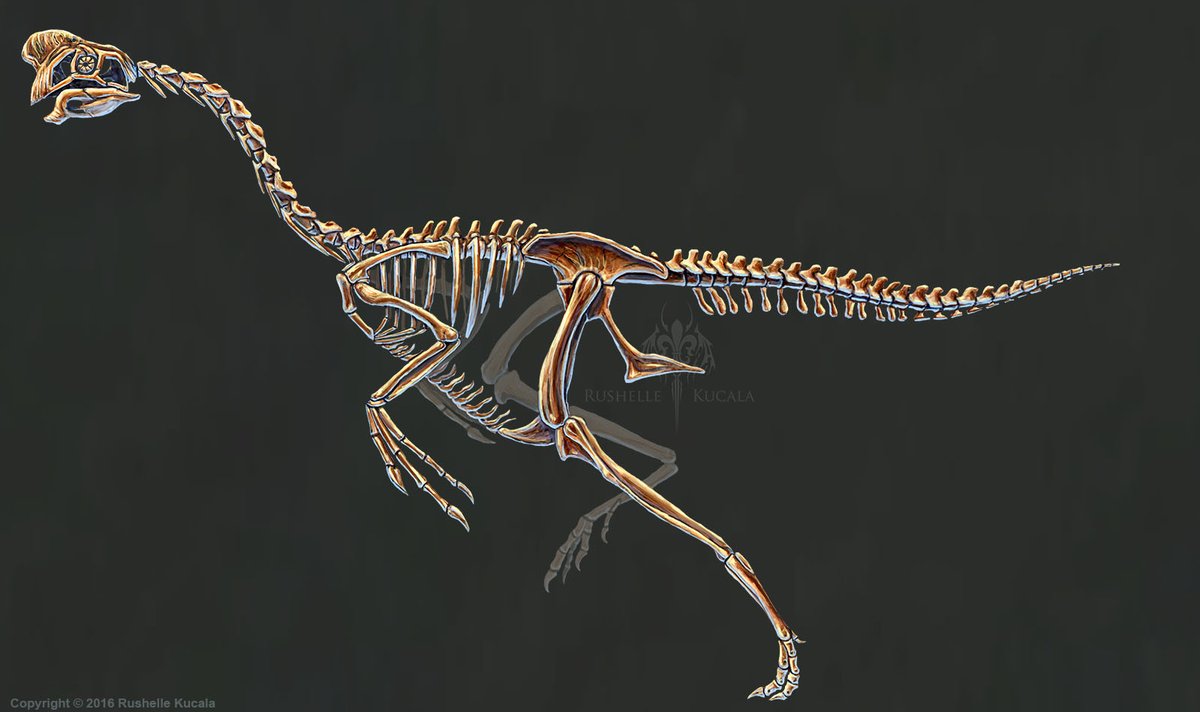
Citipati was a striking animal, reaching an estimated length of up to 3 meters (about 9.8 feet) from snout to tail tip, making it one of the largest known oviraptorids. Its body weight is estimated to have been around 75 to 85 kilograms (165 to 187 pounds), comparable to a modern emu or a large cassowary. Its most distinctive feature was a prominent, cassowary-like crest atop its short, deep skull. This crest, formed from the premaxillary and nasal bones, was taller and more elaborate than that of its close relative, Oviraptor, and likely served as a display structure for species recognition or attracting mates. The skull itself was highly pneumatized, filled with air spaces that lightened its weight without compromising strength. Citipati possessed a toothless beak, or rhamphotheca, which was robust and parrot-like, suggesting a varied diet. Its large eye sockets indicate it had good vision. The neck was long and S-shaped, leading to a compact torso. Its forelimbs were well-developed with three-fingered hands, and its long, powerful hindlimbs suggest it was a capable bipedal runner. Inferred from skeletal quill knobs and the plumage of related species like Caudipteryx, it is almost certain that Citipati was covered in a coat of feathers, including complex, vaned feathers on its arms and tail, forming wing-like structures and a tail fan, though it was flightless.
Analyses of its anatomy and fossil associations suggest Citipati was an active and adaptable omnivore. Its strong, toothless beak would have been a versatile tool, capable of crushing hard-shelled invertebrates like mollusks, cracking eggs, and processing tough plant material such as seeds and fruits. Small vertebrates, like lizards or early mammals, may also have been part of its diet. The long, gracile hindlimbs indicate it was a cursorial animal, capable of running at considerable speeds to pursue prey or evade predators like Velociraptor or juvenile Tarbosaurus. The discovery of multiple skeletons in close proximity suggests that Citipati may have exhibited some form of social behavior, perhaps living in small groups or flocks. Growth studies based on bone histology are still developing, but like other theropods, it likely experienced a rapid growth spurt during its juvenile stage. Its metabolism was likely higher than that of a typical modern reptile, placing it somewhere on the spectrum towards endothermy, a trait supported by its inferred feathered covering and active lifestyle. The most profound insight into its paleobiology comes from its nesting behavior. Fossils show Citipati adopted a specific brooding posture, with its arms spread out to cover the perimeter of the egg clutch, a position remarkably similar to that of modern birds, indicating sophisticated parental care and likely endothermic incubation of its eggs.
Citipati lived in the Djadochta Formation environment of the Gobi Desert, a habitat characterized by a semi-arid to arid climate with distinct wet and dry seasons. The landscape was dominated by sand dunes, interspersed with ephemeral streams and scrubland vegetation, broadly similar to modern desert environments. This ecosystem supported a diverse and now-famous fauna. Citipati shared its world with other dinosaurs such as the small, fleet-footed predator Velociraptor, the heavily armored ankylosaur Pinacosaurus, and the iconic horned dinosaur Protoceratops, whose abundant nests and remains suggest it was a primary food source for many local carnivores. As a medium-sized omnivore, Citipati occupied an intermediate position in the food web. It would have preyed on smaller animals and foraged for plants and eggs, while simultaneously being a potential target for larger predators, particularly the young of tyrannosaurids like Tarbosaurus that may have roamed the region. The competition for resources would have been intense, driving the evolution of specialized feeding and survival strategies among the local fauna. The discovery of Citipati nests provides direct evidence of its reproductive strategy within this challenging environment, highlighting the importance of parental investment for survival.
The history of Citipati is intrinsically linked to the legendary Polish-Mongolian and American Museum of Natural History expeditions to the Gobi Desert. The type specimen, IGM 100/978, was discovered in the Ukhaa Tolgod locality of the Djadochta Formation in Mongolia. The genus and species, Citipati osmolskae, were formally named in 2001 by paleontologists James M. Clark, Mark Norell, and Rinchen Barsbold. The genus name, 'Citipati', is derived from Sanskrit words meaning 'funeral pyre lord', referring to two ascetic monks in Tibetan Buddhist folklore who were decapitated while in a meditative trance, often depicted as dancing skeletons in cemeteries. The specific name, 'osmolskae', honors the pioneering Polish paleontologist Halszka Osmólska, whose extensive work on Mongolian dinosaurs, including oviraptorosaurs, was foundational. Perhaps the most famous specimens are the brooding individuals, nicknamed 'Big Mama' (IGM 100/979) and 'Big Auntie'. 'Big Mama', discovered in 1993, was initially thought to be an Oviraptor but was later assigned to Citipati. This spectacular fossil shows an adult positioned directly over a nest of at least 15 eggs, providing the definitive evidence that disproved the long-held 'egg thief' hypothesis for oviraptorids and established them as dedicated parents.
Citipati holds immense evolutionary significance as a key taxon for understanding the biology of maniraptoran theropods and the origin of birds. As a derived oviraptorid, it sits firmly within the Pennaraptora clade, a group of dinosaurs characterized by advanced, bird-like feathers. The skeletal anatomy of Citipati showcases numerous avian characteristics, including a furcula (wishbone), pneumatized bones, and a wrist structure that allowed for a folding motion similar to a bird's wing. The most compelling evidence is its brooding behavior. The posture adopted by the nesting Citipati specimens, with arms encircling the eggs, is a direct behavioral link to modern birds. This posture suggests the 'wings' were used to shield the eggs from the elements and perhaps to help regulate their temperature, a crucial step towards avian incubation. This discovery provided some of the strongest evidence that complex parental care and brooding behaviors evolved in non-avian dinosaurs long before the advent of flight. Citipati and its relatives thus serve as crucial data points for mapping the sequence of trait acquisition—feathers, nesting behaviors, metabolic rates—on the evolutionary line leading to Aves, blurring the distinction between what was once considered uniquely 'dinosaurian' and 'avian'.
While the parental behavior of Citipati is well-established, some scientific debates continue. The exact function of its prominent head crest is a subject of discussion; while most paleontologists agree it was a socio-sexual display structure, its precise role in visual signaling, species recognition, or even potential sound resonance remains speculative. There has also been taxonomic discussion regarding its relationship with other oviraptorids. For a time, some researchers considered the possibility that the larger, more robustly crested Citipati might represent the adult form of the more gracile Oviraptor, but differences in skull morphology and stratigraphic position have led most to accept them as distinct genera. The precise diet is also an area of ongoing research. While omnivory is the consensus, the exact proportions of plant matter, eggs, and meat in its diet are unknown. Isotopic analysis of bone chemistry and detailed biomechanical studies of its beak are future avenues that could provide more definitive answers to these questions. New discoveries of oviraptorid fossils continue to refine our understanding of the diversity and biology of this fascinating group.
The fossil record of Citipati is concentrated in the rich fossil beds of the Djadochta Formation in the Gobi Desert of Mongolia. This region is world-renowned for its exceptional preservation of Late Cretaceous terrestrial ecosystems. Several well-preserved and articulated skeletons of Citipati are known, making it one of the best-understood oviraptorids. The preservation quality is often excellent, with delicate bones of the skull and hands remaining intact and in life position. The most scientifically valuable fossils are the brooding specimens, which preserve not only the skeleton of the adult but also a complete clutch of eggs, and in one remarkable case, an embryo with identifiable skeletal features inside an egg. These fossils provide a rare snapshot of behavior frozen in time, likely the result of a sudden sandstorm that rapidly buried the nesting dinosaur. The primary fossil sites, such as Ukhaa Tolgod and Zamyn Khondt, have yielded a wealth of material that has been central to our modern perception of bird-like dinosaurs. These specimens are housed primarily in the collections of the Mongolian Academy of Sciences and the American Museum of Natural History.
Citipati has had a significant cultural impact, primarily through its role in vindicating its relative, Oviraptor. The iconic image of a dinosaur brooding its nest like a bird has become a powerful educational tool, frequently featured in museum exhibits, documentaries, and books to illustrate the close connection between dinosaurs and birds. The 'Big Mama' specimen is a centerpiece display at the American Museum of Natural History in New York, captivating the public with its poignant depiction of parental care. This fossil, more than any other, helped shift the public perception of dinosaurs from lumbering, brutish reptiles to complex, dynamic animals with sophisticated behaviors. Its striking appearance, with its prominent crest and feathered body, makes it a popular subject for paleoartists, further cementing its place in the public consciousness as a key player in the story of dinosaur evolution.
Classification
Time Period
Discovery
Location
Mongolia
Formation
Djadochta Formation
Frequently Asked Questions
What is Citipati?
Citipati osmolskae was a medium-sized, bird-like dinosaur that inhabited the arid landscapes of what is now Mongolia during the Late Cretaceous period, approximately 75 to 71 million years ago. As a member of the Oviraptoridae family, its discovery has been pivotal in reshaping our understanding of ...
When did Citipati live?
Citipati lived during the cretaceous period of the mesozoic era approximately 75-71 million years ago.
Where was Citipati discovered?
Fossils of Citipati were discovered in Mongolia in the Djadochta Formation.
What did Citipati eat?
Citipati was a omnivore. It lived in terrestrial habitats.
What type of fossil is Citipati?
Citipati is preserved as a body fossil. The preservation quality is excellent.
Related Specimens
From the mesozoic era · body fossils