Plesiosaurus
Plesiosaurus dolichodeirus
Image: Image sourced via web search (Fair use / Educational)
About Plesiosaurus
Plesiosaurus dolichodeirus represents one of the most iconic and historically significant marine reptiles of the Mesozoic Era, thriving during the Early Jurassic period approximately 199 to 175 million years ago. As the type genus of the order Plesiosauria, this remarkable creature has profoundly shaped our understanding of prehistoric marine ecosystems and the evolutionary adaptability of reptiles. Originating from the shallow, warm epicontinental seas that covered much of what is now Europe, Plesiosaurus was a highly specialized aquatic predator. Its discovery in the early 19th century was a watershed moment in the nascent science of paleontology, providing undeniable evidence of a world once dominated by bizarre, extinct beasts entirely unlike modern fauna. The significance of Plesiosaurus extends far beyond its strange anatomy; it served as a foundational taxon that helped establish the concept of extinction and deep time in scientific discourse. By studying Plesiosaurus, paleontologists have been able to trace the complex evolutionary pathways that terrestrial reptiles took as they returned to the sea, adapting to an entirely aquatic lifestyle over millions of years.
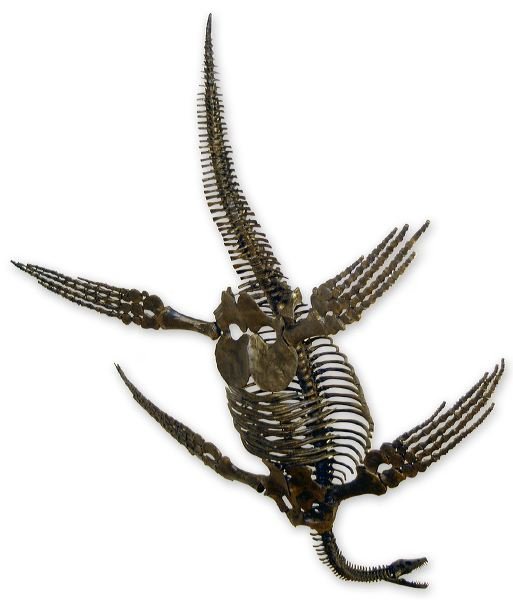
In terms of physical description, Plesiosaurus dolichodeirus was a moderately sized marine reptile, typically measuring around 3.5 meters, or roughly 350 centimeters, in total body length, with weight estimates suggesting an animal of approximately 400 to 500 kilograms. To put this into perspective, it was roughly the size of a modern beluga whale, though with a vastly different body plan. The most striking feature of Plesiosaurus was its disproportionately long neck, which comprised about forty cervical vertebrae, making up nearly a third of its total body length. This elongated neck supported a relatively small, triangular skull equipped with conical, needle-like teeth perfectly adapted for piercing and gripping slippery prey. The body itself was broad, rigid, and barrel-shaped, providing a stable platform for the attachment of massive swimming muscles. Unlike modern marine mammals or other marine reptiles like ichthyosaurs, Plesiosaurus possessed four large, elongated, paddle-like flippers of roughly equal size. The skeletal structure of these limbs reveals hyperphalangy, an increase in the number of finger bones, which transformed the ancestral reptilian hands and feet into stiff, efficient hydrofoils. Soft tissue inferences, derived from exceptionally preserved specimens of related taxa, suggest a smooth, streamlined body contour, likely lacking scales and instead covered in a tough, leathery skin to reduce drag in the water. The tail was relatively short and straight, likely serving as a rudder for steering rather than a primary organ of propulsion.
The paleobiology of Plesiosaurus reveals a highly specialized predator perfectly adapted to its marine environment. Its diet primarily consisted of small to medium-sized fish and cephalopods, such as belemnites, which were abundant in the Jurassic seas. The sharp, interlocking teeth were not designed for chewing or shearing flesh; rather, Plesiosaurus likely swallowed its prey whole, perhaps using its long neck to dart into schools of fish with sudden, rapid movements, minimizing the hydrodynamic disturbance that might alert its targets. Locomotion in Plesiosaurus has been a subject of intense biomechanical study, as its four-flipper body plan is unique in the animal kingdom. It is generally accepted that Plesiosaurus utilized a form of underwater flight, similar to modern sea turtles or penguins, where the flippers moved in a complex figure-eight pattern to generate lift and thrust on both the upstroke and downstroke. This method of swimming would have provided excellent maneuverability, allowing the animal to pivot quickly to catch agile prey. While direct evidence of social behavior is scarce, the frequent discovery of multiple plesiosaur individuals in close proximity suggests they may have congregated in productive feeding grounds or perhaps exhibited some level of gregarious behavior. Growth patterns, analyzed through bone histology, indicate a relatively rapid initial growth phase, typical of animals with elevated metabolic rates. It is highly probable that Plesiosaurus, like many other advanced marine reptiles, was endothermic or at least gigantothermic, maintaining a stable, high body temperature to sustain active foraging in varying ocean temperatures. Furthermore, evidence from related plesiosaurs strongly suggests they were viviparous, giving birth to live young at sea, as their rigid bodies and specialized limbs would have made returning to land to lay eggs an impossibility.
The ecological context of the Early Jurassic world in which Plesiosaurus lived was one of dramatic evolutionary radiation and shifting paleogeography. Following the devastating End-Triassic mass extinction, marine ecosystems were recovering and diversifying. The supercontinent Pangaea was beginning to rift apart, creating shallow, warm epicontinental seas, particularly across what is now Western Europe. The climate was generally warmer and more equable than today, with no polar ice caps, leading to high sea levels. In these vibrant marine environments, Plesiosaurus occupied a mid-to-high level position in the food web. The waters were teeming with a diverse array of life, including massive schools of teleost fish, ammonites, and belemnites, which formed the primary prey base for Plesiosaurus. It shared its habitat with other iconic marine reptiles, most notably the dolphin-like ichthyosaurs, such as Ichthyosaurus, which likely occupied a different ecological niche, focusing on high-speed pursuit of prey. Plesiosaurus also coexisted with early marine crocodiles and various species of sharks and rays. However, Plesiosaurus was not the apex predator of its ecosystem. It would have been vulnerable to larger marine reptiles, including massive pliosaurids, which were characterized by their short necks and massive, powerful jaws. The evolutionary arms race between these predators and their prey drove the development of the high maneuverability and specialized feeding strategies seen in Plesiosaurus, making it a highly successful component of the Jurassic marine fauna.
The discovery history of Plesiosaurus is inextricably linked to the birth of paleontology as a formal scientific discipline and the legendary fossil hunter Mary Anning. The first complete skeleton of Plesiosaurus dolichodeirus was discovered by Anning in December 1823 in the Early Jurassic Blue Lias cliffs of Lyme Regis, Dorset, England. This discovery was monumental; prior to this, only isolated bones and fragmentary remains had been found, leaving the true nature of the animal shrouded in mystery. The specimen was brought to the attention of the scientific community by the Reverend William Conybeare, who, along with Henry De la Beche, had previously coined the genus name Plesiosaurus in 1821 based on fragmentary material. The name, meaning 'near to reptile,' was chosen to emphasize that its anatomy was closer to terrestrial reptiles than that of the ichthyosaurs, which were thought to be more fish-like. When Conybeare presented Anning's complete skeleton to the Geological Society of London in 1824, it caused a sensation. The bizarre anatomy—famously described by William Buckland as resembling a snake threaded through the shell of a turtle—was so unprecedented that the eminent French anatomist Georges Cuvier initially suspected the specimen was a forgery, a composite of different animals. However, upon closer inspection, Cuvier conceded its authenticity, cementing Anning's reputation and establishing Plesiosaurus as a cornerstone of early paleontological study. The holotype specimen resides today in the Natural History Museum in London, serving as a testament to this pivotal moment in scientific history.
The evolutionary significance of Plesiosaurus cannot be overstated, as it provides crucial insights into the secondary adaptation of tetrapods to a marine lifestyle. Plesiosaurus belongs to the superorder Sauropterygia, a diverse group of aquatic reptiles that originated in the Early Triassic from terrestrial ancestors. The evolutionary trajectory from semi-aquatic, lizard-like forms, such as the pachypleurosaurs and nothosaurs, to the fully obligate marine plesiosaurs represents one of the most dramatic morphological transformations in vertebrate history. Plesiosaurus dolichodeirus stands as a classic representative of the Plesiosauroidea, the long-necked lineage of plesiosaurs, which would go on to diversify incredibly throughout the Jurassic and Cretaceous periods, eventually culminating in the massive, extremely long-necked elasmosaurids. By studying the anatomy of Plesiosaurus, scientists can trace the step-by-step modifications required for life in the open ocean, including the rigidification of the trunk, the transformation of limbs into hydrofoils, and the relocation of the external nostrils closer to the eyes for efficient breathing at the surface. Furthermore, the evolutionary success of the plesiosaur body plan, which persisted for over 135 million years until the Cretaceous-Paleogene extinction event, demonstrates the viability of their unique four-flipper locomotion. While Plesiosaurus left no modern descendants, its evolutionary history serves as a powerful example of convergent evolution and adaptive radiation, offering a comparative framework for understanding how modern marine mammals, like whales and pinnipeds, independently evolved similar adaptations to conquer the marine realm.
Scientific debates surrounding Plesiosaurus have persisted since its discovery, reflecting the challenges of interpreting the biology of an animal with no direct modern analog. One of the most enduring controversies has centered on the flexibility and function of its iconic long neck. Early artistic reconstructions often depicted Plesiosaurus with a highly flexible, swan-like neck, capable of raising its head high above the water or coiling like a snake to strike at prey. However, modern biomechanical studies and detailed analyses of the cervical vertebrae have significantly curtailed this view. The interlocking zygapophyses of the neck vertebrae indicate that while the neck had considerable lateral flexibility, allowing it to sweep from side to side, its vertical mobility was quite restricted. The animal could not have lifted its head far out of the water, nor could it have formed a sharp S-curve. Another major area of debate involves the precise mechanics of its four-flipper locomotion. While the 'underwater flight' model is broadly accepted, researchers continue to argue over the exact synchronization of the limbs. Did the front and hind flippers move in unison, or did they alternate to maintain a continuous, steady thrust? Recent computer modeling and robotic simulations suggest an asynchronous, out-of-phase stroking pattern would have been the most hydrodynamically efficient, minimizing wake interference between the front and rear flippers. Additionally, debates regarding their metabolic status have shifted over time, moving from the traditional view of sluggish, cold-blooded reptiles to the current consensus of active, endothermic or gigantothermic animals, a paradigm shift driven by isotopic analysis of their fossilized teeth and bones.
The fossil record of Plesiosaurus is primarily restricted to the Early Jurassic deposits of Western Europe, with the most famous and complete specimens originating from the Lias Group in England, particularly the Blue Lias formation around Lyme Regis and the Alum Shale of Yorkshire. These geological formations represent the muddy bottoms of the shallow epicontinental seas that characterized the region during the Sinemurian and Toarcian stages. The preservation quality of Plesiosaurus fossils from these sites is often exceptional. The anoxic conditions of the Jurassic seafloor muds prevented scavenging and rapid decay, allowing for the articulation of complete skeletons to be preserved in stunning detail. In some rare instances, delicate structures such as stomach contents—revealing fossilized belemnite hooks and fish scales—have been found within the ribcages of specimens, providing direct, incontrovertible evidence of their diet. While isolated teeth, vertebrae, and paddle bones are relatively common finds for amateur fossil hunters along the Jurassic Coast, complete, articulated skeletons remain exceedingly rare and are highly prized by museums and researchers. The abundance of material from the Lias Group has allowed paleontologists to study intraspecific variation and ontogeny, though the taxonomy of the genus has historically suffered from the 'wastebasket taxon' effect, where numerous fragmentary plesiosaur remains from around the world were incorrectly assigned to Plesiosaurus, a situation that modern taxonomic revisions are continually working to rectify.
The cultural impact of Plesiosaurus is immense, deeply embedded in both the history of science and popular imagination. Since its dramatic unveiling in the 1820s, it has been a staple of paleoart, famously featured in Henry De la Beche's 'Duria Antiquior' (1830), the first pictorial representation of a prehistoric ecosystem. In the modern era, the distinctive silhouette of the plesiosaur has become globally recognized, largely due to its association with the mythical Loch Ness Monster, which popular culture often depicts as a surviving plesiosaur. While scientifically unfounded, this cryptozoological connection has kept the image of Plesiosaurus firmly in the public consciousness. Today, spectacular mounted skeletons of Plesiosaurus and its relatives are centerpiece exhibits in major natural history museums worldwide, including the Natural History Museum in London and the American Museum of Natural History in New York. These displays serve a vital educational role, inspiring awe and curiosity about deep time, evolutionary biology, and the ever-changing nature of life on Earth, ensuring that Plesiosaurus remains one of the most celebrated and recognizable of all prehistoric creatures.
Classification
Time Period
Discovery
Location
England, United Kingdom
Formation
Lias Group
Frequently Asked Questions
What is Plesiosaurus?
Plesiosaurus dolichodeirus represents one of the most iconic and historically significant marine reptiles of the Mesozoic Era, thriving during the Early Jurassic period approximately 199 to 175 million years ago. As the type genus of the order Plesiosauria, this remarkable creature has profoundly sh...
When did Plesiosaurus live?
Plesiosaurus lived during the jurassic period of the mesozoic era approximately 199-175 million years ago.
Where was Plesiosaurus discovered?
Fossils of Plesiosaurus were discovered in England, United Kingdom in the Lias Group.
What did Plesiosaurus eat?
Plesiosaurus was a carnivore. It lived in marine habitats.
What type of fossil is Plesiosaurus?
Plesiosaurus is preserved as a body fossil. The preservation quality is exceptional.
Related Specimens
From the mesozoic era · body fossils