Dinomischus
Dinomischus isolatus
Image: Image sourced via web search (Fair use / Educational)
About Dinomischus
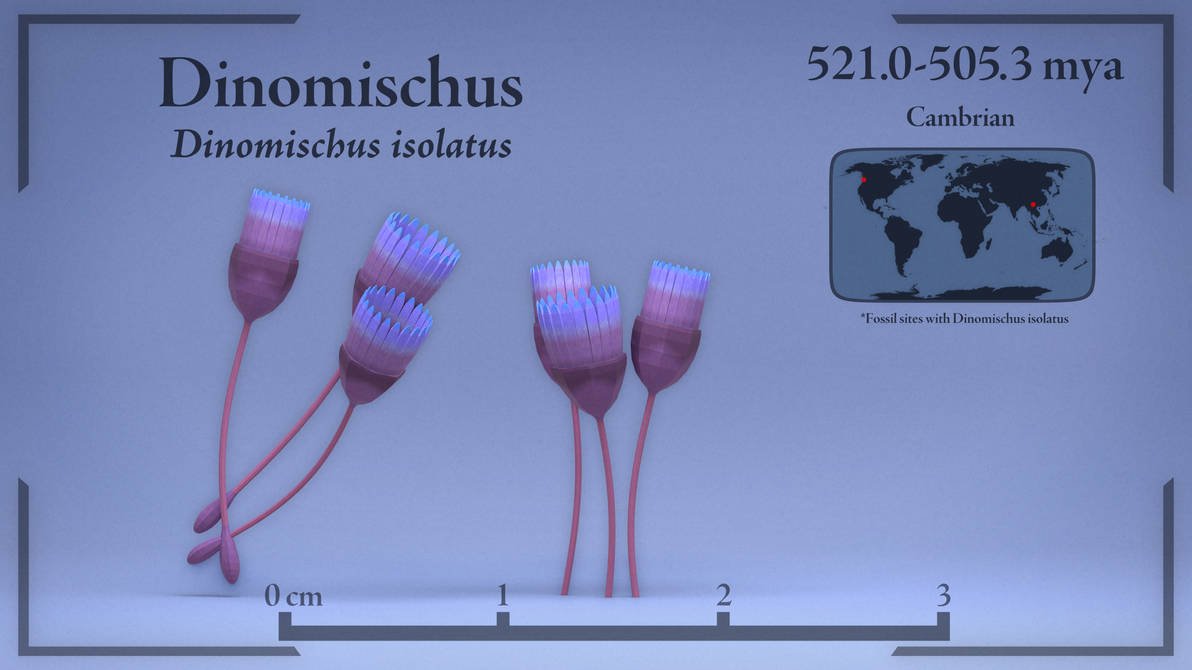
Dinomischus isolatus is a rare and deeply enigmatic marine invertebrate that inhabited the oceans of the Middle Cambrian period, approximately 508 to 505 million years ago. First discovered in the legendary Burgess Shale deposits of British Columbia, Canada, this bizarre organism is celebrated by paleontologists as one of the quintessential weird wonders of the Cambrian explosion. Its unique, flower-like anatomy, which defies easy classification into any modern animal phylum, highlights the incredible morphological experimentation and rapid diversification of life that characterized early animal evolution. As a sessile, stalked creature, Dinomischus provides a crucial window into the early development of benthic marine ecosystems and the complex suspension-feeding strategies that evolved long before the advent of modern marine communities. The physical anatomy of Dinomischus isolatus is both fascinating and highly unusual, resembling a strange, prehistoric flower rather than a typical animal. The organism was relatively small, with the entire body reaching an approximate maximum length of 10 centimeters, though many specimens are considerably smaller. The body plan is divided into three primary anatomical regions: a bulbous holdfast at the base, an elongated and slender stalk, and a cup-shaped main body at the top known as the calyx. The holdfast was a slightly swollen, rounded structure designed to anchor the animal firmly into the soft, muddy substrate of the Cambrian seafloor, ensuring it remained upright in the face of ocean currents. Extending upward from this anchor was the stalk, which was remarkably thin, rigid, and likely composed of tough, fibrous organic material, though it lacked true biomineralization. At the apex of the stalk sat the calyx, which housed the organism's internal organs. The calyx was conical or goblet-shaped and was crowned by a ring of approximately 18 to 20 elongated, stiff, petal-like structures called bracts. These bracts radiated outward and upward, creating a funnel-like apparatus. Unlike the flexible tentacles of modern sea anemones, the bracts of Dinomischus appear to have been relatively rigid, perhaps covered in microscopic cilia used to generate water currents. Inside the calyx, exceptional fossil preservation has revealed a distinct U-shaped gut, with both the mouth and the anus situated on the upper surface of the cup, facing the open water. This arrangement prevented the animal from fouling its own feeding apparatus with waste. In terms of scale, Dinomischus would have been roughly the size of a modern dandelion on a long stem, weighing only a few grams, and its soft tissues suggest a delicate constitution that relied entirely on the hydrostatic pressure of its environment to maintain its structural integrity. The paleobiology of Dinomischus isolatus points to a life as an obligate, sessile suspension feeder, a lifestyle that was becoming increasingly common during the Cambrian period. Anchored to the seafloor, Dinomischus could not actively hunt or pursue prey; instead, it relied on the movement of ocean currents and the potential action of cilia on its bracts to bring food to its mouth. Its diet likely consisted of microscopic plankton, suspended organic detritus, and single-celled organisms that drifted through the lower levels of the water column. The rigid bracts forming the funnel at the top of the calyx would have acted as a highly efficient biological sieve. Water carrying food particles would be drawn into the center of the funnel, where the particles would be trapped by mucus or cilia and transported down to the centrally located mouth. After digestion in the U-shaped stomach, waste was expelled through the adjacent anus, and the ambient water currents would carry the effluent away from the feeding apparatus. Because it was permanently tethered to the substrate, Dinomischus had no means of locomotion once it settled into its adult form. It is highly probable that, like many modern sessile marine invertebrates such as sponges and crinoids, Dinomischus possessed a mobile, free-swimming larval stage. This pelagic larva would drift in the ocean currents, allowing the species to disperse across the seafloor before eventually settling, metamorphosing, and growing its characteristic stalk and calyx. Growth patterns likely involved the gradual elongation of the stalk and the proportional expansion of the calyx and bracts as the animal aged. Its metabolic rate was likely quite low, consistent with a passive feeding strategy in a relatively cold, deep-water environment, requiring minimal energy expenditure beyond the maintenance of its ciliary feeding currents. The ecological context in which Dinomischus lived was a vibrant, rapidly evolving marine world that looked vastly different from the oceans of today. During the Middle Cambrian, the Earth's climate was generally warm, and the landmasses were entirely devoid of complex plant or animal life, presenting a barren, rocky landscape. Beneath the waves, however, life was flourishing in unprecedented ways. Dinomischus inhabited the benthic zone of a tropical or subtropical marine shelf, specifically in the area that would eventually become the Burgess Shale. This environment was characterized by a soft, muddy seafloor situated below the zone of active wave turbulence, providing a relatively calm habitat ideal for delicate, stalked organisms. Dinomischus shared its ecosystem with a dazzling array of early animals, including the fearsome apex predator Anomalocaris, the five-eyed Opabinia, heavily armored trilobites like Olenoides, and a multitude of sponges, brachiopods, and early chordates like Pikaia. In this complex food web, Dinomischus occupied the role of a primary consumer of microscopic particulate matter. It was part of a diverse community of suspension feeders that helped to clear the water column and transfer energy from planktonic producers to the benthic ecosystem. While its stalk elevated its feeding apparatus above the immediate layer of silt and competition at the seafloor, it also made Dinomischus vulnerable to grazing predators and accidental trampling by larger, mobile benthic arthropods. The constant threat of being buried by underwater mudslides—the very events that ultimately preserved them as fossils—was a defining feature of their perilous ecological reality. The discovery history of Dinomischus is intimately tied to the broader exploration of the Burgess Shale, one of the most important paleontological sites in the world. The first specimens of Dinomischus were actually collected in the early 20th century by Charles Doolittle Walcott, the American paleontologist who originally discovered the Burgess Shale in 1909. However, Walcott, overwhelmed by the sheer volume and bizarre nature of the fossils he collected, never formally described this particular organism. It remained hidden in the vast collections of the Smithsonian Institution for decades. It was not until the 1970s, during a comprehensive reinvestigation of the Burgess Shale fauna led by Harry Whittington and his graduate students at the University of Cambridge, that the organism was finally recognized. In 1977, Simon Conway Morris, one of Whittington's students, formally described the animal and gave it the name Dinomischus isolatus. The genus name Dinomischus translates to terrible stalk, a somewhat dramatic moniker that reflects its strange, imposing appearance under the microscope, while the species name isolatus refers to its rarity and its isolated, solitary nature in the fossil record. At the time of its description, only three specimens were known to science, making it one of the rarest animals in the Burgess Shale. Later expeditions by the Royal Ontario Museum, led by Desmond Collins, uncovered a few additional specimens, but Dinomischus remains a highly prized and elusive find. The evolutionary significance of Dinomischus is a subject of profound interest and ongoing debate among evolutionary biologists and paleontologists. When Simon Conway Morris first described the animal, he noted its superficial resemblance to modern entoprocts—a minor phylum of small, stalked, aquatic animals that also possess a cup-like body, a crown of tentacles, and a U-shaped gut. However, Dinomischus is vastly larger than any known entoproct, and its bracts appear to be rigid rather than flexible. Furthermore, the exact placement of the mouth and anus relative to the bracts in Dinomischus does not perfectly align with the entoproct body plan. Consequently, Dinomischus is generally classified as incertae sedis, meaning its exact taxonomic placement remains uncertain. It is often viewed as a stem-group member of a larger clade, perhaps related to the ancestors of entoprocts, or potentially representing an entirely extinct, independent lineage of early animals that experimented with a stalked, suspension-feeding body plan but ultimately left no modern descendants. Its existence provides compelling evidence for the concept of morphological disparity during the Cambrian explosion, suggesting that early animal evolution produced a wide variety of body plans, many of which were subsequently pruned by extinction. Dinomischus serves as a prime example of the weird wonders that Stephen Jay Gould highlighted in his influential book Wonderful Life, illustrating that the history of life is not a predictable march toward modern forms, but rather a complex bush of experimental lineages. Scientific debates surrounding Dinomischus primarily focus on its phylogenetic affinities and the functional morphology of its feeding apparatus. The most significant controversy lies in its potential relationship to the Entoprocta. Some researchers argue that the similarities in the U-shaped gut and the calyx structure are homologous, suggesting Dinomischus is a giant, early entoproct. Others contend that these features are the result of convergent evolution, driven by the shared biomechanical requirements of a sessile, suspension-feeding lifestyle. The discovery of a related species, Dinomischus venustus, in the slightly older Chengjiang biota of China has added new dimensions to this debate. The Chengjiang specimens show similar anatomical features but differ slightly in the proportions of the calyx and bracts. Additionally, some scientists have proposed highly unorthodox theories, such as a potential relationship between Dinomischus and early ctenophores (comb jellies), based on the radial symmetry and the structure of the bracts, though this view is not widely accepted. The exact nature of the bracts—whether they were truly rigid or possessed some degree of flexibility, and whether they were covered in cilia—also remains a topic of active biomechanical modeling and morphological interpretation. The fossil record of Dinomischus is exceptionally sparse but incredibly well-preserved. Fossils of Dinomischus isolatus are exclusively found in the Burgess Shale formation in the Canadian Rockies, specifically within the Walcott Quarry and surrounding outcrops. To date, only a few dozen specimens have ever been recovered, making it a genuinely rare component of the Cambrian fauna. The preservation quality, however, is exceptional. The fossils are preserved as two-dimensional carbonaceous compressions on the dark shale matrix. This taphonomic process has captured minute details of the animal's soft anatomy, including the delicate stalk, the individual bracts, and the internal U-shaped digestive tract. The fact that such a fragile, entirely soft-bodied organism was preserved at all is a testament to the unique conditions of the Burgess Shale, where rapid burial in anoxic mud prevented decomposition and scavenging. The related species, Dinomischus venustus, found in the Maotianshan Shales of Yunnan Province, China, exhibits a similar mode of exceptional preservation, expanding the known geographic and temporal range of the genus and proving that these strange creatures were a widespread, albeit rare, component of Cambrian marine ecosystems. The cultural impact of Dinomischus, while perhaps less pronounced than that of its famous contemporaries like Anomalocaris or Hallucigenia, is nonetheless significant within the realm of paleontology and science communication. It gained widespread public attention through Stephen Jay Gould's 1989 bestseller Wonderful Life, where it was prominently featured as a prime example of the bizarre, unclassifiable organisms of the Cambrian explosion. Today, Dinomischus is frequently depicted in artistic reconstructions and museum dioramas of the Burgess Shale, instantly recognizable by its distinctive, flower-like silhouette. It serves as a powerful educational tool in museums, such as the Royal Ontario Museum and the Smithsonian National Museum of Natural History, helping to illustrate the alien nature of early marine life and the profound mysteries that still surround the origins of animal diversity.
Classification
Time Period
Discovery
Location
British Columbia, Canada
Formation
Burgess Shale
Frequently Asked Questions
What is Dinomischus?
Dinomischus isolatus is a rare and deeply enigmatic marine invertebrate that inhabited the oceans of the Middle Cambrian period, approximately 508 to 505 million years ago. First discovered in the legendary Burgess Shale deposits of British Columbia, Canada, this bizarre organism is celebrated by pa...
When did Dinomischus live?
Dinomischus lived during the cambrian period of the paleozoic era approximately 508-505 million years ago.
Where was Dinomischus discovered?
Fossils of Dinomischus were discovered in British Columbia, Canada in the Burgess Shale.
What did Dinomischus eat?
Dinomischus was a filter-feeder. It lived in marine habitats.
What type of fossil is Dinomischus?
Dinomischus is preserved as a body fossil. The preservation quality is exceptional.
Related Specimens
From the paleozoic era · body fossils