Baryonyx
Baryonyx walkeri
Image: Image sourced via web search (Fair use / Educational)
About Baryonyx
Baryonyx walkeri was a large, carnivorous theropod dinosaur that lived during the Early Cretaceous period, approximately 130 to 125 million years ago. Its remains were first unearthed in England, providing paleontologists with a crucial window into the diverse ecosystems of prehistoric Europe and revealing a unique lineage of fish-eating dinosaurs. The discovery of Baryonyx was a landmark event, as it was the first early spinosaurid found with substantial skeletal material, fundamentally altering scientific understanding of theropod diversity and dietary specialization.
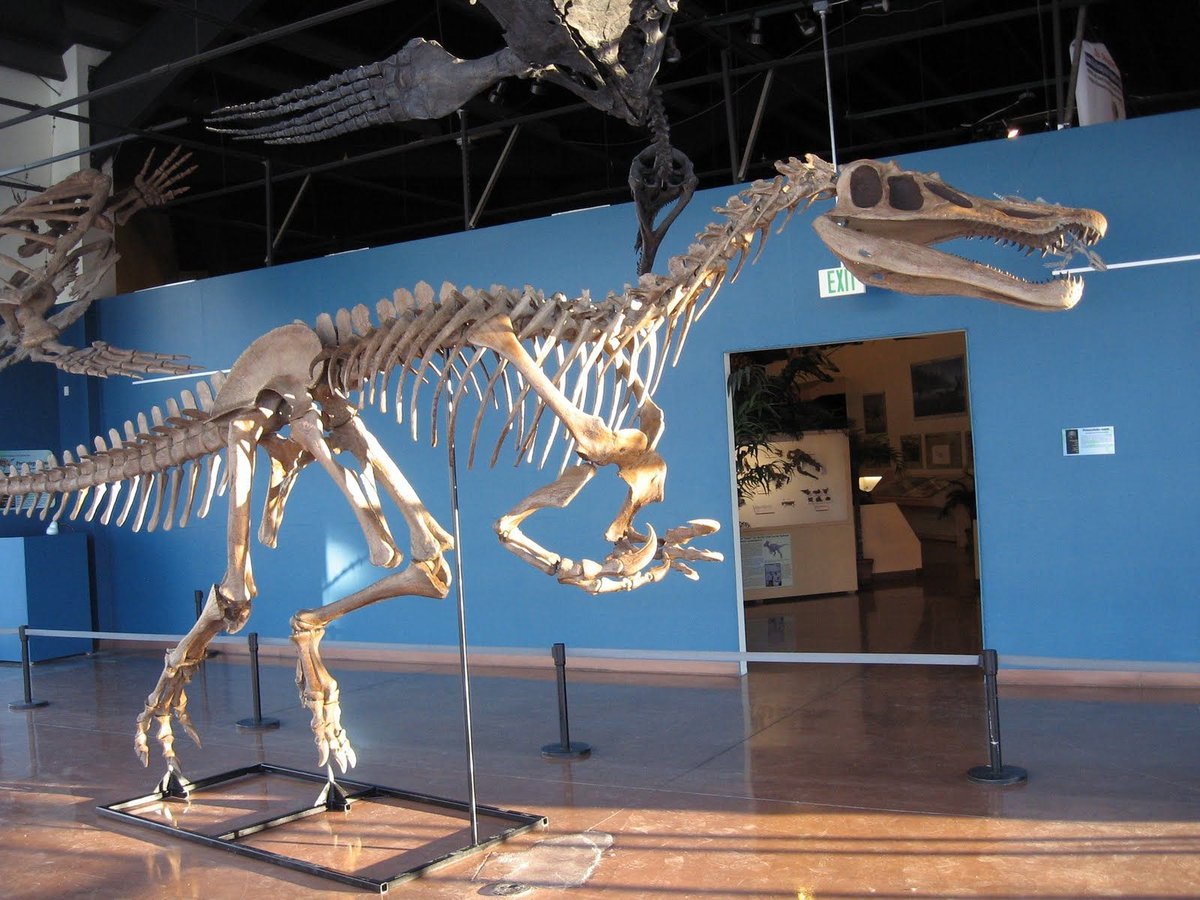
Baryonyx was a formidable predator, estimated to have reached lengths of 7.5 to 10 meters (approximately 25 to 33 feet) and a body mass of 1.2 to 2 metric tons. This size places it on par with a large saltwater crocodile or a small bus. Its most defining characteristic was the enormous, sickle-shaped claw on the first digit (thumb) of each hand, which measured around 31 centimeters (12 inches) along its outer curve. This feature inspired its name, Baryonyx, which translates from Greek as 'heavy claw'. The skull was long, low, and narrow, resembling that of a modern crocodilian, an adaptation well-suited for snatching slippery prey. Its snout was tipped with a distinctive terminal rosette of interlocking teeth, and the jaws were lined with a high number of finely serrated, conical teeth—nearly twice as many as in a Tyrannosaurus rex. The neck was less S-curved than in many other theropods, suggesting a different posture and feeding mechanism, likely involving downward strikes into water. Its forelimbs were robust and powerful, a stark contrast to the diminutive arms of tyrannosaurs, indicating they played a significant role in predation. The rest of its skeleton was that of a typical bipedal theropod, with strong hind limbs supporting its weight, though some researchers have proposed it may have occasionally adopted a quadrupedal stance.
Evidence from the holotype specimen provides direct insight into the paleobiology and diet of Baryonyx. The abdominal region of the fossil contained the acid-etched scales of the fish Scheenstia, confirming a piscivorous diet. Additionally, the remains of a juvenile Iguanodon, a herbivorous dinosaur, were found within the same area, suggesting Baryonyx was not an obligate piscivore but an opportunistic predator or scavenger capable of consuming terrestrial prey. Its crocodile-like snout, conical teeth, and large hand claws were likely a specialized toolkit for hunting in and around water. The long snout could be plunged into the water with minimal resistance, while the interlocking teeth at the tip would have been effective at gripping struggling fish. The powerful hand claws could have been used to gaff or hook fish from the water's edge, much like a modern grizzly bear, or to dismember larger carcasses. Its locomotion was primarily bipedal, but its semi-aquatic lifestyle implies it was a capable swimmer, using its powerful tail for propulsion. Isotopic analysis of its bones further supports a semi-aquatic existence, showing a chemical signature consistent with an animal that spent a significant amount of time in freshwater environments. There is no direct evidence for social behavior, and like many large predators, it may have been a solitary hunter.
The world of Baryonyx during the Barremian stage of the Early Cretaceous was a vast, warm, and humid floodplain environment, characterized by a network of rivers, lakes, and lagoons. This habitat, represented by the Weald Clay Formation in England, was a lush, subtropical landscape dominated by conifers, cycads, and ferns. Baryonyx occupied a specialized ecological niche as a top riparian predator, sharing its environment with a diverse array of other dinosaurs. Herbivores were abundant and included the large ornithopod Iguanodon, the armored polacanthid Hylaeosaurus, and various sauropods. Other predators in the ecosystem included smaller theropods like Neovenator and Eotyrannus, creating a complex food web where Baryonyx likely competed for resources. Its semi-aquatic adaptations would have given it an advantage by allowing it to exploit aquatic food sources that were inaccessible to more terrestrial carnivores, thus reducing direct competition. It would have preyed upon the large fish that populated the rivers, such as Scheenstia and Lepidotes, while also opportunistically hunting small dinosaurs and pterosaurs that ventured too close to the water's edge.
The discovery of Baryonyx is a story of amateur dedication and scientific significance. In January 1983, amateur fossil hunter William J. 'Bill' Walker was exploring a clay pit in Ockley, Surrey, England, when he discovered a massive claw bone. Recognizing its importance, he also found a phalanx bone and part of a rib. Walker presented his finds to paleontologists Alan J. Charig and Angela C. Milner at the Natural History Museum in London. They immediately understood the significance of the fossil, and a full-scale excavation was launched later that year. The team successfully recovered approximately 70% of the skeleton, including the skull, making it one of the most complete theropod dinosaurs found in the United Kingdom. The specimen was formally described by Charig and Milner in 1986 and given the scientific name Baryonyx walkeri in honor of its discoverer. This holotype specimen, cataloged as NHM R9951, remains the most complete individual of its kind and is a centerpiece of the museum's dinosaur collection. Its discovery was pivotal, as it represented the first evidence of the previously unknown family Spinosauridae in Europe.
Baryonyx holds a crucial position in the evolutionary history of theropod dinosaurs. It is a basal member of the family Spinosauridae, a group of large, semi-aquatic carnivores that includes the colossal Spinosaurus and the closely related Suchomimus. The discovery of Baryonyx provided the first clear anatomical evidence for this unique lineage, characterized by crocodilian-like skulls, conical teeth, and powerful forelimbs with enlarged claws. These features represent a significant evolutionary divergence from other large theropod groups like allosauroids and tyrannosauroids, showcasing a remarkable adaptation to a piscivorous and semi-aquatic lifestyle. Baryonyx and its relatives demonstrate that theropods exploited a much wider range of ecological niches than previously thought. It serves as an evolutionary link between earlier, more generalized megalosauroids and the later, more highly specialized spinosaurids like Spinosaurus, which exhibited even more extreme adaptations for life in water, such as paddle-like feet and a fin-like tail. Baryonyx thus illuminates a key transitional phase in the evolution of this fascinating and successful group of predatory dinosaurs.
Despite the completeness of the holotype, scientific debates surrounding Baryonyx persist. One major point of contention has been its taxonomic relationship with other spinosaurids. Some paleontologists, such as Sereno et al. in 1998, proposed that the African dinosaur Suchomimus tenerensis was so similar to Baryonyx that it should be considered a species within the same genus, Baryonyx tenerensis. However, most researchers today maintain them as distinct genera, citing significant anatomical differences in their skulls and vertebrae. Another debate concerns its posture and locomotion. While traditionally depicted as a biped, the robustness of its forelimbs led some early researchers like Charig and Milner to speculate that it might have been a facultative quadruped, resting or moving on all fours at times. This idea has largely been discounted by the wider scientific community, which favors a standard bipedal stance. The precise function of its giant claw—whether for gaffing fish, defense, or intraspecific combat—also remains a topic of discussion among paleontologists, with most evidence pointing towards a primary role in predation.
The fossil record of Baryonyx, while centered on the remarkable holotype from England, is not limited to a single specimen. Teeth and isolated bones attributed to Baryonyx have been found elsewhere in the Weald Clay and Wessex Formations of the United Kingdom. Furthermore, similar fossils discovered in the Iberian Peninsula, specifically in the Papo Seco Formation of Portugal and various sites in Spain, have been assigned to Baryonyx. These additional finds confirm its presence across the archipelago of islands that constituted Early Cretaceous Europe. The preservation quality of the holotype is considered good, providing a detailed look at its anatomy, though it was disarticulated and scattered by post-mortem scavenging or water action. The Spanish and Portuguese remains are more fragmentary, typically consisting of teeth, vertebral fragments, and limb bones. These widespread discoveries underscore that Baryonyx was a relatively successful and geographically dispersed predator within its specific riparian habitat during the Barremian age.
Baryonyx has made a significant impact on popular culture, largely due to its distinctive appearance and intriguing lifestyle. Its crocodile-like head and enormous claws make it a memorable and visually striking dinosaur, securing it a place in numerous books, documentaries, and toy lines. It was prominently featured in the 1997 film 'The Lost World: Jurassic Park' and played a more substantial role in 'Jurassic World: Fallen Kingdom' (2018), where it was depicted as an aggressive and terrifying predator. These appearances, while often dramatized, have introduced Baryonyx to a global audience. The holotype skeleton is a star attraction at the Natural History Museum in London, where its impressive mount captivates visitors and serves as a powerful educational tool for illustrating the diversity of predatory dinosaurs and the process of scientific discovery. Its unique biology makes it a frequent subject in paleontological outreach, highlighting the complex and varied ecosystems of the Mesozoic Era.
Classification
Time Period
Discovery
Location
Surrey, England, United Kingdom
Formation
Weald Clay Formation
Frequently Asked Questions
What is Baryonyx?
Baryonyx walkeri was a large, carnivorous theropod dinosaur that lived during the Early Cretaceous period, approximately 130 to 125 million years ago. Its remains were first unearthed in England, providing paleontologists with a crucial window into the diverse ecosystems of prehistoric Europe and re...
When did Baryonyx live?
Baryonyx lived during the cretaceous period of the mesozoic era approximately 130-125 million years ago.
Where was Baryonyx discovered?
Fossils of Baryonyx were discovered in Surrey, England, United Kingdom in the Weald Clay Formation.
What did Baryonyx eat?
Baryonyx was a carnivore, piscivore. It lived in semi-aquatic, freshwater, terrestrial (riparian) habitats.
What type of fossil is Baryonyx?
Baryonyx is preserved as a body fossil. The preservation quality is good.
Related Specimens
From the mesozoic era · body fossils