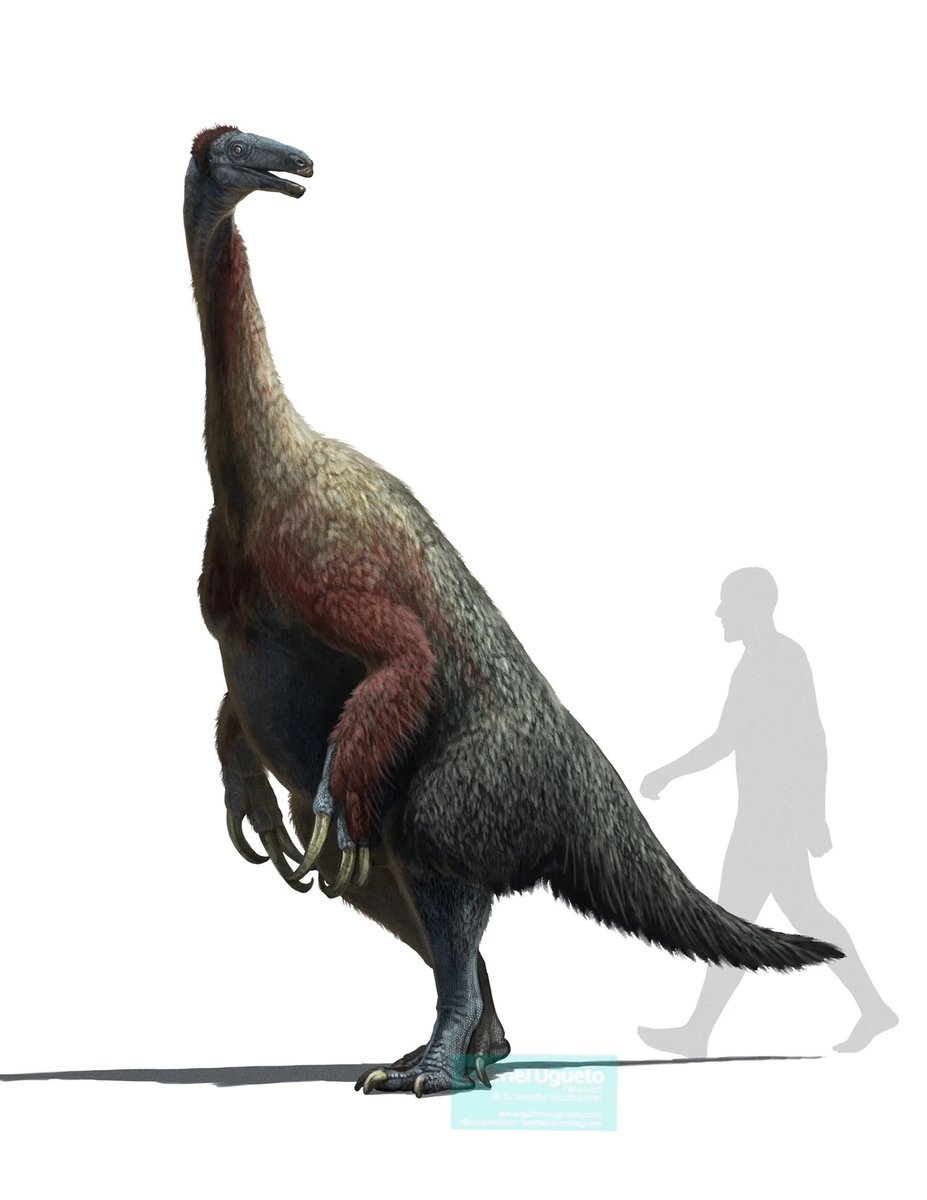
Nothronychus
Nothronychus mckinleyi
Image: Image sourced via web search (Fair use / Educational)
About Nothronychus
Nothronychus was a bizarre, herbivorous theropod dinosaur that lived during the Late Cretaceous period in what is now North America. Its discovery was a landmark event, representing the first definitive evidence of the therizinosaur group outside of Asia and fundamentally altering our understanding of dinosaur diversity and distribution. This animal, with its sloth-like claws and pot-bellied physique, challenged the long-held public and scientific image of theropods as exclusively carnivorous predators.
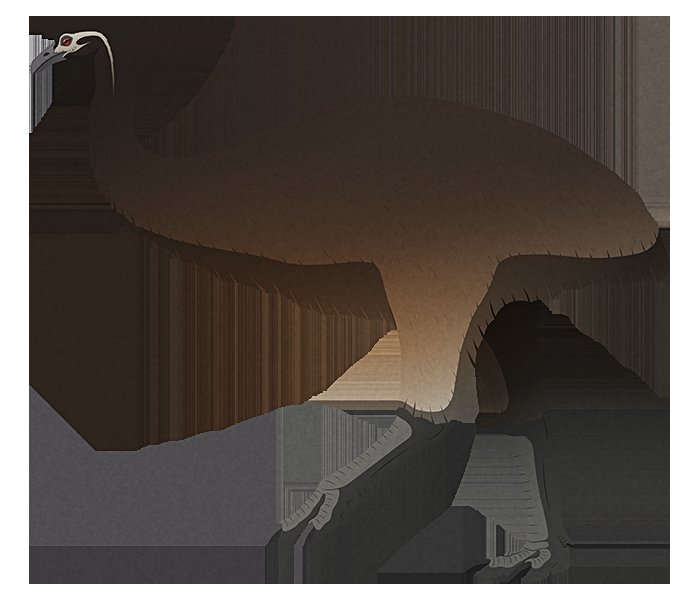
Nothronychus was a medium-sized therizinosaur, reaching an estimated length of 4.5 to 5.5 meters (about 15 to 18 feet) and standing roughly 3 to 3.6 meters tall. Weight estimates place it around 800 to 1,000 kilograms (approximately 1,760 to 2,200 pounds), comparable to a modern polar bear or a large horse. Its most striking features were its long, powerful forelimbs, each terminating in three enormous, scythe-like claws that could reach up to 30 centimeters (12 inches) in length. Despite their fearsome appearance, these claws were likely not for predation but for defense or for pulling down branches to feed. The skull was small relative to its body, with a beak-like structure at the front and small, leaf-shaped teeth suitable for shredding plant material. Its neck was long and slender, contrasting with a robust, wide-bodied torso that housed a large digestive system necessary for processing tough vegetation. The tail was relatively short, and it walked bipedally on stout, four-toed feet, a primitive trait among theropods. Inferred soft tissue suggests it was covered in primitive, shaggy feathers, similar to its Asian relatives like Beipiaosaurus, which would have provided insulation.
As a herbivore, Nothronychus's paleobiology was centered around processing large quantities of plant matter. Its small, leaf-shaped teeth were not designed for heavy chewing but for stripping foliage from branches, which would then be swallowed and broken down in a large, fermenting gut, similar to modern herbivorous birds or mammals. The enormous claws on its hands were likely multi-purpose tools. They could have been used to hook and pull high branches within reach of its beak, a feeding strategy analogous to that of giant ground sloths. These claws would also have served as formidable defensive weapons against predators like large tyrannosauroids. Locomotion was likely slow and deliberate, with a wide, waddling gait dictated by its broad pelvis and pot-bellied physique. It was not built for speed. Inferences about social behavior are speculative, but the discovery of multiple individuals of the related species, N. graffami, suggests they may have lived in groups or at least congregated in certain areas. Its metabolism was likely lower than that of its carnivorous theropod cousins, reflecting its slower lifestyle and herbivorous diet, though it was probably still more active than a modern reptile.
Nothronychus lived approximately 92 to 91 million years ago during the Turonian stage of the Late Cretaceous. At this time, North America was bisected by the Western Interior Seaway, a vast inland sea that stretched from the Arctic Ocean to the Gulf of Mexico. Nothronychus inhabited the coastal plains and swampy, subtropical environments along the western shore of this seaway. The climate was warm and humid, supporting lush vegetation, including ferns, cycads, and early flowering plants, which would have formed the bulk of its diet. The ecosystem was rich and diverse. Nothronychus shared its habitat with a variety of other dinosaurs, including the armored nodosaur Nodosaurus, various hadrosaurs, and smaller ornithopods. The apex predator of this environment was likely a mid-sized tyrannosauroid, a potential threat that Nothronychus would have defended against with its powerful claws. Its position in the food web was that of a primary consumer, a large-bodied browser that played a significant role in shaping the plant communities of its time. The discovery of Nothronychus in this specific environment provided crucial evidence of a land connection between Asia and North America during the Cretaceous, allowing for faunal exchange.
The discovery of Nothronychus is a story of serendipity and careful science. The first species, Nothronychus mckinleyi, was unearthed in 1998 in the Zuni Basin of New Mexico, on a ranch owned by Jim and Sue McKinley. Paleontologist Jim Kirkland and geologist Doug Wolfe were leading an expedition in the Moreno Hill Formation when they found the remains. The initial discovery was made by rancher Merle Graffam, who spotted a toe bone. The subsequent excavation, led by Kirkland and Wolfe, yielded about 40% of a skeleton. The name Nothronychus mckinleyi, formally described in 2001 by Kirkland and Wolfe, honors the McKinley family, with the genus name meaning 'slothful claw' in Greek, referencing its most prominent feature. A second, more complete specimen and species, Nothronychus graffami, was discovered in 2000 by Merle Graffam in the Tropic Shale Formation of southern Utah. This specimen, nicknamed 'Graffam's Nothronychus,' was remarkably complete, with about 90% of the skeleton recovered. Its description in 2009 by Lindsay Zanno and colleagues provided an unprecedentedly detailed look at therizinosaur anatomy and cemented the group's presence in North America.
Nothronychus holds immense evolutionary significance as it was the first definitive therizinosaur found in the Western Hemisphere. Before its discovery, this enigmatic group of dinosaurs was known exclusively from fossils found in China and Mongolia. Its presence in North America provided concrete evidence of faunal interchange between Asia and North America during the Late Cretaceous, likely via a land bridge across the Bering Strait. Nothronychus represents a highly specialized branch of the theropod family tree, showcasing a dramatic evolutionary shift from a carnivorous ancestry to a fully herbivorous lifestyle. This transition is evident in its anatomy: it retains the bipedal stance and three-fingered hands of its predatory ancestors but has evolved a small head, leaf-shaped teeth, a long neck for browsing, and a massive gut for digesting plants. As a member of the Maniraptora, the group that includes birds, Nothronychus is a crucial data point for understanding the incredible diversity and ecological adaptability of coelurosaurian dinosaurs, demonstrating that not all 'raptor' relatives were swift predators.
While the existence of Nothronychus is well-established, some scientific debates continue. The exact function of its enormous claws remains a topic of discussion. While defense and foraging are the leading hypotheses, other possibilities, such as intraspecific display or digging for roots, have also been considered. The degree of feathering is also an area of inference; while related Asian species show clear evidence of primitive feathers, no soft tissue has been preserved for Nothronychus, so the exact nature of its integument is based on phylogenetic bracketing. The classification within Therizinosauridae has also been refined over time. Nothronychus is considered a relatively derived or 'advanced' member of the family, more closely related to the giant Therizinosaurus than to earlier forms like Falcarius. As more therizinosaur fossils are discovered globally, the precise relationships and biogeographical history of the group are continually being updated and revised, with Nothronychus serving as a key North American benchmark in these ongoing studies.
The fossil record of Nothronychus is limited but significant. Fossils are known from two primary locations in the southwestern United States: the Moreno Hill Formation in New Mexico (N. mckinleyi) and the Tropic Shale Formation in Utah (N. graffami). The Tropic Shale specimen is particularly noteworthy for its completeness and articulation, representing one of the most complete therizinosaur skeletons ever found anywhere in the world. This level of preservation has allowed for detailed anatomical studies that were not possible with the more fragmentary Asian specimens. Typically, the more robust bones of the limbs, pelvis, and vertebrae are preserved. The skull remains the rarest part of the skeleton, as is common for many dinosaurs. The discovery sites indicate a coastal, near-marine environment, suggesting these animals lived in habitats bordering the Western Interior Seaway. These two key specimens provide the bulk of our knowledge about this unique dinosaur genus.
Despite its relatively recent discovery, Nothronychus has made a notable impact on popular culture and public understanding of dinosaurs. Its bizarre, almost comical appearance—a pot-bellied, feathered creature with giant claws—has captured the public's imagination and has been featured in documentaries like the BBC's 'Planet Dinosaur' and Discovery Channel's 'Dinosaur Revolution'. These appearances have helped popularize the concept of herbivorous theropods, challenging the monolithic 'T-rex' stereotype. The remarkably complete skeleton of N. graffami is on display at the Natural History Museum of Utah, providing a stunning and tangible look at one of the strangest dinosaurs ever discovered. Its story serves as a powerful educational tool, illustrating the process of scientific discovery and how new finds can dramatically rewrite our understanding of the prehistoric world.
Classification
Time Period
Discovery
Location
USA (New Mexico)
Formation
Moreno Hill Formation
Frequently Asked Questions
What is Nothronychus?
Nothronychus was a bizarre, herbivorous theropod dinosaur that lived during the Late Cretaceous period in what is now North America. Its discovery was a landmark event, representing the first definitive evidence of the therizinosaur group outside of Asia and fundamentally altering our understanding ...
When did Nothronychus live?
Nothronychus lived during the cretaceous period of the mesozoic era approximately 92-91 million years ago.
Where was Nothronychus discovered?
Fossils of Nothronychus were discovered in USA (New Mexico) in the Moreno Hill Formation.
What did Nothronychus eat?
Nothronychus was a herbivore. It lived in terrestrial habitats.
What type of fossil is Nothronychus?
Nothronychus is preserved as a body fossil. The preservation quality is good.
Related Specimens
From the mesozoic era · body fossils
/09c845a0ecb7.png)