Edmontosaurus
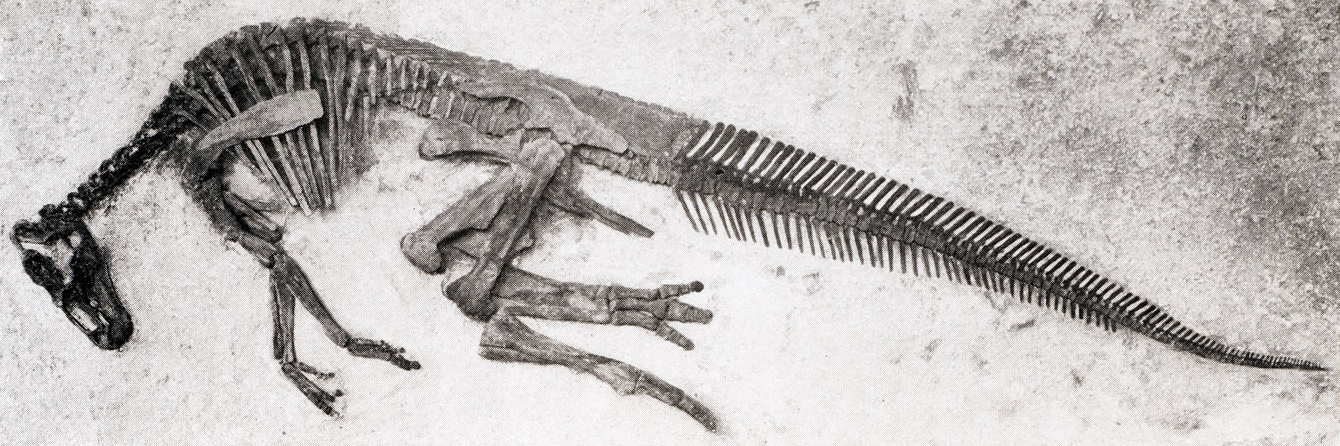
Edmontosaurus annectens
Image: File:Edmontosaurus annectens specimen.jpg - Wikimedia Commons (CC BY-SA)
About Edmontosaurus
Edmontosaurus annectens was a large, highly successful hadrosaurid, commonly referred to as a duck-billed dinosaur, that inhabited the coastal plains and terrestrial ecosystems of western North America during the Late Cretaceous period. Living specifically during the Maastrichtian age between 73 and 66 million years ago, it represents one of the last non-avian dinosaurs to exist before the catastrophic Cretaceous-Paleogene mass extinction event. This remarkable herbivore holds immense significance in the field of paleontology, serving as a critical window into the final flourishing of dinosaur ecosystems on the continent of Laramidia. Because its remains are so abundant and exceptionally well-preserved, Edmontosaurus annectens has become a cornerstone species for scientists seeking to understand dinosaur anatomy, biomechanics, and paleoecology. Its extensive fossil record, which famously includes mummified remains preserving soft tissues, has allowed researchers to reconstruct the life appearance and biology of this animal with a level of detail unmatched by almost any other extinct vertebrate.
The physical description of Edmontosaurus annectens reveals a massive and formidable animal that dominated its landscape. Fully grown individuals could reach staggering lengths of up to 1200 centimeters, or roughly 40 feet, and are estimated to have weighed between four and seven metric tons, making them comparable in mass to a modern African elephant. The postcranial skeleton was heavily built, featuring a long, stiff tail supported by a lattice of ossified tendons that provided balance and stability. Its hind limbs were incredibly robust, equipped with three large, weight-bearing toes ending in hoof-like unguals. The forelimbs were shorter and less heavily muscled but were still fully capable of supporting the animal's weight. The hands possessed four fingers, with the central digits encased in a fleshy, weight-bearing pad or hoof, a feature confirmed by fossilized soft tissue. Unlike some of its crested hadrosaurid relatives, Edmontosaurus annectens lacked a hollow bony crest on its skull. Instead, its skull was long, low, and terminated in a distinctive broad, flattened snout that closely resembled the bill of a modern duck.
Beyond its skeletal structure, the soft tissue preservation found in several specimens has revolutionized our understanding of its physical appearance. The beak was covered in a sharp, keratinous sheath that extended far beyond the bony margins of the jaw, providing a highly efficient cropping tool. Inside the cheeks, the mouth was packed with hundreds of tightly interlocked teeth forming a complex structure known as a dental battery. As teeth wore down from the abrasive plant material, new teeth continuously erupted to replace them, ensuring a constant grinding surface. Skin impressions from mummified specimens reveal that Edmontosaurus was covered in non-overlapping, pavement-like scales, punctuated by larger clusters of polygonal tubercles that may have provided protection or visual display. Furthermore, discoveries of related species have suggested the presence of a fleshy, comb-like frill atop the head, composed entirely of soft tissue, which may have been brightly colored for species recognition or sexual display, fundamentally changing the traditional depiction of these animals as featureless, drab reptiles.
The paleobiology of Edmontosaurus annectens highlights a highly specialized and adaptable herbivore. Its diet consisted of tough, fibrous plant material, including conifers, cycads, ferns, and the increasingly abundant flowering plants, or angiosperms, that were spreading across Late Cretaceous North America. To process this vegetation, Edmontosaurus employed a sophisticated feeding strategy. It would use its sharp, keratinous beak to crop large mouthfuls of foliage, which were then pushed back into the cheeks. The skull possessed a unique kinetic hinge mechanism, known as pleurokinesis, which allowed the upper jaw bones to flare outward slightly as the lower jaw closed. This motion caused the upper and lower dental batteries to grind against each other in a complex shearing action, effectively pulverizing tough plant fibers before swallowing. This highly efficient chewing mechanism is considered one of the most advanced among all terrestrial vertebrates and was a key factor in the evolutionary success of the hadrosaurids.
In terms of locomotion and behavior, Edmontosaurus annectens is classified as a facultative biped. This means that while it primarily walked on all four legs while foraging, grazing, or moving at a leisurely pace, it was fully capable of rearing up and running on its powerful hind legs when necessary. Biomechanical studies suggest that when fleeing from predators, an adult Edmontosaurus could achieve impressive speeds, utilizing its stiff tail as a dynamic counterbalance. Fossil evidence, including massive bonebeds containing the remains of hundreds or even thousands of individuals of various ages, strongly indicates that these animals were highly gregarious and lived in large herds. This herding behavior would have provided protection against predators through the safety of numbers and many eyes to watch for danger. Bone histology, the study of the microscopic structure of the fossilized bone, reveals lines of arrested growth indicating that Edmontosaurus grew rapidly during its early years, reaching adult size in a relatively short period, a strategy likely necessary to outgrow the vulnerable juvenile stage in an environment filled with apex predators.
The ecological context in which Edmontosaurus annectens lived was a dynamic and vibrant world. It inhabited the western coastal plains of the Western Interior Seaway, a shallow inland sea that divided North America into two landmasses. The specific environment, preserved in geological formations such as the Hell Creek Formation in the United States and the Frenchman Formation in Canada, was characterized by a subtropical to temperate climate. The landscape was a lush, low-lying coastal plain crisscrossed by meandering rivers, broad floodplains, dense swampy forests, and open woodlands. The flora was rich and diverse, providing an abundant food source that could sustain massive herds of megaherbivores. Edmontosaurus acted as a primary consumer and a keystone species in this ecosystem, significantly shaping the vegetation through its intensive browsing, much like modern elephants alter their habitats today.
In this Late Cretaceous ecosystem, Edmontosaurus annectens shared its habitat with a spectacular array of iconic dinosaur species. It lived alongside the heavily armored Ankylosaurus, the dome-headed Pachycephalosaurus, and the famous three-horned ceratopsian Triceratops. While it did not compete directly with Triceratops for food due to different browsing heights and dietary preferences, they were part of the same complex food web. As an abundant and large herbivore, Edmontosaurus was a primary prey item for the apex predator of its time, Tyrannosaurus rex. The predator-prey relationship between these two giants is one of the most well-documented in the fossil record. Paleontologists have discovered several Edmontosaurus specimens bearing unmistakable, healed bite marks from Tyrannosaurus rex, particularly on the neural spines of the tail. These healed injuries provide dramatic, direct evidence of active predation and failed hunts, proving that Edmontosaurus was not merely scavenged but actively hunted, and that it possessed the speed and resilience to occasionally survive such terrifying encounters.
The discovery history of Edmontosaurus annectens is deeply intertwined with the early, tumultuous days of North American paleontology. The first fossils were discovered in the late nineteenth century during the famous Bone Wars, a period of intense and often bitter scientific rivalry. The renowned paleontologist Othniel Charles Marsh first described the species in 1892, originally naming it Claosaurus annectens based on a remarkably complete skeleton collected by his legendary field worker, John Bell Hatcher, in Wyoming. Over the decades, the taxonomy of this dinosaur became incredibly convoluted. As more specimens were found, they were assigned to a dizzying array of genera, including Trachodon, Anatosaurus, and Anatotitan. It was not until the late twentieth century that scientists conducted comprehensive reviews of the fossil material and determined that many of these names actually represented different growth stages or slight variations of a single species, which was ultimately subsumed into the genus Edmontosaurus.
Among the most important discoveries in the history of paleontology are the Edmontosaurus mummies. In 1908, the fossil hunter Charles Hazelius Sternberg and his sons discovered the famous Trachodon mummy in the Lance Formation of Wyoming. Now housed at the American Museum of Natural History, this specimen preserved extensive, three-dimensional skin impressions, providing the first real look at dinosaur integument. Decades later, in 1999, a high school student named Tyler Lyson discovered another extraordinary mummy in the Hell Creek Formation of North Dakota. Nicknamed Dakota, this specimen was excavated with the help of paleontologists and subjected to advanced CT scanning. Dakota preserved not only skin but also fossilized ligaments, tendons, and evidence of muscle mass, revealing that the animal was significantly more muscular and robust than previously reconstructed from bare bones alone. These key specimens have continually pushed the boundaries of what scientists thought possible regarding fossil preservation.
The evolutionary significance of Edmontosaurus annectens lies in its position near the very end of the dinosaur family tree. It belongs to the clade Ornithischia, the order of bird-hipped dinosaurs, and is a derived member of the family Hadrosauridae. Within this family, it is classified in the subfamily Saurolophinae, which encompasses the solid-crested or crestless duck-billed dinosaurs. Edmontosaurus represents the culmination of millions of years of ornithopod evolution, tracing its lineage back to earlier, simpler bipedal herbivores like Iguanodon. The evolutionary trajectory of this lineage is marked by the progressive refinement of the chewing apparatus and the transition to a more quadrupedal stance. While Edmontosaurus left no direct modern descendants, as all non-avian dinosaurs perished in the end-Cretaceous extinction, it is often compared to modern mammalian megaherbivores. Ecologically, it filled a niche similar to that of modern bovids, such as bison or wildebeest, or large cervids, acting as a herd-dwelling bulk feeder that dominated the terrestrial landscape.
Despite its extensive fossil record, Edmontosaurus annectens has been the subject of numerous scientific debates. One of the most enduring controversies has surrounded its taxonomy, specifically regarding the status of the genus Anatotitan. For years, some paleontologists, such as Ralph Chapman and Michael Brett-Surman, argued that the massive, long-skulled specimens found in the uppermost Hell Creek Formation represented a distinct genus, Anatotitan copei. However, more recent and exhaustive studies by researchers like Jack Horner, David Evans, and Peter Campione have strongly suggested that these enormous skulls simply represent fully mature, elderly individuals of Edmontosaurus annectens. They demonstrated that as the animal aged, its skull elongated and flattened significantly, a process known as ontogenetic change. Another debate centers on their behavior, specifically regarding migration. While some early isotopic studies suggested that Edmontosaurus undertook massive, thousands-of-mile migrations from the Arctic to the mid-latitudes, recent analyses of tooth enamel isotopes by researchers like Henry Fricke indicate that they may have been more regional in their movements, migrating shorter distances between coastal and inland environments in response to seasonal changes.
The fossil record of Edmontosaurus annectens is arguably one of the best of any dinosaur, providing an unparalleled dataset for researchers. Fossils have been recovered across a vast geographic distribution in western North America, with significant concentrations in Montana, South Dakota, Wyoming, Saskatchewan, and Alberta. The sheer number of specimens numbers in the hundreds, ranging from isolated teeth and fragmented bones to perfectly articulated skeletons and the aforementioned mummies. This abundance is largely due to their herd behavior and the depositional environment they lived in; many individuals died in river crossings or flood events, where their bodies were rapidly buried by sediment, preventing scavenging and decay. Famous sites like the Ruth Mason Quarry in South Dakota have yielded the disarticulated remains of thousands of Edmontosaurus individuals, providing a treasure trove of data for studying population dynamics, disease, and variations within the species. The preservation quality at these sites allows scientists to study not just the bones, but the taphonomic processes that lead to fossilization.
The cultural impact of Edmontosaurus is significant, even if it is sometimes overshadowed by its more heavily armed contemporaries like Triceratops and Tyrannosaurus rex. Because its skeletons are so abundant and complete, Edmontosaurus is a staple in natural history museums worldwide, often forming the centerpiece of Late Cretaceous dioramas at institutions like the American Museum of Natural History and the Senckenberg Museum. In popular culture, it frequently appears in documentaries, such as the acclaimed Walking with Dinosaurs series, and serves as a background animal in the Jurassic Park franchise, illustrating the vibrant ecosystems of the Mesozoic. Educationally, Edmontosaurus is of paramount importance. It is frequently used in classrooms and textbooks to teach core scientific concepts, including the scientific method of taxonomic revision, the mechanics of fossilization and taphonomy, and the complex predator-prey dynamics of ancient ecosystems, making it one of the most important dinosaurs for public science education.
Classification
Time Period
Discovery
Location
North America (specifically western Canada and the United States)
Formation
Hell Creek Formation, Lance Formation, Frenchman Formation
Frequently Asked Questions
What is Edmontosaurus?
Edmontosaurus annectens was a large, highly successful hadrosaurid, commonly referred to as a duck-billed dinosaur, that inhabited the coastal plains and terrestrial ecosystems of western North America during the Late Cretaceous period. Living specifically during the Maastrichtian age between 73 and...
When did Edmontosaurus live?
Edmontosaurus lived during the cretaceous period of the mesozoic era approximately 73-66 million years ago.
Where was Edmontosaurus discovered?
Fossils of Edmontosaurus were discovered in North America (specifically western Canada and the United States) in the Hell Creek Formation, Lance Formation, Frenchman Formation.
What did Edmontosaurus eat?
Edmontosaurus was a herbivore. It lived in terrestrial habitats.
What type of fossil is Edmontosaurus?
Edmontosaurus is preserved as a body fossil. The preservation quality is exceptional.
Related Specimens
From the mesozoic era · body fossils
/bed7088e21a4.png)
/c81e708ee030.png)