Greenops
Greenops boothi
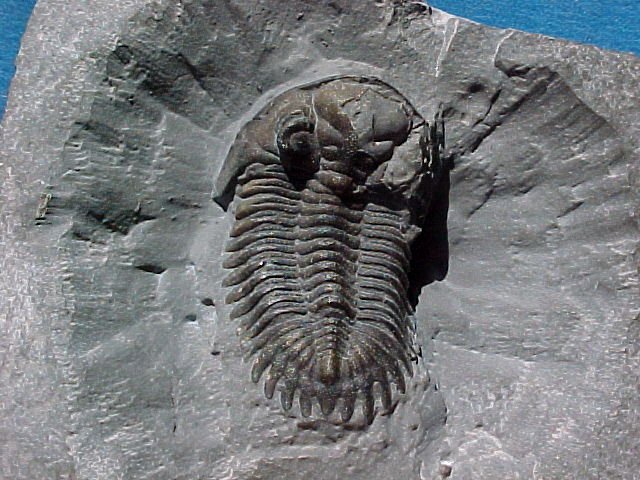
Image: Image sourced via web search (Fair use / Educational)
About Greenops
Greenops boothi is a distinctive species of trilobite, an extinct group of marine arthropods, that thrived during the Middle Devonian period, approximately 392 to 382 million years ago. Its fossils are a hallmark of the Hamilton Group strata in what is now New York State, USA, providing paleontologists with a clear window into the complex marine ecosystems of the Paleozoic Era. As a member of the order Phacopida, Greenops is significant for its advanced visual system and its characteristic defensive enrollment posture, making it a subject of enduring study and a popular fossil among collectors.
Greenops boothi was a relatively small trilobite, with most adult specimens reaching an average length of 3 to 7 centimeters (approximately 1.2 to 2.8 inches). Its body plan followed the classic trilobite tripartite structure, consisting of a cephalon (head), a segmented thorax, and a pygidium (tail shield). The most striking feature of Greenops is its ornamentation; its exoskeleton was covered in numerous tubercles and spines, particularly along the axial rings of the thorax and on the pygidium. The cephalon was semi-circular and bore prominent, crescent-shaped schizochroal eyes. These complex eyes, characteristic of phacopid trilobites, were composed of multiple, large, individually set calcite lenses, each capable of forming a separate image. This advanced visual system suggests Greenops had excellent depth perception and could detect movement effectively in its environment. The glabella, a raised central portion of the cephalon, was inflated and covered in coarse tubercles. The thorax was composed of 11 articulating segments, each bearing a prominent spine on its central axial ring. The pygidium was also spinose, featuring a series of backward-projecting spines along its margin, with a longer, terminal medial spine. These spines likely served a defensive purpose, making the trilobite difficult for predators to handle or swallow. For scale, a typical Greenops would be about the size of a large shrimp or a human thumb.
The paleobiology of Greenops boothi is inferred from its morphology and the sedimentary context of its fossils. As a benthic, or bottom-dwelling, organism, it likely spent its life crawling on or burrowing into the soft sediment of the seafloor. Its diet is presumed to have been that of a detritivore or a scavenger, feeding on organic debris, microorganisms, and decaying matter in the mud. The trilobite's legs, which are very rarely preserved, would have been used for locomotion, stirring up sediment to find food particles which were then passed forward to the mouth located on the underside of the cephalon. The complex schizochroal eyes suggest it was an active creature, visually aware of its surroundings and capable of detecting both predators and potential food sources. A key behavioral adaptation, common to many trilobites, was the ability to enroll into a tight, armored ball, a process called volvation. When threatened, Greenops could tuck its pygidium under its cephalon, protecting its soft ventral side and presenting a formidable, spiny exterior to attackers. This defensive posture is frequently observed in the fossil record, indicating it was a common and effective survival strategy. Growth occurred through molting, where the trilobite would shed its exoskeleton periodically to increase in size, leaving behind discarded molts that also contribute to the fossil record.
During the Middle Devonian, the world of Greenops was a shallow, warm, epicontinental sea known as the Kaskaskia Sea, which covered a large portion of the ancient continent of Laurentia (the precursor to North America). The climate was generally warm and tropical. The seafloor habitat was a muddy substrate, rich in organic material, supporting a diverse and complex marine ecosystem. Greenops shared its environment with a vast array of other organisms. The water column teemed with brachiopods, crinoids (sea lilies), rugose and tabulate corals, bryozoans, and various mollusks like bivalves, gastropods, and cephalopods (including ammonoids and nautiloids). Other trilobite species, such as Dipleura dekayi and the larger Terataspis grandis, were also present. Greenops occupied a low-level position in the food web as a detritivore. It faced predation from several sources. The apex predators of these Devonian seas were the placoderms, giant armored fish like Dunkleosteus, although smaller placoderms and predatory nautiloids would have been a more direct threat to a small trilobite like Greenops. The evolution of powerful, jawed predators during the Devonian likely drove the development of defensive features like the prominent spines and enrollment capabilities seen in Greenops and its relatives.
The discovery and naming of Greenops boothi are rooted in the early days of American paleontology. The species was first formally described by the naturalist Jacob Green in 1832 in his monograph, "A Monograph of the Trilobites of North America." Green originally named the species Cryphaeus boothi. The specific epithet, 'boothi', honors James Curtis Booth, a contemporary chemist and geologist. The fossils Green studied were collected from the prolific Devonian strata of New York State, which were among the first geological systems to be systematically studied in North America. Later, in 1838, the genus name Greenops was established by the French paleontologist Alexandre Brongniart's collaborator, M. Desmarest, in a publication, but it was the work of paleontologists Rudolf and Emma Richter in the 20th century that solidified the generic classification. They recognized that the American species Green described was distinct from the European Cryphaeus and belonged in its own genus, for which they resurrected the name Greenops in honor of Jacob Green. There are no famous individual specimens akin to 'Sue' the T. rex; rather, the significance of Greenops lies in its abundance, which has allowed for detailed population-level studies of its morphology and variation.
Greenops boothi holds an important place within the evolutionary history of arthropods. As a member of the Class Trilobita, it represents a highly successful and diverse group that dominated marine ecosystems for over 250 million years before their ultimate extinction at the end of the Permian period. Within the trilobites, Greenops belongs to the order Phacopida and the family Acastidae. The phacopids are particularly significant for their advanced schizochroal eyes, which are considered an evolutionary pinnacle in compound eye development, rivaling the complexity of modern insect and crustacean eyes. This visual system is a prime example of convergent evolution, as it developed independently from other complex eyes in the animal kingdom. The spinosity of Greenops is also evolutionarily significant, representing a clear example of the 'Mesozoic Marine Revolution' concept applied to the Paleozoic. This idea posits an evolutionary arms race between predators and prey, where increasing predation pressure (from jawed fish, in this case) drives the evolution of more robust defensive structures in prey animals. Greenops, with its array of spines and enrollment ability, perfectly illustrates this adaptive response. Trilobites have no direct modern descendants, as the entire class went extinct, but their closest living relatives are the chelicerates, a group that includes horseshoe crabs, spiders, and scorpions.
While the classification of Greenops boothi within the family Acastidae is stable, scientific discussion continues regarding its precise ecological role and the function of its elaborate ornamentation. The primary debate centers on the exact purpose of the spines. While a defensive function against predators is the most widely accepted hypothesis, some researchers have proposed secondary functions. These could include stabilization on the soft, muddy substrate, preventing the trilobite from sinking, or acting as sensory extensions to detect changes in water currents or the presence of other organisms. Another area of ongoing research involves the fine details of its schizochroal eyes. Studies using advanced imaging techniques aim to model the optical properties of the calcite lenses to better understand the trilobite's field of view, light-gathering ability, and how it processed visual information. Furthermore, slight variations in spine length and tubercle density among different populations of Greenops have led to discussions about whether these represent subspecies, adaptations to local environmental pressures, or simply normal intraspecific variation. The discovery of new, exceptionally preserved specimens could help resolve some of these functional and taxonomic questions.
The fossil record of Greenops boothi is robust and geographically concentrated. Its fossils are found in great abundance throughout the Middle Devonian strata of the Hamilton Group in New York State, with significant occurrences also noted in Pennsylvania and extending into Ontario, Canada. Famous fossil collecting sites include the Windom Shale near Penn Yan and the Moscow Formation near Tully, New York. The preservation quality of Greenops fossils is typically good to excellent. Because the trilobite exoskeleton was mineralized with calcite during life, it had a high potential for fossilization. Complete, articulated specimens are common, often found in their enrolled defensive posture. Disarticulated parts, such as isolated cephalons, pygidia, and thoracic segments, are even more numerous. The fine-grained nature of the shales and mudstones of the Hamilton Group allowed for the preservation of fine details, including the surface tuberculation and the individual lenses of the schizochroal eyes. Soft tissues like legs and antennae are almost never preserved, as is typical for most trilobite fossils.
Greenops has a notable, if modest, cultural impact, primarily within the communities of fossil collectors and geology enthusiasts. Its distinctive, spiny appearance and the relative abundance of well-preserved specimens make it a highly sought-after and recognizable fossil. It is often featured in fossil identification guides and serves as a classic example of a Devonian trilobite in educational settings. Major natural history museums, such as the American Museum of Natural History in New York and the Smithsonian National Museum of Natural History in Washington, D.C., hold and often display excellent specimens of Greenops boothi as part of their Paleozoic marine life exhibits. While it has not achieved the mainstream fame of dinosaurs, Greenops serves as a key ambassador for the strange and wonderful life that inhabited Earth's ancient oceans long before the first vertebrates walked on land, captivating the public with its intricate and alien beauty.
Classification
Time Period
Discovery
Location
United States (New York)
Formation
Hamilton Group (specifically the Windom Shale and Moscow Formation)
Frequently Asked Questions
What is Greenops?
Greenops boothi is a distinctive species of trilobite, an extinct group of marine arthropods, that thrived during the Middle Devonian period, approximately 392 to 382 million years ago. Its fossils are a hallmark of the Hamilton Group strata in what is now New York State, USA, providing paleontologi...
When did Greenops live?
Greenops lived during the devonian period of the paleozoic era approximately 392-382 million years ago.
Where was Greenops discovered?
Fossils of Greenops were discovered in United States (New York) in the Hamilton Group (specifically the Windom Shale and Moscow Formation).
What did Greenops eat?
Greenops was a detritivore. It lived in marine habitats.
What type of fossil is Greenops?
Greenops is preserved as a body fossil. The preservation quality is good.
Related Specimens
From the paleozoic era · body fossils