Eurypterus
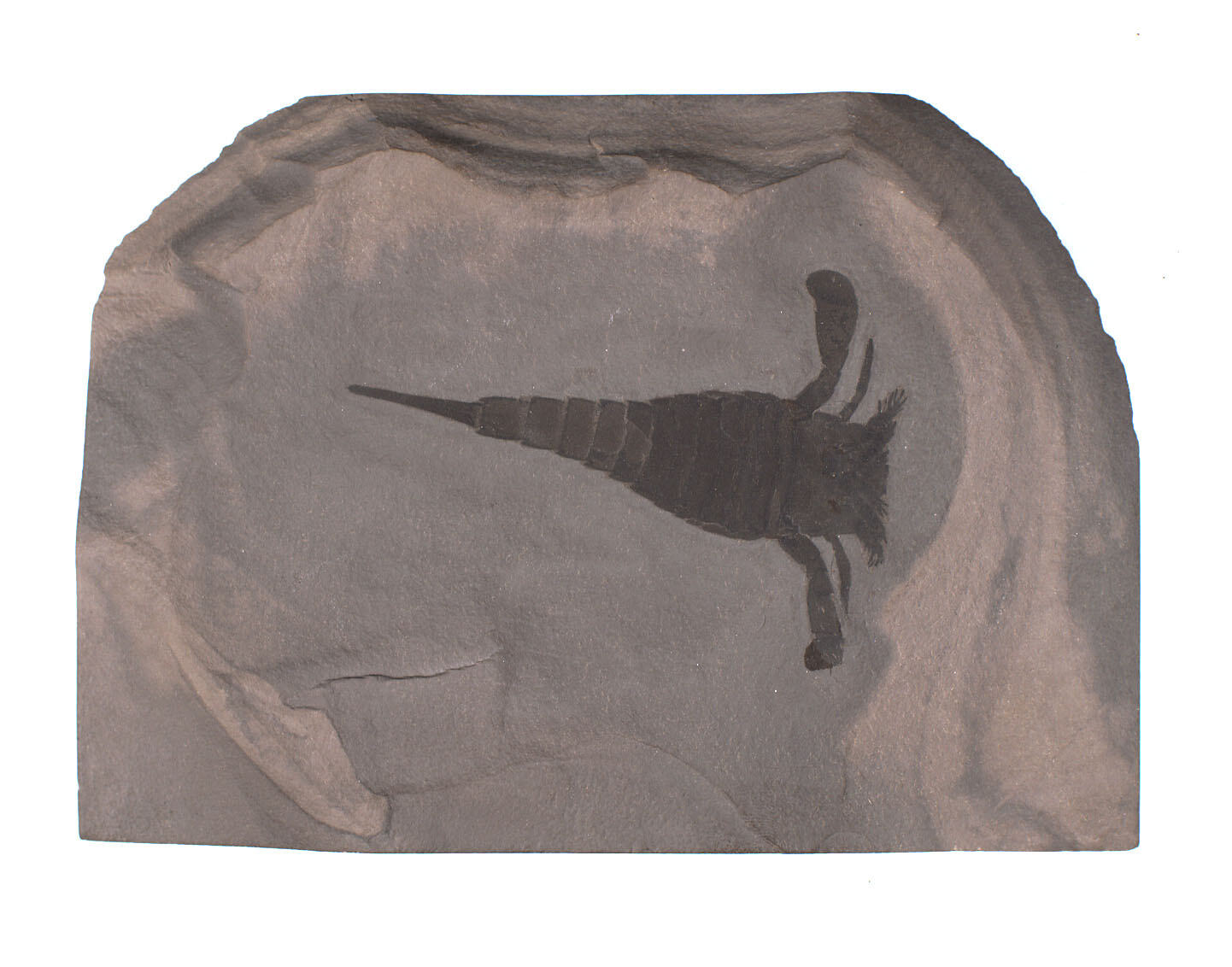
Eurypterus remipes
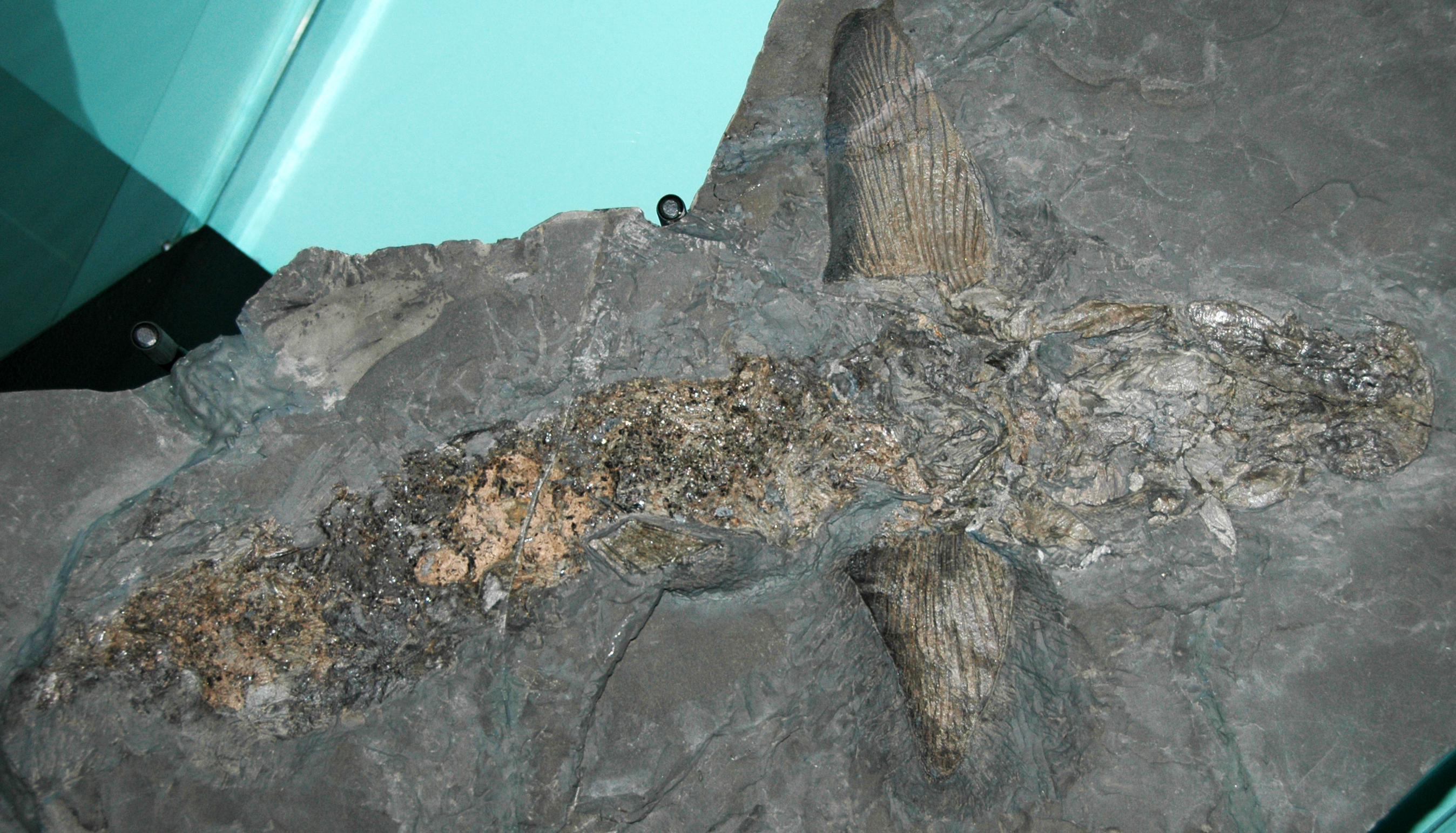
Image: File:Eurypterus remipes remipes fossil.jpg - Wikimedia Commons (CC BY-SA)
About Eurypterus
Eurypterus remipes is one of the most thoroughly studied and iconic genera of eurypterids, an extinct group of aquatic arthropods colloquially known as sea scorpions. Thriving during the Silurian Period approximately 432 to 418 million years ago, this formidable invertebrate dominated the shallow, brackish waters of what is now North America. As a foundational species in the history of paleontology, Eurypterus provides critical insights into the anatomy, ecology, and evolutionary trajectory of early chelicerates, serving as a vital index fossil for the Paleozoic Era.
The physical anatomy of Eurypterus remipes is a marvel of early arthropod design, characterized by a highly specialized, segmented body that typically measured between thirteen and twenty-three centimeters in length, though some exceptional specimens reached slightly larger proportions. The body was broadly divided into two main sections: the prosoma, or head and thorax region, and the opisthosoma, which constituted the abdomen. The prosoma was covered by a roughly semicircular carapace that housed a pair of prominent, crescent-shaped compound eyes positioned laterally, as well as a pair of much smaller, light-sensing simple eyes called ocelli located near the center. Beneath this protective shield, Eurypterus possessed six pairs of highly adapted appendages. The first pair consisted of small, pincer-like chelicerae used for grasping and manipulating food. These were followed by four pairs of walking legs of increasing length, equipped with spines to aid in traversing the muddy substrate and capturing prey. The sixth and most distinctive pair of appendages were massive, paddle-like structures that extended outward and backward, serving as the primary organs for swimming. The opisthosoma was further subdivided into a broader preabdomen and a narrower postabdomen, consisting of twelve articulating segments that provided immense flexibility. The body terminated in a long, tapering telson, or tail spine. Unlike the stingers of modern scorpions, the telson of Eurypterus lacked a venom gland and was primarily utilized as a rudder for steering and maintaining balance in the water column. Weighing an estimated few hundred grams, the creature possessed a tough chitinous exoskeleton that protected it from environmental hazards and predators, bearing a striking structural resemblance to its closest living relative, the modern horseshoe crab.
In terms of paleobiology, Eurypterus remipes was a highly capable and opportunistic carnivore that played a significant role as a predator in its aquatic ecosystem. Its diet consisted primarily of smaller, soft-bodied invertebrates, worms, early jawless fishes, and trilobites that shared its habitat. The feeding strategy of Eurypterus likely involved ambushing or actively pursuing prey along the benthic zone, using its spined walking legs to ensnare victims before passing them forward to the chelicerae for dismemberment. Locomotion was achieved through a combination of walking and swimming. Trackways preserved in the fossil record indicate that Eurypterus could walk across the ocean floor using a distinct, synchronized gait. When swimming, the large, paddle-like appendages were employed in a rowing motion, propelling the animal through the water with surprising agility. The flattened shape of its body suggests it was well-adapted to a benthic lifestyle, often resting on or partially burying itself in the soft sediment. Like all arthropods, Eurypterus had to periodically shed its rigid exoskeleton to grow, a process known as ecdysis. The vast majority of Eurypterus fossils discovered are actually these discarded molts, or exuviae, rather than the carcasses of the animals themselves. This molting process left the creature temporarily vulnerable to predation until its new exoskeleton hardened, during which time it likely sought refuge in crevices or dense algal mats. The abundance of varying sizes of these molts has allowed paleontologists to reconstruct the ontogeny and growth patterns of Eurypterus in unprecedented detail, revealing a gradual morphological shift from juvenile to adult stages.
The ecological context of Eurypterus remipes is firmly rooted in the paleogeography and climate of the Silurian Period, a time when the Earth was experiencing a warm, stable greenhouse climate. The landmass that would become North America was part of the paleocontinent Laurentia, which was situated near the equator and covered by shallow, epicontinental seas. Eurypterus primarily inhabited the nearshore environments of these seas, specifically thriving in restricted, hypersaline to brackish lagoons, estuaries, and tidal flats. These environments were characterized by fluctuating salinity levels, low oxygen conditions in the deeper waters, and fine-grained carbonate muds that would eventually lithify into the famous Bertie Formation. In this dynamic habitat, Eurypterus coexisted with a diverse array of organisms. The food web of these Silurian lagoons included various species of ostracoderms, which were heavily armored, jawless fishes, as well as early cephalopods, gastropods, bivalves, and an assortment of other arthropods. While Eurypterus remipes was a formidable predator in its own right, it was not the apex predator of its time. It shared its environment with much larger eurypterid species, such as the massive Pterygotus, which could grow to over two meters in length and likely preyed upon smaller eurypterids like Eurypterus. The ability of Eurypterus to tolerate the harsh, fluctuating conditions of brackish and hypersaline waters gave it a distinct ecological advantage, allowing it to exploit niches that were inhospitable to many strictly marine organisms.
The discovery history of Eurypterus remipes is a fascinating chapter in the annals of early paleontology, dating back to the early nineteenth century. The first known specimen was unearthed in 1818 in Oneida County, New York, by a local collector. It was initially examined by Dr. Samuel L. Mitchill, a prominent American physician and naturalist, who mistakenly identified the fossil as a species of ancient catfish due to the superficial resemblance of its appendages to the barbels of a fish. It was not until 1825 that the zoologist James Ellsworth De Kay recognized the specimen as an entirely new, extinct type of arthropod. De Kay formally named the genus Eurypterus, derived from the Greek words eurys, meaning broad, and pteron, meaning wing, in reference to its large swimming paddles. He designated the species as Eurypterus remipes, with remipes translating to oar-foot. Throughout the nineteenth century, as the Erie Canal was excavated and limestone quarries expanded across upstate New York, thousands of additional specimens were brought to light. The renowned paleontologist James Hall published extensive monographs on Eurypterus in 1859, meticulously describing its anatomy and firmly establishing its significance in the scientific community. Hall's detailed illustrations and comparative anatomical studies laid the groundwork for all future research on eurypterids. The sheer volume and exceptional preservation of the specimens recovered from the Bertie Waterlime made Eurypterus the most thoroughly understood of all Paleozoic arthropods, drawing the attention of scientists worldwide and cementing its place in the history of paleontology.
The evolutionary significance of Eurypterus remipes cannot be overstated, as it occupies a crucial position in the phylogenetic tree of arthropods. Eurypterids belong to the subphylum Chelicerata, a diverse group that includes modern spiders, scorpions, mites, and horseshoe crabs. Within this subphylum, Eurypterus is traditionally placed in the class Merostomata, though the exact taxonomic relationships have been the subject of ongoing refinement. Eurypterids are widely considered to be the sister group to the Arachnida, making them vital to understanding the evolutionary transition of life from marine environments to terrestrial ecosystems. The anatomical features of Eurypterus, such as its book gills, chelicerae, and segmented body plan, provide a morphological bridge between the primitive marine arthropods of the Cambrian and the highly specialized terrestrial arachnids that emerged later in the Paleozoic. Furthermore, the adaptation of Eurypterus to brackish and freshwater environments represents one of the earliest evolutionary steps toward the colonization of non-marine habitats by animals. By studying the respiratory and osmoregulatory adaptations that allowed Eurypterus to survive in fluctuating salinities, scientists can infer the physiological changes that eventually enabled its relatives to leave the water entirely. The genus also demonstrates a remarkable degree of evolutionary stasis and success, persisting for millions of years with relatively minor morphological changes, which speaks to the efficiency and adaptability of its body plan.
Despite the wealth of fossil evidence, Eurypterus remipes remains the subject of several scientific debates and ongoing research. One of the primary controversies revolves around the exact mechanics of its locomotion. While it is generally agreed that the large sixth appendages were used for swimming, biomechanical studies have debated whether Eurypterus employed a rowing motion, similar to a water boatman, or an underwater flying motion, akin to modern sea turtles and penguins. Recent computer modeling and fluid dynamics simulations suggest a complex rowing mechanism that generated thrust on both the forward and backward strokes, though consensus is still evolving. Another area of historical debate concerns the function of the telson. Early paleontologists, influenced by the common name sea scorpion, hypothesized that the telson might have housed a venom gland used to subdue prey. However, modern anatomical analyses have conclusively shown that the telson lacks the necessary internal structures and pores for venom delivery, confirming its role as a hydrodynamic stabilizer. Taxonomically, the validity of the class Merostomata has been challenged, with some cladistic analyses suggesting that eurypterids are more closely related to terrestrial arachnids than to horseshoe crabs, potentially rendering Merostomata a paraphyletic grouping. These debates highlight the dynamic nature of paleontological science, where new technologies continually refine our understanding of ancient life.
The fossil record of Eurypterus remipes is among the most spectacular and abundant of any extinct arthropod. The vast majority of specimens have been recovered from the Bertie Formation, a sequence of Upper Silurian dolomitic limestones that outcrops across New York State and extends into Ontario, Canada. This formation, particularly the layers known as the Fiddlers Green and Williamsville members, represents a unique taphonomic window known as a Konservat-Lagerstatte, a sedimentary deposit that exhibits extraordinary fossil preservation. The fine-grained, anoxic muds of the Silurian lagoons provided the perfect conditions for preserving the delicate chitinous exoskeletons of Eurypterus, often capturing microscopic details such as individual lenses in the compound eyes, sensory setae on the appendages, and even the internal structure of the book gills. To date, tens of thousands of Eurypterus fossils have been collected from famous localities such as Langs Quarry and the Herkimer region. Because Eurypterus remipes is so abundant, widespread within its specific geographic range, and restricted to a relatively narrow slice of geologic time, it serves as an excellent index fossil. Geologists and paleontologists rely on the presence of Eurypterus to date and correlate Silurian rock layers across different regions, making it an invaluable tool for understanding the stratigraphy of the Paleozoic Era.
The cultural impact of Eurypterus remipes extends far beyond the confines of academic journals and university laboratories. In recognition of its immense scientific value and its deep historical connection to the region, the state of New York officially designated Eurypterus remipes as its state fossil in 1984. This designation has elevated the creature to a symbol of regional pride and natural history heritage. Spectacularly preserved specimens of Eurypterus are prominently featured in major natural history museums around the world, including the American Museum of Natural History in New York City and the Paleontological Research Institution in Ithaca. These exhibits captivate the public imagination, offering a tangible connection to a world that existed over four hundred million years ago. In popular culture, the dramatic moniker of giant sea scorpion has ensured that eurypterids frequently appear in documentaries, books, and educational materials aimed at inspiring the next generation of scientists. Through its enduring presence in both scientific literature and public consciousness, Eurypterus remipes continues to serve as a powerful ambassador for the wonders of paleontology and the deep history of life on Earth.
Classification
Time Period
Discovery
Location
New York, USA
Formation
Bertie Formation
Frequently Asked Questions
What is Eurypterus?
Eurypterus remipes is one of the most thoroughly studied and iconic genera of eurypterids, an extinct group of aquatic arthropods colloquially known as sea scorpions. Thriving during the Silurian Period approximately 432 to 418 million years ago, this formidable invertebrate dominated the shallow, b...
When did Eurypterus live?
Eurypterus lived during the silurian period of the paleozoic era approximately 432-418 million years ago.
Where was Eurypterus discovered?
Fossils of Eurypterus were discovered in New York, USA in the Bertie Formation.
What did Eurypterus eat?
Eurypterus was a carnivore. It lived in brackish and freshwater habitats.
What type of fossil is Eurypterus?
Eurypterus is preserved as a impression fossil. The preservation quality is excellent.
Related Specimens
From the paleozoic era · impression fossils
/e01cc4f7f656.jpg)