Megalosaurus
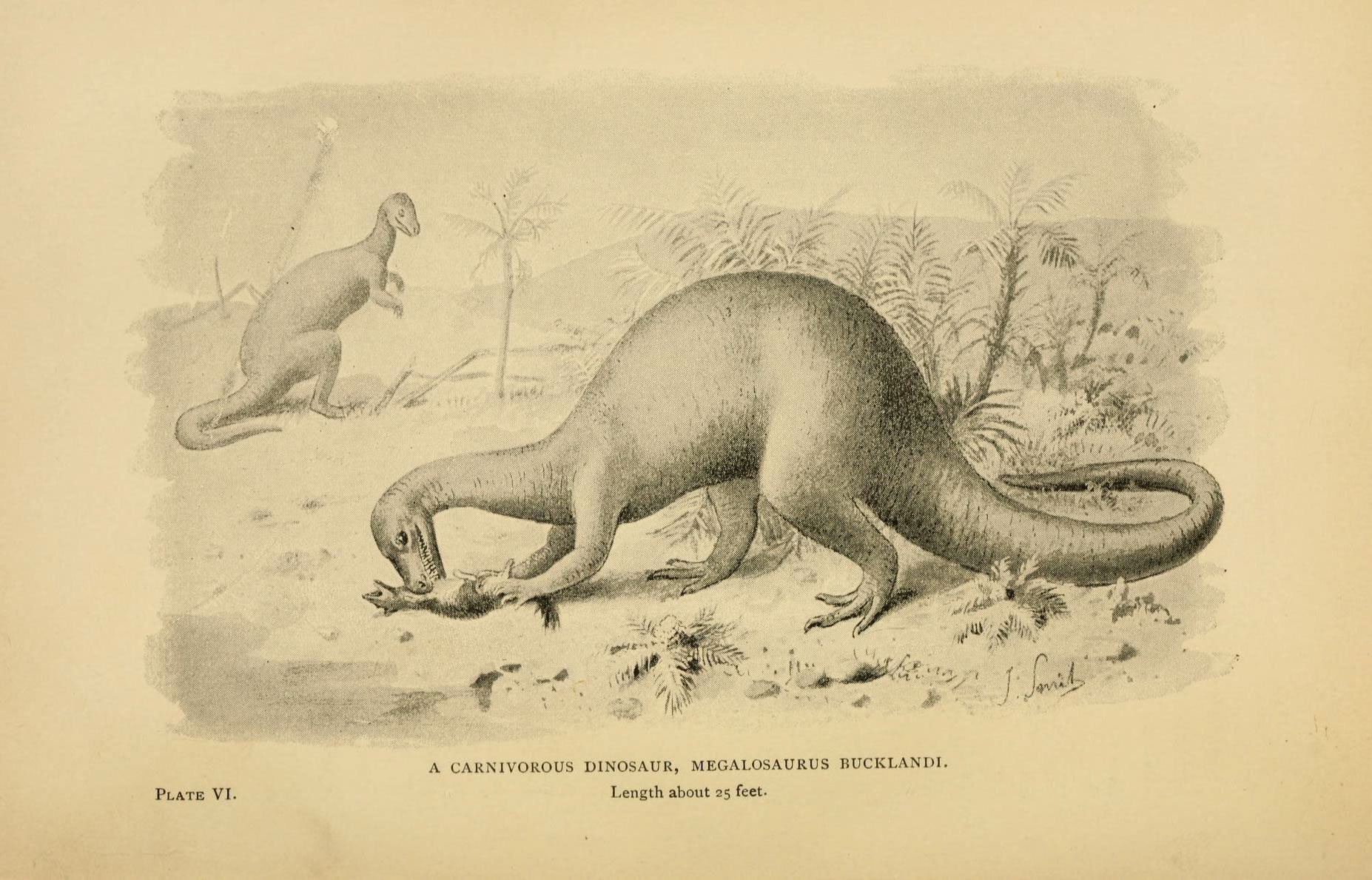
Megalosaurus bucklandii
Image: File:Megalosaurus bucklandii.jpg - Wikimedia Commons (CC BY-SA)
About Megalosaurus
Megalosaurus, whose name translates to 'great lizard,' stands as a monumental figure in the annals of science, holding the unique distinction of being the very first non-avian dinosaur to be formally named and described. This large carnivorous theropod roamed the terrestrial landscapes of what is now southern England during the Middle Jurassic period, approximately 166 million years ago. Its discovery and subsequent study not only laid the foundational stones for the entire field of paleontology but also fundamentally altered humanity's understanding of prehistoric life, culminating in the very definition of the term 'dinosaur'.
Megalosaurus was a formidable predator, a classic example of a large theropod dinosaur. Mature individuals are estimated to have reached lengths of up to 9 meters (approximately 30 feet) from snout to tail tip, with a hip height of around 3 meters, and a body mass in the region of 1 to 1.4 metric tons. Its overall build was robust and powerful, far from the sleek, gracile forms of later tyrannosaurids. The skull was large and elongated, housing a formidable arsenal of long, curved, and serrated teeth designed for slicing through flesh and bone. These blade-like teeth were laterally compressed, a common adaptation among carnivorous theropods for efficient cutting. The animal's neck was short but muscular and S-shaped, providing the strength needed to wrestle with prey and tear away large chunks of meat. Its torso was deep and heavily muscled, supported by a powerful pelvic girdle. The forelimbs, though significantly shorter than the hindlimbs, were not vestigial; they were stout and strong, terminating in three-fingered hands equipped with sharp, recurved claws, likely used for grasping and restraining struggling victims. The primary mode of locomotion was bipedal, with the body's weight carried on two massive, pillar-like hind legs. These legs were powered by immense thigh muscles, anchored to a long, heavy tail that acted as a dynamic counterbalance, providing stability during walking and agility while running.
As an apex predator of its ecosystem, the paleobiology of Megalosaurus was centered on hunting. Its powerful build and formidable dentition point to a diet consisting of the large herbivorous dinosaurs that shared its environment. Potential prey would have included the heavily armored stegosaurians like Lexovisaurus and large sauropods such as Cetiosaurus. The serrated, blade-like teeth were not adapted for crushing bone but for inflicting deep, debilitating wounds, suggesting a feeding strategy that involved ambushing prey, delivering powerful bites to slice through muscle and sinew, and causing massive blood loss. Biomechanical studies of its skull suggest it could withstand significant stress, indicating it may have engaged in active struggles with large and powerful animals. Its locomotion, while not built for extreme speed over long distances like some later theropods, would have allowed for powerful, explosive bursts of acceleration to close the distance on its targets. Inferences about its behavior remain speculative, but like modern large predators, it was likely a solitary hunter or may have formed small, temporary associations. Growth patterns, deduced from bone histology of related theropods, suggest a relatively rapid growth rate during its juvenile years, reaching near-adult size within a decade or two, a strategy that would have minimized its vulnerability period.
The world Megalosaurus inhabited during the Bathonian age of the Middle Jurassic was vastly different from modern-day England. The climate was warm, subtropical, and humid, with no polar ice caps and higher sea levels. The region that is now Oxfordshire was a shallow, tropical sea dotted with a series of small, low-lying islands covered in lush vegetation. The flora was dominated by conifers, cycads, ginkgoes, and ferns, creating a verdant, swampy archipelago. Megalosaurus was the top terrestrial predator in this island ecosystem, occupying the apex of the food web. It shared this habitat with a diverse array of other creatures. Herbivorous dinosaurs were plentiful, including the aforementioned sauropod Cetiosaurus, which would have been a challenging but rewarding meal, and various stegosaurs. The shallow seas surrounding the islands teemed with marine life, including plesiosaurs, ichthyosaurs, and a variety of fish, while the skies were patrolled by early pterosaurs like Rhamphorhynchus. The presence of such a large predator indicates a healthy and productive ecosystem capable of supporting a complex food chain, with Megalosaurus playing a crucial role in regulating the populations of large herbivores and maintaining ecological balance.
The history of Megalosaurus is inextricably linked to the birth of paleontology. The first scientifically described fossil, a fragment of the lower jawbone with teeth, was discovered in a slate quarry in Stonesfield, Oxfordshire, and came into the possession of the naturalist and theologian William Buckland at the University of Oxford. After years of careful study and consultation with other leading anatomists like Georges Cuvier, Buckland presented his findings to the Geological Society of London in 1824. In his seminal paper, "Notice on the Megalosaurus or great Fossil Lizard of Stonesfield," he formally named the creature Megalosaurus, recognizing it as a giant, extinct carnivorous reptile unlike any known living animal. This 1824 publication is widely considered the first formal scientific description of a dinosaur. The specific name, *Megalosaurus bucklandii*, was later assigned by Gideon Mantell in 1827 in honor of Buckland's pioneering work. The initial reconstructions, based on these fragmentary remains, were understandably inaccurate, often depicting a lumbering, quadrupedal, dragon-like creature. It was only with subsequent discoveries and a growing understanding of comparative anatomy that the more accurate bipedal, theropod posture was established.
The evolutionary significance of Megalosaurus cannot be overstated. As the first-named member of the group, it became the archetype for large, carnivorous dinosaurs for decades. In 1842, the anatomist Sir Richard Owen, upon examining the fossils of Megalosaurus, Iguanodon, and Hylaeosaurus, recognized that these creatures shared a unique set of anatomical features distinct from any other known reptile group. He coined the term 'Dinosauria' ('terrible lizards') to formally classify them, and thus, Megalosaurus became one of the three founding pillars of this new clade. In the grand tree of life, Megalosaurus is classified within the clade Megalosauroidea, a group of large-bodied theropods that flourished during the Middle Jurassic to the Late Cretaceous. This group is part of the larger lineage of Tetanurae, or 'stiff-tailed' theropods, which also includes allosaurs, tyrannosaurs, and birds. While not a direct ancestor to birds, Megalosaurus and its relatives represent an important early radiation of large theropods, showcasing the evolutionary experimentation that eventually led to the more specialized forms of the Late Jurassic and Cretaceous. Its anatomy provides a crucial data point for understanding the early evolution of key theropod features, such as large skull size and powerful bipedal locomotion.
Despite its historical importance, the precise taxonomy of Megalosaurus has been a source of considerable scientific debate for nearly two centuries. For over a hundred years, the name Megalosaurus became a 'wastebasket taxon'—a dumping ground for any fragmentary large theropod fossil discovered across Europe and even other continents. Dozens of species were incorrectly assigned to the genus, creating immense taxonomic confusion. It was not until the late 20th and early 21st centuries that paleontologists began the arduous process of re-examining these fossils. A comprehensive 2010 study by Benson, Carrano, and Brusatte rigorously redefined the genus, restricting it solely to the original material from the Taynton Limestone Formation of Oxfordshire. This revision clarified that *Megalosaurus bucklandii* is the only valid species and that many other fossils previously assigned to the genus belonged to different, distinct theropods. This taxonomic cleanup was vital for accurately understanding the diversity and distribution of Middle Jurassic predators and solidified the true anatomical identity of this historically pivotal dinosaur.
The known fossil record for the redefined *Megalosaurus bucklandii* is geographically restricted to the Middle Jurassic deposits of southern England, primarily the Taynton Limestone Formation in Oxfordshire. While historically many fossils from across Europe were attributed to it, the authentic material is quite localized. The fossil evidence, though foundational, remains frustratingly incomplete. No complete skeleton of Megalosaurus has ever been found. The known remains consist of a partial lower jaw (the original lectotype specimen), isolated vertebrae, pelvic bones, limb bones (including femora and tibiae), and teeth. These scattered bones have been collected from several individuals of varying sizes, allowing paleontologists to piece together a composite picture of the animal's anatomy and size range. The preservation quality of the Taynton Limestone fossils is generally good, providing detailed anatomical information despite the fragmentary nature of the finds. The Oxfordshire quarries, particularly around Stonesfield, remain the most famous and scientifically important sites for understanding this iconic dinosaur.
The cultural impact of Megalosaurus is immense, far exceeding its relatively sparse fossil record. As the first dinosaur ever named, it captured the public imagination from the very beginning. It was one of the three dinosaur genera featured as life-sized sculptures in the Crystal Palace Park in London in 1854, a depiction that, while now known to be wildly inaccurate, was the first attempt to bring these prehistoric giants to life for the public and has become an iconic piece of Victorian history. Megalosaurus has been featured in literature, including a mention in Charles Dickens' novel "Bleak House," cementing its place in the cultural lexicon of the 19th century. Today, casts and original fossils of Megalosaurus are prized exhibits in museums worldwide, most notably at the Oxford University Museum of Natural History, where they serve as a powerful educational tool to tell the story of the birth of paleontology and our ever-evolving understanding of the prehistoric world.
Classification
Time Period
Discovery
Location
Oxfordshire, England
Formation
Taynton Limestone Formation
Frequently Asked Questions
What is Megalosaurus?
Megalosaurus, whose name translates to 'great lizard,' stands as a monumental figure in the annals of science, holding the unique distinction of being the very first non-avian dinosaur to be formally named and described. This large carnivorous theropod roamed the terrestrial landscapes of what is no...
When did Megalosaurus live?
Megalosaurus lived during the jurassic period of the mesozoic era approximately 166 million years ago.
Where was Megalosaurus discovered?
Fossils of Megalosaurus were discovered in Oxfordshire, England in the Taynton Limestone Formation.
What did Megalosaurus eat?
Megalosaurus was a carnivore. It lived in terrestrial habitats.
What type of fossil is Megalosaurus?
Megalosaurus is preserved as a body fossil. The preservation quality is poor.
Related Specimens
From the mesozoic era · body fossils