Walchia
Walchia piniformis
Image: Image sourced via web search (Fair use / Educational)
About Walchia
Walchia piniformis represents one of the earliest and most widespread conifers, a pivotal plant group that came to dominate terrestrial ecosystems following the collapse of the Carboniferous coal swamps. Flourishing during the Permian Period, approximately 300 to 280 million years ago, this ancient tree is a hallmark of the significant climatic and ecological shifts that characterized the late Paleozoic Era. Its fossils, often found as beautifully preserved impressions, provide a critical window into the evolution of modern gymnosperms and the adaptation of plant life to increasingly arid, seasonal environments.
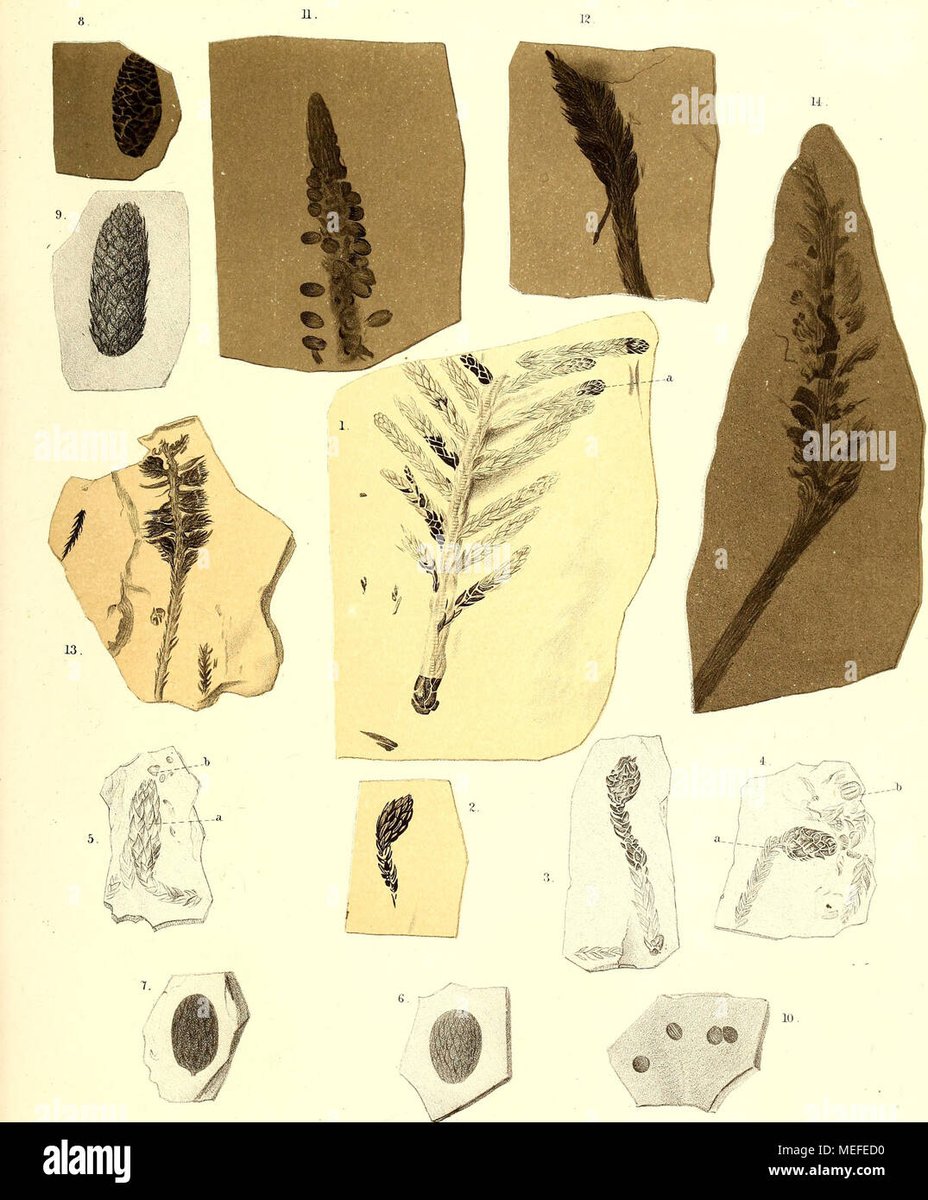
Walchia was a medium to large-sized tree, typically reaching heights of 10 to 30 meters (approximately 33 to 98 feet), comparable to a modern mid-sized pine or spruce. Its overall structure was distinctly coniferous, featuring a single, straight, woody trunk with a monopodial growth pattern, meaning the main trunk grew straight up with smaller branches radiating outwards. The branching was often regular and whorled, creating a symmetrical, conical shape reminiscent of a modern Norfolk Island Pine or a Christmas tree. The leaves, or needles, were small, scale-like, and spirally arranged around the twigs, a key adaptation for water conservation. These needles were typically short, awl-shaped or linear, and closely appressed to the stem, minimizing the surface area exposed to the dry air. This morphology, known as xeromorphic adaptation, was crucial for survival in the drier climates of the Permian. The wood of Walchia, inferred from petrified specimens, was composed of tracheids, characteristic of gymnosperms, and would have provided strong structural support. Reproductive structures consisted of small, simple seed cones (megastrobili) and pollen cones (microstrobili), which were far less complex than the large, woody cones of many modern pines but clearly established the reproductive strategy that would define conifers for hundreds of millions of years.
The paleobiology of Walchia is a story of adaptation and resilience. As a photosynthetic autotroph, it derived energy from sunlight, converting carbon dioxide and water into organic compounds. Its entire physical structure was optimized for life in the drier, more seasonal upland environments that expanded during the Permian. The small, waxy needles were highly effective at reducing water loss through transpiration, a vital trait as the vast, humid swamps of the preceding Carboniferous period receded. This allowed Walchia to colonize and thrive in habitats that were inhospitable to the dominant spore-bearing plants like lycopsids and ferns. Reproduction was achieved via wind pollination. The male cones would release vast quantities of pollen, which would be carried by the wind to the female cones on the same or different trees, a strategy still used by conifers today. This method freed the plant from the reliance on water for fertilization, a major evolutionary leap over the ferns and their allies. Walchia likely grew in dense, monospecific, or mixed-conifer forests, forming extensive woodlands across the continental interiors. Its growth was likely seasonal, possibly showing growth rings in its wood corresponding to wet and dry seasons, much like modern trees in temperate climates. Its life cycle, from seedling to mature, cone-bearing tree, would have established a new kind of forest structure, with a shaded understory and a thick layer of needle litter on the forest floor.
Walchia lived during the Permian period, a time of dramatic global change. The supercontinent of Pangaea had fully assembled, creating vast continental interiors with extreme climates, characterized by hot, dry summers and cold winters. The global climate was trending towards aridity, a stark contrast to the perpetually humid 'greenhouse' world of the Carboniferous. In this new world, Walchia was a dominant primary producer, forming the foundational layer of upland forest ecosystems. These forests provided food and shelter for a diversifying array of terrestrial life. Early synapsids (the lineage leading to mammals), such as the pelycosaurs Dimetrodon and Edaphosaurus, roamed these landscapes, along with various amphibians and early reptiles. Herbivorous tetrapods may have browsed on the lower foliage of Walchia or other plants, while a complex ecosystem of insects, including early relatives of cockroaches and dragonflies, would have inhabited these forests. Walchia's position in the food web was fundamental; it converted solar energy into biomass, supporting the entire terrestrial ecosystem. The decomposition of its needle litter would have contributed to soil formation, further altering the terrestrial landscape. It was a key player in the 'Permian-Carboniferous floral turnover,' an event where the swamp-loving lycopsids and ferns were gradually replaced by seed-bearing plants like conifers and cycads better suited to the new, drier world.
The history of Walchia's discovery is rooted in the early days of paleontology in Europe. The genus was first described in 1825 by the renowned German paleontologist and botanist Kaspar Maria von Sternberg, based on fossils found in the Rotliegend Group of Germany. The name 'Walchia' honors Franz von Walch, a German naturalist. The specific epithet 'piniformis' refers to its pine-like appearance. The Rotliegend, a thick sequence of continental red beds, sandstones, and shales deposited during the Early Permian, proved to be an exceptionally rich source of Walchia fossils. These deposits represent ancient upland basins and river systems where the trees grew in abundance. For over a century, Walchia was primarily known from these European sites, particularly in Germany and the Czech Republic. However, subsequent discoveries in the 20th century revealed its cosmopolitan distribution across Pangaea, with significant fossils being unearthed in North America, notably from the Permian deposits of Texas, New Mexico, and the famous Garnett fossil site in Kansas. These widespread discoveries confirmed that Walchia was not a localized European plant but a dominant component of global flora during the Early Permian. No single 'celebrity' specimen exists, but countless slabs showing entire fronds are displayed in museums worldwide.
Walchia's evolutionary significance cannot be overstated. It belongs to the order Voltziales, an extinct group of conifers that is considered to be the direct ancestral lineage to most, if not all, modern conifer families. It represents a crucial transitional stage between the earliest seed plants (pteridosperms) and the more advanced conifers that would dominate the Mesozoic Era, such as pines, cypresses, and redwoods. The key evolutionary innovation seen in Walchia and its relatives was the refinement of the seed cone. Unlike the simple structures of earlier gymnosperms, the ovule-bearing scales of Voltziales were subtended by a sterile bract, a precursor to the complex cone structure of modern pines. This arrangement provided better protection for the developing seeds. By perfecting wind pollination and developing xeromorphic traits, Walchia and its kin spearheaded the conquest of dry, inland environments by vascular plants, a pivotal moment in Earth's history. They set the stage for the 'Age of Cycads and Conifers' in the Mesozoic, demonstrating a successful evolutionary blueprint that allowed their descendants to survive multiple mass extinctions, including the catastrophic Permian-Triassic extinction event, and persist as a major plant group to the present day.
Despite being a well-known fossil genus, Walchia is still the subject of scientific discussion, primarily concerning its precise taxonomic classification and the diversity within the genus. Historically, 'Walchia' was used as a form genus, a classification category for fossil parts (in this case, foliage) that could not be definitively linked to a whole plant, including its reproductive structures. This led to many different types of Permian conifer foliage being lumped under the name Walchia. More recent paleobotanical research, focusing on specimens where foliage is found attached to stems and associated with cones, has worked to refine this. Some species previously assigned to Walchia have been moved to new genera, such as Utrechia or Otovicia, as their cone structures are better understood. The debate now centers on defining the true characteristics of the genus Walchia sensu stricto (in the strict sense) and untangling its complex relationships within the broader Voltziales order. This ongoing revision is crucial for accurately mapping the early evolutionary radiation of conifers and understanding how different lineages adapted to the changing Permian world.
The fossil record of Walchia is extensive and geographically widespread, making it one of the most common plant fossils of the Early Permian. Fossils are found throughout the Northern Hemisphere in strata that were part of the supercontinent Pangaea's interior. The most famous and prolific sites are in the Rotliegend Group in Germany, but equally important fossils have been recovered from the Dunkard Group in the eastern United States and various Permian formations in the American Southwest, particularly in New Mexico and Texas. The fossils are typically preserved as compression-impression fossils, where the plant material was flattened between layers of fine-grained sediment like shale or siltstone, leaving a carbonaceous film and a detailed imprint of the foliage. This type of preservation beautifully captures the delicate arrangement of the needles and the branching pattern. While complete, upright trees are exceptionally rare, large sections of branches and even entire treetops are commonly found, giving paleontologists a clear picture of the plant's overall structure. The abundance of Walchia fossils makes them an important index fossil for dating Early Permian terrestrial deposits.
Walchia's cultural impact is primarily within educational and museum contexts. As a classic and easily recognizable example of an early conifer, it is frequently featured in museum exhibits on Paleozoic life and the evolution of plants. Its aesthetically pleasing, fern-like or pine-like fronds make for excellent displays that help the public visualize the ancient forests of the Permian. It is a staple in university paleobotany courses and geology textbooks, used to illustrate key evolutionary concepts like the adaptation to arid climates and the rise of the gymnosperms. While it has not achieved the celebrity status of a Tyrannosaurus rex, Walchia holds a significant place as a silent, foundational element of the prehistoric world, representing the vast, ancient forests that were the backdrop for the evolution of terrestrial vertebrates, including our own distant ancestors.
Classification
Time Period
Discovery
Location
Europe (specifically Germany)
Formation
Rotliegend Group
Frequently Asked Questions
What is Walchia?
Walchia piniformis represents one of the earliest and most widespread conifers, a pivotal plant group that came to dominate terrestrial ecosystems following the collapse of the Carboniferous coal swamps. Flourishing during the Permian Period, approximately 300 to 280 million years ago, this ancient ...
When did Walchia live?
Walchia lived during the permian period of the paleozoic era approximately 300-280 million years ago.
Where was Walchia discovered?
Fossils of Walchia were discovered in Europe (specifically Germany) in the Rotliegend Group.
What did Walchia eat?
Walchia was a photosynthetic. It lived in terrestrial habitats.
What type of fossil is Walchia?
Walchia is preserved as a impression fossil. The preservation quality is good.
Related Specimens
From the paleozoic era · impression fossils