Jeholopterus
Jeholopterus ningchengensis
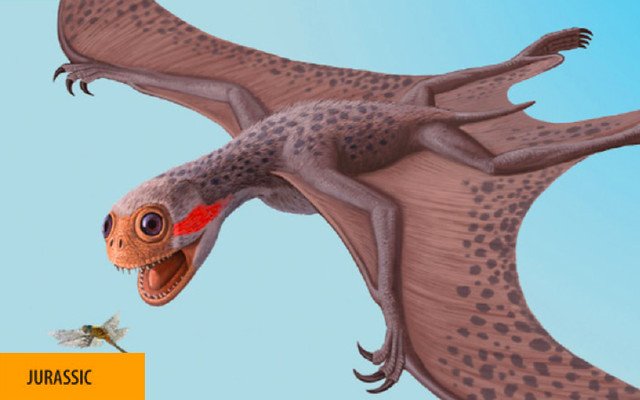
Image: Image sourced via web search (Fair use / Educational)
About Jeholopterus
Jeholopterus ningchengensis is a small, bat-like anurognathid pterosaur that inhabited the lush forests of what is now northeastern China during the Middle to Late Jurassic period, approximately 165 to 155 million years ago. Its discovery within the exceptionally preserved fossil beds of the Tiaojishan Formation has provided paleontologists with an unparalleled window into the anatomy and biology of this unique group of flying reptiles. Jeholopterus is particularly significant for its remarkable soft-tissue preservation, which includes skin impressions, hair-like pycnofibers, and wing membrane details, challenging and refining our understanding of pterosaur appearance, flight, and physiology.
Jeholopterus was a relatively small pterosaur, with an estimated wingspan of around 90 centimeters (approximately 3 feet), comparable to that of a modern crow or a small hawk. Its most striking feature was its distinctly broad and short skull, a hallmark of the Anurognathidae family. The skull measured only about 2.8 centimeters long but was exceptionally wide, giving it a frog-like or owlish appearance. This wide gape was lined with small, sharp, peg-like teeth, perfectly suited for capturing and holding onto insect prey. Unlike many other pterosaurs, Jeholopterus possessed a very short, almost non-existent tail. Its limbs were robust for its size, with long, powerful hind legs and claws that suggest it was an agile climber, capable of clinging to tree bark. The most remarkable aspect of its anatomy comes from the holotype specimen, which preserves extensive soft tissue. These remains show that its body was covered in a dense coat of pycnofibers, akin to fur, which would have provided insulation. The wing membranes, or patagia, were also preserved, revealing a complex structure that extended from the elongated fourth finger to the ankle, indicating broad wings suited for high maneuverability rather than high-speed soaring. The presence of these features paints a picture of a warm-blooded, highly active, and agile aerial predator.
The unique anatomy of Jeholopterus provides strong clues about its paleobiology and lifestyle. The wide, toothy gape strongly suggests an insectivorous diet. It likely hunted in a crepuscular or nocturnal manner, similar to modern bats and nightjars, using its large eyes, which are inferred from its wide orbits, to spot prey in low-light conditions. Its hunting strategy probably involved short, agile flights through cluttered forest environments, snatching insects like moths, beetles, and dragonflies directly from the air. The broad wings would have allowed for tight turns and rapid changes in direction, essential for pursuing erratic prey through dense vegetation. When not flying, Jeholopterus was likely arboreal. Its strong, clawed hindlimbs and flexible joints would have made it an adept climber, allowing it to scurry up tree trunks and along branches with ease, much like a modern squirrel or gecko. This climbing ability would have been crucial for roosting, evading terrestrial predators, and launching into flight. The dense covering of pycnofibers is clear evidence for endothermy, or warm-bloodedness, indicating a high metabolism necessary to power active flight and maintain a constant body temperature. There is no direct evidence for social behavior, but it is plausible that they may have roosted in groups for warmth and protection, a common behavior in many modern small, nocturnal animals.
Jeholopterus lived within the Yanliao Biota, a rich and diverse ecosystem preserved in the Tiaojishan Formation. During the Middle to Late Jurassic, this region of northeastern China was a warm, humid, and seasonal environment dominated by lush forests of conifers, cycads, ginkgoes, and ferns, interspersed with numerous lakes and rivers. This environment supported an incredible diversity of life. Jeholopterus shared its aerial space with other pterosaurs, including the larger, filter-feeding Pterodactylus and the long-tailed rhamphorhynchoids like Wukongopterus. The forest floor was home to a variety of small, feathered dinosaurs, such as the scansoriopterygids Epidexipteryx and Yi qi, and the troodontid Anchiornis. Early mammals like Juramaia and Castorocauda scurried through the undergrowth. As a mid-level predator in the food web, Jeholopterus would have played a crucial role in controlling insect populations. It, in turn, would have been prey for larger theropod dinosaurs that roamed the area. The exceptional preservation of this biota provides a detailed snapshot of a complex terrestrial ecosystem, showing intricate interactions between early birds, non-avian dinosaurs, pterosaurs, and mammals, all thriving together in a dynamic Jurassic world.
The discovery of Jeholopterus is a modern paleontological success story, rooted in the rich fossil deposits of Inner Mongolia, China. The holotype and only known specimen, cataloged as IVPP V 12705, was unearthed from the Daohugou Beds of the Tiaojishan Formation near Ningcheng County. This specimen was found by local farmers and later acquired by the Institute of Vertebrate Paleontology and Paleoanthropology (IVPP) in Beijing. A team of prominent Chinese paleontologists, including Wang Xiaolin, Zhou Zhonghe, and Xu Xing, along with their colleague Fabio Marco Dalla Vecchia, undertook the formal study of this remarkable find. They published their description in 2002, naming the new genus and species Jeholopterus ningchengensis. The genus name combines 'Jehol', referring to the Jehol Biota with which the Yanliao Biota is closely associated, and the Greek 'pteron', meaning 'wing'. The species name, 'ningchengensis', honors Ningcheng County, the locality of its discovery. The specimen itself is a nearly complete, articulated skeleton compressed onto a single slab, and its state of preservation, which includes carbonized remains of skin and pycnofibers, is so extraordinary that it has become a key reference for understanding pterosaur soft-tissue anatomy.
Jeholopterus holds immense evolutionary significance as a member of the Anurognathidae, a peculiar and highly specialized family of pterosaurs. This group is positioned as a relatively early-branching lineage within the larger pterosaur family tree, diverging before the major split between the long-tailed 'rhamphorhynchoids' and the short-tailed pterodactyloids. Anurognathids represent a distinct evolutionary experiment in pterosaur design, adapting for a niche of agile, slow-flying insectivory in cluttered environments, convergent with modern bats. The exceptional soft-tissue preservation in Jeholopterus provided some of the first definitive, widespread evidence of a dense, fur-like pycnofiber covering in pterosaurs, cementing the hypothesis that these animals were endothermic and insulated. This discovery helped shift the popular and scientific perception of pterosaurs from scaly, reptilian gliders to dynamic, fuzzy, and highly active flying creatures. Furthermore, the detailed wing membrane impressions confirmed that the main wing, or brachiopatagium, attached to the ankle, a feature long debated among paleontologists. This anatomical configuration created a very broad wing, supporting the idea that anurognathids were highly maneuverable flyers, capable of complex aerobatics rather than just simple gliding.
Despite the completeness of the holotype, Jeholopterus has not been without scientific debate, primarily centered on its diet and feeding behavior. While the insectivore hypothesis is widely accepted, a more controversial proposal was put forward by paleontologist David Peters. Through a digital analysis technique, Peters suggested that Jeholopterus was a hematophage, or vampire, that fed on the blood of large dinosaurs, using its sharp teeth to pierce their hides. This hypothesis, however, has been met with significant skepticism from the broader paleontological community, which points out that its dental morphology is inconsistent with that of modern blood-feeding animals and is far more similar to that of insectivorous bats and birds. Another area of discussion revolves around the exact flight capabilities and terrestrial locomotion of anurognathids. While their agility is accepted, the specifics of their wing kinematics and whether they were capable of a quadrupedal launch or a bipedal hop remain topics of active research and biomechanical modeling, with Jeholopterus serving as a key data point in these investigations.
The fossil record of Jeholopterus is currently limited to a single, extraordinary specimen. The holotype, IVPP V 12705, was discovered in the Daohugou Beds of the Tiaojishan Formation in Ningcheng County, Inner Mongolia, China. This geological formation is world-renowned for its lagerstätte-quality preservation, where fine-grained volcanic ash rapidly buried organisms in an anoxic lacustrine (lake) environment, leading to the fossilization of not just bones but also delicate soft tissues. This type of preservation is known as 'Konservat-Lagerstätte'. While only one Jeholopterus specimen is known, other anurognathids have been found in similar deposits in China, as well as in the Solnhofen Limestone of Germany, such as Anurognathus itself. The rarity of anurognathid fossils may be due to their small size, delicate skeletons, and potentially upland forest habitats, which are environments less conducive to fossilization than coastal or floodplain settings. The Daohugou site, therefore, provides a rare and invaluable glimpse into this otherwise poorly represented but fascinating group of pterosaurs.
Although a specialized and relatively obscure genus, Jeholopterus has made a notable cultural impact, primarily within paleontological circles and among enthusiasts of prehistoric life. Its 'bat-like' or 'gremlin-like' appearance, with its wide head and fuzzy body, makes it a memorable and distinct creature that often appears in paleoart, books, and online resources dedicated to pterosaurs. The holotype specimen is a prized possession of the Institute of Vertebrate Paleontology and Paleoanthropology in Beijing and is a testament to the remarkable fossil discoveries emerging from China. While it has not achieved the blockbuster fame of Tyrannosaurus or Triceratops, Jeholopterus serves an important educational role, beautifully illustrating the diversity of pterosaur forms and providing concrete evidence for their fuzzy, warm-blooded nature, helping to create a more accurate and dynamic public perception of these ancient rulers of the sky.
Classification
Time Period
Discovery
Location
China/Inner Mongolia
Formation
Tiaojishan Formation
Frequently Asked Questions
What is Jeholopterus?
Jeholopterus ningchengensis is a small, bat-like anurognathid pterosaur that inhabited the lush forests of what is now northeastern China during the Middle to Late Jurassic period, approximately 165 to 155 million years ago. Its discovery within the exceptionally preserved fossil beds of the Tiaojis...
When did Jeholopterus live?
Jeholopterus lived during the jurassic period of the mesozoic era approximately 165-155 million years ago.
Where was Jeholopterus discovered?
Fossils of Jeholopterus were discovered in China/Inner Mongolia in the Tiaojishan Formation.
What did Jeholopterus eat?
Jeholopterus was a insectivore. It lived in terrestrial, arboreal, aerial habitats.
What type of fossil is Jeholopterus?
Jeholopterus is preserved as a body fossil. The preservation quality is exceptional.
Related Specimens
From the mesozoic era · body fossils