Morganucodon
Morganucodon watsoni
Image: Image sourced via web search (Fair use / Educational)
About Morganucodon
Morganucodon was a small, shrew-like animal that lived during the Late Triassic to Early Jurassic periods, approximately 205 to 195 million years ago. As one of the earliest and most well-understood mammaliaforms, it holds a pivotal position in the evolutionary transition from cynodont synapsids to true mammals. Its fossils provide critical insights into the origins of key mammalian traits, including specialized teeth, a large brain, and potentially endothermy.
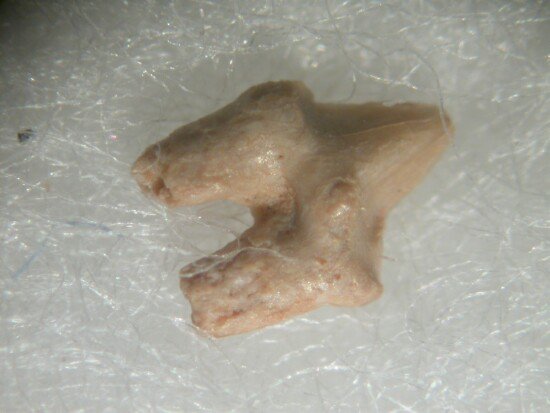
Morganucodon was a diminutive creature, with an estimated body length of about 10 to 15 centimeters, not including its long tail, and a body mass estimated to be between 20 and 40 grams. This places it in the size range of a modern house mouse or a small shrew, making it one of the smallest vertebrates in its ecosystem. Its skull was elongated, measuring only 2 to 3 centimeters in length, and possessed a relatively large braincase compared to its cynodont ancestors, indicating a significant step in encephalization. The most defining characteristic of Morganucodon was its dentition. It possessed diphyodonty, the mammalian trait of having two successive sets of teeth (deciduous and permanent), a significant departure from the continuous tooth replacement (polyphyodonty) seen in reptiles. Its teeth were highly specialized, with incisors, canines, premolars, and molars, demonstrating heterodonty. The molars featured a precise occlusion, with the cusps of the upper and lower teeth fitting together to effectively shear and crush insect exoskeletons. This dental precision is a hallmark of early mammals. The postcranial skeleton, though less completely known, suggests a sprawling or semi-sprawling posture, more akin to its cynodont relatives than the fully erect posture of most modern mammals. Inferred soft tissues, based on its large eye sockets and brain structure, suggest it had good vision and a well-developed sense of smell and hearing, crucial for a nocturnal lifestyle.
The paleobiology of Morganucodon is inferred primarily from its advanced, mammal-like skeletal features. Its specialized, occluding molars are clear evidence of an insectivorous diet, perfectly adapted for processing the tough chitinous exoskeletons of insects and other small arthropods. It may have also consumed other small prey like worms or tiny vertebrates. Analysis of tooth microwear patterns supports this interpretation, showing pits and scratches consistent with a diet of hard-shelled invertebrates. Its large eye sockets and the structure of its brain, particularly the enlarged olfactory and auditory regions, strongly suggest it was a nocturnal or crepuscular animal. This lifestyle would have allowed it to avoid predation from the larger, diurnally active dinosaurs and other archosaurs that dominated the Triassic landscape. Locomotion was likely a scuttling gait, similar to that of modern shrews or lizards, rather than the more efficient bounding of many modern small mammals. Growth studies based on bone histology indicate that Morganucodon grew relatively rapidly to its adult size, a characteristic more aligned with endothermic (warm-blooded) mammals than with ectothermic reptiles. This, combined with its likely active, nocturnal lifestyle, supports the hypothesis that it was endothermic, maintaining a constant internal body temperature, which would have been a significant metabolic innovation.
Morganucodon lived in a world recovering from the end-Triassic extinction event, a period of significant environmental upheaval. The climate during the Late Triassic and Early Jurassic was generally warm and arid, though its habitat in what is now Europe was likely a series of coastal plains and islands with more seasonal, monsoonal rainfall. The landscape was dominated by conifers, cycads, and ferns. Morganucodon shared this environment with a diverse array of fauna. The dominant terrestrial vertebrates were archosaurs, including early dinosaurs like the theropod Coelophysis, large predatory rauisuchians, and herbivorous aetosaurs. In this ecosystem, Morganucodon occupied a small, nocturnal, insectivorous niche, a strategy that likely enabled its survival and success in a world ruled by giants. It would have been prey for a variety of predators, including small theropod dinosaurs, sphenosuchian crocodylomorphs, and potentially even larger predatory cynodonts. Its position in the food web was that of a secondary consumer, feeding on abundant insects and other invertebrates, and in turn, providing a food source for larger carnivores. This ecological role, thriving in the shadows of the dinosaurs, set the stage for the next 150 million years of mammalian evolution.
The discovery history of Morganucodon is rooted in the fossil-rich quarries of Wales. The first fossils, primarily isolated teeth, were found in 1949 by Walter Georg Kühne in a fissure filling at a quarry in Pant-y-ffynnon, South Wales. Kühne recognized their significance as representing a very early mammal-like animal. The genus was officially named Morganucodon, meaning "Glamorgan tooth" (from the Welsh county of Morgannwg), by Kühne in 1949. However, a more complete specimen had been found earlier in the 1940s by F.R. Parrington from Cambridge University, but its importance was not fully realized until after Kühne's work. The species name, *Morganucodon watsoni*, honors the influential paleontologist D.M.S. Watson. Subsequent excavations in the 1950s and 1960s, led by researchers like Kenneth Kermack and Frances Mussett of University College London, unearthed thousands of specimens from the Welsh fissure fills. These finds included not just teeth but also disarticulated but well-preserved skulls and postcranial bones, making Morganucodon one of the most completely known early mammaliaforms. The sheer abundance and quality of these specimens have allowed for detailed anatomical and functional studies that are impossible for most of its contemporaries, cementing its status as a key reference taxon in vertebrate paleontology.
Morganucodon's evolutionary significance cannot be overstated; it represents a crucial node in the transition from non-mammalian synapsids (specifically, advanced cynodonts) to crown-group Mammalia. It is a quintessential example of a transitional fossil, showcasing a mosaic of ancestral reptilian traits and derived mammalian characteristics. While it possessed a reptilian-like jaw joint (the articular-quadrate joint) alongside the newly evolved mammalian one (the dentary-squamosal joint), its specialized diphyodont dentition, enlarged brain, and evidence for endothermy are all hallmarks of the mammalian lineage. This dual jaw articulation is a classic transitional feature, capturing the precise moment in evolutionary history when the bones of the old jaw joint were being repurposed to form the middle ear ossicles in true mammals. Morganucodon and its relatives in the order Morganucodonta are placed within the broader clade Mammaliaformes, which includes crown-group mammals and their closest extinct relatives. It demonstrates that many key mammalian traits evolved incrementally long before the appearance of the last common ancestor of modern monotremes, marsupials, and placentals. It provides a tangible blueprint of what the very first mammal-like animals were like, confirming evolutionary predictions and illuminating one of the most important macroevolutionary transitions in the history of life.
Despite being extensively studied, Morganucodon is still at the center of scientific debates, primarily concerning its precise phylogenetic position. The key controversy is whether it falls inside or just outside of Mammalia (the crown group). Some paleontologists, using a definition of Mammalia based on the presence of the dentary-squamosal jaw joint, classify Morganucodon as one of the earliest mammals. Others, however, prefer a more restrictive definition based on the last common ancestor of all living mammals. Under this definition, Morganucodon is a mammaliaform but not a true mammal, sitting just outside the crown group. This debate is largely semantic but highlights the difficulty of drawing sharp lines in a continuous evolutionary sequence. Another area of ongoing research involves its metabolism. While endothermy is widely inferred, the degree to which it could regulate its body temperature and its precise metabolic rate compared to modern mammals are still subjects of investigation and refinement through techniques like isotopic analysis and bone histology. New discoveries of related mammaliaforms from around the world continue to reshape our understanding of the group's diversity and early radiation.
The fossil record of Morganucodon is exceptionally rich, though geographically concentrated. The vast majority of specimens, numbering in the thousands, have been recovered from Late Triassic and Early Jurassic fissure fills in South Wales, United Kingdom, particularly from sites like Pant-y-ffynnon and Duchy Quarry. These fissures acted as natural traps, accumulating and preserving the disarticulated remains of countless small animals over millennia. The preservation quality is generally good, with bones often being uncompressed and three-dimensional, although they are almost always found as isolated elements rather than articulated skeletons. Skulls, jaws, and especially the highly durable, multi-cusped molar teeth are the most commonly found parts. Beyond the UK, fossils assigned to the genus Morganucodon or very closely related species have been found in China (the Lufeng Formation), North America, and parts of Europe, indicating that this group had a widespread, almost global distribution during the earliest part of the Mesozoic Era. This extensive fossil record has made Morganucodon a model organism for studying the anatomy and evolution of the earliest mammals.
In terms of cultural impact, Morganucodon is not a household name like Tyrannosaurus or Triceratops, but it holds a place of high regard within the scientific and educational communities. It is frequently featured in university-level paleontology textbooks and scientific documentaries about the evolution of mammals as a prime example of a transitional form. Its small, unassuming appearance belies its immense evolutionary importance, often used to illustrate the theme of mammals starting as small, nocturnal creatures living in the shadow of the dinosaurs. Major natural history museums, such as the Natural History Museum in London, hold significant collections of its fossils and may feature it in exhibits detailing the origin of mammals. Its story is a powerful educational tool for explaining how major evolutionary transitions occur and how scientists use fossil evidence to piece together the tree of life.
Classification
Time Period
Discovery
Location
Wales, United Kingdom
Formation
Rhaetian bone beds (e.g., Pant-y-ffynnon Quarry)
Frequently Asked Questions
What is Morganucodon?
Morganucodon was a small, shrew-like animal that lived during the Late Triassic to Early Jurassic periods, approximately 205 to 195 million years ago. As one of the earliest and most well-understood mammaliaforms, it holds a pivotal position in the evolutionary transition from cynodont synapsids to ...
When did Morganucodon live?
Morganucodon lived during the triassic period of the mesozoic era approximately 205-195 million years ago.
Where was Morganucodon discovered?
Fossils of Morganucodon were discovered in Wales, United Kingdom in the Rhaetian bone beds (e.g., Pant-y-ffynnon Quarry).
What did Morganucodon eat?
Morganucodon was a insectivore/carnivore. It lived in terrestrial habitats.
What type of fossil is Morganucodon?
Morganucodon is preserved as a body fossil. The preservation quality is good.
Related Specimens
From the mesozoic era · body fossils