Iguanodon
Iguanodon bernissartensis
Image: File:Iguanodon bernissartensis.jpg - Wikimedia Commons (CC BY-SA)
About Iguanodon
Iguanodon bernissartensis, whose genus name translates to iguana-tooth, stands as one of the most historically and scientifically significant dinosaurs in the annals of paleontology, representing a large, herbivorous ornithopod that thrived during the Early Cretaceous period between 130 and 122 million years ago. As the second dinosaur ever formally named by science, its initial discovery in the early nineteenth century helped launch the entire scientific discipline of dinosaur paleontology and fundamentally shaped humanity's understanding of deep time. Primarily inhabiting the terrestrial floodplains and coastal environments of what is now Western Europe, particularly the fossil-rich deposits of Belgium and the United Kingdom, this magnificent creature has provided generations of scientists with an unparalleled window into the anatomy, ecology, and evolution of Mesozoic life.
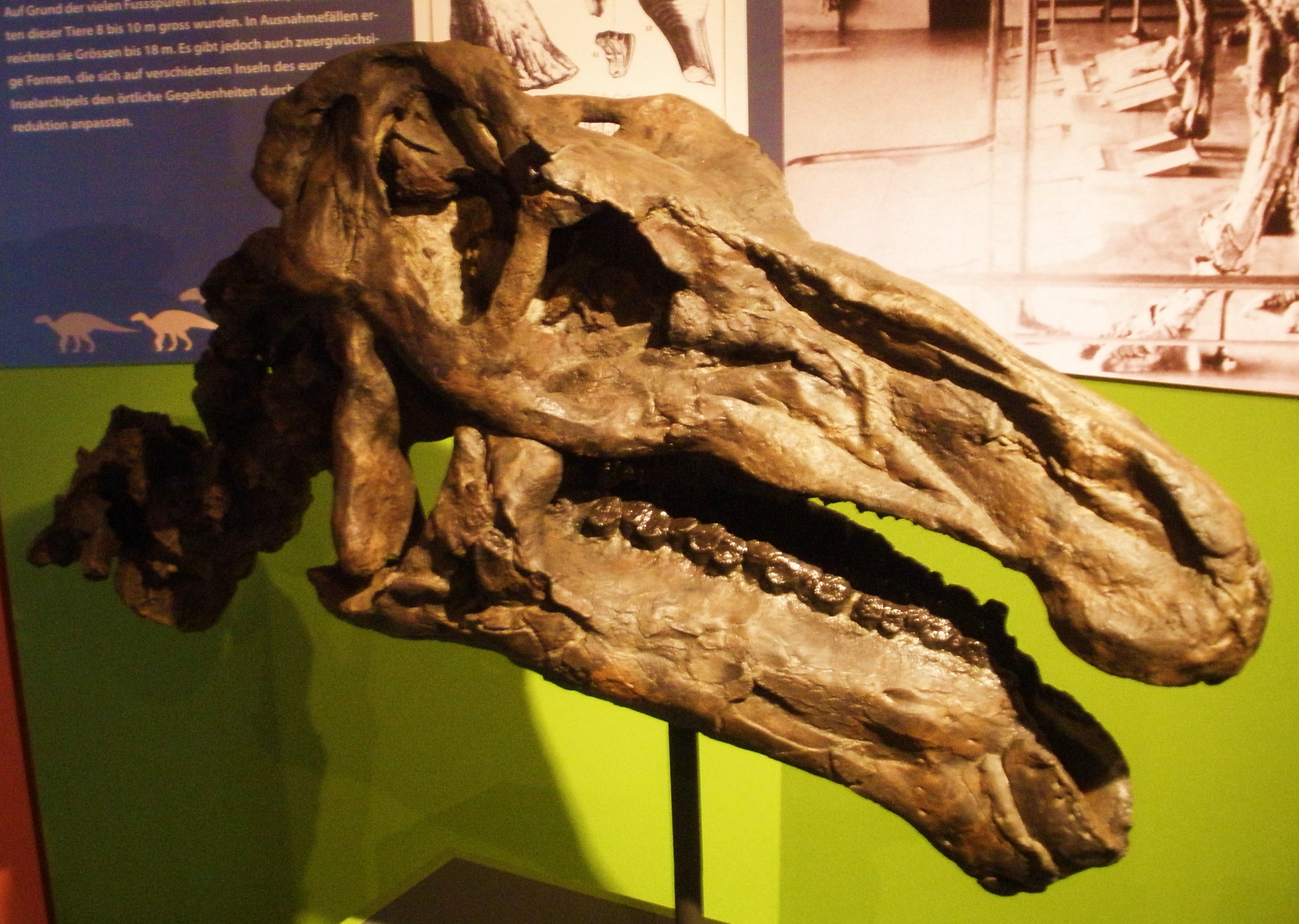
In terms of physical description, Iguanodon bernissartensis was a remarkably robust and imposing animal, reaching lengths of up to 1000 centimeters, or roughly 33 feet, and weighing an estimated three to four metric tons. Its skeletal architecture reveals a creature built for both power and specialized foraging, characterized by a large, heavy, and somewhat horse-like skull that ended in a broad, toothless, keratinous beak perfectly adapted for cropping tough vegetation. Behind this beak, the jaws were lined with tightly packed batteries of leaf-shaped cheek teeth, which bore a striking, albeit much larger, resemblance to the teeth of modern iguanas. The postcranial skeleton of Iguanodon was equally distinctive, featuring a massive, stiffened tail supported by a lattice of ossified tendons that acted as a dynamic counterbalance to the heavy torso. Perhaps the most iconic feature of Iguanodon was its highly specialized forelimbs, which were stout, heavily muscled, and terminated in complex, five-fingered hands. The three central fingers were thick, robust, and ended in blunt, hoof-like claws, clearly adapted for bearing the animal's immense weight when walking on all fours. The fifth digit, or pinky, was elongated and highly flexible, functioning as a prehensile tool that could wrap around branches and strip leaves. Most famously, the first digit was modified into a massive, conical thumb spike. Originally misinterpreted by early paleontologists as a rhinoceros-like nose horn, this formidable, bone-crushing spike was fused to the wrist and likely served as a devastating defensive weapon against predators, or perhaps as a tool for intraspecific combat and breaking open tough seeds or wood.
The paleobiology of Iguanodon reveals a highly successful and adaptable herbivore with sophisticated feeding strategies and complex biomechanics. Its diet consisted entirely of Early Cretaceous flora, such as cycads, conifers, ferns, and horsetails, which it processed using a specialized cranial mechanism known as pleurokinesis. This evolutionary innovation allowed the upper jaw bones to flex outward slightly when the mouth closed, causing the upper and lower teeth to grind against each other in a highly efficient, shearing motion that pulverized tough plant fibers before swallowing. Locomotion in Iguanodon was a subject of intense study, and modern biomechanical analyses indicate that it was a facultative biped. While juveniles and subadults likely spent more time on their hind legs to run and forage, fully grown adults of Iguanodon bernissartensis were primarily quadrupedal, using their robust forelimbs to support their massive bulk while slowly grazing, but retaining the ability to rear up on their powerful hind legs to reach higher foliage or to flee from danger. The discovery of multiple individuals of varying ages buried together strongly suggests that Iguanodon was a gregarious animal that lived in herds. This social behavior would have provided significant advantages, including shared vigilance against predators, increased foraging efficiency, and structured reproductive patterns. Bone histology studies examining the growth rings in their fossilized limbs indicate that Iguanodon grew rapidly during its early years, reaching sexual maturity and adult size relatively quickly to minimize the window of vulnerability to the large theropod predators of its ecosystem.
The ecological context of Iguanodon places it in the lush, subtropical environments of Early Cretaceous Europe, specifically within the ecosystems preserved in the Sainte-Barbe Clays Formation of Belgium and the Wealden Group of the United Kingdom. During the Barremian and early Aptian ages, this region was a dynamic landscape of meandering river systems, expansive floodplains, and coastal swamps, characterized by distinct wet and dry seasons. The flora was dominated by dense stands of conifers, understories of ferns, and early angiosperms, providing an abundant, albeit fibrous, food source. Iguanodon occupied a crucial position in this food web as a primary consumer and a megaherbivore, likely shaping the landscape through its intensive browsing, much like modern elephants do today. It shared its habitat with a diverse array of other dinosaurs, including smaller, more agile ornithopods like Hypsilophodon, the heavily armored nodosaurid Polacanthus, and closely related but more gracile iguanodontians such as Mantellisaurus. The primary threats to Iguanodon came from the apex predators of the time, most notably the large spinosaurid Baryonyx, which, despite its piscivorous adaptations, is known to have scavenged or hunted juvenile iguanodontians, and the formidable allosauroid Neovenator. Against such predators, the sheer size, herd behavior, and lethal thumb spikes of an adult Iguanodon bernissartensis would have provided a formidable defense.
The discovery history of Iguanodon is inextricably linked to the very foundation of dinosaur paleontology. The story began in 1822 in Sussex, England, when Mary Ann Mantell and her husband, the physician and amateur paleontologist Gideon Mantell, discovered large, fossilized teeth embedded in the local sandstone. Recognizing the teeth's resemblance to those of modern iguanas, albeit vastly larger, Gideon Mantell formally named the creature Iguanodon in 1825. In 1842, the anatomist Richard Owen used Iguanodon, along with Megalosaurus and Hylaeosaurus, to define a brand-new taxonomic group: the Dinosauria. Early reconstructions, such as the famous concrete sculptures created by Benjamin Waterhouse Hawkins for the Crystal Palace exhibition in 1854, depicted Iguanodon as a sprawling, rhinoceros-like quadruped with the thumb spike erroneously placed on its snout. This fundamental misconception was spectacularly corrected in 1878, when coal miners in Bernissart, Belgium, stumbled upon a massive bonebed situated 322 meters underground in the Sainte-Barbe Clays Formation. This unprecedented discovery yielded the articulated remains of over thirty individual Iguanodon skeletons. The Belgian paleontologist Louis Dollo was tasked with excavating, studying, and mounting these magnificent specimens. Dollo's meticulous work revealed the true nature of the animal's anatomy, correctly placing the spike on the thumb and reconstructing the dinosaur in a bipedal, kangaroo-like posture. Although the posture was later revised, the Bernissart discovery remains one of the most important events in the history of vertebrate paleontology, providing the first complete look at a dinosaur and cementing Iguanodon's status as a scientific icon.
The evolutionary significance of Iguanodon cannot be overstated, as it occupies a pivotal transitional position within the ornithischian family tree. Classified within the clade Iguanodontia, a subgroup of the broader Ornithopoda, Iguanodon represents a crucial evolutionary bridge between the small, fast-running, bipedal herbivores of the Jurassic period and the highly derived, incredibly successful hadrosaurids, or duck-billed dinosaurs, that dominated the Late Cretaceous ecosystems of North America and Asia. The anatomical innovations seen in Iguanodon, particularly the development of the pleurokinetic skull hinge and the complex, multi-functional hand, set the stage for the massive evolutionary radiation of the hadrosaurs. By studying Iguanodon, paleontologists can trace the gradual acquisition of these specialized traits. For instance, the transition from the simple, single-rowed teeth of early ornithopods to the complex, hundreds-strong dental batteries of the duck-billed dinosaurs is perfectly foreshadowed by the tightly packed, self-sharpening cheek teeth of Iguanodon. Furthermore, the shift from obligate bipedalism to the facultative quadrupedalism seen in Iguanodon demonstrates an evolutionary trend toward larger body sizes and more efficient low-level browsing, strategies that would come to define the later megaherbivores of the Cretaceous world.
Despite its long history of study, Iguanodon has been the subject of numerous scientific debates and taxonomic revisions. For over a century, the genus Iguanodon functioned as a taxonomic wastebasket, a convenient label applied to almost any large, Early Cretaceous ornithopod fossil found anywhere in the world, from Asia to North America. This resulted in dozens of species being assigned to the genus, creating a confusing and scientifically inaccurate picture of its diversity. In the late twentieth and early twenty-first centuries, rigorous taxonomic revisions led by paleontologists such as David Norman and Paul Barrett systematically dismantled this wastebasket. Through careful anatomical comparisons, they demonstrated that many of these fossils actually represented distinct, separate genera. Consequently, former Iguanodon species were reclassified into new genera, such as Mantellisaurus, Barilium, Hypselospinus, and Dakotadon. Today, Iguanodon bernissartensis is recognized as the only universally accepted species within the genus, with Iguanodon galvensis from Spain considered a possible second species. Another major historical debate centered on the animal's posture. While Louis Dollo's upright, tail-dragging kangaroo pose dominated museum displays for nearly a century, biomechanical studies in the 1980s proved that the rigid, ossified tendons in the tail would have snapped if the animal stood completely upright. Modern science now universally recognizes that Iguanodon held its spine horizontally, parallel to the ground, whether walking on two legs or four.
The fossil record of Iguanodon is exceptionally rich, though heavily concentrated in specific geographic regions. The vast majority of definitively identified Iguanodon bernissartensis material originates from the Early Cretaceous deposits of Western Europe. The most famous and prolific site remains the Bernissart coal mine in Belgium, which yielded over thirty complete or nearly complete articulated skeletons. The preservation quality at Bernissart was extraordinary, capturing the animals in death poses that provided invaluable data on their osteology and joint articulation. However, the Bernissart fossils were heavily permeated with pyrite, commonly known as fool's gold. When exposed to the humidity of the air, the pyrite began to oxidize and expand, a process known as pyrite disease, which threatened to shatter the priceless bones. It required decades of pioneering chemical conservation techniques by the Royal Belgian Institute of Natural Sciences to stabilize and save the skeletons. Beyond Belgium, isolated bones, teeth, and trackways attributed to Iguanodon or closely related iguanodontians are frequently found in the Wealden deposits of the Isle of Wight and Sussex in the United Kingdom, as well as in contemporaneous formations in Spain and Germany. These trackways, featuring distinctive three-toed footprints, provide crucial ichnological evidence supporting the theory that these animals moved in herds and were capable of both bipedal and quadrupedal locomotion.
The cultural impact of Iguanodon is profound and enduring, deeply intertwined with the public's fascination with dinosaurs. From the moment the Crystal Palace dinosaur sculptures were unveiled in 1854, Iguanodon captured the Victorian imagination and helped spark a global dinosaur craze that continues to this day. The spectacular mounted skeletons at the Royal Belgian Institute of Natural Sciences in Brussels remain one of the most important and awe-inspiring paleontological exhibits in the world, drawing countless visitors and serving as a monument to scientific discovery. In popular culture, Iguanodon has been featured prominently in literature and film, perhaps most notably serving as the inspiration for the creatures in Arthur Conan Doyle's classic novel The Lost World, and starring as the protagonist species in Disney's animated film Dinosaur. Educationally, Iguanodon serves as a classic textbook example of how the scientific method works, illustrating how new fossil discoveries and advanced biomechanical analyses can correct past mistakes and refine our understanding of the natural world. Its journey from a mysterious tooth found in a Sussex quarry to a fully understood, dynamic living animal represents the very essence of paleontological progress.
Classification
Time Period
Discovery
Location
Bernissart, Belgium
Formation
Sainte-Barbe Clays Formation
Frequently Asked Questions
What is Iguanodon?
Iguanodon bernissartensis, whose genus name translates to iguana-tooth, stands as one of the most historically and scientifically significant dinosaurs in the annals of paleontology, representing a large, herbivorous ornithopod that thrived during the Early Cretaceous period between 130 and 122 mill...
When did Iguanodon live?
Iguanodon lived during the cretaceous period of the mesozoic era approximately 130-122 million years ago.
Where was Iguanodon discovered?
Fossils of Iguanodon were discovered in Bernissart, Belgium in the Sainte-Barbe Clays Formation.
What did Iguanodon eat?
Iguanodon was a herbivore. It lived in terrestrial habitats.
What type of fossil is Iguanodon?
Iguanodon is preserved as a body fossil. The preservation quality is excellent.
Related Specimens
From the mesozoic era · body fossils