Oviraptor
Oviraptor philoceratops
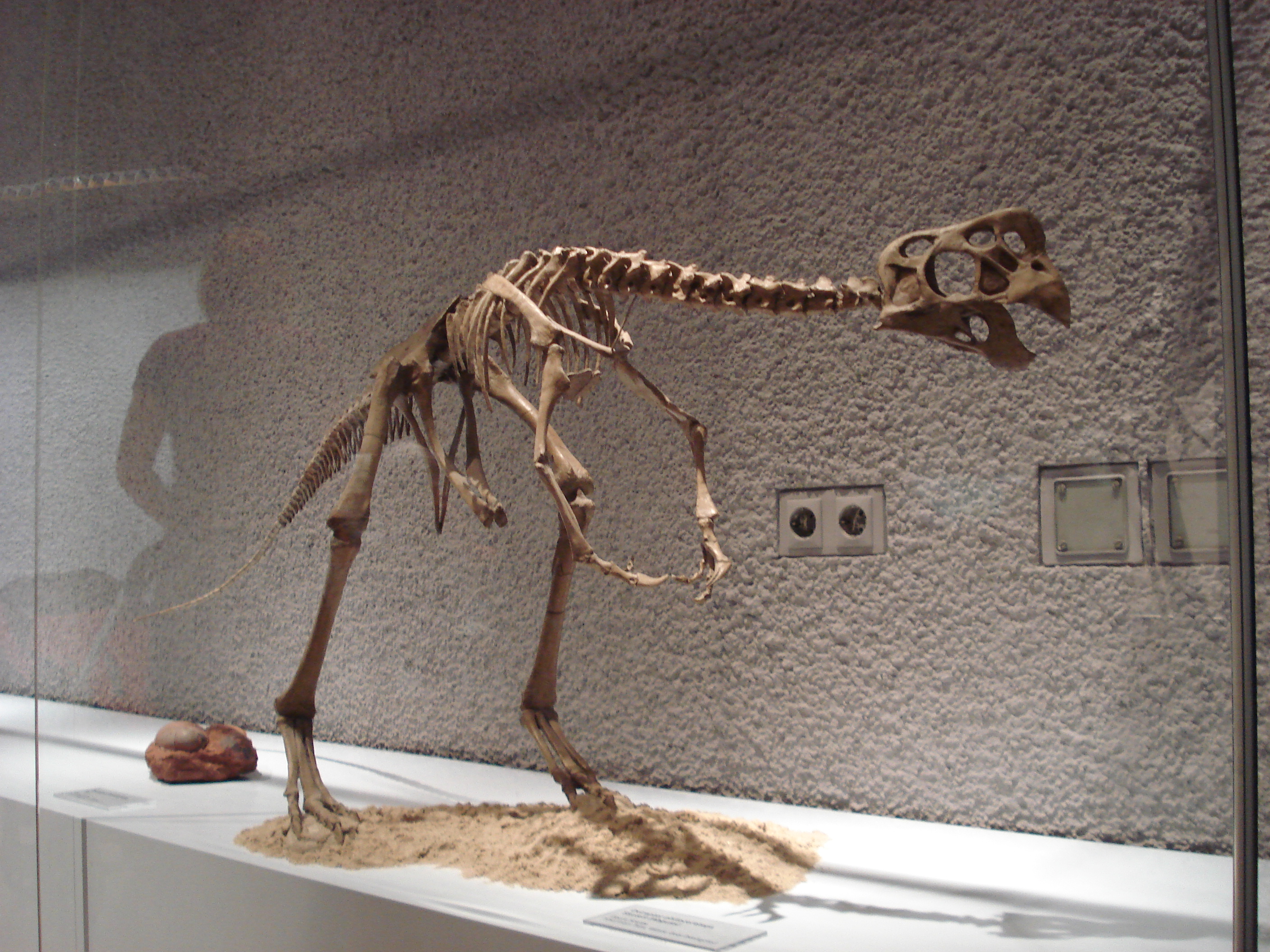
Image: File:Oviraptor philoceratops.JPG - Wikimedia Commons (CC BY-SA)
About Oviraptor
Oviraptor philoceratops is a small, bird-like theropod dinosaur that inhabited the arid landscapes of what is now Mongolia approximately 75 million years ago during the Campanian stage of the Late Cretaceous period. Its name, a famous misnomer meaning 'egg thief, fond of ceratopsians,' belies its true nature as a dedicated parent, a revelation that has profoundly reshaped our understanding of dinosaur behavior and strengthened the evolutionary link to modern birds. This remarkable dinosaur serves as a classic case study in paleontological revision, transforming from a perceived villain into a symbol of avian-like parental care.
The physical appearance of Oviraptor philoceratops was strikingly avian, a testament to its close relationship with birds. It was a relatively small dinosaur, measuring approximately 1.8 meters (about 6 feet) in length from its beak to the tip of its tail, and likely weighing between 25 to 35 kilograms (55 to 77 pounds). Its skeleton was lightly built and pneumatized, with hollow spaces in the bones similar to those of modern birds, which would have reduced its overall weight. The most distinctive feature of Oviraptor was its skull. It possessed a short, deep, and powerfully built head topped with a prominent, yet poorly preserved, crest of nasal bone. Unlike most theropods, its jaws were completely toothless, forming a robust, parrot-like beak. The lower jaw had a pair of bony prongs that projected downwards from the palate, which may have been used to crush hard-shelled food items. Its large eye sockets suggest it had keen eyesight, a crucial adaptation for a visually oriented animal. The body was likely covered in a full coat of feathers, ranging from simple downy filaments for insulation to more complex pennaceous feathers on its arms and tail, forming wing-like structures and a tail fan, though their exact configuration remains speculative for this specific genus. Its long, slender legs ended in three-toed feet with sharp claws, indicating it was a nimble and agile runner.
The paleobiology of Oviraptor reveals an adaptable and complex animal. Its powerful, toothless beak was a versatile tool, suggesting an omnivorous diet. The initial hypothesis of egg-eating, while plausible, is now seen as only one component of a much broader feeding strategy. The beak's crushing power would have been effective against the hard shells of mollusks, such as clams found in the freshwater environments of the Djadochta Formation, as well as tough-shelled seeds and nuts. It may also have consumed small vertebrates like lizards, early mammals, and even the young of other dinosaurs. This dietary flexibility would have been a significant advantage in its harsh, semi-arid environment where food sources could be seasonally scarce. In terms of locomotion, Oviraptor was a bipedal cursorial animal, built for running. Its long legs and balanced body, counterweighted by its tail, would have allowed it to move swiftly across the sandy plains, both to pursue prey and to evade larger predators like Velociraptor and Tarbosaurus. The most profound insight into its behavior comes from the evidence of brooding. Fossils of related oviraptorids, such as Citipati, show individuals in a bird-like posture over their nests, with their arms spread out to protect the eggs. This posture strongly implies that Oviraptor engaged in active parental care, incubating its eggs to regulate their temperature and protecting them from predators and the elements, a complex behavior once thought to be exclusive to birds and mammals.
Oviraptor philoceratops lived within the unique ecological context of the Djadochta Formation, a region characterized by a semi-arid to desert-like climate with vast sand dunes, intermittent streams, and oases. This environment, often compared to the modern Gobi Desert, supported a diverse but specialized fauna. Oviraptor shared this habitat with a host of other dinosaurs, creating a complex food web. Herbivores were abundant, including the ubiquitous Protoceratops andrewsi, a sheep-sized ceratopsian whose nests were central to Oviraptor's initial misidentification. Other plant-eaters included the armored dinosaurs Pinacosaurus and Saichania. The apex predator of this ecosystem was likely a tyrannosaurid, possibly an early relative of Tarbosaurus, while the swift and intelligent dromaeosaurid Velociraptor mongoliensis would have been a significant threat, both as a competitor and a predator of Oviraptor itself. As an omnivore, Oviraptor occupied a crucial intermediate position in the food web. It was a predator of small animals and a forager of plants and eggs, while also being prey for larger carnivores. This ecological niche required a high degree of adaptability, and its versatile diet and agile movement were key to its survival in this challenging, resource-limited landscape.
The history of Oviraptor's discovery is one of the most famous stories in paleontology, marked by serendipity and dramatic reinterpretation. The first and only definitive specimen of Oviraptor philoceratops (AMNH 6517) was discovered in 1923 by George Olsen, a technician on the legendary Central Asiatic Expeditions led by Roy Chapman Andrews for the American Museum of Natural History. The fossil was found at the Flaming Cliffs (also known as Bayn Dzak) in the Gobi Desert of Mongolia. The skeleton was remarkably preserved, lying directly atop a nest of elongated eggs. At the time, these eggs were attributed to the most common dinosaur in the formation, Protoceratops. Based on this direct association and the dinosaur's crushed skull, paleontologist Henry Fairfield Osborn, who formally named the species in 1924, concluded that the animal had died in the act of raiding the nest. He coined the name Oviraptor philoceratops, which translates to 'egg thief, fond of ceratopsians,' cementing its reputation as a nest-raiding predator for over seventy years. This narrative remained the accepted truth until the 1990s, when subsequent discoveries of related oviraptorids, most notably Citipati, were found in identical brooding postures over identical nests, which were then found to contain oviraptorid embryos. This new evidence exonerated Oviraptor, revealing that the original specimen was not a thief but a devoted parent, likely protecting its own clutch from a sandstorm or a collapsing dune that buried it alive.
Oviraptor holds immense evolutionary significance as a key member of the Oviraptorosauria, a group of maniraptoran theropods that showcases the close evolutionary relationship between non-avian dinosaurs and birds. Positioned within the broader clade Pennaraptora, which also includes dromaeosaurs (like Velociraptor) and birds themselves, oviraptorosaurs display a mosaic of primitive and advanced, bird-like traits. Oviraptor's skeleton exhibits numerous avian characteristics, including a furcula (wishbone), pneumatized bones, and wrist bones that allowed for a flexible, folding motion of the forelimbs, a precursor to the flight stroke in birds. While it was flightless, the probable presence of complex feathers on its arms and tail further blurs the line between classic dinosaurs and early birds. The discovery of its brooding behavior provided some of the most compelling evidence for non-avian dinosaur parental care that mirrors modern avian strategies. This behavioral link is as important as the anatomical similarities, suggesting that many complex behaviors associated with birds, such as nest-building and incubation, have deep roots within their dinosaurian ancestry. Oviraptor and its relatives thus serve as crucial transitional fossils, illustrating the evolutionary steps and adaptations that ultimately led to the emergence of Aves, the group containing all modern birds.
Despite its fame, Oviraptor philoceratops has been the subject of considerable scientific debate, primarily concerning its taxonomy. The original specimen is incomplete, particularly the crest, which has made it difficult to compare with more complete oviraptorid skeletons discovered later. Many well-preserved specimens initially attributed to Oviraptor, including the famous brooding fossils, were later reassigned to a new, closely related genus, Citipati. This has led some paleontologists to question the validity of many Oviraptor reconstructions seen in popular media, which are often based on the more complete Citipati material. The precise function of its distinctive head crest also remains a topic of discussion; proposals range from a species-recognition signal and a display structure for attracting mates, similar to the casques of modern cassowaries, to a tool for thermoregulation. The exact nature of its diet continues to be debated as well. While omnivory is the consensus, the specific proportions of meat, eggs, shellfish, and plant matter in its diet are unknown, and the function of the bony prongs on its palate is still being investigated, with some suggesting they were adapted for cracking specific types of hard food.
The fossil record for Oviraptor philoceratops itself is surprisingly sparse, being definitively known from only the single holotype specimen discovered in 1923. This specimen, however, is of high quality, preserving a nearly complete skeleton and skull, albeit crushed, in direct association with a nest. All known material comes from the Djadochta Formation of Mongolia, specifically from the Flaming Cliffs locality. While Oviraptor is rare, the broader family Oviraptoridae is exceptionally well-represented in the Late Cretaceous fossil beds of Mongolia and China. Famous sites like Ukhaa Tolgod and the Flaming Cliffs have yielded numerous spectacular fossils of related genera like Citipati, Khaan, and Nemegtomaia, including the iconic "Big Mama" brooding specimen. The exceptional preservation in the fine-grained sandstones of these formations has provided paleontologists with complete skeletons, nests, eggs, and even embryos, offering an unparalleled window into the biology and behavior of this fascinating group of dinosaurs. The abundance of its relatives has allowed scientists to piece together a detailed picture of what Oviraptor was likely doing, even if its own fossil record is limited.
The dramatic story of Oviraptor's misidentification and subsequent redemption has given it a significant cultural impact. Its original name, 'egg thief,' created a memorable and easily understood narrative that made it a popular dinosaur in books, toys, and films for decades, often cast as a cunning villain. The scientific correction of this story has made Oviraptor an even more powerful educational tool, serving as a prime example of the self-correcting nature of science and how new discoveries can overturn long-held beliefs. It is now celebrated not as a thief, but as a symbol of dinosaurian parental care. Skeletons and life reconstructions of Oviraptor and its close relative Citipati are prominent displays in major museums worldwide, including the American Museum of Natural History, where its story is told to millions of visitors, highlighting the dynamic process of paleontological discovery.
Classification
Time Period
Discovery
Location
Mongolia
Formation
Djadochta Formation
Frequently Asked Questions
What is Oviraptor?
Oviraptor philoceratops is a small, bird-like theropod dinosaur that inhabited the arid landscapes of what is now Mongolia approximately 75 million years ago during the Campanian stage of the Late Cretaceous period. Its name, a famous misnomer meaning 'egg thief, fond of ceratopsians,' belies its tr...
When did Oviraptor live?
Oviraptor lived during the cretaceous period of the mesozoic era approximately 75 million years ago.
Where was Oviraptor discovered?
Fossils of Oviraptor were discovered in Mongolia in the Djadochta Formation.
What did Oviraptor eat?
Oviraptor was a omnivore. It lived in terrestrial habitats.
What type of fossil is Oviraptor?
Oviraptor is preserved as a body fossil. The preservation quality is excellent.
Related Specimens
From the mesozoic era · body fossils