Douvilleiceras
Douvilleiceras mammillatum
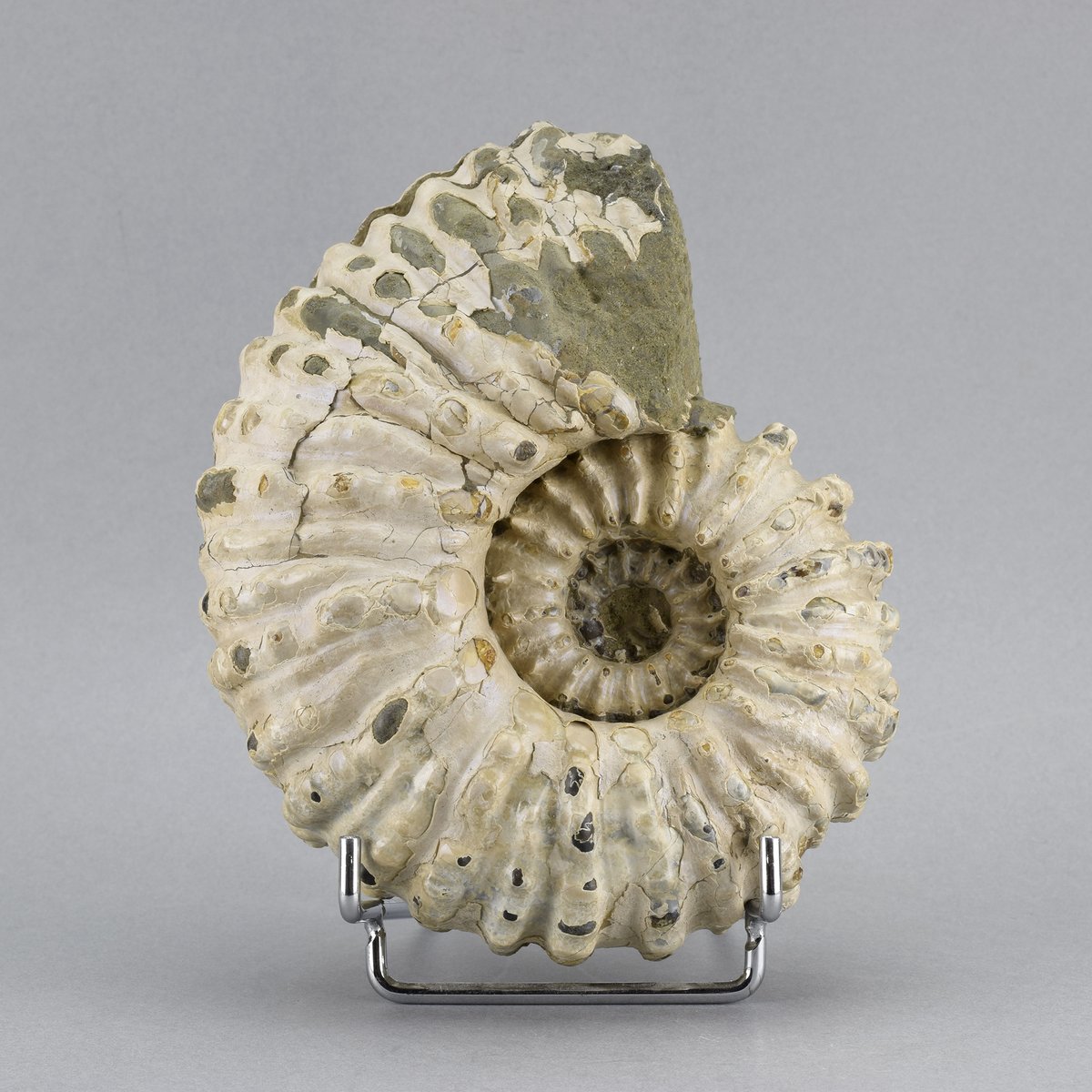
Image: Image sourced via web search (Fair use / Educational)
About Douvilleiceras
Douvilleiceras mammillatum is an extinct species of ammonite cephalopod that thrived during the Early Cretaceous period, specifically the Albian stage, approximately 115 to 110 million years ago. Found in marine deposits across the globe, this iconic invertebrate is celebrated for its distinctive, heavily ribbed and tuberculated shell, which has made it a crucial index fossil for paleontologists dating Mesozoic marine strata. Its widespread distribution and recognizable morphology provide invaluable insights into the marine ecosystems of the Cretaceous world, serving as a biological timekeeper for geologists and paleontologists alike. The sheer abundance of this organism in the fossil record underscores its evolutionary success and its fundamental role in the ancient oceans it inhabited.
The physical anatomy of Douvilleiceras mammillatum is defined by its robust, evolute shell, which typically measures between 10 and 20 centimeters in diameter, though some exceptional specimens can grow slightly larger. The shell is characterized by prominent, coarse ribbing that radiates outward from the umbilicus to the venter. Along these ribs are multiple rows of pronounced tubercles or nodes, giving the shell a spiky, heavily armored appearance. This multi-tuberculate ornamentation is a hallmark of the genus and served both defensive and structural purposes. In life, the living animal occupied the outermost chamber of the shell, known as the body chamber, while the inner chambers, or phragmocone, were used for buoyancy control via a specialized tube called the siphuncle. Soft tissue inferences, based on modern cephalopods like the nautilus and squid, suggest that Douvilleiceras possessed a ring of tentacles surrounding a sharp, parrot-like beak used for grasping and tearing prey. Large, well-developed eyes likely provided excellent vision in the photic zones of the Cretaceous seas. Compared to a modern nautilus, Douvilleiceras was similar in overall size but possessed a much more heavily ornamented and texturally complex shell, reflecting a different set of evolutionary pressures and ecological adaptations.
As a marine predator, Douvilleiceras mammillatum was a carnivorous cephalopod that likely fed on a variety of small marine organisms, including crustaceans, small fish, and other smaller mollusks. Its hunting strategy probably involved cruising through the water column or hovering near the seafloor, using its tentacles to ambush or actively pursue prey. Locomotion was achieved through a combination of buoyancy control, managed by adjusting gas and fluid levels within the phragmocone chambers, and jet propulsion, expelling water through a muscular funnel or hyponome. However, the heavily ribbed and tuberculated nature of its shell suggests that Douvilleiceras was not a fast, streamlined swimmer like modern squid, but rather a slower, more maneuverable predator adapted to complex environments like reefs or shallow shelf habitats. Growth patterns, recorded in the accretionary growth lines of the shell, indicate that these ammonites grew continuously throughout their lives, adding new chambers as they increased in size. Metabolism estimates suggest a relatively active lifestyle compared to modern nautiluses, though perhaps less energetically demanding than that of fast-swimming coleoid cephalopods. Social behavior is difficult to infer directly from the fossil record, but the occurrence of mass mortality assemblages in some deposits suggests that they may have congregated in large numbers for mating or spawning events, similar to the behavior observed in many modern squid species.
During the Albian stage of the Early Cretaceous, the world was experiencing a greenhouse climate with high global temperatures and elevated sea levels, resulting in extensive shallow epicontinental seas that flooded large portions of the continents. Douvilleiceras mammillatum inhabited these warm, shallow marine environments, which were teeming with life and characterized by high biodiversity. The geography of the time featured a breaking up of the supercontinent Pangea, creating new oceanic gateways and facilitating the global distribution of marine organisms. In this vibrant ecosystem, Douvilleiceras shared its habitat with a wide array of marine life, including other ammonite species, belemnites, marine reptiles such as ichthyosaurs and plesiosaurs, and early teleost fish. Benthic communities were rich with bivalves, gastropods, echinoderms, and reef-building organisms like rudist clams and corals. Within the food web, Douvilleiceras occupied a mid-level predatory niche. It was a consumer of smaller invertebrates and fish, but it also served as prey for larger marine predators. The heavy armor of its shell, with its prominent ribs and tubercles, likely evolved as a defensive mechanism against shell-crushing predators, such as mosasaurs, large fish, and specialized crustaceans. The dynamic predator-prey relationships of the Cretaceous seas drove an evolutionary arms race, resulting in the diverse and elaborate shell morphologies seen in ammonites like Douvilleiceras.
The discovery and naming of Douvilleiceras mammillatum are deeply intertwined with the early history of paleontology in Europe. The species was first scientifically described by the German paleontologist Ernst Friedrich von Schlotheim in 1813, originally under the name Ammonites mammillatus. The specific epithet 'mammillatum' refers to the nipple-like tubercles that adorn the ribs of the shell. Later, in 1890, the French paleontologist Walter de Grossouvre established the genus Douvilleiceras, naming it in honor of his colleague, the eminent French paleontologist Henri Douvillé. The type specimens were primarily collected from the rich Albian deposits of the Paris Basin in France and the Gault Clay and Lower Greensand formations in England. These early discoveries were crucial in establishing the stratigraphic framework for the Cretaceous period in Europe. Over the centuries, thousands of specimens of Douvilleiceras mammillatum have been unearthed by both professional paleontologists and amateur collectors. While there is no single famous specimen akin to the dinosaur 'Sue,' the sheer abundance and widespread distribution of Douvilleiceras fossils have made it a staple in paleontological collections worldwide. The historical significance of these discoveries lies in their contribution to the development of biostratigraphy, the science of dating rock layers using the fossils contained within them.
Within the tree of life, Douvilleiceras mammillatum belongs to the subclass Ammonoidea, a highly successful and diverse group of cephalopods that dominated the world's oceans for over 300 million years before their extinction at the end of the Cretaceous period. Specifically, it is classified within the family Douvilleiceratidae, a lineage known for its robust, heavily ornamented shells. The evolutionary significance of Douvilleiceras lies in its representation of the peak of ammonite morphological diversity during the mid-Cretaceous. The elaborate ribbing and tuberculation of its shell highlight the evolutionary trends toward increased defensive armor in response to the proliferation of shell-crushing predators during the Mesozoic Marine Revolution. Furthermore, the widespread geographic distribution of Douvilleiceras mammillatum makes it an invaluable index fossil, allowing paleontologists to correlate rock formations across different continents and reconstruct the paleogeography of the Cretaceous world. While ammonites left no direct modern descendants, their closest living relatives are the coleoid cephalopods, such as squid, octopuses, and cuttlefish, and the more distantly related nautiluses. Studying the evolutionary trajectory of ammonites like Douvilleiceras provides critical insights into the dynamics of marine ecosystems, the processes of speciation and extinction, and the ways in which organisms adapt to changing environmental pressures over geological time scales.
Despite its well-documented fossil record, Douvilleiceras mammillatum remains the subject of ongoing scientific debates and discussions. One area of contention involves the precise taxonomic classification and the boundaries between different species within the genus Douvilleiceras. Because ammonite shells can exhibit significant intraspecific variation—meaning individuals of the same species can look quite different due to factors like sexual dimorphism, environmental conditions, or geographic isolation—paleontologists sometimes disagree on whether certain variations represent distinct species or merely different forms of a single, highly variable species. Additionally, the functional morphology of the shell's elaborate tubercles is still debated. While generally accepted as a defensive adaptation against predators, some researchers suggest these structures may have also played a role in buoyancy regulation, hydrodynamic stability, or even species recognition during mating. Recent advances in high-resolution imaging and biomechanical modeling are helping to shed light on these questions, but the interpretation of extinct animal behavior from fossilized shells remains a complex and challenging endeavor that continues to evolve with new discoveries.
The fossil record of Douvilleiceras mammillatum is exceptionally rich and geographically extensive, reflecting the species' cosmopolitan distribution during the Early Cretaceous. Fossils of this ammonite have been found on nearly every continent, with notable concentrations in Europe, North America, South America, and Africa. Some of the most famous fossil sites include the Gault Clay and Lower Greensand of the United Kingdom, the Paris Basin in France, and the Mahajanga Basin in Madagascar. The preservation quality of these fossils ranges from fair to exceptional. In many cases, the original aragonite shell material has been replaced by more stable minerals like calcite or pyrite, preserving the intricate details of the ribbing and tubercles. In other instances, the fossils are preserved as internal molds, or steinkerns, which represent the sediment that filled the shell after the animal died and decayed. These internal molds often display the complex suture patterns—the lines where the internal chamber walls met the outer shell—which are crucial for identifying ammonite species. The abundance and high preservation potential of Douvilleiceras make it a common and highly sought-after fossil for both scientific study and private collection.
Douvilleiceras mammillatum has made a significant cultural impact, particularly within the realm of fossil collecting and natural history education. Its striking, spiky appearance makes it a popular and recognizable fossil, frequently featured in museum displays, educational materials, and paleontology textbooks around the world. Institutions like the Natural History Museum in London and the American Museum of Natural History in New York house prominent specimens that captivate the public's imagination and serve as tangible links to the ancient oceans. The aesthetic appeal of Douvilleiceras has also made it a favorite among amateur fossil hunters and collectors, driving a thriving market for commercial specimens, particularly those from the prolific deposits of Madagascar. Beyond its visual appeal, Douvilleiceras plays a crucial role in public education, helping to illustrate concepts of deep time, evolution, and the dynamic history of life on Earth.
Classification
Time Period
Discovery
Location
France
Formation
Gault Clay
Frequently Asked Questions
What is Douvilleiceras?
Douvilleiceras mammillatum is an extinct species of ammonite cephalopod that thrived during the Early Cretaceous period, specifically the Albian stage, approximately 115 to 110 million years ago. Found in marine deposits across the globe, this iconic invertebrate is celebrated for its distinctive, h...
When did Douvilleiceras live?
Douvilleiceras lived during the cretaceous period of the mesozoic era approximately 115-110 million years ago.
Where was Douvilleiceras discovered?
Fossils of Douvilleiceras were discovered in France in the Gault Clay.
What did Douvilleiceras eat?
Douvilleiceras was a carnivore. It lived in marine habitats.
What type of fossil is Douvilleiceras?
Douvilleiceras is preserved as a body fossil. The preservation quality is excellent.
Related Specimens
From the mesozoic era · body fossils