Leonardo (JRF 115H)
Brachylophosaurus canadensis
Image: Image sourced via web search (Fair use / Educational)
About Leonardo (JRF 115H)
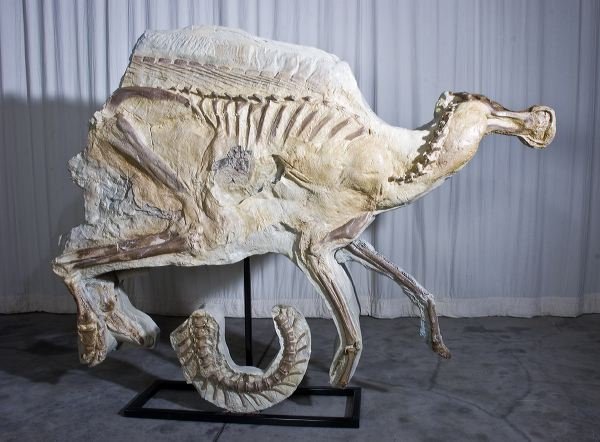
Leonardo, officially cataloged as JRF 115H, is an exceptionally well-preserved subadult specimen of the hadrosaurid dinosaur Brachylophosaurus canadensis. Living approximately 77 to 76 million years ago during the Campanian stage of the Late Cretaceous period, this remarkable organism inhabited the lush, coastal plains of what is now the northern United States and southern Canada. Leonardo represents one of the most extraordinary paleontological discoveries of the twenty-first century, widely celebrated as a "dinosaur mummy" due to the unprecedented preservation of its soft tissues, including extensive skin impressions, muscle mass, and even fossilized stomach contents. Its significance in paleontology cannot be overstated; Leonardo has provided scientists with a rare, three-dimensional glimpse into the anatomy and biology of a prehistoric creature, bridging the vast temporal gap between fossilized bone and a living, breathing animal. By offering direct evidence of soft tissue structures that typically decay long before fossilization can occur, this specimen has fundamentally transformed our understanding of hadrosaurid anatomy, physiology, and paleoecology.
In terms of physical description, Brachylophosaurus canadensis was a medium to large-sized hadrosaur, and Leonardo, being a subadult at the time of its death, measured approximately 7 meters (about 23 feet) in length and is estimated to have weighed around 1.5 to 2 tons. Fully grown adults of the species could reach up to 9 meters in length. The most distinctive skeletal feature of Brachylophosaurus is its flat, paddle-like bony crest that extends backward over the top of its skull, which was likely used for intra-species display or age recognition rather than vocalization, distinguishing it from the hollow-crested lambeosaurines. What makes Leonardo truly spectacular, however, is the soft tissue preservation. Nearly 90 percent of the animal's body is covered in fossilized skin impressions, revealing a complex mosaic of non-overlapping, polygonal scales that vary in size across different regions of the body. Larger, tubercle-like scales are interspersed among smaller background scales, providing a detailed map of the dinosaur's integument. Furthermore, Leonardo's preservation includes a three-dimensional muscle profile, particularly around the neck, shoulders, and robust hind limbs, indicating a heavily muscled animal capable of sustained locomotion. The preservation of a keratinous beak over the bony premaxilla and predentary bones offers a precise look at its feeding apparatus. Compared to modern animals, Leonardo would have had the bulk of a large rhinoceros or a small elephant, but with the bipedal-capable stance and long, balancing tail characteristic of ornithopod dinosaurs.
The paleobiology of Leonardo offers a treasure trove of data, particularly regarding the diet and feeding strategies of Late Cretaceous hadrosaurs. As a herbivore, Brachylophosaurus possessed a highly specialized dental battery consisting of hundreds of tightly packed teeth designed to shear and grind tough plant material. Leonardo's most groundbreaking contribution to paleobiology is the preservation of its gut contents, providing direct, undeniable evidence of its last meals. Paleobotanical analysis of the material found within its abdominal cavity revealed a diet rich in ferns, conifers, magnolias, and other angiosperms, indicating that this dinosaur was a browser that fed on a variety of low to medium-height vegetation. The presence of pollen and fragmented plant cuticles suggests a highly efficient chewing mechanism, supported by the muscular cheeks inferred from the skull's anatomy. Locomotion in Brachylophosaurus was facultatively bipedal; while it likely spent most of its time foraging on all fours, it could rear up on its powerful hind legs to reach higher vegetation or to flee from predators. Social behavior inferences, drawn from bonebed discoveries of multiple Brachylophosaurus individuals, suggest they were gregarious animals that lived in herds, which would have provided safety in numbers and facilitated complex social interactions, possibly mediated by visual displays using their cranial crests. Growth patterns analyzed through bone histology indicate rapid growth rates, a metabolic strategy likely necessary to reach a size refuge from predators as quickly as possible, pointing towards an elevated, endothermic-like metabolism.
The ecological context of Leonardo's world was vastly different from the modern landscape of Montana. During the Campanian, the region was part of Laramidia, an island continent formed by the Western Interior Seaway that divided North America in two. The climate was warm, temperate to subtropical, and highly humid, supporting dense, lush forests and extensive coastal wetlands. The Judith River Formation, where Leonardo was discovered, represents a dynamic ecosystem of river channels, floodplains, and swamps. This environment was teeming with life, and Brachylophosaurus shared its habitat with a diverse array of co-existing species. Other herbivores included ceratopsians like Albertaceratops and Judiceratops, ankylosaurs, and various pachycephalosaurs. As a primary consumer, Brachylophosaurus occupied a crucial position in the food web, converting vast amounts of plant biomass into animal protein. This made it a prime target for the apex predators of the time, particularly large tyrannosaurids such as Daspletosaurus and Gorgosaurus. The evolutionary arms race between these formidable predators and their hadrosaur prey likely drove the development of the hadrosaurs' rapid growth rates, acute senses, and herd behaviors. The ecosystem also supported a rich assemblage of freshwater fish, amphibians, turtles, crocodilians, and early mammals, creating a complex and highly interactive biological community.
The discovery history of Leonardo is a dramatic and celebrated chapter in modern paleontology. The specimen was discovered in the summer of 2000 by Dan Stephenson, a volunteer participating in a paleontological expedition led by Nate Murphy, the then-curator of paleontology at the Phillips County Museum (now the Great Plains Dinosaur Museum) in Malta, Montana. The team was prospecting in the Judith River Formation when Stephenson noticed a series of articulated tail vertebrae protruding from a sandstone outcrop. As excavation began, the team quickly realized they had uncovered something extraordinary: the surrounding rock preserved extensive, three-dimensional skin impressions. Recognizing the fragility and immense scientific value of the "mummy," the excavation was conducted with extreme care, ultimately resulting in the removal of a massive, 6.5-ton block of rock containing the nearly complete, articulated skeleton and its soft tissue envelope. The specimen was affectionately named "Leonardo" after a piece of graffiti found near the dig site that read "Leonard Webb loves Mary Cityman 1917." The preparation of Leonardo was a painstaking process that took years, utilizing specialized air scribes and micro-sandblasters to expose the skin without damaging it. To study the internal structures without destroying the fossil, Leonardo was transported to the Johnson Space Center in Houston, Texas, where it underwent extensive high-resolution CT scanning, a pioneering use of medical and aerospace technology in paleontology.
The evolutionary significance of Brachylophosaurus, and Leonardo in particular, lies in its position within the hadrosaurid family tree. Brachylophosaurus is a member of the Saurolophinae (formerly Hadrosaurinae), the subfamily of "solid-crested" or "crestless" duck-billed dinosaurs. Within this group, it forms a specific clade known as the Brachylophosaurini, alongside closely related genera such as Maiasaura, Probrachylophosaurus, and Acristavus. The evolutionary trajectory of this tribe provides crucial insights into the development of cranial ornamentation and social behavior in ornithopods. Probrachylophosaurus, a slightly older genus, exhibits a smaller, less developed crest, representing a perfect transitional form leading to the more pronounced crest of Brachylophosaurus. This lineage demonstrates how sexual selection and species recognition pressures drove the rapid morphological divergence of cranial structures in Late Cretaceous dinosaurs. Furthermore, the detailed soft tissue anatomy provided by Leonardo has allowed scientists to better understand the evolutionary adaptations of the hadrosaurid integument and musculature, tracing how these animals optimized their bodies for efficient terrestrial locomotion and high-capacity feeding, traits that made them some of the most successful and abundant herbivores of the Mesozoic era.
Despite the wealth of information Leonardo has provided, its study has not been without scientific debates and controversies. One major area of ongoing discussion concerns the exact taphonomic processes that led to its extraordinary preservation. While it is widely referred to as a "mummy," the process was not true mummification (desiccation) in the traditional sense. Instead, researchers debate the precise combination of rapid burial, anoxic conditions, and mineral replacement that allowed the soft tissues to fossilize before bacterial decomposition could destroy them. Some scientists suggest that the animal was buried in a sudden flood event, while others propose that the carcass may have been submerged in a stagnant, mineral-rich oxbow lake. Another debate centers on the interpretation of the gut contents; while most agree they represent the animal's last meal, some skeptics have argued that the plant material could have washed into the body cavity post-mortem. However, the specific composition and location of the plant matter strongly support the genuine gut content hypothesis. Additionally, the taxonomy of the Brachylophosaurini tribe undergoes periodic revision as new specimens are discovered, leading to debates over the exact phylogenetic relationships and the timing of their evolutionary divergence.
The fossil record of Brachylophosaurus is primarily restricted to the Campanian deposits of the Judith River Formation in Montana and the roughly contemporaneous Oldman Formation in Alberta, Canada. While isolated bones and partial skeletons are relatively uncommon compared to other hadrosaurs like Edmontosaurus or Corythosaurus, the genus is famous for yielding several exceptionally preserved specimens. In addition to Leonardo, the Malta area has produced other notable Brachylophosaurus fossils, including "Elvis," a beautifully articulated skeleton with some skin impressions; "Peanut," a juvenile specimen; and "Roberta." The quality of preservation in this specific geographic region suggests a unique set of environmental and geological conditions favorable to rapid burial and fossilization. Typically, hadrosaur fossils consist of disarticulated bones, with skulls and limb bones being the most commonly identified elements. The discovery of multiple, highly complete individuals in the Judith River Formation has made it one of the most important sites in the world for understanding dinosaur taphonomy and anatomy, providing a robust dataset that compensates for the relative geographic restriction of the genus.
The cultural impact of Leonardo has been profound, capturing the public's imagination and significantly boosting interest in paleontology. Shortly after its discovery and initial preparation, Leonardo was recognized by the Guinness Book of World Records as the best-preserved dinosaur specimen ever found. The dinosaur became the subject of a major Discovery Channel documentary titled "Secrets of the Dinosaur Mummy," which detailed the discovery, the cutting-edge CT scanning process, and the scientific revelations it produced. This media exposure brought the meticulous, often slow-paced world of paleontological research to a global audience. Leonardo is currently housed at the Great Plains Dinosaur Museum in Malta, Montana, where it serves as the centerpiece of their exhibits, drawing tourists and researchers from around the world. Its educational importance is immense, as it provides a tangible, highly visual representation of a dinosaur as a real, biological entity rather than just a collection of dry bones, inspiring future generations of scientists and dinosaur enthusiasts alike.
Classification
Time Period
Discovery
Location
Montana, USA
Formation
Judith River Formation
Frequently Asked Questions
What is Leonardo (JRF 115H)?
Leonardo, officially cataloged as JRF 115H, is an exceptionally well-preserved subadult specimen of the hadrosaurid dinosaur Brachylophosaurus canadensis. Living approximately 77 to 76 million years ago during the Campanian stage of the Late Cretaceous period, this remarkable organism inhabited the ...
When did Leonardo (JRF 115H) live?
Leonardo (JRF 115H) lived during the cretaceous period of the mesozoic era approximately 77-76 million years ago.
Where was Leonardo (JRF 115H) discovered?
Fossils of Leonardo (JRF 115H) were discovered in Montana, USA in the Judith River Formation.
What did Leonardo (JRF 115H) eat?
Leonardo (JRF 115H) was a herbivore. It lived in terrestrial habitats.
What type of fossil is Leonardo (JRF 115H)?
Leonardo (JRF 115H) is preserved as a body fossil. The preservation quality is exceptional.
Related Specimens
From the mesozoic era · body fossils
/cc86f4a1bc00.jpg)