Stupendemys
Stupendemys geographicus
Image: Image sourced via web search (Fair use / Educational)
About Stupendemys
Stupendemys geographicus represents one of the largest turtles to have ever lived, a colossal freshwater reptile that inhabited the vast wetland systems of northern South America during the Late Miocene epoch, approximately 10 to 5 million years ago. Its immense size, rivaling that of a modern sedan, and unique anatomical features make it a subject of profound paleontological interest, offering critical insights into the gigantism of ancient chelonians and the rich, dynamic ecosystems of the Neogene tropics. The discovery of its remarkably complete fossils has allowed scientists to reconstruct not just its appearance, but also its lifestyle and the perilous world it navigated, a world teeming with other giants.
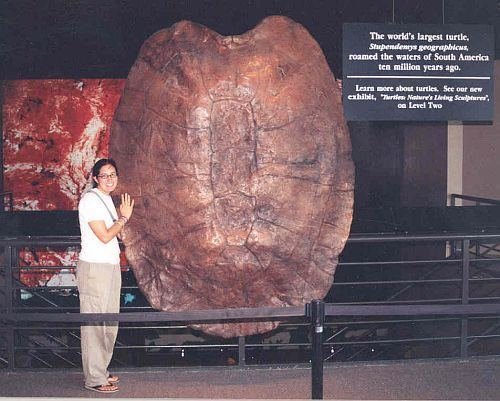
Stupendemys was a creature of truly staggering proportions, far exceeding any living freshwater turtle. The carapace, or upper shell, of the largest known individuals reached lengths of up to 3.3 meters (11 feet), with an estimated total body length approaching 4 meters (13.1 feet). Weight estimates for such a giant are substantial, ranging from 900 to 1,250 kilograms (2,000 to 2,750 pounds), making it comparable in mass to a modern black rhinoceros. The carapace itself was exceptionally broad and relatively flattened, an adaptation likely suited for its aquatic environment. One of the most striking and unique features of Stupendemys, particularly in males, was the presence of two massive, forward-pointing horns protruding from the anterior edge of the carapace, just above the neck opening. These robust, horn-like projections, which could be up to 30 centimeters long, were deeply grooved, suggesting they were covered in a keratinous sheath, much like the horns of a bull. The plastron, or lower shell, was also immense and featured a deep notch at the front, allowing for greater mobility of its powerful limbs and neck. The skull, while disproportionately small compared to the shell as is common in turtles, was robustly built with a powerful beak, indicating a strong bite force. Its limbs were large and paddle-like, well-suited for propelling its massive body through water, though it was also capable of terrestrial locomotion to bask or lay eggs.
Analysis of its jaw morphology and the paleoenvironment suggests that Stupendemys was likely an opportunistic omnivore with a varied diet. Its powerful, beak-like jaws would have been capable of crushing hard-shelled prey such as large mollusks, crabs, and even smaller turtles and crocodilians. Fossil evidence, including bite marks on its own shell, confirms it coexisted with and was preyed upon by enormous crocodilians like Purussaurus, so it is plausible Stupendemys also scavenged on carcasses. Furthermore, the sheer size of the animal would have required a substantial caloric intake, making a diet supplemented with abundant aquatic vegetation, fruits, and seeds that fell into the water a near certainty. Its locomotion was primarily aquatic; the flattened shell and powerful limbs suggest it was a capable, though not particularly fast, swimmer in the slow-moving rivers and swamps it called home. The prominent horns on the males are a key indicator of complex social behavior. They were almost certainly used for intraspecific combat, likely for mating rights or territorial disputes, with males ramming and locking horns with rivals in a manner analogous to modern horned mammals. This sexual dimorphism points to a sophisticated social structure and competitive breeding system. Growth patterns inferred from bone histology suggest a relatively rapid growth rate to reach its immense size, a strategy to quickly outgrow potential predators.
The world of Stupendemys during the Late Miocene was a vastly different South America. The continent was an island, isolated from North America, and the northern region was dominated by a massive, continent-spanning wetland system known as the Pebas Mega-Wetland System. This environment was a network of enormous lakes, swamps, and sluggish rivers, fed by the early, low-lying Andes Mountains. The climate was tropical, warm, and humid year-round, supporting incredibly lush vegetation and a high level of biodiversity. Stupendemys occupied a significant niche in this ecosystem as a large, low-level consumer and occasional predator. It shared its habitat with a bestiary of other gigantic creatures. Its primary predator was the colossal caiman Purussaurus, a 12-meter-long crocodilian whose teeth marks are found embedded in Stupendemys shells. Other neighbors included giant ground sloths like Megatherium, massive capybara-like rodents called Phoberomys, and a variety of large fish, river dolphins, and other turtle species. Stupendemys's immense size and formidable shell were its primary defenses in this dangerous environment, placing it high in the food web, though still vulnerable to the apex predators of its time. Its role as a large omnivore would have made it an important agent of nutrient cycling within the freshwater ecosystem.
The history of Stupendemys's discovery begins in 1972 with paleontologist Roger C. Wood, who was conducting fieldwork in the Urumaco region of Falcón state, Venezuela, an area renowned for its rich Neogene fossil beds. Wood unearthed the first, impressively large fossil remains, including a nearly complete carapace that immediately signaled the existence of a turtle of unprecedented size. He formally described and named the creature Stupendemys geographicus in 1976. The genus name, Stupendemys, is a combination of the Latin 'stupendus' (meaning stupendous or amazing) and the Greek 'emys' (freshwater turtle), a fitting tribute to its astonishing size. The species name, 'geographicus', was given in honor of the National Geographic Society, which funded the expedition that led to its discovery. The holotype specimen, MCNC-244, remains a cornerstone of its study. For decades, knowledge of Stupendemys was based on these and other fragmentary finds. However, a major breakthrough came in the 2010s with the discovery of new, exceptionally well-preserved fossils from both Venezuela's Urumaco Formation and Colombia's La Tatacoa Desert (part of the La Venta Formation). These discoveries, described in a 2020 paper led by Edwin Cadena, included the first-ever associated lower jaw and the most complete carapace found to date, which crucially revealed the presence of the massive frontal horns, a feature previously unknown and a game-changer in understanding the animal's biology and behavior.
Stupendemys holds a crucial position in the evolutionary history of turtles. It belongs to the family Podocnemididae, a group of side-necked turtles (pleurodires) that are today found primarily in South America and Madagascar. Its existence demonstrates that this lineage was capable of achieving gigantism on a scale comparable to the famous sea turtle Archelon. The evolution of such immense size was likely driven by a combination of factors, including a warm, stable climate, highly productive ecosystems providing abundant food, and intense predation pressure from colossal crocodilians. Achieving a massive size would have provided a significant defensive advantage. Stupendemys, along with other giant pleurodires from the Cenozoic of South America, represents an evolutionary radiation of freshwater turtles that capitalized on the unique environmental conditions of the continent before the formation of the Isthmus of Panama. Its eventual extinction around 5 million years ago is linked to major environmental shifts, including the uplift of the Andes Mountains, which dramatically altered the drainage patterns of the continent, breaking up the vast wetland systems and leading to a cooler, drier climate to which these giants could not adapt. Its closest living relatives are the much smaller side-necked turtles of the Amazon basin, such as the Arrau turtle (Podocnemis expansa).
Despite recent discoveries, several scientific debates surrounding Stupendemys persist. The exact function of the male's horns is a primary topic of discussion. While intraspecific combat is the leading hypothesis, other potential uses, such as defense against predators or a role in courtship displays, are also considered. Another area of active research is the precise number of species within the genus. Originally, a second species, Stupendemys souzai, was named based on fossils from Brazil. However, the 2020 study by Cadena and colleagues proposed that the differences were likely attributable to individual variation or sexual dimorphism within a single species, S. geographicus, effectively synonymizing S. souzai. This re-evaluation highlights the ongoing process of taxonomic refinement as more complete fossils become available. Furthermore, the exact environmental pressures that drove both the evolution of its gigantism and its ultimate extinction continue to be modeled and debated by paleontologists, with varying emphasis placed on predation, climate change, and habitat loss as primary drivers. New fossil finds are continuously sought to help resolve these questions and provide a clearer picture of this magnificent animal's life.
Fossils of Stupendemys geographicus are primarily found in two key regions of northern South America: the Urumaco Formation in Falcón, Venezuela, and the La Venta Formation in the Tatacoa Desert of Colombia. These sites represent the sedimentary deposits of the ancient Pebas wetland system. The fossil record, while not abundant, is significant, comprising several dozen known individuals represented by various skeletal elements. The most commonly preserved parts are fragments of the incredibly thick and durable carapace and plastron. However, the discoveries published in 2020 included a remarkably complete carapace (over 90% intact) and the first associated skull material, dramatically improving the quality of the record. The preservation quality is generally good, with some specimens showing fine details, including the aforementioned bite marks from Purussaurus, which provide a rare, direct snapshot of predator-prey interactions in the fossil record. These fossil sites are critical windows into the Miocene epoch and continue to yield important discoveries about South America's prehistoric fauna.
While not as famous as dinosaurs like Tyrannosaurus rex, Stupendemys has captured the public imagination due to its sheer scale. It is a recurring feature in documentaries and books about prehistoric life, often highlighted as the 'largest turtle ever' and used to illustrate the concept of Cenozoic megafauna. Major natural history museums, including the American Museum of Natural History and the Paleontological Research Institute in the United States, as well as museums in Venezuela and Colombia, hold and display casts or original fossils of Stupendemys. These exhibits serve as powerful educational tools, allowing visitors to physically appreciate the immense size of the animal and learn about the incredible ecosystems that have vanished from our planet. Its 'stupendous' nature makes it a compelling ambassador for paleontological science and the story of life on Earth.
Classification
Time Period
Discovery
Location
Venezuela
Formation
Urumaco Formation, La Venta Formation
Frequently Asked Questions
What is Stupendemys?
Stupendemys geographicus represents one of the largest turtles to have ever lived, a colossal freshwater reptile that inhabited the vast wetland systems of northern South America during the Late Miocene epoch, approximately 10 to 5 million years ago. Its immense size, rivaling that of a modern sedan...
When did Stupendemys live?
Stupendemys lived during the neogene period of the cenozoic era approximately 10-5 million years ago.
Where was Stupendemys discovered?
Fossils of Stupendemys were discovered in Venezuela in the Urumaco Formation, La Venta Formation.
What did Stupendemys eat?
Stupendemys was a omnivore. It lived in freshwater, semi-aquatic habitats.
What type of fossil is Stupendemys?
Stupendemys is preserved as a body fossil. The preservation quality is good.
Related Specimens
From the cenozoic era · body fossils