Argentinosaurus
Argentinosaurus huinculensis
Image: Image sourced via web search (Fair use / Educational)
About Argentinosaurus
Argentinosaurus huinculensis stands as a true titan of the prehistoric world, a colossal sauropod dinosaur that roamed what is now South America during the Late Cretaceous period, approximately 97 to 94 million years ago. Its discovery reshaped our understanding of the upper limits of terrestrial animal size, cementing its status as one of the largest and heaviest land animals ever to have lived. As a member of the titanosaur group, Argentinosaurus represents a pinnacle of sauropod evolution, a testament to the biological engineering required to support such immense bulk.
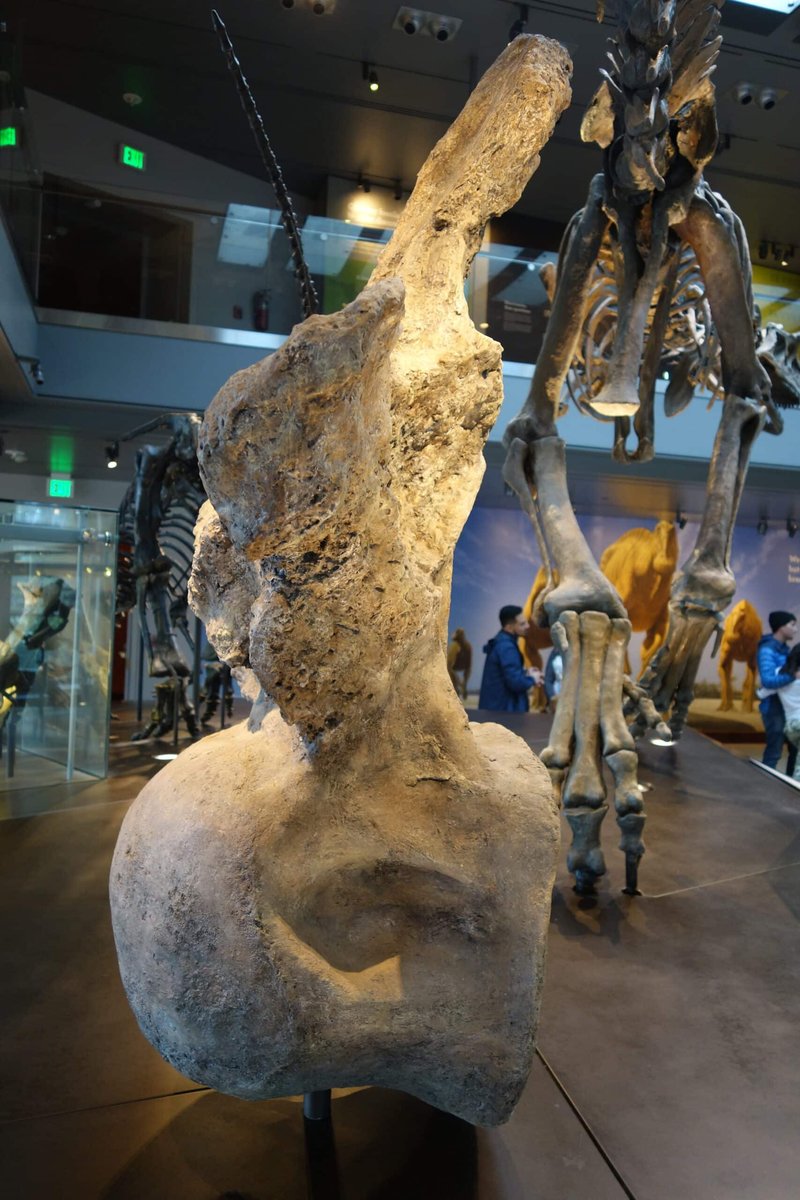
Reconstructing the full anatomy of Argentinosaurus is challenging due to the fragmentary nature of its remains, but the fossils we have paint a picture of an animal of almost incomprehensible scale. Estimates for its total body length vary, but most paleontologists place it between 30 and 35 meters (98 to 115 feet), roughly the length of three school buses parked end-to-end. Its weight is even more debated, with figures ranging from a conservative 60 metric tons to upwards of 100 metric tons (132,000 to 220,000 pounds). The holotype specimen includes several enormous dorsal vertebrae, some of which are 1.6 meters (over 5 feet) tall, providing a sense of the creature's immense torso. Its sacrum, the fused vertebrae that connect to the pelvis, was exceptionally wide. A single discovered tibia (shin bone) measures about 1.55 meters (5.1 feet) long. Its massive, pillar-like legs supported a barrel-chested body, a tremendously long neck for browsing high vegetation, and a lengthy, whip-like tail for balance and potentially defense. Its head, though never found, was likely disproportionately small, a common trait among sauropods, equipped with simple, peg-like teeth for stripping foliage.
Paleobiological interpretations suggest Argentinosaurus was a high-browsing herbivore, using its incredible neck length to access vegetation far beyond the reach of most other contemporary plant-eaters. Its simple dentition indicates it did not chew its food but rather stripped leaves and branches, which were then likely broken down in a massive gut, possibly aided by gastroliths (stomach stones). Locomotion for such a gigantic creature would have been a slow, ponderous affair. Biomechanical models suggest a top speed of perhaps 5-8 kilometers per hour (3-5 mph), with its columnar legs moving in a stately, graviportal manner to support its weight. The discovery of titanosaur nesting sites in Patagonia, containing vast numbers of eggs, suggests that Argentinosaurus, like its relatives, may have engaged in colonial nesting behavior. These dinosaurs would have laid clutches of eggs and likely did not provide parental care, a reproductive strategy relying on producing a large number of offspring to ensure some survived to adulthood. Growth would have been incredibly rapid, with hatchlings increasing their mass by several orders of magnitude to reach their gigantic adult size in just a few decades.
The world of Argentinosaurus was a warm, seasonally arid floodplain environment, as indicated by the geology of the Huincul Formation in Patagonia. This landscape was crisscrossed by braided river systems and supported a diverse flora of conifers, cycads, and ferns. Argentinosaurus occupied the top tier of the herbivore food web, its sheer size making it a mobile, ecosystem-shaping force, clearing vast tracts of vegetation as it fed. However, it was not without threats. It shared its environment with some of the largest terrestrial predators known to science, most notably the formidable carcharodontosaurid Mapusaurus roseae. Fossil evidence of Mapusaurus bonebeds suggests these massive carnivores may have hunted in packs, a strategy that would have been necessary to tackle an adult Argentinosaurus. A lone, healthy adult was likely invulnerable, but juveniles, the old, or the sick would have been prime targets, creating a dramatic predator-prey dynamic between the largest herbivore and one of the largest carnivores of all time.
The discovery of Argentinosaurus is a story of serendipity and collaboration. In 1987, a local farmer named Guillermo Heredia stumbled upon what he initially thought was a massive piece of petrified wood on his ranch near the city of Plaza Huincul in Neuquén Province, Argentina. He alerted the local Carmen Funes Municipal Museum, whose staff recognized the true nature of the find. Formal excavation began in 1989, led by the renowned Argentine paleontologists José F. Bonaparte and Rodolfo Coria. The fossils they unearthed were staggering in size, including the aforementioned tibia and gigantic vertebrae. In their 1993 paper, Bonaparte and Coria formally named the new genus and species Argentinosaurus huinculensis. The genus name means "Argentine lizard," honoring the country of its discovery, while the species name, huinculensis, refers to Plaza Huincul, the town near the discovery site. The holotype specimen, designated MCF-PVPH-1, remains the primary source of information for this dinosaur.
In the grand tapestry of evolution, Argentinosaurus represents a key branch of the sauropod family tree. It belongs to the Titanosauria, a highly successful and diverse clade of sauropods that flourished during the Cretaceous, particularly in the Southern Hemisphere (Gondwana). Within this group, it is often placed in the family Antarctosauridae or the clade Lognkosauria, a group of particularly gigantic titanosaurs that also includes other giants like Patagotitan and Futalognkosaurus. The evolution of such extreme gigantism in this lineage tells a story of an evolutionary arms race. The immense size likely evolved as a primary defense against the equally massive carcharodontosaurid predators of Late Cretaceous South America. Furthermore, its physiology, including a hypothesized avian-like respiratory system with air sacs, was a critical adaptation that allowed for efficient oxygen exchange and lightened its massive skeleton, making such colossal sizes biologically feasible. Argentinosaurus provides a crucial data point for understanding the biomechanical and metabolic limits of life on land.
Despite its fame, Argentinosaurus is at the center of several scientific debates, primarily stemming from the incompleteness of its fossil remains. The exact size and weight of the animal are subjects of ongoing discussion, as different researchers use different sauropod skeletons (like Saltasaurus or Rapetosaurus) as a basis for scaling up the missing parts, leading to a wide range of estimates. Some paleontologists argue that other titanosaurs, such as Patagotitan mayorum, may have been larger or at least more robustly built, potentially challenging Argentinosaurus for the title of 'largest land animal'. The classification within Titanosauria is also fluid; whether it belongs to Antarctosauridae or is a basal lognkosaur remains a point of taxonomic debate. Every new titanosaur discovery in South America helps to refine our understanding of where Argentinosaurus fits and provides more context for its incredible size and evolutionary journey, constantly reshaping the narrative of these Cretaceous giants.
The fossil record for Argentinosaurus huinculensis is frustratingly sparse and fragmentary. The known material comes exclusively from the Huincul Formation in Neuquén Province, Argentina. To date, only a handful of specimens have been confidently assigned to the species. The holotype (MCF-PVPH-1) consists of three anterior and three posterior dorsal vertebrae, the first five sacral vertebrae, a dorsal rib, and the right tibia. A second, unconfirmed specimen includes an incomplete femur, which, if correctly assigned, would measure an estimated 2.5 meters (8.2 feet) when complete. The preservation quality is generally poor to fair, with the bones often being fractured and incomplete. This scarcity of material makes a full skeletal reconstruction highly speculative and reliant on comparisons with more complete relatives. The fossil sites in Patagonia are world-renowned for yielding remains of colossal dinosaurs, making the region a critical location for studying the upper limits of dinosaur gigantism and the unique ecosystems of Cretaceous Gondwana.
Argentinosaurus has captured the public imagination like few other dinosaurs, becoming a cultural icon symbolizing the sheer scale and majesty of prehistoric life. Its name is synonymous with 'giant dinosaur'. Reconstructed skeletons, often composites based on the known bones and filled in with parts from related titanosaurs, are awe-inspiring centerpieces in museums worldwide. Notable displays can be found at the Fernbank Museum of Natural History in Atlanta, Georgia (USA), and the Carmen Funes Municipal Museum in Plaza Huincul, Argentina. It has been featured prominently in numerous television documentaries, including the BBC's "Walking with Dinosaurs" special "Land of Giants" and "Chased by Dinosaurs," where it was depicted in its epic struggle against Mapusaurus (portrayed as Giganotosaurus in the program). This media exposure has cemented its place in popular culture and serves as a powerful educational tool, inspiring wonder and a deeper interest in paleontology and the natural world.
Classification
Time Period
Discovery
Location
Argentina, Neuquén Province
Formation
Huincul Formation
Frequently Asked Questions
What is Argentinosaurus?
Argentinosaurus huinculensis stands as a true titan of the prehistoric world, a colossal sauropod dinosaur that roamed what is now South America during the Late Cretaceous period, approximately 97 to 94 million years ago. Its discovery reshaped our understanding of the upper limits of terrestrial an...
When did Argentinosaurus live?
Argentinosaurus lived during the cretaceous period of the mesozoic era approximately 97-94 million years ago.
Where was Argentinosaurus discovered?
Fossils of Argentinosaurus were discovered in Argentina, Neuquén Province in the Huincul Formation.
What did Argentinosaurus eat?
Argentinosaurus was a herbivore. It lived in terrestrial habitats.
What type of fossil is Argentinosaurus?
Argentinosaurus is preserved as a body fossil. The preservation quality is poor.
Related Specimens
From the mesozoic era · body fossils