Pulmonoscorpius
Pulmonoscorpius kirktonensis
Image: Image sourced via web search (Fair use / Educational)
About Pulmonoscorpius
Pulmonoscorpius kirktonensis, meaning 'breathing scorpion of Kirkton,' represents one of the most extraordinary and terrifying arthropods to have ever walked the Earth. Thriving during the Visean age of the Carboniferous period, approximately 340 to 330 million years ago, this colossal arachnid is a premier example of the phenomenon of Paleozoic arthropod gigantism. Discovered in the fossil-rich deposits of Scotland, Pulmonoscorpius holds immense significance in the field of paleontology because it provides crucial insights into the early terrestrialization of scorpions and the physiological adaptations required to survive on land. Its existence highlights a unique epoch in Earth's history when atmospheric conditions allowed invertebrates to reach sizes that are biologically impossible today, making it a focal point for studies on the relationship between atmospheric chemistry and animal evolution.
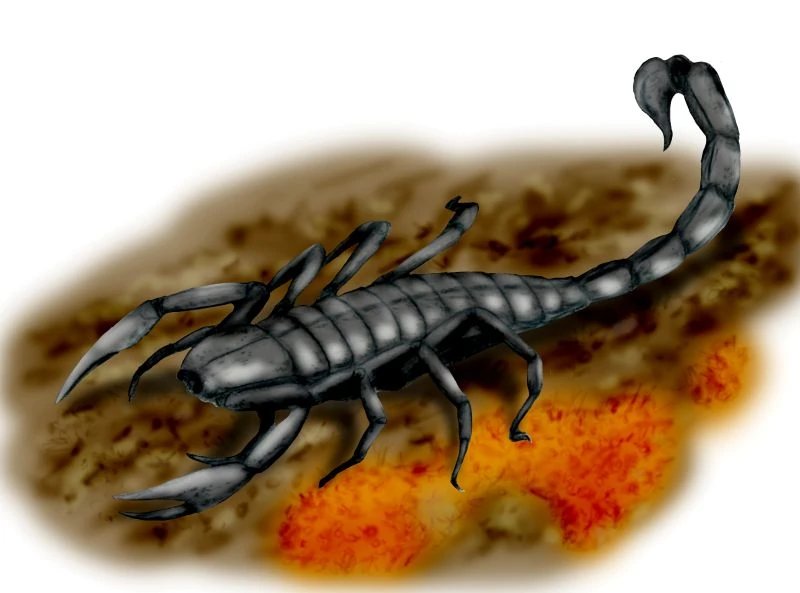
The physical dimensions of Pulmonoscorpius are truly staggering when compared to its modern extant relatives. While the largest scorpions today, such as the Emperor scorpion or the giant forest scorpion, rarely exceed twenty-three centimeters in length, Pulmonoscorpius reached an astonishing seventy centimeters, or roughly twenty-eight inches, from the tip of its chelicerae to the end of its venomous telson. This massive size would have made it a formidable presence on the Carboniferous forest floor. Despite its monstrous proportions, the overall anatomical bauplan of Pulmonoscorpius was remarkably similar to that of modern scorpions, indicating that the scorpion body plan is an evolutionary triumph that has remained largely unchanged for hundreds of millions of years. It possessed a pair of large, grasping pedipalps armed with robust chelae, or pincers, which were likely used to subdue struggling prey. Its carapace was relatively smooth but featured a pair of unusually large, laterally situated compound eyes, a primitive trait that contrasts with the smaller, simpler eyes of modern scorpions. These large eyes suggest that Pulmonoscorpius was a highly visual predator, possibly relying on sight as much as on the sensory setae that cover the bodies of modern arachnids. The most defining anatomical feature, however, and the one that gives the genus its name, is the presence of well-developed book lungs. These respiratory organs, preserved in exquisite detail in some specimens, confirm that Pulmonoscorpius was fully adapted to a terrestrial lifestyle, breathing atmospheric oxygen rather than relying on the gills used by its aquatic ancestors. The tail, or metasoma, was thick and muscular, terminating in a bulbous telson equipped with a sharp aculeus, or stinger. While the exact toxicity of its venom cannot be determined from the fossil record, the size of the telson suggests it was capable of delivering a substantial and potentially lethal dose of venom to its victims.
In terms of its paleobiology, Pulmonoscorpius was undoubtedly an apex invertebrate predator within its ecosystem. Its diet would have consisted of a wide variety of prey items, limited only by what it could successfully overpower with its massive pincers and venomous sting. Given its size, it is highly probable that Pulmonoscorpius did not restrict itself to hunting other invertebrates, such as early insects, millipedes, and smaller arachnids, but also actively preyed upon the early tetrapods that shared its habitat. Small amphibians and early basal amniotes would have been prime targets for this giant scorpion. Its hunting strategy likely involved a combination of ambush tactics and active pursuit. The exceptionally large compound eyes suggest it may have been a diurnal hunter, scanning the forest floor for movement, though it could also have utilized tactile and chemical cues like modern scorpions to hunt in low-light conditions. Locomotion would have been achieved through the coordinated movement of its four pairs of walking legs, propelling its heavy body across the damp, uneven terrain of the Carboniferous landscape. The metabolic requirements of such a massive terrestrial arthropod would have been substantial. Arthropods are limited in size by their open circulatory systems and the efficiency of their respiratory organs. The large book lungs of Pulmonoscorpius were an evolutionary solution to this problem, allowing it to extract sufficient oxygen from the atmosphere to fuel its large muscles and active predatory lifestyle. Growth would have occurred through a series of molts, or ecdysis, a vulnerable process during which the giant scorpion would have to shed its rigid exoskeleton and wait for a new, larger one to harden. During these molting periods, even a formidable predator like Pulmonoscorpius would have been susceptible to predation or cannibalism. Socially, it was likely a solitary creature, coming together with others of its kind only for the purpose of mating, a process that may have involved complex courtship dances similar to those observed in extant scorpion species.
The ecological context in which Pulmonoscorpius lived was a world vastly different from our own, characterized by extreme environmental conditions that fostered the evolution of giant arthropods. During the Visean age of the Carboniferous period, the Earth's landmasses were largely consolidated into the supercontinent of Pangaea. The climate was generally warm and humid, supporting the growth of vast, dense, swampy rainforests dominated by towering lycopsids, giant horsetails, and seed ferns. These extensive forests acted as massive carbon sinks, drawing down carbon dioxide and pumping unprecedented levels of oxygen into the atmosphere. Estimates suggest that atmospheric oxygen levels during the Carboniferous may have reached as high as thirty-five percent, compared to the twenty-one percent we experience today. This hyperoxic environment is widely believed to be the primary driver of arthropod gigantism, as it allowed oxygen to diffuse more deeply into the tissues of creatures relying on book lungs and tracheae, overcoming the physiological constraints that limit their size today. Pulmonoscorpius shared this lush, alien landscape with a bizarre array of creatures. The skies were patrolled by massive griffinflies like Meganeura, which boasted wingspans of over two feet. On the forest floor, it would have encountered giant millipedes such as Arthropleura, which could grow to over two meters in length. The aquatic environments were teeming with early sharks, lobe-finned fishes, and a diverse array of early amphibians. In this complex food web, Pulmonoscorpius occupied a position near the top of the terrestrial invertebrate hierarchy. Its primary competitors for food would have been other large arthropods and the increasingly diverse early tetrapods. While adult Pulmonoscorpius had few natural predators, juveniles and molting individuals would have been vulnerable to predation by larger amphibians and perhaps even cannibalistic adults. The specific environment of the East Kirkton Limestone, where Pulmonoscorpius was discovered, was a unique setting characterized by a volcanically active landscape with hot springs and mineral-rich lakes, providing a highly specialized habitat that supported a rich and diverse ecosystem.
The discovery history of Pulmonoscorpius is intimately tied to the rich paleontological heritage of Scotland, specifically the East Kirkton Quarry located in West Lothian. For many years, the East Kirkton Limestone was known primarily for its poorly preserved plant fossils and occasional fish scales, generating little interest among vertebrate paleontologists. However, this changed dramatically in the mid-1980s when the legendary Scottish fossil collector Stan Wood began systematically excavating the site. Wood's meticulous and persistent efforts revealed an astonishingly well-preserved terrestrial ecosystem dating back to the Carboniferous, yielding a treasure trove of early tetrapods, myriapods, and arachnids. Among these spectacular finds were the fossilized remains of a giant scorpion. The formal scientific description and naming of the creature were undertaken by paleontologist Andrew J. Jeram in 1994. Jeram recognized the unique anatomical features of the specimens, particularly the exceptionally preserved respiratory organs, and christened the new genus Pulmonoscorpius, which translates to 'lung scorpion.' The specific epithet, kirktonensis, honors the East Kirkton locality where the fossils were unearthed. The discovery of Pulmonoscorpius was a watershed moment in the study of fossil arachnids, as it provided some of the first definitive evidence of terrestrial adaptations in early scorpions. The specimens collected by Stan Wood, many of which are now housed in the National Museums Scotland in Edinburgh, include several partial bodies and isolated appendages that collectively allow for a comprehensive reconstruction of the animal. The meticulous preparation of these fossils, often involving the careful removal of the surrounding silica-rich matrix, has revealed microscopic details of the exoskeleton, including the structure of the book lungs and the lenses of the compound eyes, cementing Pulmonoscorpius as one of the most important arachnid fossils ever discovered.
The evolutionary significance of Pulmonoscorpius cannot be overstated, as it occupies a crucial transitional point in the evolutionary history of scorpions and arthropods as a whole. Scorpions are an ancient lineage, with their earliest known representatives appearing in the Silurian period as fully aquatic organisms equipped with gills. The transition from a marine to a terrestrial lifestyle was a monumental evolutionary hurdle, requiring profound physiological and anatomical changes, particularly in the respiratory and excretory systems. Pulmonoscorpius provides a spectacular snapshot of this transition having been successfully completed. The presence of well-developed book lungs demonstrates that by the Carboniferous period, scorpions had fully conquered the terrestrial realm and were capable of extracting oxygen directly from the air. Furthermore, Pulmonoscorpius retains certain primitive characteristics, such as the large, laterally placed compound eyes, which are reminiscent of their aquatic eurypterid ancestors but have been lost or significantly reduced in modern scorpions. This mosaic of primitive and derived traits makes Pulmonoscorpius an invaluable taxon for understanding the phylogenetic relationships within Arachnida. It helps bridge the morphological gap between the basal, aquatic scorpions of the Paleozoic and the highly derived, terrestrial scorpions we see today. Additionally, Pulmonoscorpius serves as a prime case study in the phenomenon of evolutionary gigantism. By comparing its anatomy to that of modern scorpions, scientists can better understand the biomechanical and physiological limits of the arthropod body plan and how these limits are influenced by environmental factors such as atmospheric composition. The evolutionary lineage of Pulmonoscorpius eventually succumbed to the changing climate and declining oxygen levels of the Permian period, but its legacy endures in the genetic and anatomical blueprint of every scorpion scuttling across the desert sands or forest floors today.
Despite the wealth of information provided by the East Kirkton fossils, Pulmonoscorpius remains the subject of several ongoing scientific debates and controversies. One of the primary areas of contention revolves around the exact cause of its immense size. While the hyperoxia hypothesis—which posits that high atmospheric oxygen levels enabled arthropod gigantism—is widely accepted, some researchers argue that oxygen alone is insufficient to explain the phenomenon. They suggest that the absence of large, agile vertebrate predators and competitors during the early Carboniferous created an ecological vacuum that allowed arthropods to grow to unprecedented sizes. As early tetrapods evolved and became more efficient terrestrial predators, they may have outcompeted and preyed upon giant arthropods, driving them to extinction regardless of oxygen levels. Another debate centers on the specific diet of Pulmonoscorpius. While its large size and formidable weaponry clearly indicate a predatory lifestyle, the extent to which it preyed upon early tetrapods versus other invertebrates is difficult to quantify. Some paleontologists argue that its large compound eyes and robust pedipalps were specifically adapted for hunting fast-moving vertebrates, while others maintain that giant millipedes and insects would have formed the bulk of its diet. Furthermore, the exact taxonomic placement of Pulmonoscorpius within the broader scorpion family tree has been subject to revision, as new analytical techniques and fossil discoveries continually refine our understanding of arachnid phylogeny.
The fossil record of Pulmonoscorpius is relatively restricted, being known exclusively from the East Kirkton Limestone formation in West Lothian, Scotland. This geographic limitation suggests that it may have been an endemic species adapted to the specific environmental conditions of that region, although it is also possible that similar giant scorpions existed elsewhere but have simply not been preserved or discovered. The East Kirkton deposits are renowned for their exceptional preservation quality, often yielding fossils with exquisite three-dimensional detail. The fossils of Pulmonoscorpius are typically preserved in a matrix of silica-rich limestone, which formed in the hot spring environments of the Carboniferous landscape. While completely articulated skeletons are exceedingly rare, the known specimens include numerous well-preserved fragments, such as isolated pedipalps, carapace segments, and sections of the metasoma. The most scientifically valuable specimens are those that preserve the delicate internal structures, such as the book lungs, which are rarely fossilized in other deposits. The total number of recognized Pulmonoscorpius specimens is relatively small, numbering in the dozens rather than the hundreds, which contributes to its classification as a rare fossil find. The National Museums Scotland holds the most significant collection of these fossils, serving as the primary repository for researchers studying this magnificent creature.
In the realm of cultural impact, Pulmonoscorpius has captured the public imagination as a quintessential prehistoric monster, frequently appearing in popular media and documentaries. Its terrifying appearance and massive size make it a natural subject for television programs exploring the bizarre fauna of the Paleozoic era. Notably, Pulmonoscorpius was featured prominently in the popular British science fiction television series Primeval, as well as in the documentary series Prehistoric Park, where its size and predatory nature were dramatically brought to life through computer-generated imagery. These media representations, while sometimes taking creative liberties with its behavior, have played a significant role in introducing the concept of Carboniferous gigantism to a broader audience. In educational settings, museum displays featuring life-sized models or fossil casts of Pulmonoscorpius serve as powerful tools for engaging the public with paleontology and evolutionary biology. The sheer scale of the animal challenges our modern preconceptions of what an insect or arachnid can be, sparking curiosity and wonder about the deep history of life on Earth and the dramatic ways in which our planet's environment has changed over millions of years.
Classification
Time Period
Discovery
Location
Scotland
Formation
East Kirkton Limestone
Frequently Asked Questions
What is Pulmonoscorpius?
Pulmonoscorpius kirktonensis, meaning 'breathing scorpion of Kirkton,' represents one of the most extraordinary and terrifying arthropods to have ever walked the Earth. Thriving during the Visean age of the Carboniferous period, approximately 340 to 330 million years ago, this colossal arachnid is a...
When did Pulmonoscorpius live?
Pulmonoscorpius lived during the carboniferous period of the paleozoic era approximately 340-330 million years ago.
Where was Pulmonoscorpius discovered?
Fossils of Pulmonoscorpius were discovered in Scotland in the East Kirkton Limestone.
What did Pulmonoscorpius eat?
Pulmonoscorpius was a carnivore. It lived in terrestrial habitats.
What type of fossil is Pulmonoscorpius?
Pulmonoscorpius is preserved as a body fossil. The preservation quality is good.
Related Specimens
From the paleozoic era · body fossils