Hildoceras
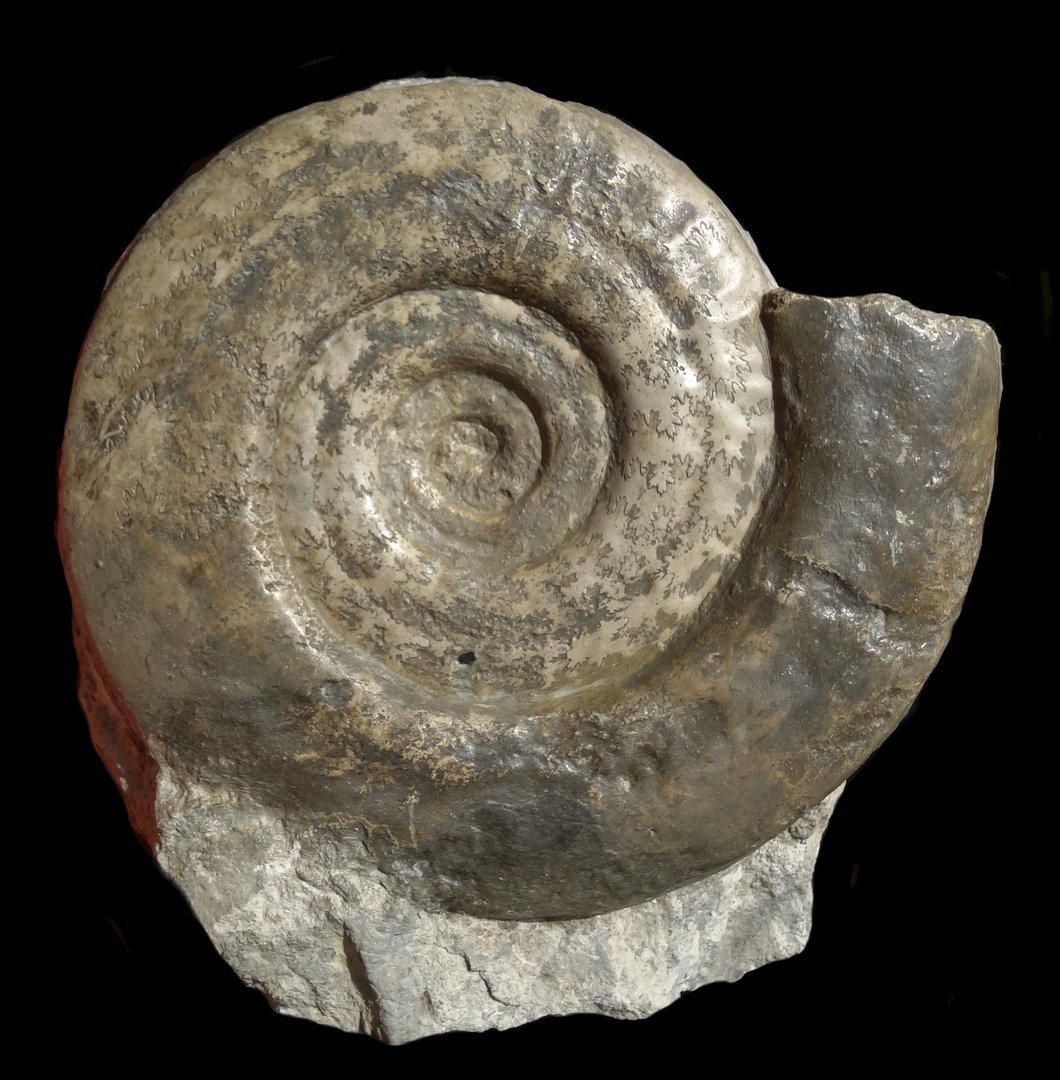
Hildoceras bifrons
Image: Image sourced via web search (Fair use / Educational)
About Hildoceras
Hildoceras is an extinct genus of ammonite cephalopod that lived during the Toarcian Age of the Early Jurassic Period, approximately 183 to 175 million years ago. Its fossils are found worldwide, making it a crucial index fossil for dating Jurassic marine strata. The type species, Hildoceras bifrons, is particularly renowned for its distinctive, beautifully preserved shells, which provide invaluable insights into the biology of ammonites and the marine ecosystems of the Mesozoic Era.
Hildoceras bifrons possessed a moderately evolute, discoidal shell, meaning the whorls were somewhat compressed and only partially overlapped, leaving the inner whorls visible. The shell typically ranged from 5 to 20 centimeters in diameter, with some exceptional specimens reaching slightly larger sizes. For comparison, a common specimen would fit comfortably in the palm of a human hand. The most striking feature of its shell is the prominent, single, deep groove, or sulcus, running along the mid-venter (the outer edge) of the outer whorls. Flanking this groove are strong, falcoid (sickle-shaped) ribs that curve gracefully from the umbilical seam towards the venter, becoming more pronounced on the outer part of the whorl. The cross-section of the whorl is subquadrate to compressed. The suture lines—the complex, folded walls separating the internal chambers (camerae)—are intricately detailed, a characteristic of the Ammonitida order. These chambers were filled with gas, allowing the animal to control its buoyancy in the water column, much like the modern nautilus. While soft tissues are not preserved, it is inferred that the living animal resembled a squid or octopus, with a head, large eyes, and numerous tentacles protruding from the shell's aperture, which it used for capturing prey and for locomotion.
The paleobiology of Hildoceras is inferred from its shell morphology and its relationship to modern cephalopods. As a carnivore, it likely preyed upon small marine organisms such as crustaceans, small fish, and possibly other cephalopods. Its streamlined, discoidal shell suggests it was an active swimmer (a nektonic organism), capable of moderate speeds to pursue prey and evade predators. Locomotion was achieved by jet propulsion, expelling water from a siphon. The intricate suture lines provided structural support to the shell, allowing it to withstand the immense pressures of deeper waters, suggesting it could inhabit a range of depths within the water column, from near-surface to the mesopelagic zone. Its global distribution indicates it was a successful and adaptable genus. Growth patterns are visible in the shell's structure, with new chambers being added to the aperture as the animal grew. Like modern cephalopods, Hildoceras likely had a relatively short lifespan, possibly only a few years, characterized by rapid growth and culminating in a single reproductive event. The presence of both microconchs (smaller, presumed male shells) and macroconchs (larger, presumed female shells) in some ammonite groups suggests sexual dimorphism may have been present in Hildoceras as well, though this is still a subject of study.
Hildoceras lived in the warm, shallow epicontinental seas that covered much of Europe and other parts of the world during the Toarcian Age. This period was marked by a significant oceanic anoxic event, which led to widespread extinction but also created conditions for the exceptional preservation of fossils in black shales. The climate was generally warm and humid, with no polar ice caps. Hildoceras shared its marine habitat with a diverse array of life. It was a mid-level predator in the food web, likely preyed upon by larger marine reptiles such as ichthyosaurs like Stenopterygius and plesiosaurs. It coexisted with other ammonites, such as Dactylioceras, belemnites, bivalves like Posidonia, crinoids, and various fish. The seabed was often a soft, muddy substrate, which, under anoxic conditions, allowed for the rapid burial and subsequent fossilization of organisms that fell to the bottom. The abundance of Hildoceras fossils in specific layers indicates it was a dominant component of the pelagic fauna of its time, playing a critical role in the marine ecosystem's structure.
The discovery and study of Hildoceras are deeply intertwined with the history of paleontology in England. The type species, Hildoceras bifrons, was first formally described by the Belgian paleontologist Jean-Jacques d'Omalius d'Halloy in 1842, but the fossils themselves were known for centuries before. They are famously abundant in the Whitby Mudstone Formation (formerly known as the Upper Lias) exposed along the coast of Yorkshire, England. These fossils, often called 'snakestones' in local folklore, were collected by early geologists like William 'Strata' Smith, who used them to develop the principles of biostratigraphy. The genus name 'Hildoceras' honors Saint Hilda of Whitby (614–680 AD), an abbess who, according to legend, turned a plague of snakes into stone, thus explaining the coiled, snake-like appearance of the ammonites found there. The species name 'bifrons' is Latin for 'two-fronted' or 'two-faced,' likely referring to the distinct ornamentation on the inner and outer parts of the whorl. The specimens from Whitby are renowned for their exceptional preservation, often retaining their original aragonitic shell material and sometimes being preserved as pyritized internal molds, giving them a beautiful golden sheen.
Hildoceras holds immense evolutionary and stratigraphic significance. As a member of the family Hildoceratidae, it represents a key lineage within the Ammonitida that flourished during the Jurassic. The rapid evolution and widespread geographic distribution of different Hildoceras species make them one of the most important index fossils for the Toarcian Age. Geologists and paleontologists can precisely date rock layers around the world by identifying the specific Hildoceras species present, a cornerstone of biostratigraphy. The Bifrons Zone, named after Hildoceras bifrons, is a globally recognized biostratigraphic unit. The evolution of the Hildoceratidae showcases trends in ammonite morphology, including changes in coiling, ribbing, and suture complexity, providing a detailed case study of macroevolutionary patterns in the fossil record. Although ammonites have no direct living descendants, their closest living relatives are the coleoids (octopus, squid, and cuttlefish), and more distantly, the nautiloids. Studying Hildoceras helps scientists understand the diversity, biology, and eventual extinction of this incredibly successful group of cephalopods that dominated the world's oceans for over 300 million years.
While the taxonomy of Hildoceras bifrons is well-established, scientific debate continues regarding the finer points of its paleobiology and the classification of related species. One area of ongoing research is the precise function of the complex suture lines; while their role in shell strengthening is accepted, the exact hydrodynamic and metabolic advantages of specific patterns are still being modeled and discussed. Another debate revolves around the mode of life. While a nektonic (free-swimming) lifestyle is widely accepted, the specific depth range and migratory patterns of Hildoceras are inferred and subject to revision as new geochemical evidence, such as stable isotope analysis of shell material, becomes available. These analyses can provide clues about the temperature and salinity of the water the ammonite inhabited during its life. Furthermore, the classification within the superfamily Hildoceratoidea is complex, with ongoing revisions as new fossil discoveries refine our understanding of the relationships between different genera and the evolutionary pathways they followed during the Jurassic.
The fossil record of Hildoceras is exceptionally rich and geographically widespread. Fossils are most famously found in the Jurassic Coast of Dorset and the Yorkshire coast of England, particularly in the Whitby Mudstone Formation. However, the genus had a cosmopolitan distribution, and its fossils are also found in other parts of Europe (France, Germany, Italy, Spain, Hungary), North Africa, the Caucasus, Siberia, Japan, and North and South America. The sheer abundance of specimens makes Hildoceras a common fossil, accessible to both professional paleontologists and amateur collectors. Preservation is often excellent, with many fossils retaining fine details of the shell ornamentation and suture lines. Complete, uncrushed shells are common, often preserved as calcite, aragonite, or pyrite internal molds. The famous fossil beds of Whitby, England, and the Posidonia Shale of Holzmaden, Germany, have produced tens of thousands of high-quality Hildoceras specimens, making it one of the best-represented of all ammonite genera.
Due to its beautiful and distinctive spiral shell, Hildoceras has had a notable cultural impact. It is one of the most recognizable and iconic ammonites, frequently featured in fossil books, museum displays, and educational materials about the Jurassic period. The 'snakestone' legend of St. Hilda of Whitby is a famous piece of English folklore, and local artisans in Yorkshire have historically carved snake heads onto Hildoceras fossils to sell to tourists, a tradition that continues today. Major natural history museums worldwide, including the Natural History Museum in London and the Senckenberg Museum in Frankfurt, feature prominent displays of Hildoceras bifrons, showcasing its scientific importance and aesthetic appeal. Its role as a key index fossil makes it a fundamental part of geological and paleontological education, serving as a perfect example of how fossils can be used to read the history of our planet.
Classification
Time Period
Discovery
Location
England
Formation
Whitby Mudstone Formation (formerly Upper Lias)
Frequently Asked Questions
What is Hildoceras?
Hildoceras is an extinct genus of ammonite cephalopod that lived during the Toarcian Age of the Early Jurassic Period, approximately 183 to 175 million years ago. Its fossils are found worldwide, making it a crucial index fossil for dating Jurassic marine strata. The type species, Hildoceras bifrons...
When did Hildoceras live?
Hildoceras lived during the jurassic period of the mesozoic era approximately 183-175 million years ago.
Where was Hildoceras discovered?
Fossils of Hildoceras were discovered in England in the Whitby Mudstone Formation (formerly Upper Lias).
What did Hildoceras eat?
Hildoceras was a carnivore. It lived in marine habitats.
What type of fossil is Hildoceras?
Hildoceras is preserved as a body fossil. The preservation quality is excellent.
Related Specimens
From the mesozoic era · body fossils