Tapejara
Tapejara wellnhoferi
Image: Image sourced via web search (Fair use / Educational)
About Tapejara
Tapejara wellnhoferi was a remarkable genus of Brazilian pterosaur dating from the Early Cretaceous period, specifically the Albian stage, approximately 112 to 108 million years ago. Discovered in the famous fossil beds of the Araripe Basin in northeastern Brazil, this flying reptile represents a crucial piece of the puzzle in understanding the diversity and ecological adaptations of azhdarchoid pterosaurs. The name Tapejara translates to 'the old being' in the indigenous Tupi language, a fitting moniker for an animal that soared through the skies millions of years before the advent of modern birds. Tapejara is particularly significant in paleontology because it was one of the first pterosaurs discovered with a highly specialized, short, and downturned toothless beak, which radically changed scientific perspectives on pterosaur diets and ecological niches. Prior to its discovery, most well-known pterosaurs were presumed to be piscivores or generalist carnivores, but Tapejara pointed toward a much more diverse range of feeding strategies, including potential frugivory or omnivory. Its discovery helped establish the family Tapejaridae, a group of bizarrely crested, short-faced pterosaurs that achieved a global distribution during the Cretaceous.
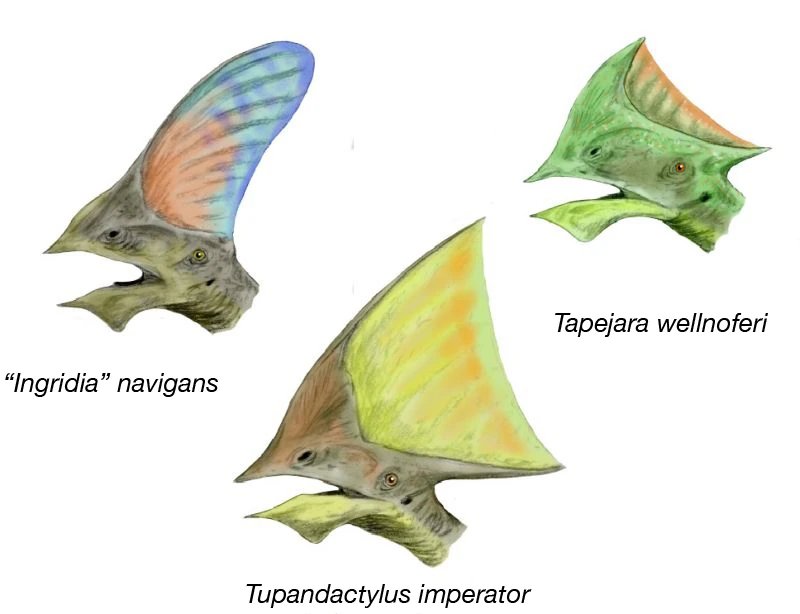
The physical anatomy of Tapejara wellnhoferi is defined by its highly unusual cranial morphology. Unlike the elongated, toothed snouts of earlier pterosaurs like Rhamphorhynchus or contemporary ornithocheirids, Tapejara possessed a short, deep skull with a pronounced, downturned rostrum that strongly resembled the beak of a modern parrot or macaw. The skull was adorned with a prominent sagittal crest that began at the tip of the snout and extended backward over the top of the head. This bony crest was relatively modest compared to some of its later relatives, but it likely supported a much larger extension of soft tissue, possibly made of keratin or skin, which could have been brightly colored for display purposes. In terms of size, Tapejara wellnhoferi was a medium-sized pterosaur. Its wingspan is estimated to have been around 1.5 to 3.5 meters (approximately 5 to 11.5 feet), making it roughly comparable in wingspan to a modern albatross or a large eagle, though its body mass was significantly lighter due to the extreme pneumatization of its skeleton. Weight estimates vary, but it likely weighed between 5 and 10 kilograms. The postcranial skeleton reveals robust forelimbs adapted for powerful flight, alongside relatively long hind limbs that suggest it was quite capable of terrestrial locomotion. Soft tissue inferences, drawn from related tapejarids and well-preserved pterosaur specimens, indicate that Tapejara was covered in pycnofibers—hair-like filaments that provided insulation, suggesting a warm-blooded metabolism. Its large eyes, positioned laterally on the skull, would have provided excellent stereoscopic vision, a crucial adaptation for a flying animal navigating complex environments.
The paleobiology of Tapejara is a subject of intense scientific interest, particularly regarding its diet and feeding strategies. The parrot-like beak of Tapejara has led many paleontologists to hypothesize that it was primarily a frugivore or a seed-eater, utilizing its strong, toothless jaws to crack open tough plant material or pluck fruits from the canopy of Cretaceous gymnosperms and early angiosperms. This would make Tapejara one of the earliest known flying vertebrates to exploit a fruit-based diet, potentially playing a role in seed dispersal. However, other researchers argue for an omnivorous or opportunistic scavenging lifestyle, suggesting that the robust beak could have also been used to crush the shells of terrestrial invertebrates or small vertebrates. In terms of locomotion, Tapejara was an adept flyer, but its wing morphology suggests it was adapted for maneuverability in cluttered environments, such as forests or coastal woodlands, rather than for long-distance dynamic soaring over open oceans. When on the ground, Tapejara is believed to have been a quadrupedal walker, using its long limbs to adopt a relatively upright, digitigrade stance. This terrestrial capability suggests it spent a significant amount of time foraging on the ground or in the lower branches of trees. Social behavior is difficult to infer directly from the fossil record, but the presence of the elaborate cranial crest strongly implies that visual communication played a vital role in its life. These crests were likely sexually dimorphic and used in courtship displays, species recognition, or establishing social hierarchies, similar to the elaborate casques of modern hornbills or the colorful bills of toucans. Growth patterns inferred from bone histology indicate that tapejarids grew rapidly, reaching adult size in a matter of years, which aligns with the high metabolic rates expected of active, endothermic flyers.
The ecological context of Tapejara wellnhoferi is rooted in the Early Cretaceous environment of the Araripe Basin, a region that is now part of northeastern Brazil. During the Albian stage, this area was characterized by a complex system of brackish lagoons, shallow inland seas, and coastal environments, created as the supercontinent of Gondwana continued to rift apart, separating South America from Africa. The climate was generally warm, arid to semi-arid, with distinct wet and dry seasons. The terrestrial landscape surrounding the water bodies was vegetated with a mix of ferns, cycads, conifers, and some of the earliest flowering plants (angiosperms), providing a rich and evolving floral ecosystem. Tapejara shared this vibrant habitat with a spectacular array of other prehistoric creatures. The skies were crowded with other pterosaurs, including the giant, fish-eating ornithocheirids like Anhanguera and Tropeognathus, as well as other tapejarids. The waters below teemed with diverse fish populations, which supported the piscivorous pterosaurs and aquatic predators. On land, the ecosystem was populated by various dinosaurs, including the spinosaurid Irritator, which likely hunted along the water's edge, and small coelurosaurs like Santanaraptor. In this complex food web, Tapejara likely occupied a unique niche as a terrestrial or arboreal forager, avoiding direct competition with the large, marine-focused pterosaurs. Its potential role as a frugivore or omnivore would have linked it closely to the evolving plant life of the region, making it an integral part of the terrestrial ecosystem rather than a purely coastal or marine animal.
The discovery history of Tapejara is intimately tied to the rich paleontological heritage of Brazil. The genus was first described and named in 1989 by the prominent Brazilian paleontologist Alexander Kellner. The type species, Tapejara wellnhoferi, was named in honor of the renowned German pterosaur expert Peter Wellnhofer, acknowledging his massive contributions to the study of flying reptiles. The holotype specimen was discovered in the Romualdo Member of the Santana Formation, a geological unit famous for its exceptional, three-dimensionally preserved fossils encased in calcareous nodules. The initial discovery consisted of a partial skull that clearly demonstrated the unique, short-snouted morphology that set it apart from previously known pterosaurs. In the years following the initial description, several other species were assigned to the genus Tapejara, most notably Tapejara imperator and Tapejara navigans. These species possessed massive, sail-like cranial crests that were much larger than that of T. wellnhoferi. However, the classification of these species sparked significant debate, and they were eventually reassigned to a new genus, Tupandactylus, leaving Tapejara wellnhoferi as the sole undisputed species within its genus. The discovery of Tapejara was a watershed moment in South American paleontology, highlighting the Araripe Basin as one of the most important pterosaur fossil sites in the world and showcasing the incredible morphological diversity that these animals achieved during the Cretaceous.
In terms of evolutionary significance, Tapejara occupies a pivotal position within the pterosaur family tree. It is a basal member of the clade Azhdarchoidea, a major group of advanced, toothless pterosaurs that dominated the Cretaceous skies and eventually gave rise to the colossal azhdarchids, such as Quetzalcoatlus and Hatzegopteryx, which were the largest flying animals in Earth's history. Tapejara and its close relatives in the family Tapejaridae represent an early radiation of azhdarchoids that specialized in terrestrial and arboreal niches, diverging from the typical piscivorous lifestyles of their ancestors. The evolution of the toothless, keratinous beak in Tapejara is a classic example of convergent evolution, mirroring the later development of similar structures in birds. This adaptation allowed for a lighter skull and facilitated new feeding strategies, such as frugivory and hard-object feeding. Furthermore, the elaborate cranial crests seen in Tapejara and other tapejarids provide crucial insights into the evolution of display structures and sexual selection in extinct archosaurs. By studying Tapejara, paleontologists can trace the evolutionary steps that led from the relatively simple, toothed pterosaurs of the Jurassic to the highly specialized, bizarrely ornamented, and ecologically diverse azhdarchoids of the Late Cretaceous, demonstrating the remarkable adaptability and evolutionary success of the Pterosauria.
Scientific debates surrounding Tapejara have primarily focused on its taxonomy and its feeding ecology. The most significant taxonomic controversy involved the splitting of the genus. For many years, Tapejara imperator, with its enormous, sail-like crest, was considered the most famous representative of the genus. However, detailed morphological analyses eventually revealed that T. imperator and T. navigans were distinct enough from T. wellnhoferi to warrant their own genus, Tupandactylus. This revision clarified the evolutionary relationships within the Tapejaridae but required a shift in how the genus Tapejara was defined in the scientific literature. Another ongoing debate centers on the exact diet of Tapejara. While the frugivory hypothesis is popular and supported by the parrot-like beak, biomechanical studies of the skull and jaw musculature suggest that the bite force may not have been sufficient to crack hard seeds or nuts. Some researchers argue that Tapejara may have been a generalist omnivore, feeding on soft fruits, insects, and small vertebrates, or perhaps even a scavenger that used its beak to tear flesh from carcasses. The lack of direct fossil evidence, such as gut contents or coprolites, means that the precise diet of Tapejara remains a subject of active research and interpretation, highlighting the challenges of reconstructing the behavior of extinct animals from skeletal remains alone.
The fossil record of Tapejara is geographically restricted but of exceptionally high quality. All confirmed specimens of Tapejara wellnhoferi have been recovered from the Romualdo Member of the Santana Formation in the Araripe Basin of northeastern Brazil. The preservation quality in this formation is world-renowned; fossils are typically found encased in hard, calcareous nodules that protect the bones from crushing and distortion during fossilization. As a result, Tapejara skulls and postcranial bones are often preserved in pristine, three-dimensional detail, allowing for highly accurate anatomical reconstructions and biomechanical studies. While the total number of known specimens is relatively small compared to some other pterosaurs, the quality of the material compensates for the lack of quantity. The fossil record primarily consists of cranial material, which is robust enough to survive the fossilization process, but partial postcranial skeletons have also been discovered, providing valuable information about the animal's wings, limbs, and overall body proportions. The Santana Formation remains one of the most critical windows into Early Cretaceous life, and the fossils of Tapejara recovered from this site continue to yield new insights into pterosaur biology.
The cultural impact of Tapejara has been significant, particularly within the realm of paleoart and educational media. Its bizarre, crested appearance and parrot-like beak make it a visually striking animal that frequently appears in books, documentaries, and museum exhibits about prehistoric life. Although the more extravagantly crested Tupandactylus (formerly Tapejara imperator) often steals the spotlight in popular depictions, Tapejara wellnhoferi remains a staple representation of the diverse and unusual pterosaurs of South America. It has been featured in various television series, such as the BBC's 'Walking with Dinosaurs' franchise, where it is often depicted in its hypothesized role as a coastal or arboreal frugivore. In museums, casts and reconstructions of Tapejara skulls are popular exhibits, used to educate the public about the incredible diversity of pterosaurs and the concept of convergent evolution between extinct flying reptiles and modern birds. The public fascination with Tapejara underscores the enduring appeal of pterosaurs as some of the most alien and spectacular creatures to have ever inhabited our planet.
Classification
Time Period
Discovery
Location
Brazil
Formation
Santana Formation
Frequently Asked Questions
What is Tapejara?
Tapejara wellnhoferi was a remarkable genus of Brazilian pterosaur dating from the Early Cretaceous period, specifically the Albian stage, approximately 112 to 108 million years ago. Discovered in the famous fossil beds of the Araripe Basin in northeastern Brazil, this flying reptile represents a cr...
When did Tapejara live?
Tapejara lived during the cretaceous period of the mesozoic era approximately 112-108 million years ago.
Where was Tapejara discovered?
Fossils of Tapejara were discovered in Brazil in the Santana Formation.
What did Tapejara eat?
Tapejara was a omnivore. It lived in aerial habitats.
What type of fossil is Tapejara?
Tapejara is preserved as a body fossil. The preservation quality is excellent.
Related Specimens
From the mesozoic era · body fossils