Nodosaurus
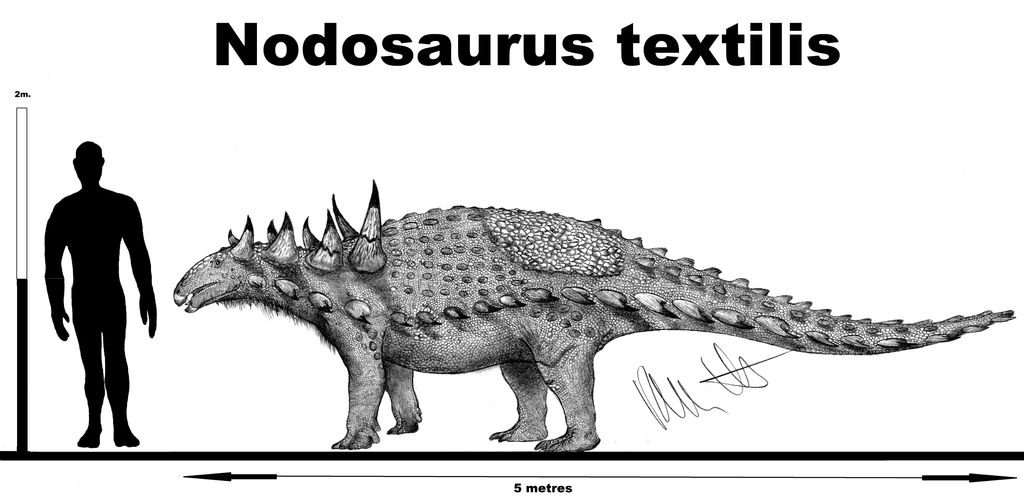
Nodosaurus textilis
Image: Image sourced via web search (Fair use / Educational)
About Nodosaurus
Nodosaurus textilis represents a quintessential example of the armored dinosaurs that roamed North America during the Late Cretaceous period, approximately 110 to 100 million years ago. As the namesake of the family Nodosauridae, this heavily-built herbivore provides a crucial window into the evolution of defensive adaptations among dinosaurs. Its discovery in the late 19th century helped define a major group of ankylosaurs, characterized by their formidable armor but lack of a tail club, making it a historically and scientifically significant genus in the study of Mesozoic life.
Nodosaurus was a medium-sized, quadrupedal dinosaur, estimated to be between 4 and 6 meters (13 to 20 feet) in length and weighing around 1.5 to 2.5 metric tons (3,300 to 5,500 pounds). Its most striking feature was its extensive body armor, composed of osteoderms—bony plates and nodules embedded in the skin. This armor was arranged in parallel rows running along its back, neck, and tail, creating a protective shield. The name Nodosaurus, meaning 'knobbed lizard,' refers to these prominent bony scutes. The species name, textilis, meaning 'woven,' was chosen by its discoverer, Othniel Charles Marsh, to describe the intricate, patterned texture of the dermal armor. Unlike its relatives in the Ankylosauridae family, such as Ankylosaurus, Nodosaurus lacked a bony tail club, instead possessing a long, stiff tail that was also armored. Its skull was narrow and pear-shaped, with a small brain cavity, and its teeth were small and leaf-shaped, suitable for cropping low-lying vegetation. Its limbs were stout and powerful, particularly the forelimbs, supporting its heavy body and suggesting a slow, deliberate gait comparable to that of a modern rhinoceros or hippopotamus.
As a low-browsing herbivore, the paleobiology of Nodosaurus was centered around the consumption of ground-level plants. Its narrow snout suggests a selective feeding strategy, likely targeting soft, non-fibrous vegetation such as ferns, cycads, and early flowering plants. The small, weak teeth were not designed for extensive chewing; instead, it likely used a simple slicing or chopping motion to process food, which was then further broken down in a large, complex gut through fermentation, a process common in large herbivores. Locomotion in Nodosaurus was slow and steady, a necessity for a creature of its bulk and build. Its robust limbs and graviportal stance indicate it was not capable of running at high speeds. Instead of fleeing from predators, its primary defense was its formidable armor, which would have made it a difficult target for even the largest carnivores of its time. It likely hunkered down when threatened, presenting an impenetrable fortress of bone and scutes. There is no direct fossil evidence for social behavior, but like many large herbivores, it is plausible that they were solitary or lived in small, loosely-associated groups, roaming across the landscape in search of food and water.
The world Nodosaurus inhabited during the Albian to Cenomanian stages of the Cretaceous was a warm, humid environment characterized by extensive coastal plains, river systems, and lush forests. It lived in what is now western North America, which at the time was part of the western coast of the Western Interior Seaway, an epicontinental sea that divided the continent. The climate was subtropical, supporting a rich and diverse flora that formed the base of the food web. Nodosaurus shared its habitat with a variety of other dinosaurs. Fellow herbivores included other ornithischians like the iguanodontian Zephyrosaurus and the early hadrosauroid Eolambia. The ecosystem was also home to formidable predators, placing Nodosaurus squarely in the position of prey. The primary threat would have come from large theropods such as the carcharodontosaurid Acrocanthosaurus and early tyrannosauroids. The defensive armor of Nodosaurus was a direct evolutionary response to this intense predation pressure, allowing it to survive and thrive in a dangerous world. Its role in the ecosystem was that of a primary consumer, converting plant matter into a food source for the apex predators that were capable of penetrating its defenses.
The discovery of Nodosaurus has its roots in the 'Bone Wars,' the fierce 19th-century rivalry between paleontologists Othniel Charles Marsh and Edward Drinker Cope. The holotype specimen, YPM 1815, was discovered in 1889 by William H. Reed, a collector working for Marsh, in the Frontier Formation of Wyoming. The fossil was incomplete, consisting of several articulated vertebrae, a partial sacrum, parts of the pelvic girdle, and numerous osteoderms. Despite the fragmentary nature of the find, Marsh recognized its significance and, in the same year, named and described it as Nodosaurus textilis. He correctly identified it as a new type of armored dinosaur, distinct from Stegosaurus, which he had also named. This initial discovery was crucial as it established the basis for the Nodosauridae family. While YPM 1815 remains the type specimen, other fragmentary remains attributed to Nodosaurus have since been found in both Wyoming and Kansas. However, the genus remains known from relatively sparse material, and no complete skeleton has ever been unearthed, which has limited a more detailed understanding of its anatomy compared to more well-preserved relatives like Borealopelta.
Nodosaurus holds a key position in the evolutionary history of dinosaurs, specifically within the Thyreophora, the group of 'shield-bearers' that also includes stegosaurs. It is the type genus for the family Nodosauridae, one of the two major branches of the larger Ankylosauria clade. Nodosaurids are distinguished from their cousins, the ankylosaurids, primarily by their narrower skulls, lack of a tail club, and often the presence of prominent shoulder spines, although the latter is not confirmed for Nodosaurus itself due to incomplete fossils. The evolution of nodosaurids represents a successful defensive strategy that relied purely on passive armor rather than active, weaponized defense like the tail clubs of ankylosaurids. This divergence illustrates two different evolutionary pathways to solving the problem of predation. Nodosaurus and its relatives show a trend towards increasingly heavy and complex armor throughout the Cretaceous, culminating in forms like Edmontonia and Panoplosaurus. As an early member of this lineage, Nodosaurus helps paleontologists trace the development of these features and understand the diversification of armored dinosaurs in North America during the Cretaceous period.
Despite its historical importance, Nodosaurus has been the subject of some scientific debate, primarily concerning its exact taxonomic placement and the referral of other fossil material to the genus. Because the holotype is so incomplete, it is difficult to compare it definitively with more complete nodosaurid skeletons discovered later. Some paleontologists have argued that Nodosaurus should be considered a nomen dubium, or 'doubtful name,' because the type specimen may lack sufficient diagnostic features to distinguish it from other nodosaurids. For example, some material previously assigned to Nodosaurus has since been reclassified into new genera, such as the well-preserved 'Casper Nodosaur' which was later named Borealopelta. The debate centers on whether the unique texture of the armor described by Marsh is a truly diagnostic feature or simply a variation seen in other related species. Resolving this requires the discovery of more complete and associated skeletal material of Nodosaurus textilis, which would allow for a more robust comparison with other members of its family and solidify its validity as a distinct genus.
The fossil record of Nodosaurus is relatively sparse and geographically restricted. The primary fossils, including the holotype, have been found in the Frontier Formation of Wyoming and potentially the Cedar Mountain Formation of Utah. These formations preserve sediments from the coastal plain environments of the early Late Cretaceous. The known material is fragmentary, consisting mostly of isolated osteoderms, vertebrae, and limb bone fragments. No complete skulls or articulated skeletons have been definitively assigned to Nodosaurus textilis. This scarcity makes it a rare dinosaur in the fossil record compared to contemporaries like hadrosaurs or ceratopsians. The preservation quality of the known specimens is generally fair, sufficient for initial description but lacking the fine detail seen in exceptional fossils like the 'mummified' Borealopelta from Canada. The limited fossil evidence means that many aspects of Nodosaurus's appearance and biology are inferred from its more completely known relatives, highlighting the ongoing need for new discoveries to flesh out our understanding of this foundational armored dinosaur.
In popular culture, Nodosaurus is less famous than its tail-clubbed relative, Ankylosaurus, but it holds a significant place in paleontological history and education. It is often featured in dinosaur encyclopedias and educational materials as the archetypal example of a nodosaurid. Museums with significant North American Cretaceous collections, such as the Yale Peabody Museum of Natural History (which houses the holotype), may feature casts or illustrations of Nodosaurus to represent this important group of armored dinosaurs. While it rarely appears as a major 'character' in films or television, its image as a walking fortress helps illustrate the incredible diversity of dinosaur forms and the complex predator-prey dynamics of the Mesozoic Era. Its legacy is primarily scientific, providing the name and the original concept for an entire family of fascinating, heavily-armored herbivores.
Classification
Time Period
Discovery
Location
Wyoming, USA
Formation
Frontier Formation, Cedar Mountain Formation
Frequently Asked Questions
What is Nodosaurus?
Nodosaurus textilis represents a quintessential example of the armored dinosaurs that roamed North America during the Late Cretaceous period, approximately 110 to 100 million years ago. As the namesake of the family Nodosauridae, this heavily-built herbivore provides a crucial window into the evolut...
When did Nodosaurus live?
Nodosaurus lived during the cretaceous period of the mesozoic era approximately 110-100 million years ago.
Where was Nodosaurus discovered?
Fossils of Nodosaurus were discovered in Wyoming, USA in the Frontier Formation, Cedar Mountain Formation.
What did Nodosaurus eat?
Nodosaurus was a herbivore. It lived in terrestrial habitats.
What type of fossil is Nodosaurus?
Nodosaurus is preserved as a body fossil. The preservation quality is fair.
Related Specimens
From the mesozoic era · body fossils