Cephalaspis
Cephalaspis lyelli
Image: Image sourced via web search (Fair use / Educational)
About Cephalaspis
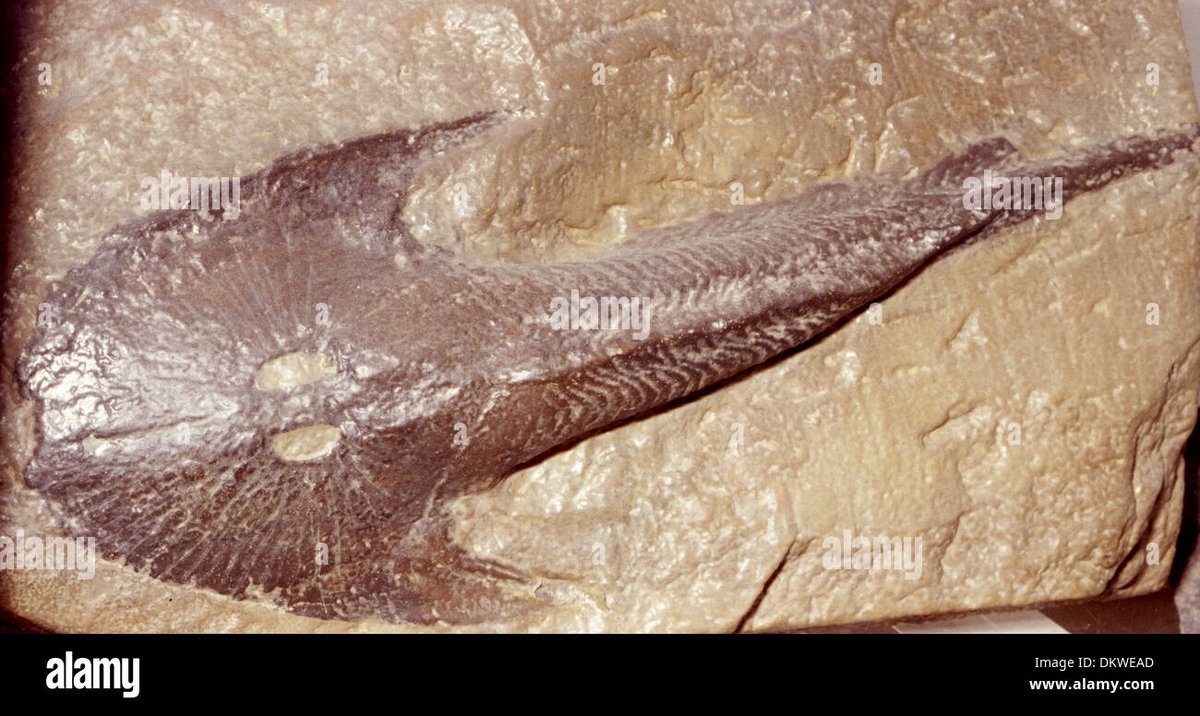
Cephalaspis lyelli is an extinct genus of jawless fish that thrived in the freshwater rivers and estuaries of the Early Devonian period, approximately 419 to 393 million years ago. As a prominent member of the Osteostraci class, its fossils, particularly from the Old Red Sandstone formations of Europe and North America, provide a crucial window into the early evolution of vertebrates. Its distinctive armored head shield and unique sensory fields make it a cornerstone for understanding the diversification of fish before the rise of jaws.
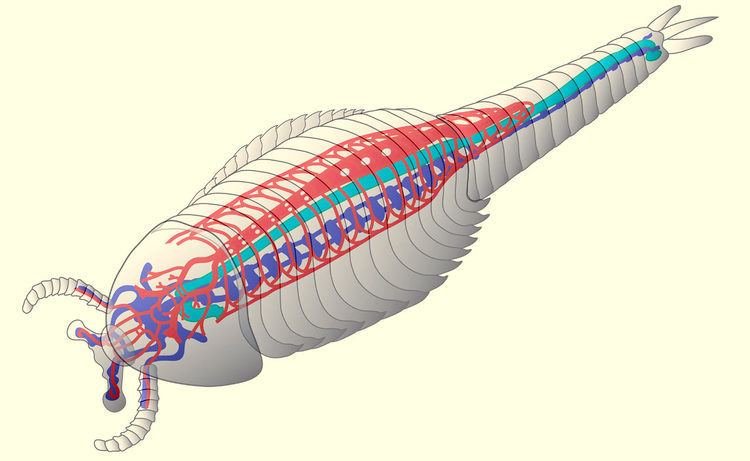
Cephalaspis was a relatively small fish, typically measuring between 20 to 30 centimeters in length, comparable to a modern-day trout or large goldfish. Its most defining characteristic was the massive, crescent-shaped or horseshoe-shaped cephalic shield that covered its head and the anterior part of its trunk. This shield was a solid piece of dermal bone, providing significant protection against predators like the formidable eurypterids (sea scorpions). The shield's surface was often ornamented with small tubercles. Two closely set eyes were positioned dorsally on top of the head, suggesting a bottom-dwelling lifestyle. Between the eyes was a single, median nostril, and just behind that, a keyhole-shaped opening for the pineal gland, a light-sensitive organ. The underside of the shield was flat, featuring a small, jawless mouth adapted for suction-feeding. Behind the shield, the body was more traditionally fish-like, covered in smaller, rhombic scales and tapering towards a heterocercal tail, where the vertebral column extends into the upper lobe. A single dorsal fin and a pair of pectoral fins, which were actually fleshy, fin-like lobes emerging from the posterior corners of the head shield, provided stability and maneuverability. Its internal skeleton was cartilaginous, but the head shield was heavily ossified, which is why it is so well-preserved in the fossil record.
Based on its anatomy, the paleobiology of Cephalaspis is interpreted as that of a benthic, or bottom-dwelling, creature. Its flattened ventral surface, dorsally placed eyes, and jawless, ventrally oriented mouth strongly indicate it spent its life scouring the substrate of freshwater riverbeds and deltas. It was likely a detritivore or microphagous feeder, using weak suction to ingest organic detritus, algae, and small invertebrates from the mud and sand. The powerful, muscular tail would have provided the main propulsive force for swimming, likely in short, rapid bursts to escape danger or move between feeding areas, while the pectoral lobes and dorsal fin would have acted as stabilizers. A key feature of the head shield are the areas known as 'sensory fields' on the dorsal and lateral surfaces. For many years, these were thought to be electric organs, but modern consensus suggests they were pressure-sensitive or vibration-detecting lateral line organs, allowing Cephalaspis to detect the movement of prey hidden in the sediment or the approach of predators from above. There is no direct evidence of social behavior, but given their abundance in certain fossil deposits, it is plausible they congregated in favorable feeding grounds. Their heavy armor suggests a slow metabolism, typical of many bottom-feeders that rely on defense rather than speed.
Cephalaspis lived during the Early Devonian, a time often called the 'Age of Fishes' due to the incredible diversification of aquatic vertebrates. The world's geography was dominated by the supercontinents of Gondwana in the south and Euramerica (also known as Laurussia or the Old Red Sandstone Continent) in the north. Cephalaspis inhabited the freshwater river systems, lakes, and estuaries that crisscrossed Euramerica. The climate was generally warm and arid, and these river systems were subject to seasonal fluctuations. The ecosystems were complex and competitive. Cephalaspis shared its habitat with a host of other jawless fish (agnathans), including other osteostracans, heterostracans like Pteraspis, and the anaspids. More significantly, this was the era when jawed fish (gnathostomes) were rapidly diversifying. Early placoderms (armored fish) and acanthodians ('spiny sharks') were becoming major players in the aquatic food web. The primary predators for a small, slow-moving fish like Cephalaspis would have been the giant aquatic arthropods, particularly the eurypterids, such as the fearsome Pterygotus, which could reach over two meters in length. Cephalaspis's position in the food web was that of a primary consumer or detritivore, forming a crucial link by processing organic matter at the bottom of the ecosystem and, in turn, becoming prey for larger carnivores.
The history of Cephalaspis discovery is deeply intertwined with the pioneering days of geology and paleontology in the 19th century. The first fossils were found in the distinctive red-colored sedimentary rock layers of Scotland, part of the extensive Old Red Sandstone formation. The Swiss naturalist Louis Agassiz, a monumental figure in ichthyology and geology, was the first to formally study and describe the genus. In his seminal work, 'Recherches sur les Poissons Fossiles' (Research on Fossil Fishes), published between 1833 and 1843, he established the genus Cephalaspis, meaning 'head shield'. The type species, Cephalaspis lyelli, was named in 1835 in honor of his contemporary and friend, the renowned geologist Sir Charles Lyell, who had provided him with some of the first specimens. The early interpretations of these strange, armored fossils were varied, but Agassiz correctly identified them as a type of fish. The exceptional preservation within the Old Red Sandstone allowed for detailed anatomical studies, and over the decades, numerous other species were assigned to the genus, though many have since been reclassified. The work of later paleontologists, notably Erik Stensiö in the early 20th century, who used serial grinding techniques to meticulously reconstruct the internal anatomy of the head shield, revolutionized the understanding of Cephalaspis and early vertebrate neuroanatomy, revealing details of the brain, nerves, and circulatory system.
Cephalaspis holds immense evolutionary significance as a classic example of the Osteostraci, one of the most advanced groups of jawless fish. The osteostracans are considered the sister group to all jawed vertebrates (gnathostomes), meaning they are our closest extinct relatives among the agnathans. This placement is supported by several key features. Most importantly, Cephalaspis possessed paired pectoral fins, a critical precursor to the paired limbs of terrestrial vertebrates. It also had a well-developed bony endoskeleton in the head shield, encasing the brain and sensory organs, which represents a major step in the evolution of the vertebrate cranium. The detailed impressions of its brain, cranial nerves, and inner ear preserved on the inner surface of the shield, as revealed by Stensiö's work, show a complexity that approaches the condition seen in early gnathostomes. By studying Cephalaspis, scientists can infer the primitive state of many vertebrate features just before the revolutionary evolution of jaws, providing a vital calibration point for understanding the anatomical and genetic changes that led to the rise of sharks, bony fish, and ultimately, all land-dwelling vertebrates, including humans. It is a perfect illustration of a successful evolutionary side-branch that demonstrates the anatomical toolkit present just prior to one of life's most important innovations.
Despite being a well-studied genus for nearly two centuries, Cephalaspis is still the subject of scientific debate. A primary area of contention has been its taxonomy. Historically, the genus became a 'wastebasket taxon', with dozens of species from across the Devonian world assigned to it. Modern phylogenetic analyses, however, have led to a significant revision, and many of these species have been moved to new genera. Today, the genus Cephalaspis is considered much less diverse, with some researchers arguing it may even be monotypic, containing only the type species, C. lyelli. Another long-standing debate concerned the function of the head shield's 'sensory fields'. Early hypotheses suggested they were electric organs for stunning prey or for electrolocation, similar to some modern fish. However, detailed histological studies have failed to find the necessary structures for generating electricity. The prevailing modern view, championed by Philippe Janvier and others, is that these were extensive expansions of the lateral line system, highly sensitive to water pressure and vibrations, which would have been invaluable for a bottom-feeder navigating murky waters and detecting both prey and predators without direct sight.
The fossil record of Cephalaspis is robust, particularly for the Early Devonian period. Its remains are most famously and abundantly found in the Old Red Sandstone deposits of Scotland, Wales, and the Welsh Borderlands. Similar fossils are also known from corresponding strata in western and eastern Europe (such as Norway's Spitsbergen archipelago) and parts of North America that were once connected as the Euramerican continent. The fossils are typically preserved as three-dimensional body fossils within sandstone or siltstone nodules. The most commonly preserved element is the heavily ossified cephalic shield, which is far more durable than the rest of the cartilaginous and lightly scaled body. Consequently, complete specimens showing the tail and trunk are much rarer than isolated head shields, but they do exist and provide a full picture of the animal's anatomy. The quality of preservation can be excellent, with some specimens retaining fine surface detail on the shield and, remarkably, internal impressions of the braincase, nerves, and blood vessels, which have been critical for anatomical studies. Famous fossil sites include the Achanarras Quarry in Scotland, which has yielded a wealth of Devonian fish fossils in a state of exceptional preservation.
Cephalaspis has secured a modest but firm place in popular culture as a quintessential example of an 'early armored fish'. Its bizarre yet recognizable form—a swimming head—has made it a staple in educational books, museum displays, and documentaries about prehistoric life. It was prominently featured in the influential 1999 BBC documentary series 'Walking with Monsters', where it was depicted navigating the dangerous Devonian rivers and falling prey to the giant eurypterid Pterygotus. This appearance cemented its image in the public consciousness. Major natural history museums, such as the National Museum of Scotland and the Natural History Museum in London, often feature well-preserved Cephalaspis fossils in their Paleozoic exhibits. Its importance lies in its educational value, serving as an accessible and visually striking introduction for the public to the strange world of early vertebrate evolution and the 'Age of Fishes'.
Classification
Time Period
Discovery
Location
Scotland, United Kingdom
Formation
Old Red Sandstone
Frequently Asked Questions
What is Cephalaspis?
Cephalaspis lyelli is an extinct genus of jawless fish that thrived in the freshwater rivers and estuaries of the Early Devonian period, approximately 419 to 393 million years ago. As a prominent member of the Osteostraci class, its fossils, particularly from the Old Red Sandstone formations of Euro...
When did Cephalaspis live?
Cephalaspis lived during the devonian period of the paleozoic era approximately 419-393 million years ago.
Where was Cephalaspis discovered?
Fossils of Cephalaspis were discovered in Scotland, United Kingdom in the Old Red Sandstone.
What did Cephalaspis eat?
Cephalaspis was a detritivore. It lived in freshwater habitats.
What type of fossil is Cephalaspis?
Cephalaspis is preserved as a body fossil. The preservation quality is good.
Related Specimens
From the paleozoic era · body fossils