Thalattosaurus
Thalattosaurus alexandrae
Image: Image sourced via web search (Fair use / Educational)
About Thalattosaurus
Thalattosaurus alexandrae, whose name translates to 'Alexandra's ocean lizard', is a fascinating and enigmatic marine reptile that swam in the shallow, warm seas of the Late Triassic period, approximately 228 to 209 million years ago. As the type genus for the order Thalattosauria, this creature represents a highly specialized group of diapsid reptiles that returned to an aquatic lifestyle shortly after their ancestors had conquered the land. Discovered in the Hosselkus Limestone of California, Thalattosaurus provides critical insights into the rapid diversification of marine ecosystems following the devastating Permian-Triassic extinction event. Its unique anatomical features, particularly its specialized dentition and elongated body, make it a subject of significant interest for paleontologists studying the evolutionary pathways of secondary marine adaptation in reptiles.
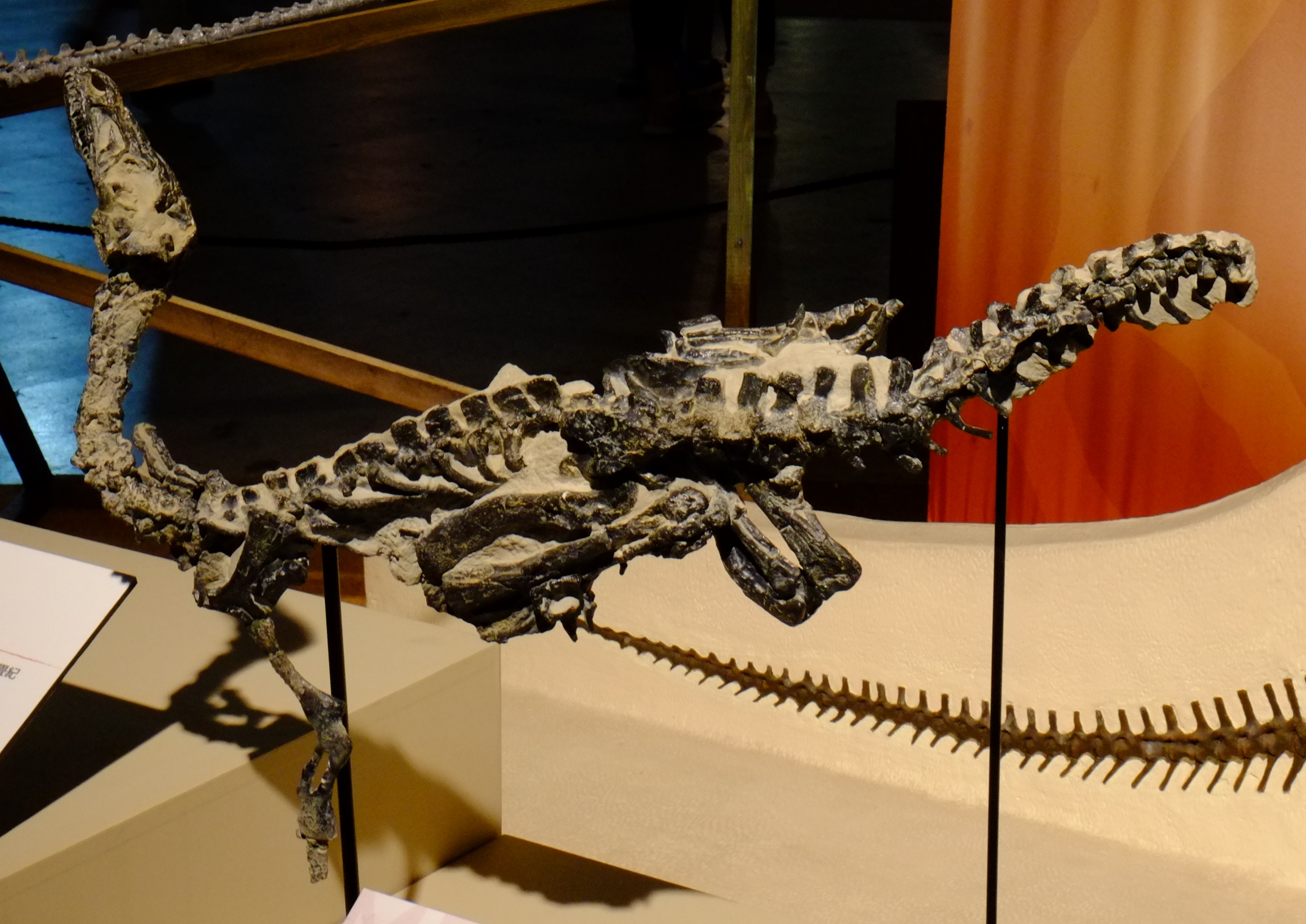
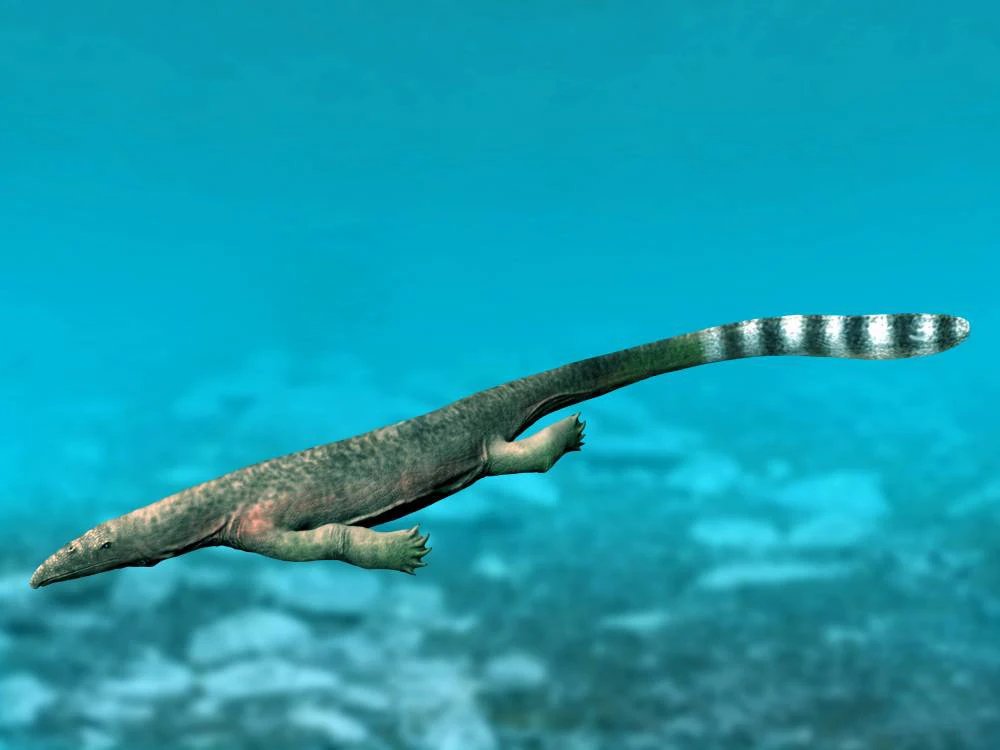
In terms of physical description, Thalattosaurus alexandrae was a moderately sized marine reptile, with adult specimens estimated to have reached lengths of approximately 2 to 3 meters (200 to 300 centimeters), making it roughly comparable in size to a modern Komodo dragon, albeit with a much more streamlined, aquatic build. Weight estimates suggest an animal of perhaps 30 to 50 kilograms, depending on the robustness of the individual and the extent of its soft tissue. The most distinctive feature of Thalattosaurus was its skull, which featured a notably elongated, downward-curving snout. The dentition was highly specialized and heterodont, meaning it possessed different types of teeth in its jaws. The anterior portion of the snout was equipped with pointed, conical teeth suited for grasping slippery prey, while the posterior regions of the jaws, particularly the palate and the dentary, housed robust, flattened, button-like teeth. This dental arrangement is a classic hallmark of durophagy, indicating an ability to crush hard-shelled organisms. The postcranial skeleton reveals a creature supremely adapted for a life in the water. It possessed a long, laterally compressed tail that would have served as its primary organ of propulsion. The limbs were relatively short and paddle-like, though not as highly modified into flippers as those seen in later ichthyosaurs or plesiosaurs. The digits remained distinct but were likely webbed in life. The ribs were thickened, a condition known as pachyostosis, which acted as ballast to help the animal maintain neutral buoyancy in the water column, a common adaptation in shallow-diving marine tetrapods. Soft tissue inferences suggest a smooth, perhaps slightly scaly integument, optimized for reducing hydrodynamic drag.
The paleobiology of Thalattosaurus alexandrae is largely inferred from its specialized anatomy, particularly its skull and teeth. The heterodont dentition strongly suggests a diet heavily reliant on hard-shelled invertebrates, a feeding strategy known as durophagy. Its primary prey likely included ammonites, bivalves, brachiopods, and possibly heavily scaled fish or small crustaceans that were abundant in the Triassic seas. The pointed front teeth would have been used to pluck or snatch these organisms from the sea floor or the water column, while the robust posterior teeth and strong jaw musculature would have been employed to crush the protective shells before swallowing. In terms of locomotion, Thalattosaurus was an axial swimmer. It relied on lateral undulations of its elongated body and powerful, flattened tail to propel itself through the water, a mode of swimming similar to that of modern marine iguanas or sea snakes. The paddle-like limbs were likely used primarily for steering and stabilization rather than for generating forward thrust. Given its pachyostotic ribs, it is probable that Thalattosaurus was a relatively slow, deliberate swimmer that inhabited shallow coastal waters, foraging along the bottom rather than engaging in high-speed pursuit of pelagic prey. Metabolism estimates suggest it was likely an ectotherm, relying on the warm ambient temperatures of the Triassic oceans to maintain its body heat. It may have occasionally hauled itself onto rocky shores or beaches to bask in the sun, much like modern marine iguanas, though its postcranial anatomy suggests it was quite clumsy on land. Growth patterns, as inferred from the bone histology of related thalattosaurs, indicate a relatively rapid initial growth phase followed by a slowing down upon reaching sexual maturity.
The ecological context of the Late Triassic world in which Thalattosaurus lived was one of dramatic recovery and innovation. Following the 'Great Dying' at the end of the Permian, marine ecosystems were being rebuilt from the ground up. The global climate was generally hot and arid, with no polar ice caps, and the world's landmasses were amalgamated into the supercontinent of Pangea. Thalattosaurus inhabited the Panthalassic Ocean, specifically the shallow, warm epicontinental seas that fringed the western coast of North America. These waters were teeming with life and supported complex food webs. The sea floor was dominated by extensive reefs built not by modern scleractinian corals, but by sponges, bivalves, and early reef-building organisms. Thalattosaurus shared its habitat with a diverse array of other marine reptiles, including early ichthyosaurs like Shastasaurus, which were the apex predators of the time, as well as placodonts, nothosaurs, and early plesiosaurs. In this ecosystem, Thalattosaurus occupied a specific mid-level niche as a specialized durophagous predator. It helped regulate the populations of hard-shelled invertebrates. While it was a predator itself, Thalattosaurus was not immune to predation. Juveniles and even smaller adults would have been potential prey for large, fast-swimming ichthyosaurs or massive predatory fish that patrolled the deeper waters adjacent to the coastal shelves.
The discovery history of Thalattosaurus is deeply intertwined with the early days of vertebrate paleontology in the American West. The first fossils of Thalattosaurus alexandrae were discovered in the late 19th and early 20th centuries in the Hosselkus Limestone formation of Shasta County, California. The formal description and naming of the genus and species were undertaken by the eminent American paleontologist John C. Merriam in 1904. Merriam, a pioneer in the study of Triassic marine reptiles of North America, recognized the unique nature of these fossils, which did not neatly fit into any previously known group of marine reptiles. He named the genus Thalattosaurus, derived from the Greek words 'thalatta' (meaning sea) and 'sauros' (meaning lizard). The specific epithet, alexandrae, was chosen to honor Annie Montague Alexander, a prominent philanthropist, explorer, and patron of paleontology who financed many of Merriam's expeditions and founded the University of California Museum of Paleontology (UCMP). The initial discoveries consisted of partial skulls, jaws, and fragmented postcranial material. The rugged terrain of the Hosselkus Limestone made excavation exceedingly difficult, and the fossils were often encased in extremely hard rock matrices. Despite these challenges, Merriam's meticulous work established Thalattosaurus as a cornerstone of Triassic marine paleontology. Over the decades, additional, albeit fragmentary, specimens have been recovered from California and Nevada, further illuminating the anatomy of this peculiar reptile.
The evolutionary significance of Thalattosaurus lies in its position as a representative of one of the earliest waves of marine adaptation among reptiles. The order Thalattosauria is a distinct clade of diapsid reptiles that evolved during the Early to Middle Triassic and went entirely extinct by the end of the Triassic period. Their exact placement within the broader reptilian family tree has been a subject of considerable debate, but they are generally considered to be neodiapsids, possibly related to the ancestors of modern squamates (lizards and snakes) or archosauromorphs (the lineage leading to crocodiles and dinosaurs). Thalattosaurus provides a spectacular example of convergent evolution. Its elongated body, paddle-like limbs, and specialized dentition evolved independently of similar traits seen in other marine reptile groups like mosasaurs or placodonts. The existence of Thalattosauria demonstrates the immense evolutionary plasticity of the reptilian body plan and highlights how quickly terrestrial vertebrates could exploit vacant marine niches following a mass extinction. The group exhibits a fascinating array of transitional features; while their skulls and tails are highly modified for aquatic life, their limbs retain a relatively primitive, terrestrial-like structure, indicating that they were not as fully committed to a pelagic lifestyle as the contemporaneous ichthyosaurs. Because thalattosaurs left no modern descendants, studying them is crucial for understanding the full breadth of reptilian diversity and the various evolutionary dead-ends that occurred throughout the Mesozoic era.
Scientific debates surrounding Thalattosaurus and its kin have primarily focused on their phylogenetic relationships and the specific mechanics of their feeding behavior. For decades, the exact taxonomic placement of Thalattosauria within Diapsida was highly contentious. Some researchers argued for a close relationship with squamates, citing similarities in skull structure, while others proposed affinities with basal archosauromorphs or even ichthyosaurs. Recent cladistic analyses utilizing high-resolution CT scanning of thalattosaur skulls have provided stronger support for their placement as basal neodiapsids, though consensus is still evolving. Another area of active debate involves the precise diet of Thalattosaurus alexandrae. While the durophagous interpretation is widely accepted due to the robust posterior teeth, some paleontologists argue that the pointed anterior teeth suggest a more generalized diet that included slippery, soft-bodied prey like fish or cephalopods. The degree of their terrestrial capability is also debated; while most agree they were primarily aquatic, the extent to which they could move on land for reproduction or resting remains speculative, as no thalattosaur tracks or embryos have been definitively identified to confirm viviparity (live birth) or terrestrial egg-laying.
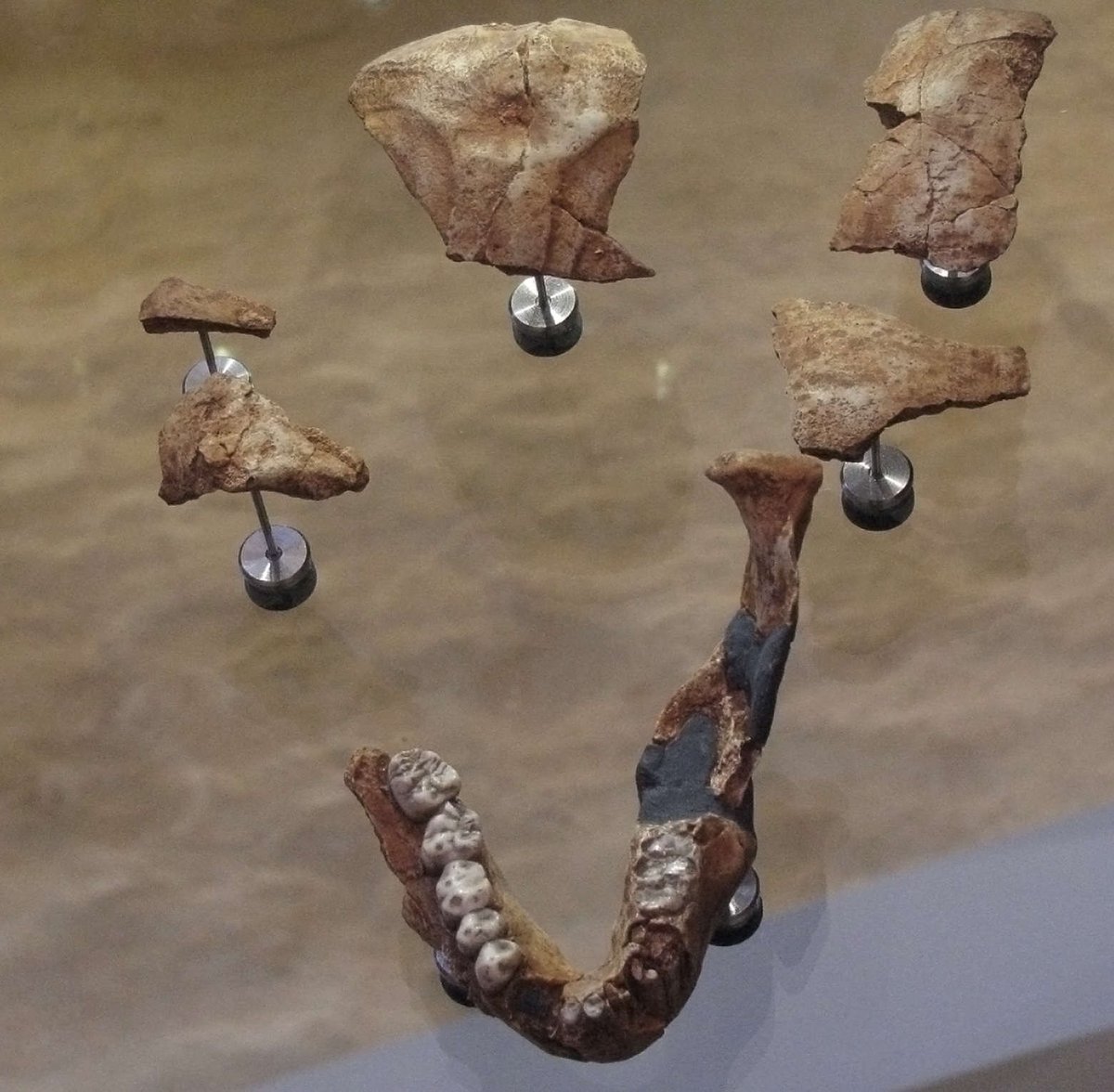
The fossil record of Thalattosaurus is relatively sparse and geographically restricted, which contributes to its rarity and the ongoing mysteries surrounding its biology. Fossils of Thalattosaurus alexandrae are predominantly found in the Hosselkus Limestone of northern California, with some referred material originating from the Favret Formation in Nevada. The number of known specimens is limited to a few dozen, many of which are highly fragmented. The preservation quality is generally fair to good, but the fossils are often heavily crushed or distorted by tectonic activity that has affected the western coast of North America over millions of years. Typically, the most commonly preserved parts are the robust jawbones, teeth, and vertebrae, as these dense elements are more resistant to taphonomic destruction. Complete, articulated skeletons of Thalattosaurus alexandrae are exceptionally rare, making comprehensive anatomical reconstructions challenging. The UCMP houses the most significant collection of Thalattosaurus material, including the holotype specimen described by Merriam. The difficulty in extracting these fossils from their hard limestone matrix means that new discoveries are infrequent, and much of our current understanding relies on the meticulous preparation of historical specimens.
The cultural impact of Thalattosaurus is relatively modest compared to more famous prehistoric marine reptiles like plesiosaurs or mosasaurs, largely due to its obscure nature and the lack of complete, visually striking skeletons on public display. However, within the realm of paleontology enthusiasts and academic circles, it holds a place of high esteem as a bizarre and unique evolutionary experiment. It occasionally appears in specialized books on marine reptiles and paleoart reconstructions focusing on Triassic ecosystems. Notable displays featuring Thalattosaurus material or casts can be found at the University of California Museum of Paleontology in Berkeley, which celebrates the legacy of John C. Merriam and Annie Montague Alexander. Educationally, Thalattosaurus serves as an excellent case study for teaching concepts of convergent evolution, adaptive radiation, and the complex history of secondary marine adaptations in tetrapods.
Classification
Time Period
Discovery
Location
California, USA
Formation
Hosselkus Limestone
Frequently Asked Questions
What is Thalattosaurus?
Thalattosaurus alexandrae, whose name translates to 'Alexandra's ocean lizard', is a fascinating and enigmatic marine reptile that swam in the shallow, warm seas of the Late Triassic period, approximately 228 to 209 million years ago. As the type genus for the order Thalattosauria, this creature rep...
When did Thalattosaurus live?
Thalattosaurus lived during the triassic period of the mesozoic era approximately 228-209 million years ago.
Where was Thalattosaurus discovered?
Fossils of Thalattosaurus were discovered in California, USA in the Hosselkus Limestone.
What did Thalattosaurus eat?
Thalattosaurus was a carnivore. It lived in marine habitats.
What type of fossil is Thalattosaurus?
Thalattosaurus is preserved as a body fossil. The preservation quality is good.
Related Specimens
From the mesozoic era · body fossils