Postosuchus
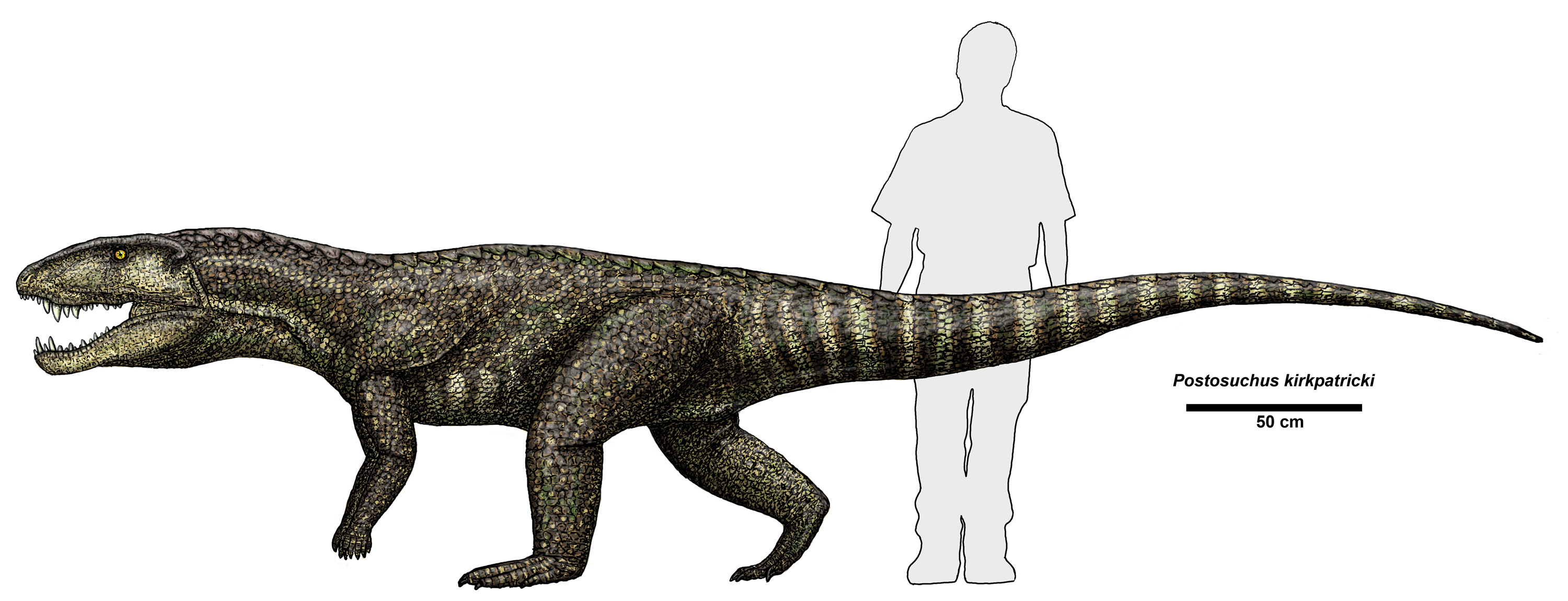
Postosuchus kirkpatricki
Image: File:Postosuchus kirkpatricki.jpg - Wikimedia Commons (CC BY-SA)
About Postosuchus
Postosuchus kirkpatricki was a formidable archosaur that roamed what is now North America during the Late Triassic period, a time of great evolutionary transition. As one of the largest and most powerful terrestrial predators of its era, this rauisuchian played a crucial role as an apex carnivore in ecosystems that predated the global dominance of dinosaurs. Its fossils, primarily unearthed from the Dockum Group in Texas, provide a vital window into the anatomy, behavior, and ecological dynamics of non-dinosaurian archosaurs just before the Triassic-Jurassic extinction event reshaped life on Earth.
Postosuchus was a powerfully built and visually intimidating reptile, measuring between four and five meters (approximately 13 to 16.5 feet) in length and standing roughly 1.2 meters (4 feet) tall at the hips. Estimates of its body mass vary, but a healthy adult likely weighed between 250 and 300 kilograms (550 to 660 pounds), making it comparable in size to a modern Siberian tiger, though far more robustly constructed. Its most striking feature was its massive, deep skull, which could reach over 55 centimeters (22 inches) in length. This skull was fenestrated with large openings, a common archosaurian trait that reduced weight without compromising structural integrity. The jaws were lined with large, serrated, dagger-like teeth that were heterodont, meaning they varied in size and shape, with some resembling caniniform fangs for gripping and others being more blade-like for slicing flesh. Its body was long and deep-chested, supported by a strong vertebral column. Unlike its crocodilian relatives, Postosuchus possessed a fully erect or pillar-erect posture, with its limbs positioned directly beneath its body, a more efficient stance for terrestrial locomotion than the sprawling gait of lizards and early amphibians. The forelimbs were notably shorter than the hindlimbs, being about 64% of their length, a disparity that fueled long-standing debates about its locomotion. The animal's back was likely adorned with osteoderms, bony plates embedded in the skin that would have provided a degree of armor against rivals or desperate prey.
The paleobiology of Postosuchus reveals an animal perfectly adapted to its role as a hypercarnivore. Its formidable dentition and powerful jaw musculature, inferred from the skull's architecture, indicate it was capable of delivering devastating bites to subdue large prey. It likely employed an ambush strategy, using its strength to overwhelm victims rather than engaging in prolonged chases. Its diet would have consisted of the most abundant large vertebrates in its environment, including dicynodonts like the tusked, pig-like Placerias, aetosaurs such as the heavily armored Typothorax, and early dinosaurs like Coelophysis. The debate over its locomotion—whether it was an obligate quadruped or a facultative biped—has been central to understanding its hunting behavior. Early reconstructions depicted it as bipedal, striding across the Triassic landscape like a theropod dinosaur. However, detailed biomechanical studies by paleontologists like J. Michael Parrish in the 1990s, analyzing the wrist and forelimb structure, concluded that its hands were not well-suited for supporting its weight in a fully bipedal stance for long periods. The current consensus is that Postosuchus was primarily a quadruped, walking on all fours, but its powerful hindlimbs and shorter forelimbs may have allowed it to rear up or engage in short, rapid bursts of bipedal running to lunge at prey. Its growth patterns, inferred from bone histology, suggest it grew relatively quickly, reaching adult size in a decade or so, a strategy common among apex predators needing to establish dominance early in life.
Postosuchus lived in a world vastly different from our own. During the Late Triassic, from the Carnian to the Norian ages (approximately 221 to 203 million years ago), the continents were coalescing into the supercontinent of Pangaea. The region of modern-day Texas was located in the western equatorial belt, characterized by a hot, semi-arid climate with pronounced wet and dry seasons. The environment was a mosaic of river floodplains, deltas, and fern-covered prairies, crisscrossed by seasonal streams and dotted with lakes. This habitat, represented by the rock layers of the Dockum Group, supported a diverse and complex ecosystem. Postosuchus sat firmly at the top of this food web. Its prey included the aforementioned dicynodonts and aetosaurs, as well as rhynchosaurs and large, carnivorous temnospondyl amphibians that lurked in the waterways. It also shared its environment with other large predators, including phytosaurs—crocodile-like archosaurs that were primarily aquatic—and other rauisuchians, suggesting a high degree of niche partitioning. The presence of smaller, early dinosaurs like Coelophysis and Chindesaurus indicates that these future rulers of the Mesozoic were, at this time, secondary players in an ecosystem dominated by pseudosuchians like Postosuchus. Its role was to regulate herbivore populations, a critical function that maintained ecological balance before the rise of giant theropods.
The discovery of Postosuchus is a relatively recent chapter in paleontological history, intrinsically linked to the rich fossil beds of West Texas. While fragmentary remains attributable to the genus were found earlier, the breakthrough came in 1980 when paleontologist Sankar Chatterjee and his team from Texas Tech University began excavating in the Post Quarry, located in Garza County, Texas. This site, part of the Cooper Canyon Formation within the Dockum Group, yielded a remarkably complete and well-preserved skeleton of a large archosaur. This specimen, designated TTU P 9002, became the holotype for a new genus and species. In 1985, Chatterjee formally named the animal Postosuchus kirkpatricki. The generic name, *Postosuchus*, means "Post crocodile," a direct reference to the Post Quarry where it was found. The specific name, *kirkpatricki*, honors the Kirkpatrick family, on whose land the quarry was located. Chatterjee's initial description and subsequent work provided the first comprehensive look at a North American rauisuchian, revealing its anatomy in stunning detail and cementing its status as a key predator of the Late Triassic. The discovery of the holotype was pivotal, as its completeness allowed for detailed biomechanical analyses that would later inform our understanding of its posture and locomotion.
In the grand tapestry of life, Postosuchus occupies a crucial branch within the archosaur family tree. Archosauria, the "ruling reptiles," split into two main lineages early in the Triassic: the Avemetatarsalia, which includes dinosaurs, pterosaurs, and their bird descendants, and the Pseudosuchia, which includes modern crocodilians and a vast diversity of extinct forms. Postosuchus is a member of the Pseudosuchia, specifically belonging to a group called Rauisuchia. The rauisuchians were a highly successful and widespread clade of terrestrial predators during the Triassic, representing the dominant large carnivores on every continent. They are characterized by their large size, powerful skulls, and, most importantly, an erect or "pillar-erect" limb posture, which evolved independently from the erect posture of dinosaurs. This convergence is a remarkable example of different lineages arriving at the same solution for efficient terrestrial movement. As a pseudosuchian, Postosuchus is more closely related to modern crocodiles than to dinosaurs, but it is not a direct ancestor. Instead, it represents a side branch of the crocodilian line that flourished and then vanished. The study of Postosuchus and its rauisuchian kin is essential for understanding the evolutionary "experiments" that occurred within Archosauria before dinosaurs ultimately rose to prominence following the Triassic-Jurassic extinction event, which wiped out the rauisuchians and most other large pseudosuchians.
Despite its well-preserved remains, Postosuchus has been at the center of several scientific debates. The most prominent controversy, as mentioned, revolved around its posture and locomotion. Chatterjee's initial 1985 description proposed that Postosuchus was an obligate biped, a revolutionary idea for a pseudosuchian. This interpretation was heavily influenced by its shorter forelimbs and was popularized in media. However, subsequent analysis by other paleontologists, focusing on the anatomy of the hands, wrists, and pectoral girdle, strongly suggested that the forelimbs were robust and weight-bearing, making a quadrupedal stance more likely. Another area of debate concerns its precise taxonomic placement. While it is firmly nested within Rauisuchia, its relationship to other members of the group, such as Saurosuchus from South America and Teratosaurus from Europe, is complex. Some researchers have proposed that Postosuchus belongs to the family Rauisuchidae, while others place it in the family Poposauroidea or a related clade. These taxonomic revisions are ongoing as new fossils are discovered and phylogenetic analyses become more sophisticated, continually refining our understanding of pseudosuchian evolution.
The fossil record of Postosuchus, while not extensive in terms of the number of individuals, is notable for the quality of its key specimens. The vast majority of its remains have been unearthed from the Dockum Group of Texas, with the Post Quarry being the most significant locality. Additional fossils have been found in the Chinle Formation of Arizona and New Mexico, indicating a geographic range that spanned much of the American Southwest. The holotype skeleton (TTU P 9002) is the most famous and scientifically important specimen, as it includes a nearly complete skull and a significant portion of the postcranial skeleton. Other referred specimens from different localities have filled in anatomical gaps, providing a more complete picture of its skeletal morphology. The excellent preservation of these fossils, particularly the skull, has allowed for detailed studies of its feeding mechanics, sensory capabilities, and braincase anatomy through CT scanning. The concentration of fossils in specific geological formations helps paleontologists reconstruct the Late Triassic paleoenvironment with high fidelity, making Postosuchus a cornerstone species for understanding this critical period in Earth's history.
Through its imposing presence and critical role in pre-dinosaur ecosystems, Postosuchus has captured the public imagination and secured a place in popular culture. It was famously featured as the primary antagonist in the first episode of the groundbreaking 1999 BBC documentary series "Walking with Dinosaurs," where it was depicted as a relentless apex predator hunting Placerias and Coelophysis. This portrayal, though containing some scientific inaccuracies based on the knowledge of the time (such as its bipedalism), introduced Postosuchus to a global audience and cemented its image as a Triassic titan. Skeletons and life-sized reconstructions of Postosuchus are now displayed in major museums, including the American Museum of Natural History and the Museum of Texas Tech University, where they serve as powerful educational tools to illustrate the diversity of life before the age of dinosaurs.
Classification
Time Period
Discovery
Location
Post Quarry, Garza County, Texas, USA
Formation
Dockum Group (Cooper Canyon Formation)
Frequently Asked Questions
What is Postosuchus?
Postosuchus kirkpatricki was a formidable archosaur that roamed what is now North America during the Late Triassic period, a time of great evolutionary transition. As one of the largest and most powerful terrestrial predators of its era, this rauisuchian played a crucial role as an apex carnivore in...
When did Postosuchus live?
Postosuchus lived during the triassic period of the mesozoic era approximately 221-203 million years ago.
Where was Postosuchus discovered?
Fossils of Postosuchus were discovered in Post Quarry, Garza County, Texas, USA in the Dockum Group (Cooper Canyon Formation).
What did Postosuchus eat?
Postosuchus was a carnivore. It lived in terrestrial habitats.
What type of fossil is Postosuchus?
Postosuchus is preserved as a body fossil. The preservation quality is good.
Related Specimens
From the mesozoic era · body fossils