Mucrospirifer
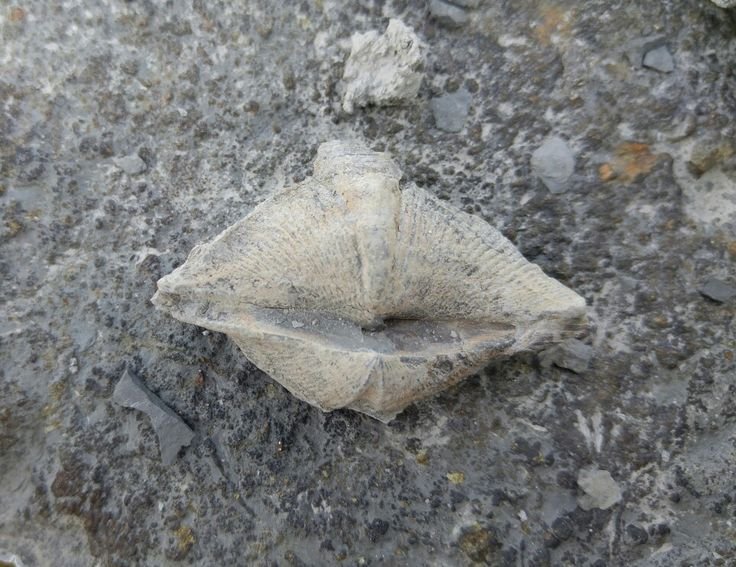
Mucrospirifer mucronatus
Image: Image sourced via web search (Fair use / Educational)
About Mucrospirifer
Mucrospirifer mucronatus is an extinct species of articulate brachiopod that thrived in the warm, shallow seas of the Middle to Late Devonian Period, approximately 390 to 370 million years ago. As a quintessential index fossil, its abundant and well-preserved remains provide paleontologists with a crucial tool for dating geological strata and reconstructing ancient marine ecosystems. This small, bivalved invertebrate, often nicknamed the 'butterfly shell' for its distinctive wing-like shape, represents one of the most common and recognizable fossils from the Paleozoic Era, offering a clear window into the rich biodiversity of the Devonian 'Age of Fishes'.
The physical form of Mucrospirifer mucronatus is its most defining characteristic. The shell, or conch, was biconvex, composed of two unequal valves: a larger, more convex pedicle valve and a slightly smaller brachial valve. A typical specimen measured between 2.5 to 4 centimeters in width, though some exceptionally large individuals could reach up to 6 centimeters. The most striking feature was the shell's extreme transverse extension, where the hinge line extended laterally into long, pointed, mucronate (spine-like) projections, giving the organism its 'butterfly' or 'wing' appearance and its scientific name, which translates to 'pointed spire-bearer'. The shell's surface was adorned with fine, radiating ribs or costae, which increased in number toward the shell margin through bifurcation. A prominent fold on the brachial valve and a corresponding sulcus (a groove) on the pedicle valve were centrally located, running from the hinge to the front edge. Internally, the brachial valve housed a delicate, spirally coiled calcareous structure called a spīralium. This complex, ribbon-like support was the framework for the lophophore, a ciliated feeding organ. The pedicle valve had a small opening near the hinge, the pedicle foramen, through which a fleshy stalk, the pedicle, emerged to anchor the animal to the seafloor or other hard substrates. The shell itself was composed of calcite, arranged in fibrous layers, providing robust protection against predators and the dynamic marine environment.
As a sessile, benthic organism, Mucrospirifer was a suspension feeder, a lifestyle dictated by its anatomy. It lived attached to the substrate, such as rocks, shell debris, or even other organisms like crinoid stems, via its pedicle. Positioned with the front of its shell facing into the current, it would open its valves slightly to expose the lophophore. The cilia on the lophophore created a water current that flowed into the shell cavity, drawing in microscopic food particles like phytoplankton, zooplankton, and suspended organic detritus. These particles were trapped in mucus and transported along ciliated tracts to the mouth, located at the base of the lophophore. This filter-feeding strategy was highly efficient and allowed Mucrospirifer to thrive in the nutrient-rich Devonian seas. Growth occurred incrementally, with new layers of calcite being added along the commissure (the margin where the valves meet). These growth lines are often clearly visible on the exterior of well-preserved fossils, providing a record of the individual's life history. Being a stationary animal, its locomotion was non-existent in its adult stage. It is inferred that they lived in dense clusters or 'nests', forming extensive brachiopod beds on the seafloor, a social behavior that offered some protection and likely enhanced reproductive success through proximity for broadcast spawning.
The world of Mucrospirifer during the Middle Devonian was a vastly different place. The continents were coalescing into the supercontinent of Laurussia, and much of what is now North America was covered by the shallow, tropical Kaskaskia Sea. Mucrospirifer inhabited the muddy and silty bottoms of this epeiric sea, often in environments associated with underwater deltas and near-shore reefs. The climate was warm and stable, fostering immense biodiversity. It shared its habitat with a rich fauna, including other brachiopods (like Atrypa and Spinocyrtia), rugose and tabulate corals, trilobites (such as Phacops and Greenops), bryozoans, mollusks (bivalves and gastropods), and vast forests of crinoids, or 'sea lilies'. As a primary consumer, Mucrospirifer occupied a low level on the food web, converting planktonic matter into biomass. It, in turn, served as a food source for various predators. Evidence of this predation comes from boreholes found on some shells, likely drilled by predatory gastropods, as well as shells that show signs of crushing, possibly from durophagous (shell-crushing) placoderm fish like Dunkleosteus or shell-cracking invertebrates like nautiloids and eurypterids.
The discovery and formal description of Mucrospirifer mucronatus are rooted in the foundational period of American geology. The species was first formally described by the American naturalist Timothy Abbott Conrad in 1841 as Delthyris mucronatus. Conrad was working as a paleontologist for the Natural History Survey of New York, a monumental project initiated in the 1830s to document the state's geology and natural resources. The fossils were collected from the highly fossiliferous strata of the Hamilton Group in central and western New York, which were being exposed by canal and railroad construction. Later, in 1894, the American paleontologist Charles Emerson Beecher of Yale University recognized the distinct characteristics of this group and established the genus Mucrospirifer, with Conrad's species as the type species. There is no single 'holotype' specimen akin to a famous vertebrate fossil, as the species is defined by a vast collection of material. The sheer abundance of specimens collected during the 19th-century surveys means that key collections are housed in major institutions like the New York State Museum, the Paleontological Research Institution in Ithaca, and Yale's Peabody Museum of Natural History, forming the basis of our understanding of this iconic Devonian fossil.
Mucrospirifer holds significant evolutionary importance as a representative of the order Spiriferida, one of the most successful and diverse groups of brachiopods during the Paleozoic. The spiriferids are defined by their complex, spiral-shaped lophophore support, an evolutionary innovation that allowed for a much larger and more efficient filter-feeding apparatus compared to earlier brachiopod lineages. This adaptation likely contributed to their dominance in many Devonian marine communities. Mucrospirifer itself represents a highly specialized form within this order, with its exaggerated, wing-like shell shape possibly serving multiple functions, such as providing stability on soft substrates (acting like snowshoes to prevent sinking into the mud) or deterring predators by making the shell difficult to handle or swallow. While the entire phylum Brachiopoda suffered greatly during the Permian-Triassic extinction event, the spiriferids were completely wiped out. Brachiopods as a whole never regained the ecological dominance they held during the Paleozoic, being largely replaced by bivalve mollusks. Thus, Mucrospirifer and its relatives represent a pinnacle of a unique and ultimately extinct evolutionary pathway in marine invertebrate life.
Despite being a well-known and extensively studied fossil, Mucrospirifer is not without its scientific debates, primarily concerning its taxonomy and paleoecology. For decades, numerous species of Mucrospirifer were named based on slight variations in shell shape, size, and the angle of the wing-like extensions. However, more recent research, particularly by paleontologists like G. Arthur Cooper and J. Thomas Dutro Jr., has suggested that many of these 'species' may simply represent ecophenotypic variations—differences in form caused by environmental factors rather than genetic divergence. For example, individuals living in calmer, deeper waters may have developed longer, more delicate spines, while those in high-energy, shallow environments may have had shorter, more robust shells. This has led to a consolidation of many previously named species under M. mucronatus, which is now viewed as a highly variable and adaptable species. The exact function of the extreme mucronate extensions also remains a topic of discussion, with hypotheses ranging from stabilization and predator deterrence to roles in guiding feeding currents.
The fossil record of Mucrospirifer mucronatus is exceptionally rich and widespread. Its fossils are found in great abundance in Middle Devonian marine sedimentary rocks, particularly shales and limestones. The primary localities are in North America, with the Hamilton Group of New York State being the most famous source, yielding millions of perfectly preserved specimens. Other significant North American occurrences include the Traverse Group in Michigan, the Silica Shale in Ohio, and various formations in Ontario, Canada. Globally, related species of the genus Mucrospirifer are found in Devonian rocks in Europe, Asia, and South America. The preservation is often excellent, with the original calcite shell material intact, allowing for detailed study of both external and internal features. Fossils are typically found as disarticulated single valves, but complete, articulated specimens are also common. Entire bedding planes covered with thousands of individuals have been discovered, providing a snapshot of the ancient seafloor. Famous sites like Penn Dixie Fossil Park & Nature Reserve in Hamburg, New York, allow the public to collect their own high-quality Mucrospirifer fossils directly from the source rock.
Due to its distinctive and aesthetically pleasing shape, Mucrospirifer mucronatus has a notable cultural impact, especially among fossil collectors and educators. It is often one of the first fossils a budding paleontologist or amateur collector finds, making it an important 'gateway' fossil that sparks interest in the deep past. Its abundance and excellent preservation make it a staple in museum collections, university teaching collections, and rock shop inventories worldwide. Major institutions like the American Museum of Natural History in New York and the Field Museum in Chicago feature displays of Devonian marine life where Mucrospirifer is prominently showcased. Its recognizable 'butterfly' form makes it an effective tool for teaching concepts like adaptation, ancient environments, and the vastness of geologic time.
Classification
Time Period
Discovery
Location
North America (specifically New York State, USA)
Formation
Hamilton Group (including the Moscow, Ludlowville, and Skaneateles Formations)
Frequently Asked Questions
What is Mucrospirifer?
Mucrospirifer mucronatus is an extinct species of articulate brachiopod that thrived in the warm, shallow seas of the Middle to Late Devonian Period, approximately 390 to 370 million years ago. As a quintessential index fossil, its abundant and well-preserved remains provide paleontologists with a c...
When did Mucrospirifer live?
Mucrospirifer lived during the devonian period of the paleozoic era approximately 390-370 million years ago.
Where was Mucrospirifer discovered?
Fossils of Mucrospirifer were discovered in North America (specifically New York State, USA) in the Hamilton Group (including the Moscow, Ludlowville, and Skaneateles Formations).
What did Mucrospirifer eat?
Mucrospirifer was a filter-feeder. It lived in marine, reef, shallow-sea habitats.
What type of fossil is Mucrospirifer?
Mucrospirifer is preserved as a body fossil. The preservation quality is excellent.
Related Specimens
From the paleozoic era · body fossils

/09c845a0ecb7.png)
/bf5239087f6c.png)