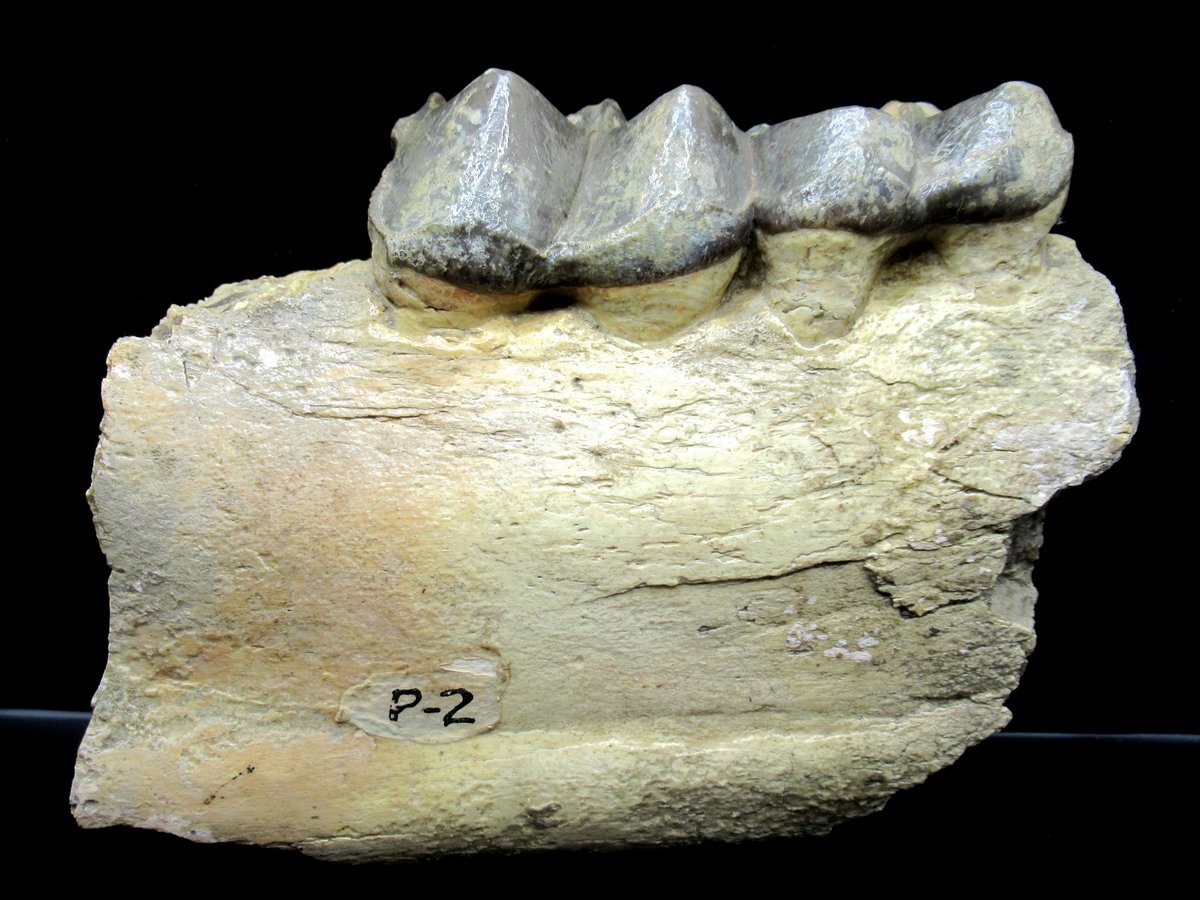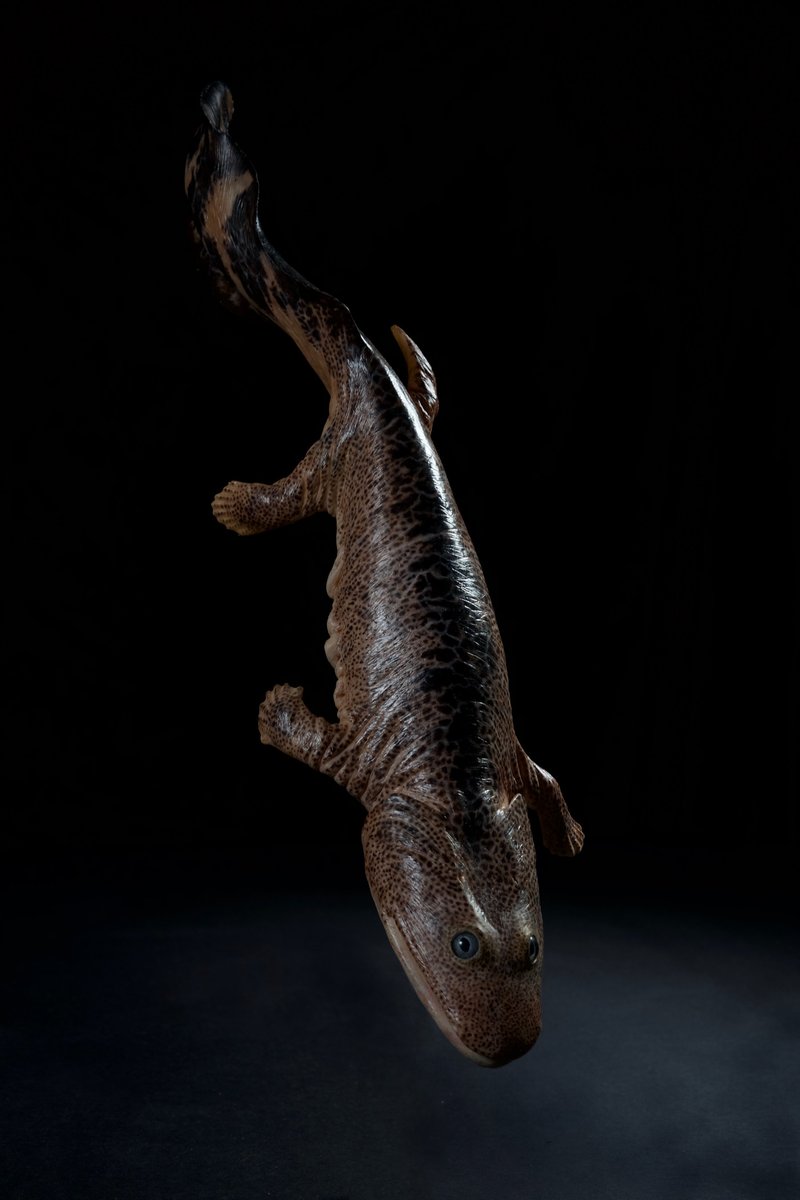
Acanthostega
Acanthostega gunnari
Image: Image sourced via web search (Fair use / Educational)
About Acanthostega
Acanthostega gunnari is an extinct genus of stem-tetrapod that lived during the Late Devonian period, approximately 365 to 360 million years ago. Discovered primarily in the fossil-rich deposits of East Greenland, this remarkable organism represents one of the most crucial transitional forms in the history of vertebrate evolution, bridging the gap between lobe-finned fishes and fully terrestrial tetrapods. Acanthostega is of paramount significance in paleontology because it fundamentally overturned the long-held scientific assumption that limbs and digits evolved as an adaptation for walking on land; instead, its anatomy demonstrates that these features first evolved in fully aquatic environments. By providing a detailed window into the anatomical shifts that preceded the vertebrate conquest of land, Acanthostega remains a cornerstone species for understanding the origins of all modern amphibians, reptiles, birds, and mammals.
In terms of physical description, Acanthostega was a moderately sized organism, reaching an approximate body length of 60 centimeters (about 24 inches) and likely weighing only a few kilograms. Its overall appearance would have somewhat resembled a heavily scaled, robust salamander, but with distinctively fish-like characteristics. The most striking and famous anatomical feature of Acanthostega is the presence of eight well-developed digits on each of its front limbs, a stark contrast to the five-digit (pentadactyl) limb structure that would later become standard for most tetrapods. These limbs lacked the necessary wrist and ankle joints to support the animal's weight out of the water, indicating they were used primarily as paddles or for grasping submerged vegetation rather than for terrestrial locomotion. Furthermore, Acanthostega possessed a large, fin-like tail supported by long bony rays, which was its primary organ of propulsion. Its skull was relatively flat and broad, equipped with a lateral line system—a sensory organ found in fish used to detect water vibrations. Crucially, the skeletal structure of its branchial arches indicates that Acanthostega retained functional internal gills alongside lungs, much like modern lungfish, firmly anchoring its physical adaptations to an aquatic lifestyle.
The paleobiology of Acanthostega paints a picture of a specialized, primarily aquatic ambush predator. Given the structure of its jaws and the arrangement of its sharp, conical teeth, it is highly likely that Acanthostega fed on smaller fish, aquatic invertebrates, and perhaps other early tetrapods. Its feeding strategy likely involved lying in wait among dense aquatic vegetation, using its paddle-like limbs to hold onto roots or stems, before launching a sudden, snapping strike at passing prey. Locomotion was almost entirely aquatic; the large tail fin provided the thrust needed for swimming, while the limbs were used for steering and stabilization rather than active paddling. The lack of weight-bearing joints in the limbs, combined with a relatively weak rib cage that could not have prevented the lungs from collapsing under the animal's own weight on land, suggests that Acanthostega rarely, if ever, ventured out of the water. Growth patterns inferred from bone histology suggest a relatively slow metabolism compared to modern endotherms, typical of early ectothermic vertebrates. Social behavior is difficult to infer from the fossil record, but the concentration of multiple individuals in certain fossil beds suggests they may have congregated in specific environments, either for breeding purposes or due to the shrinking of water bodies during dry seasons.
The ecological context of the Late Devonian world in which Acanthostega lived was vastly different from today. During this time, the landmasses were grouped into two supercontinents, Gondwana and Euramerica, with East Greenland located near the equator, resulting in a warm, tropical to subtropical climate. The terrestrial landscape was undergoing a massive transformation, with the first extensive forests of early vascular plants, such as Archaeopteris, spreading across the continents. These forests created complex river systems and extensive freshwater swamps, providing the perfect habitat for early tetrapods. The waters Acanthostega inhabited were likely choked with decaying plant matter, creating hypoxic (low oxygen) conditions. This environment would have strongly favored organisms that possessed lungs to gulp air from the surface when dissolved oxygen levels dropped. Acanthostega shared its ecosystem with a diverse array of organisms, including large predatory lobe-finned fishes, early ray-finned fishes, and other early tetrapods like Ichthyostega. In this food web, Acanthostega was a mid-level predator, feeding on smaller aquatic fauna while likely falling prey to larger, more powerful aquatic predators of the Devonian rivers.
The discovery history of Acanthostega is a fascinating tale of paleontological perseverance. The first fossils, consisting only of skull roof fragments, were discovered in 1933 by the Swedish paleontologist Gunnar Säve-Söderbergh and his colleague Erik Jarvik in the Late Devonian deposits of East Greenland. Säve-Söderbergh named the genus Acanthostega, meaning 'spiny roof,' in reference to a small spine on the tabular bone of the skull, and designated the type species Acanthostega gunnari. However, because the initial remains were so fragmentary, the true significance of the animal remained obscured for decades. It was not until 1987 that the narrative dramatically changed. A team led by Dr. Jenny Clack from the University of Cambridge returned to East Greenland and discovered exceptionally preserved, nearly complete articulated skeletons of Acanthostega in the Britta Dal Formation. The most famous of these specimens, affectionately nicknamed 'Grace,' provided the first clear look at the postcranial skeleton of the animal, revealing the shocking presence of eight digits and internal gills. Clack's meticulous preparation and subsequent publication of these fossils in the early 1990s revolutionized the field, bringing Acanthostega out of obscurity and into the spotlight of evolutionary biology.
The evolutionary significance of Acanthostega cannot be overstated, as it fundamentally altered our understanding of the water-to-land transition. Prior to the detailed study of Acanthostega, the prevailing theory—often championed by early paleontologists like Alfred Romer—suggested that fish developed limbs to crawl from drying pools of water to larger, more permanent bodies of water. Acanthostega turned this 'drying pond' hypothesis on its head. Because it possessed fully formed limbs with digits but was anatomically incapable of walking on land, it proved that limbs evolved in the water first, likely as an adaptation for navigating shallow, weed-choked environments. Only millions of years later were these pre-existing structures co-opted for terrestrial locomotion by later tetrapods. Acanthostega sits on the stem of the tetrapod lineage, representing a mosaic of ancestral fish traits (like gills, a tail fin, and a lateral line) and derived tetrapod traits (like limbs with digits and a separated pectoral girdle). It is not a direct ancestor to modern amphibians, reptiles, or mammals, but rather a close cousin to the direct ancestors, providing a perfect snapshot of the anatomical intermediate stages of vertebrate evolution.
Despite the wealth of information provided by the Greenland fossils, Acanthostega remains the subject of ongoing scientific debates and revisions. One of the primary areas of contention revolves around the exact degree of its terrestriality. While the consensus strongly favors a fully aquatic lifestyle, some researchers have debated whether juveniles might have been more capable of terrestrial movement than adults, or if the animal could have used its limbs to drag itself across mudflats in extreme emergencies. Additionally, the taxonomy and exact phylogenetic placement of early tetrapods are constantly being refined as new fossils are discovered. The relationship between Acanthostega, Ichthyostega, and slightly older transitional forms like Tiktaalik is a subject of intense cladistic analysis. Recent studies utilizing high-resolution CT scanning have also led to debates regarding the exact mechanics of its bite and the functional morphology of its gill arches, with some arguing that its feeding mechanism was more akin to suction feeding than previously thought.
The fossil record of Acanthostega is geographically restricted but remarkably rich in quality. All known specimens have been recovered from the Celsius Bjerg Group, specifically the Britta Dal Formation, in East Greenland. To date, dozens of specimens have been collected, ranging from isolated bones to nearly complete, articulated skeletons. The preservation quality of these fossils is often exceptional, largely due to the fine-grained sedimentary rock in which they were entombed, which likely represents a slow-moving or stagnant river channel. The skulls, lower jaws, and limb bones are typically well-preserved, allowing for detailed three-dimensional reconstructions. The famous 1987 expedition yielded a mass death assemblage, suggesting that multiple individuals were buried simultaneously, perhaps during a sudden flood event or a localized drought that trapped them in a shrinking pool. This concentration of high-quality fossils makes Acanthostega one of the best-understood stem-tetrapods in the entire fossil record.
In terms of cultural impact, Acanthostega has achieved a level of fame rarely seen for Paleozoic amphibians, becoming a staple in educational materials concerning evolution. It featured prominently in the acclaimed PBS documentary series and book 'Your Inner Fish' by Neil Shubin, where it was used to illustrate the aquatic origins of the human hand. Casts and original specimens of Acanthostega are displayed in major institutions worldwide, including the University Museum of Zoology in Cambridge and the American Museum of Natural History in New York. Its eight-fingered hand has become an iconic symbol of evolutionary biology, capturing the public's fascination and serving as a powerful educational tool to demonstrate that evolution often repurposes existing structures for entirely new functions.
Classification
Time Period
Discovery
Location
East Greenland
Formation
Britta Dal Formation
Frequently Asked Questions
What is Acanthostega?
Acanthostega gunnari is an extinct genus of stem-tetrapod that lived during the Late Devonian period, approximately 365 to 360 million years ago. Discovered primarily in the fossil-rich deposits of East Greenland, this remarkable organism represents one of the most crucial transitional forms in the ...
When did Acanthostega live?
Acanthostega lived during the devonian period of the paleozoic era approximately 365-360 million years ago.
Where was Acanthostega discovered?
Fossils of Acanthostega were discovered in East Greenland in the Britta Dal Formation.
What did Acanthostega eat?
Acanthostega was a carnivore. It lived in freshwater habitats.
What type of fossil is Acanthostega?
Acanthostega is preserved as a body fossil. The preservation quality is exceptional.
Related Specimens
From the paleozoic era · body fossils
/e01cc4f7f656.jpg)