Andrewsarchus
Andrewsarchus mongoliensis
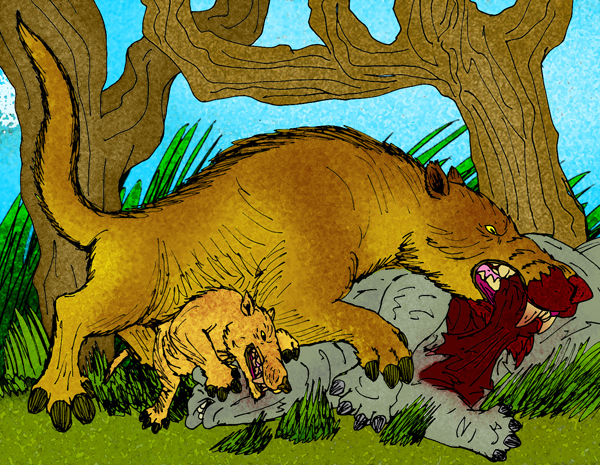
Image: File:Andrewsarchus mongoliensis.jpeg - Wikimedia Commons (CC BY-SA)
About Andrewsarchus
Andrewsarchus mongoliensis was a massive and enigmatic mammal that inhabited the coastal plains of what is now Inner Mongolia during the Middle Eocene epoch, approximately 45 to 36 million years ago. Its significance in the paleontological record is immense, not for the completeness of its remains, but for the sheer size of its only known fossil—a single, enormous skull—and the profound scientific debates it has ignited for nearly a century. This creature represents a fascinating chapter in the evolution of mammals, a time when new forms rose to ecological prominence in the wake of the dinosaurs, and its story is a powerful illustration of how scientific understanding can evolve dramatically with new analytical methods.
The physical characteristics of Andrewsarchus are almost entirely inferred from its colossal skull, the only fossil evidence discovered to date. This cranium, measuring an impressive 83.4 centimeters (32.8 inches) in length and 56 centimeters (22 inches) in width, is one of the largest known from any terrestrial predatory mammal. Its most striking features are the exceptionally long snout, which took up roughly 60% of the skull's total length, and the widely flaring zygomatic arches (cheekbones), which indicate the attachment points for incredibly powerful jaw muscles. The dental formula reveals large canines, robust, blunt-crowned premolars, and bunodont (low, rounded) molars, a combination that suggests a generalized, powerful bite rather than the specialized shearing carnassials of hypercarnivores like cats or dogs. Early reconstructions, drawing comparisons to mesonychids or even hyenas, depicted Andrewsarchus as a gigantic, wolf-like creature. These estimates placed its body length at over 3.4 meters (11 feet) and its weight at a staggering 1,000 kilograms (2,200 pounds) or more, potentially making it the largest terrestrial mammalian carnivore of all time. However, its revised placement among artiodactyls suggests a different body plan, likely more robust and stocky, perhaps resembling a heavily built entelodont or even a terrestrial hippo, with a large head, a thick neck, a barrel-shaped torso, and relatively stout limbs.
The paleobiology of Andrewsarchus is a subject of intense speculation, dictated by its ambiguous anatomy. Its dentition provides the most direct clues to its diet and feeding strategy. The large, tusk-like canines were suitable for intimidation or defense, while the powerful, flattened premolars and molars were not adapted for slicing flesh but were exceptionally well-suited for crushing hard objects. This suggests an omnivorous or durophagous (hard-object eating) diet. Andrewsarchus likely possessed one of the most powerful bites of any mammal, capable of pulverizing large bones, turtle shells, or hard-shelled mollusks found along the Eocene coastlines. It was probably not a swift pursuit predator; its inferred heavy build would have precluded high-speed chases. Instead, it likely occupied an ecological niche as a dominant scavenger, using its immense size to intimidate other predators and claim their kills. It may also have been an opportunistic predator, ambushing slower-moving prey, or a shore-line forager, digging for roots, consuming carrion washed ashore, or cracking open the tough defenses of coastal invertebrates and vertebrates. Its behavior was likely solitary and territorial, given its immense size and the resources required to sustain such a large animal.
During the Middle Eocene, the environment of the Irdin Manha Formation was vastly different from the arid Gobi Desert of today. The region was a lush, subtropical coastal plain, characterized by extensive river systems, wetlands, and forests bordering the ancient Tethys Sea. This warm, humid climate supported a rich and diverse ecosystem. Andrewsarchus shared this habitat with a remarkable array of other large mammals, placing it within a complex food web. Herbivores were abundant and included brontotheres, massive rhinoceros-like perissodactyls such as Embolotherium, which would have been formidable prey or a source of carrion. Other contemporaries included early rhinos like Forstercooperia, chalicotheres, and various smaller mammals. The predator guild was also diverse, featuring creodonts like Sarkastodon, another massive carnivore, and smaller mesonychids. Given its size and powerful jaws, Andrewsarchus likely sat at or near the apex of this food web. It would have competed directly with other large carnivores for carcasses and territory, likely using its sheer bulk to dominate feeding sites. Its role as a potential scavenger and bone-crusher would have been crucial for nutrient cycling within the ecosystem, clearing away large carcasses that other predators could not fully consume.
The discovery of Andrewsarchus is a classic tale from the golden age of paleontological exploration. The single known skull was found on June 23, 1923, by Kan Chuen Pao, a Chinese technician on the Third Asiatic Expedition of the American Museum of Natural History. This ambitious series of expeditions, led by the famous explorer and naturalist Roy Chapman Andrews, aimed to uncover the origins of humanity in Central Asia but instead unearthed a treasure trove of dinosaur and early mammal fossils. The skull was discovered in the gray sediments of the Irdin Manha Formation in a region of Inner Mongolia known as Erenhot. Upon its collection, it was studied by paleontologist Henry Fairfield Osborn, then president of the American Museum of Natural History. In his 1924 publication, Osborn formally named the creature Andrewsarchus mongoliensis, meaning "Andrews' Ruler from Mongolia," in honor of the expedition's leader. The holotype specimen, AMNH 20135, consists of the cranium without the lower jaw. Despite extensive subsequent fieldwork in the region by numerous international teams over the following century, no other skeletal elements of Andrewsarchus have ever been definitively identified, leaving this single, magnificent skull as the sole testament to the animal's existence.
The evolutionary significance of Andrewsarchus has been a moving target, reflecting major shifts in our understanding of mammalian phylogeny. Initially, Osborn classified it within the Mesonychia, an extinct order of hoofed carnivores thought to be the ancestors of whales. This placement was based on dental similarities, particularly the structure of the molars, which resembled those of mesonychids like Mesonyx. For decades, this classification was widely accepted, and Andrewsarchus was popularly depicted as the largest and most terrifying of the mesonychids. However, the advent of cladistics and molecular biology in the late 20th and early 21st centuries revolutionized mammal systematics. Detailed analyses of the skull, particularly features of the ear region and other cranial structures, revealed that Andrewsarchus was not a mesonychid. Instead, it shared key derived traits with the Cetancodontamorpha, a clade within the Artiodactyla (even-toed ungulates) that includes modern hippos, whales, and the extinct entelodonts, colloquially known as "hell pigs." This reclassification was profound, transforming Andrewsarchus from a "hoofed wolf" into a relative of pigs and hippos. It is now considered a stem-artiodactyl, closely related to the entelodonts, and part of the broader group that gave rise to cetaceans, highlighting the deep and often surprising evolutionary connections between seemingly disparate groups of mammals.
This dramatic taxonomic shift lies at the heart of the scientific debates surrounding Andrewsarchus. The primary controversy has been its phylogenetic placement: is it a mesonychid or an artiodactyl? While the consensus has strongly shifted towards the latter, based on studies by researchers like McKenna, O'Leary, and Spaulding, the lack of postcranial remains means the debate cannot be definitively closed. This uncertainty directly fuels controversies about its appearance and behavior. The mesonychid hypothesis supported a cursorial, wolf-like predator, whereas the artiodactyl hypothesis suggests a more heavily built, omnivorous scavenger akin to an entelodont or a terrestrial hippo. Without leg bones or vertebrae, its locomotion and posture remain entirely speculative. Its diet is also debated; while its teeth point towards omnivory and bone-crushing, some researchers have not ruled out a more predatory lifestyle, perhaps specializing in large, slow-moving prey. These ongoing discussions underscore the limitations of interpreting an animal from a single, incomplete fossil and highlight how new analytical frameworks can completely reshape our vision of a prehistoric creature.
The fossil record of Andrewsarchus mongoliensis is exceptionally sparse, consisting solely of the holotype skull, AMNH 20135. This specimen was recovered from the Irdin Manha Formation of Inner Mongolia, China, a geological unit renowned for its rich Middle Eocene mammalian fauna. The skull itself is remarkably well-preserved, though it lacks the mandible (lower jaw) and has suffered some crushing and distortion over the millions of years of fossilization. Despite the fame of this fossil and the paleontological importance of the formation, no other bones attributable to Andrewsarchus have ever been found, either in Inner Mongolia or elsewhere. This extreme rarity is puzzling for such a large animal, which would presumably have had a robust skeleton with a high preservation potential. It is possible that other remains have been found but not recognized, or that the animal was naturally rare in its environment. The Irdin Manha Formation remains the only known locality for this genus, making its known geographic distribution highly restricted. The singular nature of its fossil record makes Andrewsarchus one of the most enigmatic and tantalizingly incomplete megafauna in the history of paleontology.
Despite its fragmentary nature, Andrewsarchus has made a significant cultural impact, largely due to its former title as the potential "largest terrestrial mammalian carnivore." This superlative status secured its place in popular science books, museum exhibits, and documentaries. The iconic skull is a centerpiece display at the American Museum of Natural History in New York, where it captivates visitors with its sheer size. It gained widespread public recognition after being featured prominently in the 2001 BBC documentary series "Walking with Beasts," which depicted it as an enormous, hyena-like beachcomber and apex predator. This portrayal, though now considered outdated in its mesonychid-based reconstruction, cemented its image in the public consciousness as a formidable prehistoric monster. For educators, Andrewsarchus serves as a perfect case study in the scientific process, demonstrating how paleontological reconstructions are hypotheses that can be overturned by new evidence and analytical techniques.
Classification
Time Period
Discovery
Location
Inner Mongolia, China
Formation
Irdin Manha Formation
Frequently Asked Questions
What is Andrewsarchus?
Andrewsarchus mongoliensis was a massive and enigmatic mammal that inhabited the coastal plains of what is now Inner Mongolia during the Middle Eocene epoch, approximately 45 to 36 million years ago. Its significance in the paleontological record is immense, not for the completeness of its remains, ...
When did Andrewsarchus live?
Andrewsarchus lived during the paleogene period of the cenozoic era approximately 45-36 million years ago.
Where was Andrewsarchus discovered?
Fossils of Andrewsarchus were discovered in Inner Mongolia, China in the Irdin Manha Formation.
What did Andrewsarchus eat?
Andrewsarchus was a omnivore. It lived in terrestrial habitats.
What type of fossil is Andrewsarchus?
Andrewsarchus is preserved as a body fossil. The preservation quality is poor.
Related Specimens
From the cenozoic era · body fossils