Acrocanthosaurus
Acrocanthosaurus atokensis
Image: Image sourced via web search (Fair use / Educational)
About Acrocanthosaurus
Acrocanthosaurus atokensis was a colossal carnivorous dinosaur that roamed North America during the Early Cretaceous period, approximately 116 to 110 million years ago. As one of the largest theropods of its time, it was an apex predator, distinguished by the unusually tall neural spines on its vertebrae, which formed a prominent ridge along its back. Its discovery and subsequent study have provided crucial insights into the diversity of large predatory dinosaurs and the ecosystems they inhabited prior to the rise of the tyrannosaurids.
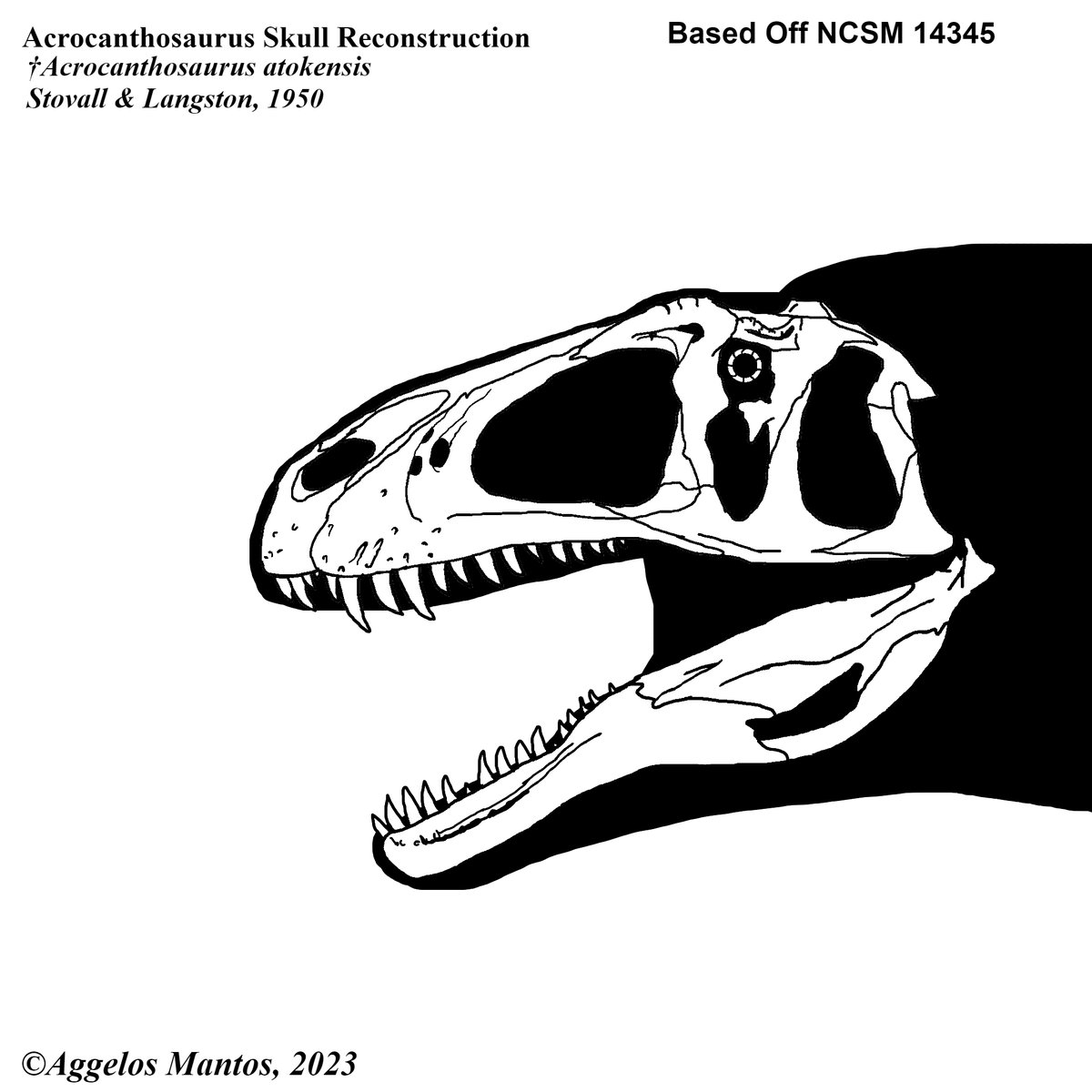
Acrocanthosaurus was a truly immense animal, rivaling some of the more famous giant theropods in size. It measured up to 11.5 meters (about 38 feet) in length and stood approximately 3.5 meters (11.5 feet) tall at the hips, with weight estimates ranging from 5.6 to 7 metric tons. For comparison, it was comparable in length to a city bus and weighed as much as a large African elephant. Its most defining characteristic was the series of elongated neural spines extending from its neck, back, hip, and tail vertebrae, some reaching over 30 centimeters (1 foot) in height above the vertebra itself. These spines were not thin and rod-like as in Spinosaurus, but rather blade-like, likely supporting a muscular ridge or sail of tissue. Its skull was long, low, and massive, measuring about 1.3 meters (4.3 feet) in length, and filled with dozens of serrated, blade-like teeth well-suited for slicing through flesh. The skull featured large openings (fenestrae) that reduced its weight without compromising structural strength. Its forelimbs, though small relative to its body size, were robust and possessed three sharp claws, indicating they were functional and likely used for grasping prey. Its hind limbs were powerful and pillar-like, supporting its massive frame and enabling it to move with surprising agility for its size.
The paleobiology of Acrocanthosaurus reveals a formidable apex predator. Its diet consisted primarily of large herbivorous dinosaurs, such as the ornithopod Tenontosaurus and the giant sauropod Sauroposeidon. Fossil trackways found in the Glen Rose Formation in Texas, attributed to Acrocanthosaurus, show it stalking a sauropod, providing direct evidence of its hunting behavior. The powerful bite force, combined with its serrated teeth, suggests a 'slash-and-tear' feeding strategy, inflicting deep, bleeding wounds to weaken its massive prey. Its powerful hind limbs and relatively long legs indicate it was an active pursuit predator, capable of moving at considerable speeds over short distances. Analysis of its inner ear structure suggests it held its head at a 25-degree downward angle, providing good binocular vision for judging distance to prey. Growth studies based on bone histology are limited, but like other large theropods, it likely experienced a rapid adolescent growth spurt. Its metabolism was likely mesothermic, possessing a higher metabolic rate than modern reptiles but lower than that of birds or mammals, allowing it to sustain an active predatory lifestyle.
Acrocanthosaurus lived in a world vastly different from our own. During the Early Cretaceous, North America was split by the encroaching Western Interior Seaway, and Acrocanthosaurus inhabited the coastal plains and forested floodplains to the east of this shallow sea. The climate was warm and subtropical, with distinct wet and dry seasons, supporting a lush ecosystem. This environment was home to a diverse array of fauna. Acrocanthosaurus shared its habitat with the much smaller but swift dromaeosaurid Deinonychus, which may have competed for smaller prey or scavenged its kills. Its primary prey included the large ornithopod Tenontosaurus, the armored nodosaur Sauropelta, and colossal sauropods like Paluxysaurus and Sauroposeidon, the latter being one of the tallest animals to have ever lived. The presence of such gigantic herbivores necessitated an equally massive predator to control their populations, a role Acrocanthosaurus filled as the undisputed apex predator of its ecosystem. Its position at the top of the food web was critical for maintaining ecological balance in these Early Cretaceous North American environments.
The discovery history of Acrocanthosaurus began in the 1940s in Atoka County, Oklahoma. Partial skeletal remains, including the distinctive high-spined vertebrae, were found by collectors Cephis Hall and Sid Love. These fossils were formally described in 1950 by paleontologists J. Willis Stovall and Wann Langston Jr., who named the dinosaur Acrocanthosaurus atokensis. The genus name means 'high-spined lizard,' referencing its most prominent feature, while the species name honors its discovery location. For decades, the dinosaur was known only from these and a few other fragmentary remains. This changed dramatically with the discovery of two much more complete specimens. The first was found in McCurtain County, Oklahoma, in the 1980s and excavated by the Black Hills Institute. The second, and most significant, is specimen NCSM 14345, nicknamed 'Fran,' discovered in the Antlers Formation of Oklahoma in 1990 by amateur fossil hunters Cephis Hall and Sid Love. This specimen is the most complete Acrocanthosaurus skeleton known, preserving nearly the entire skull and a significant portion of the postcranial skeleton, providing paleontologists with a wealth of anatomical information that revolutionized understanding of the animal.
Acrocanthosaurus holds a crucial position in the evolutionary history of theropod dinosaurs. It belongs to the family Carcharodontosauridae, a group of giant carnivorous dinosaurs that were the dominant predators across the southern continents (Gondwana) and North America during the Early and Mid-Cretaceous. Its relatives include the famous Giganotosaurus from South America and Carcharodontosaurus from Africa. The presence of Acrocanthosaurus in North America demonstrates that this group, often considered a primarily Gondwanan lineage, had a global distribution. It represents an earlier, separate radiation of giant theropods that predates the rise of the tyrannosaurids, which would come to dominate North America millions of years later. Acrocanthosaurus and its carcharodontosaurid kin show a different evolutionary path to gigantism than the tyrannosaurs, evolving massive, blade-toothed skulls for slicing rather than the bone-crushing skulls of animals like Tyrannosaurus rex. It fills a vital gap in the fossil record, illustrating the faunal composition of North America before the major faunal turnover at the end of the Early Cretaceous.
Despite the completeness of recent finds, some scientific debates surrounding Acrocanthosaurus persist. The exact function of its tall neural spines is a primary topic of discussion. Hypotheses range from thermoregulation (acting as a radiator or heat collector) to species recognition and display for attracting mates. However, the most widely accepted theory is that the spines served as attachment points for powerful back and neck muscles, forming a prominent, muscular ridge rather than a delicate sail. This musculature would have been crucial for supporting its massive head and delivering powerful bites when wrestling with large prey. Another area of ongoing research is its precise relationship within the Carcharodontosauridae family. While its placement within the group is secure, its exact position relative to other genera like Concavenator and Eocarcharia is still being refined as new fossils are discovered and analyzed, continually reshaping our understanding of this family's evolutionary tree.
The fossil record of Acrocanthosaurus, while not abundant, is significant. Fossils are primarily found in the south-central United States, with key specimens unearthed in Oklahoma, Texas, and Wyoming. The geological formations that yield its remains include the Antlers Formation, the Twin Mountains Formation, and the Cloverly Formation. For many years, only fragmentary skeletons were known, making it a poorly understood dinosaur. The discovery of the highly complete 'Fran' specimen (NCSM 14345) was transformative, providing the first complete skull and articulated postcranial material. In addition to body fossils, numerous theropod tracks from the Paluxy River in Texas, part of the Glen Rose Formation, have been attributed to Acrocanthosaurus. These tracks, some showing a predator apparently stalking a sauropod, offer rare and compelling behavioral evidence, making the Paluxy River site a world-famous location for dinosaur ichnology.
Though not as famous as Tyrannosaurus rex, Acrocanthosaurus has carved out a significant niche in popular culture and public consciousness. It is a staple in dinosaur-themed video games, documentaries, and toy lines, often portrayed as a formidable and unique-looking predator. The most impressive and important public display is the fully mounted skeleton of the 'Fran' specimen at the North Carolina Museum of Natural Sciences in Raleigh. This stunning exhibit, which also includes the fossilized braincase and forearms, has made the museum a key destination for dinosaur enthusiasts and has been instrumental in raising the public profile of this magnificent Early Cretaceous carnivore, cementing its status as one of North America's greatest predators.
Classification
Time Period
Discovery
Location
Oklahoma, USA
Formation
Antlers Formation, Twin Mountains Formation, Cloverly Formation
Frequently Asked Questions
What is Acrocanthosaurus?
Acrocanthosaurus atokensis was a colossal carnivorous dinosaur that roamed North America during the Early Cretaceous period, approximately 116 to 110 million years ago. As one of the largest theropods of its time, it was an apex predator, distinguished by the unusually tall neural spines on its vert...
When did Acrocanthosaurus live?
Acrocanthosaurus lived during the cretaceous period of the mesozoic era approximately 116-110 million years ago.
Where was Acrocanthosaurus discovered?
Fossils of Acrocanthosaurus were discovered in Oklahoma, USA in the Antlers Formation, Twin Mountains Formation, Cloverly Formation.
What did Acrocanthosaurus eat?
Acrocanthosaurus was a carnivore. It lived in terrestrial habitats.
What type of fossil is Acrocanthosaurus?
Acrocanthosaurus is preserved as a body fossil. The preservation quality is good.
Related Specimens
From the mesozoic era · body fossils