Knightia
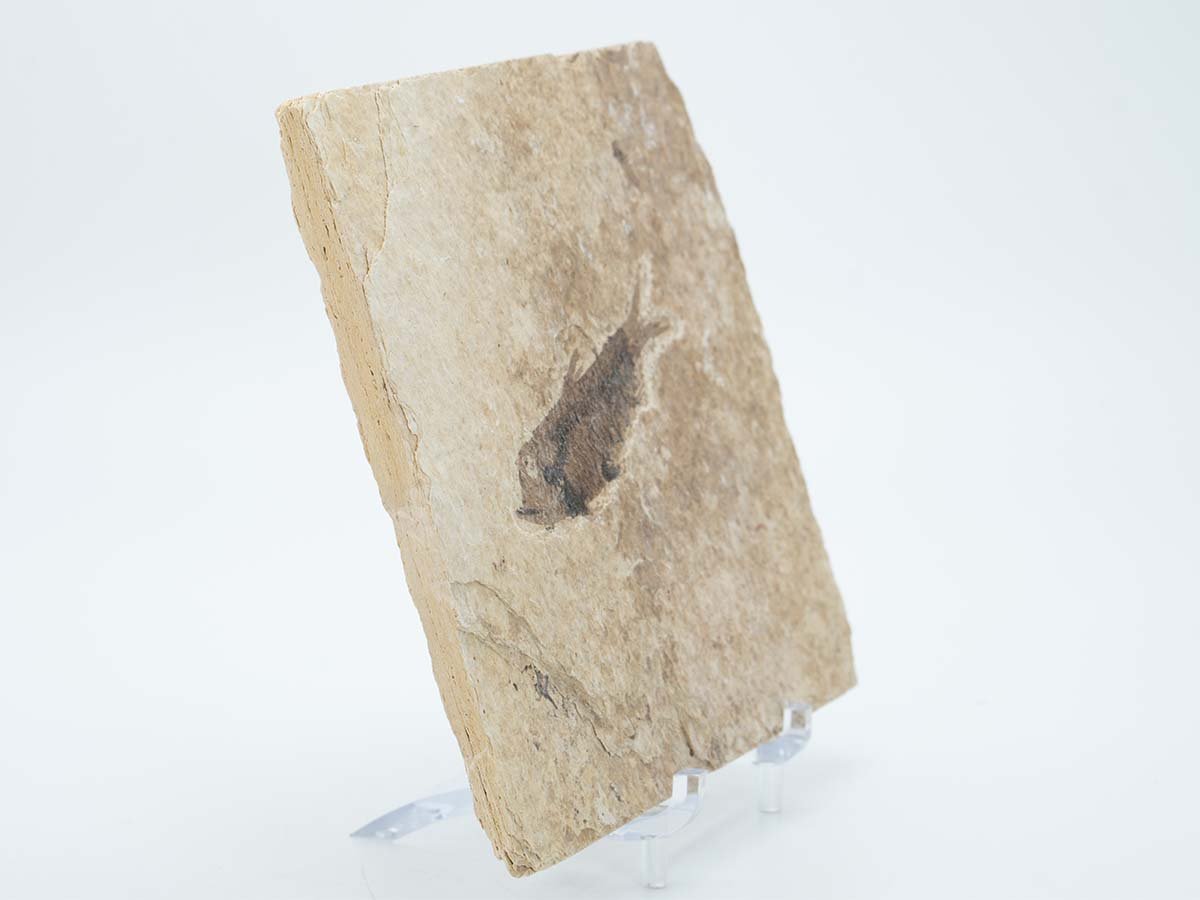
Knightia eocaena
Image: Image sourced via web search (Fair use / Educational)
About Knightia
Knightia eocaena is an extinct species of freshwater clupeid fish that thrived during the Eocene epoch, approximately 56 to 40 million years ago, primarily in the ancient lake systems of what is now North America. As one of the most abundant vertebrate fossils in the world, Knightia holds immense significance in paleontology, offering an unprecedented window into Paleogene aquatic ecosystems and the evolutionary history of modern herrings and sardines. Its exceptional preservation in the fossil record has made it a cornerstone species for understanding the paleoecology of the Green River Formation. The physical anatomy of Knightia eocaena closely mirrors that of modern herrings, characterized by a streamlined, laterally compressed body that was perfectly adapted for efficient cruising through the open waters of Eocene lakes. Most adult specimens range from 10 to 15 centimeters in length, though exceptional individuals reaching up to 25 centimeters have been documented. Weight estimates suggest these fish were relatively light, likely weighing between 20 and 50 grams in life. Distinctive skeletal features include a deeply forked tail fin (caudal fin) that provided rapid propulsion, and a single, centrally located dorsal fin. The skull is relatively small with a terminal mouth, equipped with fine, delicate teeth suited for a diet of small prey. The vertebral column is robust, typically consisting of around 40 to 45 vertebrae, and the ribs are long and slender. Soft tissue inferences, drawn from the exceptionally preserved carbonized films found in some specimens, indicate that Knightia possessed large, well-developed eyes for visual hunting in the photic zone, and a body covered in large, overlapping cycloid scales that likely gave the living fish a silvery, reflective appearance similar to extant clupeids. This silvery countershading would have been a crucial defense mechanism against predators striking from below or above. In terms of paleobiology, Knightia eocaena was a pelagic schooling fish, exhibiting behaviors strongly analogous to modern sardines and herrings. Its diet consisted primarily of zooplankton, ostracods, diatoms, and small insects that fell onto the water's surface, making it a crucial primary consumer and omnivore within its ecosystem. The fine gill rakers preserved in some specimens suggest it was an efficient filter-feeder, capable of straining microscopic organisms from the water column. Locomotion was achieved through carangiform swimming, utilizing the posterior half of the body and the deeply forked tail to generate thrust, allowing for both sustained cruising and rapid bursts of speed to evade predators. Social behavior is strongly inferred from the fossil record; mass mortality plates frequently preserve hundreds or even thousands of Knightia individuals aligned in the same direction, providing compelling evidence that they formed massive, synchronized schools. This schooling behavior would have offered hydrodynamic benefits and reduced the individual risk of predation. Growth patterns, analyzed through the growth rings (annuli) on their scales and otoliths, indicate a relatively short lifespan of perhaps four to seven years, with rapid initial growth during the first two years of life. The ecological context of Knightia eocaena is intrinsically tied to the Fossil Lake, Lake Gosiute, and Lake Uinta systems—a series of massive, interconnected freshwater lakes that dominated the landscape of Eocene Wyoming, Colorado, and Utah. During this period, the Earth was experiencing the Early Eocene Climatic Optimum, characterized by a warm, subtropical climate with high global temperatures and no polar ice caps. The region surrounding these lakes was lushly vegetated with palm trees, ferns, and broadleaf forests, supporting a diverse array of terrestrial life including early primates, primitive horses, and diverse bird species. In the aquatic realm, Knightia occupied a foundational position in the food web. It was the primary prey item for a multitude of larger predators, including the voracious predatory fish Diplomystus, the massive gar Lepisosteus, the bowfin Amia, and various aquatic reptiles such as turtles and early crocodilians. Avian predators, similar to modern herons and kingfishers, likely hunted Knightia from the surface. The sheer abundance of Knightia suggests it was the ecological equivalent of modern forage fish, converting the massive planktonic productivity of the Eocene lakes into biomass that supported the entire upper trophic structure of the ecosystem. The discovery history of Knightia is deeply intertwined with the exploration of the American West. The first fossils of these fish were noted by early explorers and missionaries in the mid-19th century, but they were formally described and brought to scientific prominence by the pioneering paleontologist Edward Drinker Cope in the 1870s. Cope initially assigned these fossils to various genera, but it was David Starr Jordan, a prominent ichthyologist, who erected the genus Knightia in 1907. Jordan named the genus in honor of Wilbur Clinton Knight, a pioneering geologist and paleontologist at the University of Wyoming who had made significant contributions to the study of the state's fossil resources. The specific epithet 'eocaena' simply refers to the Eocene epoch from which the fossils derive. The circumstances of discovery often involved the splitting of finely laminated limestone shales, revealing the perfectly flattened, dark brown skeletons against the pale rock. Over the decades, commercial quarrying and scientific expeditions in the Green River Formation, particularly around Kemmerer, Wyoming, have unearthed millions of specimens, making Knightia one of the most thoroughly documented extinct vertebrates in the history of paleontology. The evolutionary significance of Knightia lies in its position within the Clupeiformes, the order that includes modern herrings, shads, sardines, and anchovies. As an early member of the family Clupeidae, Knightia provides critical morphological data on the early divergence and radiation of this economically and ecologically vital group of fishes. While it is not considered a direct ancestor to any single modern species, it represents a highly successful early offshoot that adapted specifically to freshwater lacustrine environments, a somewhat unusual niche given that the majority of modern clupeids are marine. The skeletal anatomy of Knightia demonstrates that the fundamental clupeid body plan—optimized for schooling and planktivory—was already fully established by the early Eocene. Studying Knightia helps evolutionary biologists understand the conservative nature of this body plan, which has remained largely unchanged for over 50 million years due to its extreme biomechanical efficiency. Furthermore, the presence of such a derived clupeid in freshwater Eocene lakes provides important clues about the paleogeographic connections between marine and freshwater environments during the Paleogene. Scientific debates surrounding Knightia have historically focused on its exact taxonomic placement within the Clupeiformes and the specific environmental conditions that led to the mass mortality events preserved in the fossil record. While its status as a clupeid is universally accepted, its relationships to other extinct Eocene fishes, such as Diplomystus (which belongs to a different family, Ellimmichthyidae), have been the subject of intensive cladistic analysis. A more enduring controversy involves the taphonomy of the mass mortality beds. Some researchers argue that these massive die-offs were caused by sudden changes in water chemistry, such as seasonal overturns of the stratified lake water that brought toxic, anoxic bottom waters to the surface. Others propose that massive algal blooms, triggered by volcanic ash falls or sudden temperature shifts, depleted the oxygen in the photic zone, suffocating the massive schools of Knightia. Recent geochemical analyses of the surrounding limestone matrices continue to refine our understanding of these catastrophic events, though a single, unifying cause remains a subject of active scientific inquiry. The fossil record of Knightia is almost entirely restricted to the Green River Formation of the western United States, but within this localized geographic area, the sheer volume of fossils is staggering. It is estimated that millions of individual Knightia specimens have been collected, ranging from isolated scales to complete, perfectly articulated skeletons. The preservation quality is frequently exceptional, a result of the unique depositional environment of the Eocene lakes. When a Knightia died, it sank into the anoxic, highly saline bottom waters of the lake, where a lack of oxygen prevented decomposition by bacteria and scavenging by bottom-dwelling organisms. Fine layers of calcium carbonate mud then gently covered the carcass, preserving even the most delicate structures, including fin rays, scales, and occasionally the outline of the digestive tract. The most famous fossil sites are the commercial and scientific quarries located in Fossil Butte National Monument and the surrounding areas near Kemmerer, Wyoming, where the 'split fish' layers yield specimens of breathtaking detail. The cultural impact of Knightia is uniquely profound for a fossil fish. Due to its incredible abundance and the aesthetic appeal of the dark fossils against the light limestone, Knightia is arguably the most commonly owned vertebrate fossil in the world, frequently sold in rock shops, museum gift stores, and online marketplaces. In 1987, the state of Wyoming officially designated Knightia as its state fossil, recognizing its historical and economic importance to the region. It appears in virtually every major natural history museum globally, often displayed in massive mortality plates that serve as striking visual testaments to the deep history of life on Earth. For educators and the general public, Knightia serves as an accessible and tangible entry point into paleontology, illustrating concepts of fossilization, paleoecology, and deep time in a way that few other extinct organisms can achieve.
Classification
Time Period
Discovery
Location
Wyoming, USA
Formation
Green River Formation
Frequently Asked Questions
What is Knightia?
Knightia eocaena is an extinct species of freshwater clupeid fish that thrived during the Eocene epoch, approximately 56 to 40 million years ago, primarily in the ancient lake systems of what is now North America. As one of the most abundant vertebrate fossils in the world, Knightia holds immense si...
When did Knightia live?
Knightia lived during the paleogene period of the cenozoic era approximately 56-40 million years ago.
Where was Knightia discovered?
Fossils of Knightia were discovered in Wyoming, USA in the Green River Formation.
What did Knightia eat?
Knightia was a omnivore. It lived in freshwater habitats.
What type of fossil is Knightia?
Knightia is preserved as a body fossil. The preservation quality is exceptional.
Related Specimens
From the cenozoic era · body fossils