Gomphotherium
Gomphotherium productum
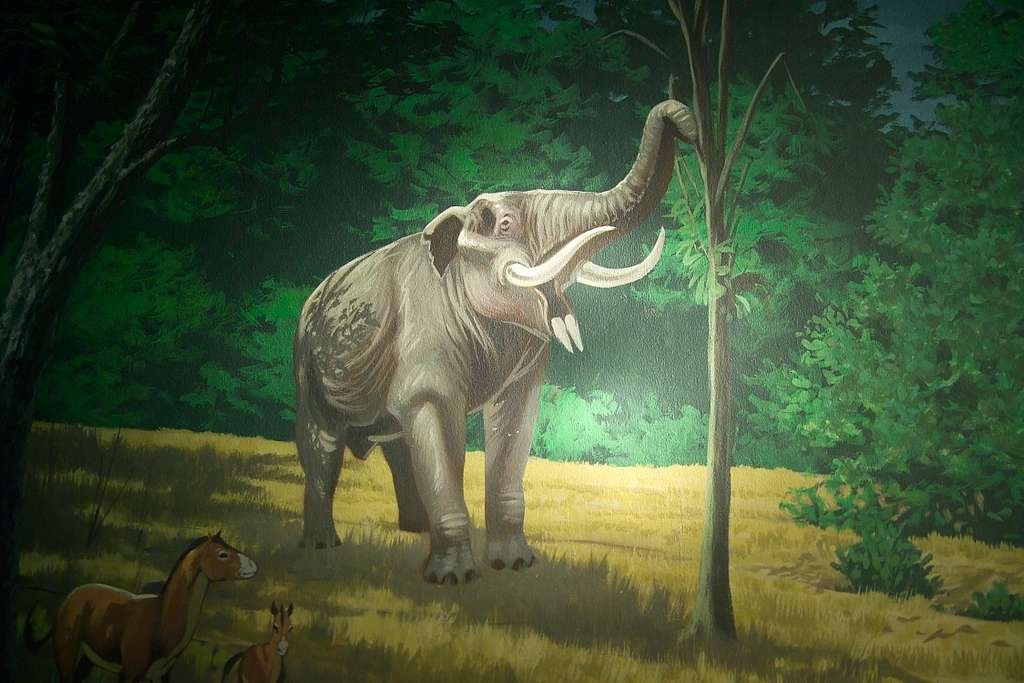
Image: Image sourced via web search (Fair use / Educational)
About Gomphotherium
Gomphotherium productum represents one of the most iconic and widespread proboscideans of the Neogene period, serving as a crucial evolutionary link between early elephant relatives and the modern giants we recognize today. Living approximately 14 to 5 million years ago during the Miocene and early Pliocene epochs, this remarkable mammal roamed extensively across the diverse landscapes of North America. As a prominent member of the family Gomphotheriidae, it holds immense significance in the field of paleontology for illustrating the complex adaptive radiations of proboscideans as they migrated out of Africa and colonized new continents. The presence of Gomphotherium fossils across various geological formations provides invaluable insights into the shifting climates and ecosystems of the Cenozoic era, marking a time when the Earth's terrestrial environments were undergoing profound transformations from dense forests to more open woodland and grassland habitats.
In terms of physical description, Gomphotherium productum was a formidable creature, standing approximately 2.5 to 3 meters (8 to 10 feet) tall at the shoulder and measuring roughly 4.5 meters (15 feet) in length. Weight estimates suggest that a fully grown adult could weigh between 4 and 5 metric tons, making it comparable in size to a modern Asian elephant, though with a distinctly different bodily proportion and cranial architecture. The most striking and distinctive anatomical feature of Gomphotherium was its possession of four tusks—two protruding from the upper jaw and two extending from the elongated lower jaw. The upper tusks curved gently downward and outward, while the lower tusks were flatter, somewhat shovel-like, and positioned close together. The skull was elongated to accommodate these massive dental structures, and the lower jaw (mandible) was significantly longer than that of modern elephants. Skeletal characteristics indicate a robust, barrel-shaped body supported by thick, pillar-like legs designed to bear immense weight. Soft tissue inferences, derived from the structure of the nasal cavity and the attachment points on the skull, strongly suggest the presence of a muscular trunk (proboscis). However, because of the elongated lower jaw, this trunk was likely shorter and less flexible than the trunks of extant elephants, perhaps functioning more like a prehensile lip used in conjunction with the lower tusks to manipulate vegetation.
The paleobiology of Gomphotherium productum reveals a highly adaptable herbivore equipped with specialized feeding strategies. Its diet consisted primarily of a mixture of browse and graze, including leaves, twigs, fruits, and increasingly, the tough grasses that were beginning to dominate the Miocene landscape. The unique four-tusked arrangement was intricately linked to its feeding mechanics. Paleontologists hypothesize that the flat, elongated lower tusks were used to strip bark from trees, dig up nutrient-rich roots and tubers, or scoop up aquatic vegetation from shallow wetlands, functioning much like a biological shovel or scoop. The upper tusks may have been used for defense, intraspecific combat, or further manipulation of large branches. Locomotion was graviportal, meaning its limbs were adapted primarily for supporting its massive bulk rather than for speed, resulting in a slow, deliberate walking pace similar to modern elephants. Social behavior inferences, drawn from the accumulation of multiple individuals in single fossil quarries and comparisons with extant proboscideans, suggest that Gomphotherium likely lived in matriarchal herds. These herds would have provided protection for vulnerable calves and facilitated the transfer of generational knowledge regarding migration routes and water sources. Growth patterns analyzed from the incremental lines in their tusks indicate a slow maturation process, with individuals likely taking over a decade to reach sexual maturity, accompanied by a relatively low metabolic rate typical of megaherbivores.
The ecological context in which Gomphotherium productum thrived was characterized by significant climatic and environmental shifts. During the middle to late Miocene, the global climate was gradually cooling and drying, leading to the retreat of dense, continuous forests and the expansion of open woodlands, savannas, and early grassland ecosystems. Gomphotherium occupied a keystone position in these transitional habitats. As a megaherbivore, it played a crucial role in shaping its environment—knocking down trees, dispersing seeds over vast distances through its digestive tract, and creating clearings that benefited smaller herbivores. It shared its habitat with a diverse array of co-existing species, including early horses like Merychippus, rhinoceroses such as Teleoceras, camelids, and various artiodactyls. The food web of the Miocene was complex, and while an adult Gomphotherium was largely immune to predation due to its immense size, calves and sick individuals would have been vulnerable to the formidable predators of the time. These included bone-crushing dog relatives (borophagines), early saber-toothed cats (machairodontines), and large bear-dogs (amphicyonids). The evolutionary arms race between these predators and their prey drove the development of herd behaviors and the formidable defensive tusks seen in Gomphotherium.
The discovery history of Gomphotherium productum is deeply intertwined with the early, pioneering days of North American paleontology. The genus Gomphotherium was first established by the eminent German paleontologist Hermann von Meyer in 1837, based on European specimens. However, the specific species Gomphotherium productum was identified and named much later, during the intense period of paleontological exploration in the American West known as the Bone Wars. Fossils of this species were prominently collected in the late 19th and early 20th centuries from rich fossil beds in states like Texas, Nebraska, and Kansas. Edward Drinker Cope, one of the central figures of the Bone Wars, was instrumental in describing many early proboscidean remains from North America, though the taxonomy was initially highly confused, with numerous overlapping names such as Trilophodon and Tetrabelodon being used before being synonymized under Gomphotherium. Key specimens, including beautifully preserved skulls and nearly complete skeletons recovered from the Ogallala Formation, have provided the foundation for our understanding of this species. These discoveries were often made by intrepid field crews working in harsh, arid conditions, carefully excavating the massive, fragile bones from hardened sandstone and siltstone deposits.
The evolutionary significance of Gomphotherium cannot be overstated, as it occupies a central, transitional node in the proboscidean family tree. Originating in Africa during the early Miocene, the ancestors of Gomphotherium took advantage of the closing of the Tethys Sea to migrate into Eurasia and eventually across the Bering land bridge into North America. Gomphotherium represents a crucial evolutionary grade characterized by the bunodont (rounded cusp) molar teeth and the distinctive four-tusked jaw structure. It serves as a morphological bridge between the more primitive, pig-sized proboscideans like Palaeomastodon and the highly derived, two-tusked giants of the Pleistocene, such as the true mastodons (Mammutidae) and the elephants and mammoths (Elephantidae). The evolutionary trends observed in the Gomphotheriidae—including the gradual shortening of the lower jaw, the loss of the lower tusks, and the corresponding elongation and increased flexibility of the trunk—are perfectly encapsulated in the fossil record following Gomphotherium. By studying Gomphotherium productum, scientists can trace the step-by-step anatomical adaptations that allowed proboscideans to transition from specialized forest browsers to versatile, widespread megaherbivores capable of dominating diverse ecosystems across the globe.
Despite its extensive fossil record, Gomphotherium remains the subject of ongoing scientific debates and taxonomic revisions. One of the primary controversies revolves around the exact mechanics of its feeding behavior and the function of its lower tusks. While the traditional view posits that the lower tusks were used as shovels to dig up roots in swampy environments, recent biomechanical studies and dental microwear analyses suggest a more varied use, including stripping bark or cutting tough vegetation, implying that they were not strictly tied to wetland habitats. Additionally, the taxonomy of the Gomphotheriidae is notoriously complex and often described as a taxonomic wastebasket. Researchers continuously debate the boundaries between different species and genera, with some arguing that Gomphotherium productum may actually represent a complex of closely related species rather than a single, monolithic taxon. The exact length and flexibility of its trunk also remain a point of contention, as soft tissue does not fossilize, leaving scientists to rely on competing interpretations of cranial muscle attachment sites.
The fossil record of Gomphotherium productum is exceptionally rich and geographically widespread, making it one of the best-documented extinct proboscideans. Fossils are predominantly found throughout the central and western United States, with notable concentrations in the Great Plains region, including Texas, Oklahoma, Kansas, and Nebraska. The preservation quality ranges from isolated, fragmentary teeth and tusk shards to spectacularly complete, articulated skeletons. Because of their immense size and durability, the teeth and tusks are the most commonly preserved elements, often surviving the destructive forces of fossilization better than the more porous postcranial bones. Famous fossil sites, such as the Clarendon beds in Texas and various quarries within the Ogallala Group, have yielded hundreds of specimens. These sites often represent ancient river channels or watering holes where individuals congregated, died, and were rapidly buried by fluvial sediments, ensuring a high degree of preservation that allows for detailed anatomical and histological studies.
In terms of cultural impact, Gomphotherium has captured the public imagination as a bizarre, almost alien relative of the familiar elephant. Its unique four-tusked appearance makes it a popular subject in paleoart and a striking centerpiece in natural history museums worldwide. Notable displays, featuring towering mounted skeletons, can be found in institutions such as the American Museum of Natural History in New York and the Denver Museum of Nature and Science. These exhibits play a vital educational role, vividly illustrating the concepts of evolution, extinction, and the dynamic history of Earth's changing climates to millions of visitors. The public fascination with Gomphotherium underscores the enduring appeal of prehistoric megafauna and highlights the importance of continued paleontological research in uncovering the deep history of life on our planet.
Classification
Time Period
Discovery
Location
North America
Formation
Ogallala Formation
Frequently Asked Questions
What is Gomphotherium?
Gomphotherium productum represents one of the most iconic and widespread proboscideans of the Neogene period, serving as a crucial evolutionary link between early elephant relatives and the modern giants we recognize today. Living approximately 14 to 5 million years ago during the Miocene and early ...
When did Gomphotherium live?
Gomphotherium lived during the neogene period of the cenozoic era approximately 14-5 million years ago.
Where was Gomphotherium discovered?
Fossils of Gomphotherium were discovered in North America in the Ogallala Formation.
What did Gomphotherium eat?
Gomphotherium was a herbivore. It lived in terrestrial habitats.
What type of fossil is Gomphotherium?
Gomphotherium is preserved as a body fossil. The preservation quality is good.
Related Specimens
From the cenozoic era · body fossils