Adelobasileus
Adelobasileus cromptoni
Image: Image sourced via web search (Fair use / Educational)
About Adelobasileus
Adelobasileus cromptoni represents a pivotal, albeit enigmatic, figure in the grand narrative of vertebrate evolution, living during the Late Triassic period approximately 225 million years ago. This small, shrew-like creature from what is now Texas, USA, is known from a single, incomplete skull, yet its anatomical details provide crucial insights into the transition from non-mammalian synapsids to true mammals. Its significance lies in its status as one of the earliest known mammaliaforms, a group that includes the last common ancestor of all living mammals and its closest extinct relatives, making it a key subject for understanding the origins of Mammalia. Adelobasileus lived in a world dominated by archosaurs, long before the dinosaurs reached their zenith, occupying a humble niche that would ultimately lead to one of the most successful evolutionary radiations in Earth's history.
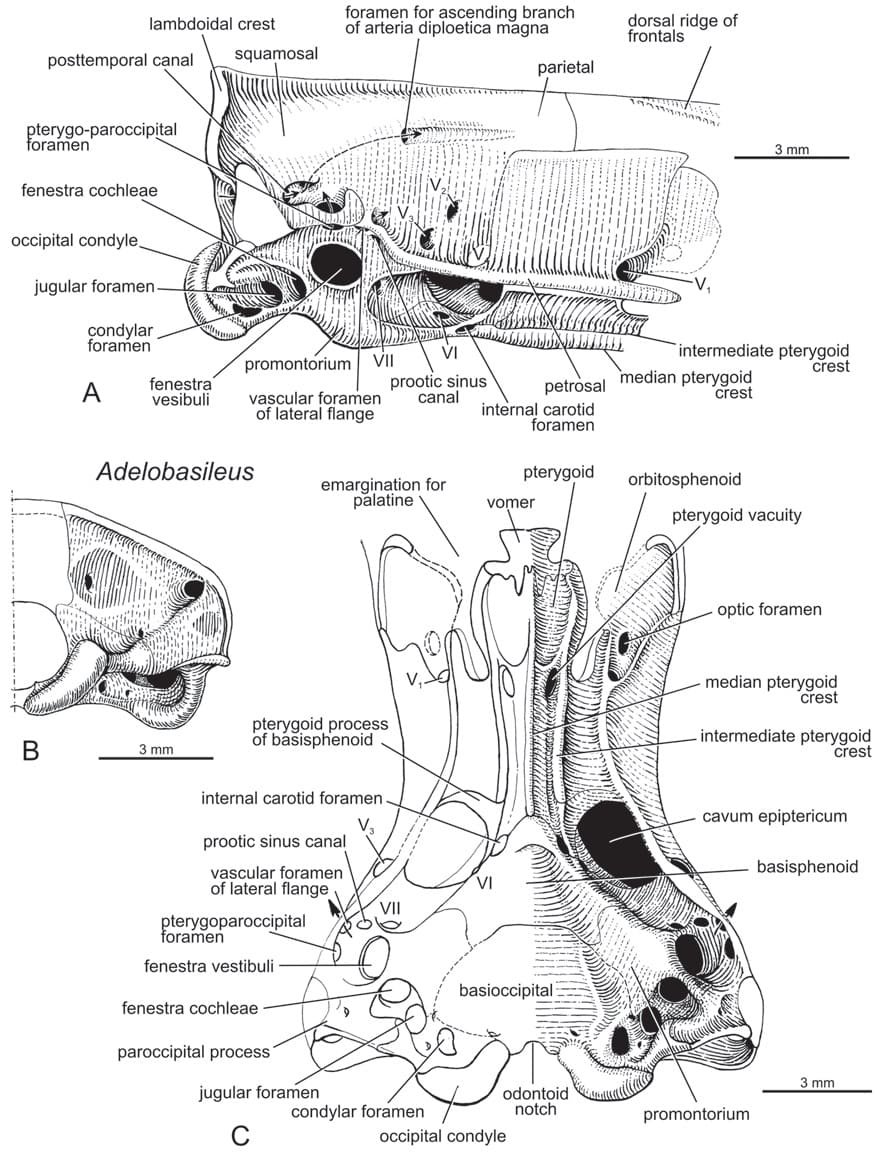
Based on the fragmentary holotype skull (NMMNH P-12971), Adelobasileus was a diminutive animal, with an estimated total body length of only 10 to 15 centimeters, comparable in size to a modern house mouse or a small shrew. Its weight would have been negligible, likely just a few tens of grams. The fossil itself consists of the posterior portion of a cranium, including the braincase and parts of the basicranium and occiput. Despite its incompleteness, the skull reveals a mosaic of primitive and advanced features. The most striking characteristic is the presence of a well-developed promontorium of the petrosal bone, which houses a cochlear canal that is coiled, though not to the extent seen in modern therian mammals. This feature is a significant step towards the complex hearing apparatus of later mammals and is considered a key mammalian synapomorphy. The braincase was relatively large for its body size compared to earlier cynodonts, suggesting an increase in brain volume, another hallmark of the mammalian lineage. While no teeth were preserved with the holotype, its inferred diet and relationship to other early mammaliaforms suggest it likely possessed small, multi-cusped teeth adapted for processing insects and other small invertebrates. Its overall skeletal structure, though not preserved, is inferred to have been gracile and adapted for a quick, scuttling lifestyle, similar to that of many small, nocturnal insectivores today.
The paleobiology of Adelobasileus is largely inferred from its limited fossil evidence and its phylogenetic position. Its small size and presumed dental morphology strongly suggest an insectivorous diet. It would have hunted for insects, worms, and other small arthropods in the leaf litter and undergrowth of its Triassic environment. This dietary niche was common among early mammaliaforms, allowing them to avoid direct competition with the larger reptilian carnivores and herbivores of the time. Locomotion was likely quadrupedal and cursorial, characterized by quick, scurrying movements to navigate the complex forest floor and evade predators. There is no direct evidence for social behavior, but like many small, modern insectivores, it may have been a solitary and primarily nocturnal animal. This nocturnal activity pattern would have been a crucial adaptation, enabling it to forage under the cover of darkness when many of its larger, diurnally active archosaurian predators were less active. Its metabolism is a subject of debate; while it was on the path to mammalian endothermy (warm-bloodedness), it is unclear whether Adelobasileus had achieved the high metabolic rate of modern mammals. It likely possessed some form of insulation, such as fur, a trait thought to have evolved early in the cynodont-mammal transition to aid in thermoregulation, especially for a small-bodied, potentially nocturnal creature.
Adelobasileus inhabited the supercontinent of Pangaea during the Carnian stage of the Late Triassic. The world at this time was generally hot and arid, though regional climates varied. The Tecovas Formation, where its fossil was found, represents a floodplain environment with meandering rivers, seasonal lakes, and lush vegetation along the waterways, transitioning to more arid plains further inland. The climate would have been monsoonal, with distinct wet and dry seasons. This ecosystem was teeming with a diverse array of life. The dominant terrestrial vertebrates were archosaurs, including early dinosaurs like Herrerasaurus and Eoraptor (or their close relatives), large predatory rauisuchians such as Postosuchus, and armored aetosaurs like Desmatosuchus. Giant, herbivorous dicynodonts like Placerias were also common. In this formidable landscape, Adelobasileus occupied a low trophic level, positioned as a small insectivore in the food web. Its primary predators would have included a variety of small to medium-sized reptiles, such as the agile, bipedal dinosaur precursors and perhaps even larger amphibians that lurked in the waterways. Adelobasileus and its kin survived by being small, secretive, and likely nocturnal, a strategy that would define the mammalian lineage for the next 150 million years under the reign of the dinosaurs.
The discovery of Adelobasileus cromptoni is a story of meticulous paleontological fieldwork and insightful analysis. The single known specimen, a partial skull cataloged as NMMNH P-12971, was discovered in 1989 by a field crew from the New Mexico Museum of Natural History and Science. The fossil was found in the Crosby County badlands of West Texas, within the fossil-rich layers of the Tecovas Formation, part of the larger Dockum Group. The paleontologists Spencer G. Lucas and Adrian P. Hunt were instrumental in the study of this specimen. In 1990, they formally described the fossil, naming the new genus and species Adelobasileus cromptoni. The genus name translates from Greek as 'inconspicuous king' or 'hidden ruler' (adēlos, 'unseen' + basileus, 'king'), a clever reference to its basal position at the very root of the mammalian royal lineage. The species name, cromptoni, honors the influential paleontologist Alfred W. 'Fuzz' Crompton, whose extensive work on cynodonts and early mammals laid much of the groundwork for understanding this critical evolutionary transition. The discovery was significant because, at the time, it represented the oldest known mammaliaform, pushing back the fossil record of the group and providing a glimpse of a more primitive morphology than previously known forms like morganucodonts.
Adelobasileus holds a place of immense evolutionary significance as it sits near the very base of the mammaliaform family tree. It is considered by many paleontologists to be the sister taxon to all other mammaliaforms, including the crown-group Mammalia. This means it branched off just before the lineage that would give rise to every mammal that has ever lived, from morganucodonts to monotremes, marsupials, and placentals. Its anatomy provides a crucial snapshot of the final stages of the transition from advanced, non-mammalian cynodonts (like the family Tritylodontidae or Tritheledontidae) to the first true mammals. The most important transitional feature is its coiled cochlea, a distinctly mammalian trait not seen in its cynodont ancestors, which indicates a significant advancement in auditory acuity. However, it retains primitive features in its basicranium that link it back to its cynodont forebears. This mosaic of old and new traits perfectly exemplifies the concept of a transitional fossil. Adelobasileus demonstrates that key mammalian characteristics, such as advanced hearing, evolved before other hallmark features, like the definitive mammalian jaw joint and middle ear structure seen in later forms. It helps scientists calibrate the timeline of mammalian origins, suggesting that the divergence of the mammalian line occurred at least 225 million years ago.
Despite its importance, the fragmentary nature of the only known Adelobasileus fossil leaves room for considerable scientific debate. Its precise phylogenetic placement remains a topic of discussion. While most analyses place it as the most basal mammaliaform, a sister group to all others, some researchers have questioned this position, suggesting it could be an advanced cynodont closely related to, but outside of, Mammaliaformes. This debate hinges on the interpretation of subtle anatomical features in the partial braincase and how they are coded in phylogenetic analyses. Without teeth, postcranial remains, or a more complete skull, resolving this issue definitively is challenging. Another area of uncertainty is its physiology. While fur and some degree of endothermy are often assumed for an animal in its phylogenetic position, there is no direct evidence. The degree to which it had developed other mammalian sensory abilities, such as a refined sense of smell or touch via whiskers (vibrissae), is entirely speculative. New discoveries of contemporaneous fossils from other parts of the world could potentially shed more light on these debates, either by providing more complete Adelobasileus material or by revealing close relatives that can fill in the anatomical and physiological gaps in our understanding of the earliest stages of mammalian evolution.
The fossil record of Adelobasileus is exceptionally sparse, limited to a single, partial cranium. This holotype specimen (NMMNH P-12971) was unearthed from the Bull Canyon Formation's Tecovas Member in Crosby County, Texas, USA. To date, no other fossils attributable to Adelobasileus have been found anywhere in the world, making it one of the rarest and most tantalizingly incomplete fossils in the story of mammalian origins. The preservation quality of the holotype is considered poor to fair; while the bone itself is preserved in three dimensions, it is heavily fragmented and missing the entire anterior portion of the skull, including the snout, jaws, and dentition. The preserved parts are primarily the braincase and occipital region. The rarity of Adelobasileus is likely a result of taphonomic bias—the small, delicate bones of such a tiny animal are far less likely to survive the processes of death, decay, burial, and fossilization compared to the robust skeletons of the giant archosaurs that dominated the Triassic landscape. Famous fossil sites like the Tecovas Formation are thus critical for finding such rare treasures, requiring careful and patient prospecting to locate the remains of the ecosystem's smallest inhabitants.
Given its highly fragmentary nature and specialized scientific importance, Adelobasileus cromptoni has had a minimal cultural impact and is virtually unknown to the general public. It has not appeared in any major films, documentaries, or popular literature, unlike more charismatic prehistoric animals. Its significance is primarily academic, recognized by paleontologists and evolutionary biologists as a key piece of the puzzle of mammalian origins. The holotype fossil is housed in the collections of the New Mexico Museum of Natural History and Science in Albuquerque, where it is available for scientific study, but it is not typically a centerpiece of public exhibits due to its small size and incompleteness. Its educational importance lies in its role as a textbook example of a transitional fossil, used in university-level courses to illustrate the gradual, mosaic nature of macroevolution and the deep, ancient roots of the mammalian lineage. For the public, its story serves as a powerful reminder that evolutionary success stories often have the humblest of beginnings.
Classification
Time Period
Discovery
Location
Texas, USA
Formation
Tecovas Formation
Frequently Asked Questions
What is Adelobasileus?
Adelobasileus cromptoni represents a pivotal, albeit enigmatic, figure in the grand narrative of vertebrate evolution, living during the Late Triassic period approximately 225 million years ago. This small, shrew-like creature from what is now Texas, USA, is known from a single, incomplete skull, ye...
When did Adelobasileus live?
Adelobasileus lived during the triassic period of the mesozoic era approximately 225-220 million years ago.
Where was Adelobasileus discovered?
Fossils of Adelobasileus were discovered in Texas, USA in the Tecovas Formation.
What did Adelobasileus eat?
Adelobasileus was a insectivore. It lived in terrestrial habitats.
What type of fossil is Adelobasileus?
Adelobasileus is preserved as a body fossil. The preservation quality is poor.
Related Specimens
From the mesozoic era · body fossils