Alalcomenaeus
Alalcomenaeus cambricus
Image: Image sourced via web search (Fair use / Educational)
About Alalcomenaeus
Alalcomenaeus cambricus is an extinct arthropod from the middle Cambrian Period, a pivotal time in Earth's history known as the Cambrian Explosion, when most major animal phyla first appeared. Its exquisitely preserved fossils, primarily from the Burgess Shale of British Columbia, Canada, offer a remarkable window into the complex marine ecosystems that flourished approximately 508 million years ago. As a member of the enigmatic group Megacheira, or 'great-appendage' arthropods, Alalcomenaeus is crucial for understanding the early evolution and diversification of the most successful animal phylum on the planet.
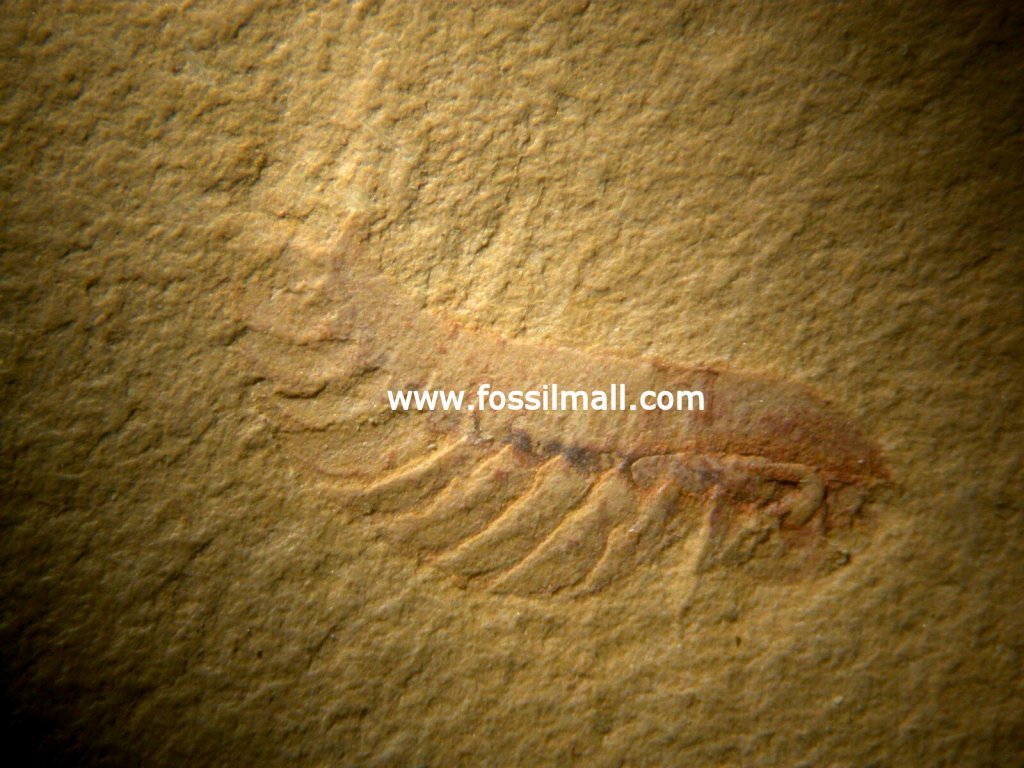
Alalcomenaeus was a relatively small animal, with most specimens measuring between 1 and 6 centimeters in length, roughly the size of a large shrimp. Its body was elongated and segmented, composed of a distinct head shield (cephalon), a trunk of eleven segments, and a paddle-like tail fan (telson). The most striking feature was a pair of large, specialized appendages attached to the head. These 'great appendages' were multi-jointed and equipped with spines along their inner edges, forming a basket-like structure likely used for grasping prey. Unlike the single-branched appendages of chelicerates (like spiders and scorpions), these were biramous, meaning they had two branches: a spiny, leg-like inner branch (endopod) for walking or grasping, and a feathery, gill-bearing outer branch (exopod) for respiration and swimming. The body was covered by a non-mineralized exoskeleton, which is why its preservation required the unique conditions of Lagerstätten like the Burgess Shale. Its eyes were stalked, providing a wide field of view, and it possessed a total of twelve pairs of biramous limbs along its body, one for the head segment behind the great appendages and one for each of the eleven trunk segments. The preservation of internal structures, including the nervous system, in some specimens provides unparalleled anatomical detail for a Cambrian organism.
As a predator, Alalcomenaeus likely employed an ambush or active hunting strategy on or near the seafloor. Its large, stalked eyes would have been effective at spotting small prey in the murky Cambrian seas. The formidable great appendages were perfectly adapted for seizing and manipulating victims, such as small trilobites, worms, or other soft-bodied invertebrates. Once captured, prey would be passed to the mouth, located on the underside of the head. Locomotion was achieved through the coordinated movement of its eleven pairs of trunk limbs. The leg-like endopods would have allowed it to scuttle along the muddy substrate, while the paddle-like exopods, with their fine setae, could have propelled it through the water in short bursts of swimming, perhaps to escape larger predators or to lunge at prey. The tail fan may have acted as a rudder for steering or for rapid backward propulsion, similar to a modern crayfish. Evidence from a 2013 study by Tanja Strausfeld and colleagues, which identified a remarkably preserved nervous system, revealed a brain structure that suggests sophisticated sensory processing and motor control, consistent with an active, predatory lifestyle. This neuroanatomy, including a three-part brain and optic nerves, shares characteristics with both modern chelicerates and mandibulates, placing Alalcomenaeus in a critical position for understanding arthropod brain evolution.
The world of Alalcomenaeus was a shallow marine environment at the base of a submerged limestone cliff, known as the Cathedral Escarpment. The seafloor was a soft, muddy substrate, and the water was likely cool and well-oxygenated, supporting a dense and diverse community of organisms. This was the Burgess Shale ecosystem, one of the most famous fossil assemblages in the world. Alalcomenaeus shared this habitat with a bizarre cast of characters, including the apex predator Anomalocaris, the iconic trilobite Olenoides, the five-eyed Opabinia, and the armored slug-like Wiwaxia. Alalcomenaeus occupied a mid-level position in the food web as a mesopredator. It preyed on smaller benthic and nektobenthic creatures while itself being a potential food source for larger animals like Anomalocaris. The intricate predator-prey dynamics and niche partitioning evident in this community demonstrate that complex, modern-style ecosystems were already established by the middle Cambrian. The exceptional preservation of this fauna provides a detailed snapshot of this ancient food web, revealing the ecological roles and interactions of its inhabitants with a clarity rarely seen in the fossil record.
Alalcomenaeus was first described by the renowned paleontologist Charles Doolittle Walcott, the discoverer of the Burgess Shale. Walcott collected the first specimens between 1909 and 1911 from his quarry on the slopes of Mount Stephen in British Columbia, Canada. He formally named the species Alalcomenaeus cambricus in 1911, with the genus name derived from Alalcomenae, a town in Boeotia, Greece, and the species name referring to the Cambrian Period. However, Walcott's initial interpretation placed it within the crustaceans, a view colored by his attempt to fit all Burgess Shale fauna into existing modern groups. It was not until the comprehensive reinvestigation of the Burgess Shale fossils, initiated by Harry B. Whittington and his graduate students Derek Briggs and Simon Conway Morris in the 1970s, that the true, more alien nature of Alalcomenaeus and its kin was appreciated. This reassessment correctly identified it as a primitive arthropod but distinct from the major living subphyla. The holotype specimen, USNM 57646, is housed at the Smithsonian National Museum of Natural History, along with many of Walcott's other original finds. Subsequent discoveries at other Cambrian sites, notably the Chengjiang fossil beds in China, have yielded related species, expanding our knowledge of this group's diversity and geographic distribution.
Alalcomenaeus is a key taxon for deciphering the early evolutionary history of Arthropoda, the most diverse animal phylum today. It belongs to the class Megacheira ('great appendages'), a group of stem-arthropods characterized by their distinctive grasping head appendages. The evolutionary placement of Megacheira has been a subject of intense study and debate. Some analyses place them as stem-chelicerates, suggesting their great appendages are homologous to the chelicerae (fangs or pincers) of spiders, scorpions, and horseshoe crabs. This hypothesis is supported by similarities in brain architecture, specifically the innervation of the great appendages from the front part of the brain (the protocerebrum), similar to the chelicerae of modern chelicerates. Other studies, however, argue that megacheirans are stem-eucrustaceans or even stem-arthropods that predate the split between the major lineages (Chelicerata and Mandibulata). The biramous nature of all its limbs, including the great appendages, is a primitive arthropod trait, and its overall body plan provides a model for the ancestral arthropod condition. Regardless of its precise placement, Alalcomenaeus demonstrates that by the middle Cambrian, arthropods had already evolved into a wide array of specialized predators, showcasing the rapid pace of evolutionary innovation during this period.
The classification of Alalcomenaeus and the entire Megacheira group remains a dynamic area of paleontological research. The primary debate centers on their relationship to the major arthropod subphyla. The stem-chelicerate hypothesis, bolstered by neuroanatomical evidence from fossils like Alalcomenaeus, is currently a strong contender. This model suggests that the great appendage is the evolutionary precursor to the chelicerae. An alternative view, based on different interpretations of limb homology, places megacheirans closer to the base of the entire arthropod tree, before the divergence of chelicerates and mandibulates. The discovery of new, exceptionally preserved fossils from sites like the Chengjiang Biota in China, such as Leanchoilia and Yohoia, has added more data points but has also complicated the picture, revealing a greater diversity of great-appendage morphologies than previously known. Resolving this debate is fundamental to understanding the origin of the fundamental arthropod body plans that have been so successful for the past half-billion years. Each new fossil with preserved soft tissues, especially neural structures, has the potential to shift the consensus on this critical evolutionary question.
Fossils of Alalcomenaeus are best known from the Burgess Shale in Yoho National Park, British Columbia, Canada, specifically from the Walcott Quarry and other nearby localities. Over 400 specimens have been recovered from this formation, making it an uncommon but well-represented member of the fauna. The preservation quality is often exceptional, with fossils appearing as flattened carbonaceous films on shale that retain fine details of the non-mineralized exoskeleton, limbs, gills, and even internal organs like the gut tract and nervous system. This type of preservation is characteristic of a Burgess Shale-type Lagerstätte, where rapid burial in anoxic mud prevented decay and scavenging. In addition to the Canadian finds, a closely related or possibly identical species, Alalcomenaeus illecebrosus, has been described from the slightly older (c. 518 Mya) Chengjiang Biota in Yunnan Province, China. This geographic distribution indicates that the genus was widespread in the shallow seas of the Cambrian, inhabiting similar environments on different paleocontinents.
While not as famous as Anomalocaris or Hallucigenia, Alalcomenaeus is a staple in depictions of the Burgess Shale ecosystem. It appears in numerous books, television documentaries, and museum exhibits about the Cambrian Explosion. Its predatory nature and distinctive appearance make it a compelling example of early animal life. Major museums like the Smithsonian National Museum of Natural History in Washington, D.C., and the Royal Ontario Museum in Toronto feature impressive displays of Burgess Shale fossils, where specimens of Alalcomenaeus are often exhibited. Its primary cultural and educational impact lies in its role as a key piece of evidence in the scientific narrative of early arthropod evolution, illustrating the complexity and 'weirdness' of life that emerged during this formative period of Earth's history.
Classification
Time Period
Discovery
Location
Canada
Formation
Burgess Shale
Frequently Asked Questions
What is Alalcomenaeus?
Alalcomenaeus cambricus is an extinct arthropod from the middle Cambrian Period, a pivotal time in Earth's history known as the Cambrian Explosion, when most major animal phyla first appeared. Its exquisitely preserved fossils, primarily from the Burgess Shale of British Columbia, Canada, offer a re...
When did Alalcomenaeus live?
Alalcomenaeus lived during the cambrian period of the paleozoic era approximately 508-505 million years ago.
Where was Alalcomenaeus discovered?
Fossils of Alalcomenaeus were discovered in Canada in the Burgess Shale.
What did Alalcomenaeus eat?
Alalcomenaeus was a carnivore. It lived in marine, benthic habitats.
What type of fossil is Alalcomenaeus?
Alalcomenaeus is preserved as a body fossil. The preservation quality is exceptional.
Related Specimens
From the paleozoic era · body fossils