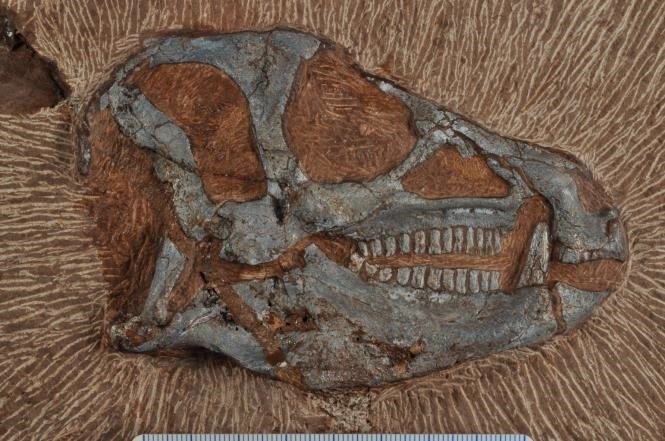
Heterodontosaurus
Heterodontosaurus tucki
Image: Image sourced via web search (Fair use / Educational)
About Heterodontosaurus
Heterodontosaurus tucki was a small, bipedal ornithischian dinosaur that lived during the Early Jurassic period, approximately 200 to 190 million years ago. Its fossils, found primarily in what is now South Africa, provide a crucial window into the early evolution of the great dinosaur clade Ornithischia. Its name, meaning 'different-toothed lizard,' refers to its most remarkable and scientifically significant feature: a complex and specialized dentition unlike that of most other reptiles, which has profound implications for understanding dinosaur physiology and dietary adaptations.
Heterodontosaurus was a relatively small dinosaur, with most adult specimens measuring between 1 and 1.75 meters (3.3 to 5.7 feet) in length and standing less than a meter tall at the hips. Weight estimates vary, but a consensus places it around 2 to 10 kilograms (4.4 to 22 pounds), comparable in size to a modern wild turkey or a large domestic cat. Its skeleton was lightly built, suggesting an agile and fast-moving animal. The most defining characteristic was its skull, which housed three distinct types of teeth. At the front of the upper jaw (the premaxilla), it possessed small, incisor-like teeth, likely used for nipping or cropping vegetation. Following these, in both the upper and lower jaws, were a pair of prominent, tusk-like caniniform teeth that could reach over 3 centimeters in length. The function of these 'tusks' is debated, but they may have been used for defense against predators, intraspecific display, or even for digging up roots and tubers. Behind these caniniforms were rows of tightly packed, chisel-shaped cheek teeth (molars and premolars) in the maxilla and dentary, which were adapted for grinding tough plant material. This dental arrangement is analogous to that of many mammals but is highly unusual for a reptile. The forelimbs were robust and relatively long, with five-fingered hands that possessed sharp claws. The hands were surprisingly powerful and may have been used for grasping or digging. In contrast, the hind limbs were long and slender, with three main weight-bearing toes, clearly adapted for swift, bipedal locomotion. Its long tail would have acted as a counterbalance while running. Some researchers have proposed the presence of simple, bristle-like proto-feathers covering its body, based on evidence from its close relative Tianyulong, though no direct fossil evidence of such structures has been found for Heterodontosaurus itself. This combination of features—specialized teeth, powerful grasping hands, and legs built for speed—paints a picture of a highly adapted and successful small herbivore.
The unique dental morphology of Heterodontosaurus provides strong evidence for a primarily herbivorous diet, though some have speculated on omnivorous tendencies. The incisiform teeth were ideal for snipping off leaves, ferns, or cycads, while the molariform cheek teeth, with their wear facets, indicate a sophisticated chewing mechanism involving precise jaw movements to grind and process fibrous plant matter. This level of oral processing was advanced for an early dinosaur and suggests it could consume tougher vegetation than many of its contemporaries. The large caniniforms remain a subject of debate; while they could have been used to supplement its diet with small animals or insects, most paleontologists favor a non-dietary function, such as display or defense, similar to the tusks of modern musk deer or water deer. Locomotion was clearly bipedal and cursorial. The long tibia and metatarsals relative to the femur are hallmarks of a fast runner, capable of reaching significant speeds to escape predators. However, the robust forelimbs suggest it may have occasionally adopted a quadrupedal posture, perhaps while foraging at low levels. Inferences about social behavior are speculative, but the presence of potential display structures like the tusks could imply complex social interactions, possibly involving competition for mates or territory. Growth studies based on bone histology are limited, but like many dinosaurs, it likely grew relatively quickly to reach adult size. Its advanced chewing mechanism and inferred high activity levels have led some scientists, such as Robert Bakker, to propose that Heterodontosaurus, and other ornithischians, may have been warm-blooded (endothermic), possessing a higher metabolism than typical reptiles to sustain an active lifestyle.
The world of Heterodontosaurus during the Hettangian and Sinemurian stages of the Early Jurassic was a semi-arid environment characterized by braided river systems and floodplains. The climate was seasonal, with distinct wet and dry periods, supporting a flora dominated by ferns, cycads, and conifers. This was a critical time in dinosaur evolution, following the Triassic-Jurassic extinction event which had eliminated many competing archosaur groups. Heterodontosaurus shared its habitat with a variety of other animals. The dominant large herbivores were the early sauropodomorphs, such as Massospondylus and Aardonyx, which would have browsed on higher vegetation. Other ornithischians included its close relative Abrictosaurus and the slightly larger Lesothosaurus. The primary predators in this ecosystem were early theropod dinosaurs like Dracovenator and Coelophysis rhodesiensis. Heterodontosaurus, being small and swift, would have occupied a niche as a low-browsing herbivore, likely forming a key part of the food web as prey for these larger carnivores. Its speed and potentially defensive tusks would have been its primary means of survival. The environment of the Elliot Formation, where its fossils are found, was a dynamic landscape, and Heterodontosaurus was well-adapted to navigate its challenges, from finding sufficient food to avoiding predation in a world increasingly dominated by dinosaurs.
The discovery history of Heterodontosaurus is rooted in the rich fossil beds of South Africa. The holotype specimen, designated SAM-PK-K337, was discovered in the Elliot Formation at Tyinira, Transkei, during a 1961-1962 expedition led by paleontologists Alfred W. Crompton and F. Ellenberger. The specimen consisted of a nearly complete but crushed skull. It was formally named and described in 1962 by Crompton and Alan J. Charig. The genus name, Heterodontosaurus, was chosen to highlight its 'different-toothed' nature, while the species name, tucki, honors G. C. Tuck, a director of the Austin Motor Company, which provided a vehicle for the expedition. A second, far more significant specimen was discovered in 1966 by Crompton's team near the town of Fouriesburg. This specimen, SAM-PK-K1332, is a nearly complete and fully articulated skeleton, missing only parts of the hind feet and tail. It remains one of the most complete early ornithischian skeletons ever found and has been instrumental in our understanding of the group's anatomy and biology. This remarkable fossil was painstakingly prepared over many years at Harvard University and was the subject of a detailed monograph by Albert de Lapparent de Broin, Richard Butler, and Paul Sereno in the 21st century, providing an unprecedented look at the animal's osteology. Several other partial skulls and postcranial remains have since been uncovered from the same geological formation, solidifying our knowledge of this important dinosaur.
Heterodontosaurus holds a pivotal position in the evolutionary history of dinosaurs. It is the namesake and best-known member of the family Heterodontosauridae, a group of early ornithischians that were among the first dinosaurs to evolve specialized adaptations for herbivory. For many years, heterodontosaurids were considered the most basal (primitive) members of the Ornithischia, representing the ancestral stock from which all other 'bird-hipped' dinosaurs, such as stegosaurs, ankylosaurs, and ceratopsians, evolved. This placement was based on features thought to be primitive, such as the powerful five-fingered hands. However, more recent and comprehensive phylogenetic analyses, particularly those by paleontologist Paul Sereno, have challenged this view. These studies suggest that heterodontosaurids may not be the most basal ornithischians but rather a distinct, early-diverging side branch. Some analyses even place them outside of the main ornithischian group (Genasauria) or, in a more controversial hypothesis, as basal marginocephalians, more closely related to the horned dinosaurs. Regardless of its exact placement, Heterodontosaurus is crucial because it demonstrates that complex dental batteries and sophisticated chewing mechanisms evolved very early in ornithischian history. It serves as a key anatomical model for understanding the foundational traits that led to the immense success and diversity of herbivorous dinosaurs throughout the Mesozoic Era.
Despite the exceptional quality of its fossils, Heterodontosaurus is still at the center of several scientific debates. The most prominent controversy revolves around its precise phylogenetic position within Ornithischia, as mentioned previously. Whether it represents the basalmost form or an early offshoot continues to be debated as new fossils and analytical methods emerge. Another area of discussion is the function of its prominent caniniform tusks. While most researchers lean towards a role in display or defense, the possibility of their use in digging or as a dietary tool for cracking hard seeds or invertebrates has not been entirely ruled out. The question of its metabolism is also a classic debate; its active lifestyle and advanced chewing suggest endothermy, but definitive proof is lacking. A more recent debate concerns its locomotion. While primarily seen as a bipedal runner, detailed studies of its forelimb anatomy by researchers like David Norman have suggested that it was capable of, and may have regularly engaged in, quadrupedal locomotion, challenging the long-held image of it as an exclusively two-legged animal. Finally, the discovery of Tianyulong in China, a relative preserved with filamentous integumentary structures, has ignited discussion about whether Heterodontosaurus itself was covered in 'dino-fuzz,' a hypothesis that awaits direct fossil evidence.
The fossil record of Heterodontosaurus is geographically restricted but of exceptionally high quality. All confirmed specimens have been unearthed from the upper Elliot Formation and the Clarens Formation in the Cape Province and Free State of South Africa. The most famous locality is the area around Fouriesburg. While not abundant, several key specimens are known, providing a comprehensive view of its anatomy. The most important of these is SAM-PK-K1332, the beautifully articulated, nearly complete skeleton that forms the basis for most reconstructions and scientific studies. The holotype skull (SAM-PK-K337) and other referred cranial and postcranial material provide additional data on individual variation and growth. The preservation quality of these fossils is often excellent, with bones found in articulation and showing fine anatomical detail. This high-fidelity preservation allows for detailed studies of its biomechanics, such as the precise movements of its jaw during chewing and the range of motion in its limbs. The Elliot Formation is a globally significant fossil site for understanding the faunal turnover from the Triassic to the Jurassic, and Heterodontosaurus is one of its most iconic inhabitants.
Heterodontosaurus, while not as famous as Tyrannosaurus or Triceratops, holds a special place in popular culture and paleontological education due to its unique appearance and evolutionary importance. Its combination of tusks, beak, and bipedal stance makes it a memorable and frequently illustrated early dinosaur. It is often featured in dinosaur books, documentaries, and museum exhibits as a prime example of early ornithischian diversity. Notable mounted skeletons and reconstructions can be seen in institutions such as the Iziko South African Museum in Cape Town. Its manageable size and intriguing features make it an excellent subject for teaching concepts like dietary adaptation, convergent evolution (with mammalian dentition), and the early radiation of major dinosaur groups. Its distinctive look has also led to its inclusion in various toy lines and video games, ensuring its recognition among dinosaur enthusiasts of all ages.
Classification
Time Period
Discovery
Location
South Africa
Formation
Elliot Formation
Frequently Asked Questions
What is Heterodontosaurus?
Heterodontosaurus tucki was a small, bipedal ornithischian dinosaur that lived during the Early Jurassic period, approximately 200 to 190 million years ago. Its fossils, found primarily in what is now South Africa, provide a crucial window into the early evolution of the great dinosaur clade Ornithi...
When did Heterodontosaurus live?
Heterodontosaurus lived during the jurassic period of the mesozoic era approximately 200-190 million years ago.
Where was Heterodontosaurus discovered?
Fossils of Heterodontosaurus were discovered in South Africa in the Elliot Formation.
What did Heterodontosaurus eat?
Heterodontosaurus was a herbivore. It lived in terrestrial habitats.
What type of fossil is Heterodontosaurus?
Heterodontosaurus is preserved as a body fossil. The preservation quality is excellent.
Related Specimens
From the mesozoic era · body fossils
/c81e708ee030.png)