Smilodon
Smilodon fatalis
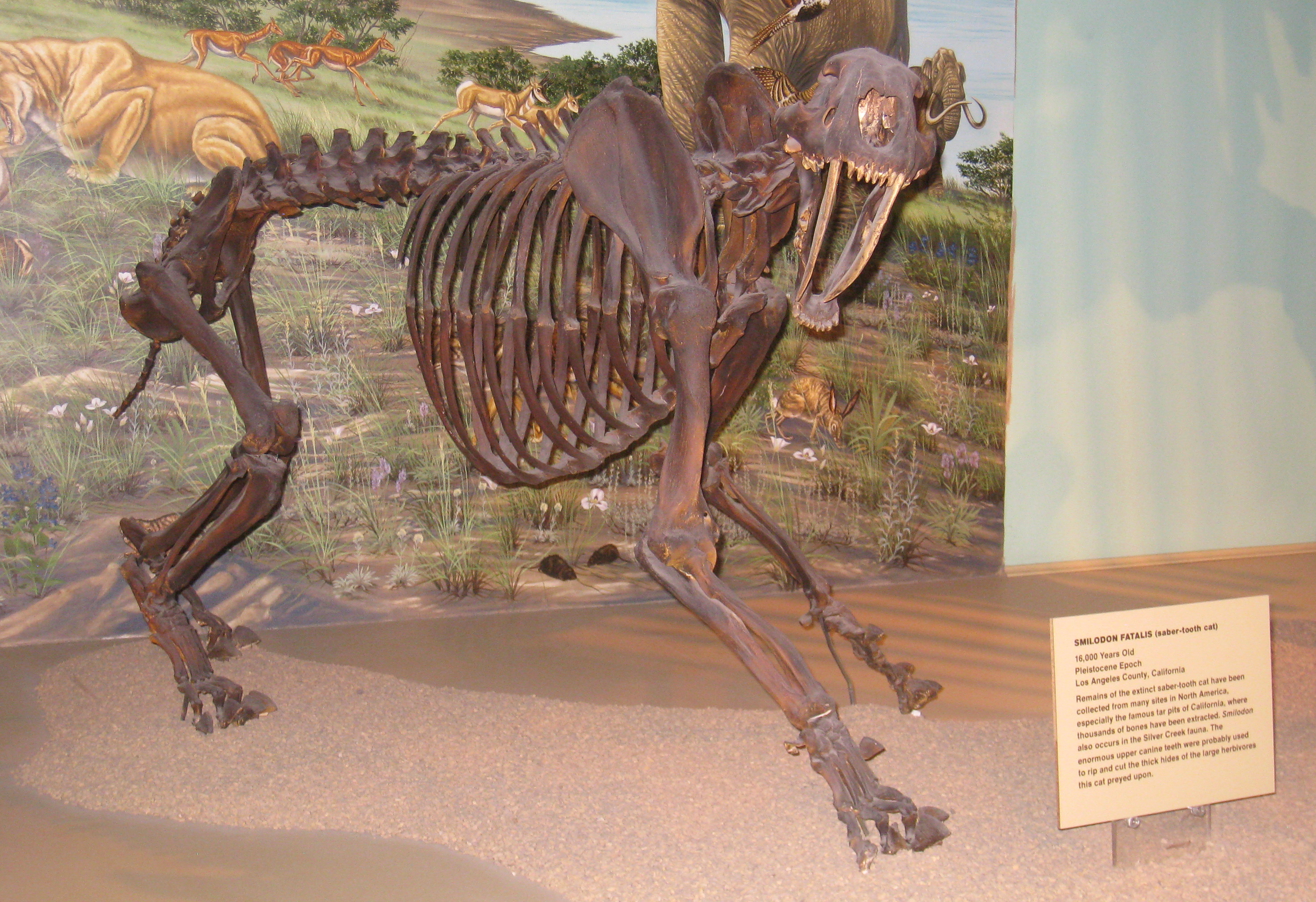
Image: File:Smilodon fatalis UMNH.jpg - Wikimedia Commons (CC BY-SA)
About Smilodon
Smilodon fatalis, colloquially known as the saber-toothed cat, stands as one of the most formidable and iconic apex predators of the Pleistocene epoch. This hypercarnivorous mammal roamed the terrestrial landscapes of North America and western South America from approximately 1.6 million to 10,000 years ago, during the Quaternary Period. Its profound significance in paleontological study stems from its extreme anatomical specializations for hunting megafauna and the extraordinary fossil record it left behind, most notably at the La Brea Tar Pits in California.
The physical anatomy of Smilodon fatalis reveals a predator built for power rather than speed, a stark contrast to the sleek, cursorial forms of modern big cats like cheetahs or even lions. An adult S. fatalis stood about 1 meter tall at the shoulder and measured roughly 1.75 meters in length, with an estimated body mass ranging from 160 to 280 kilograms, making it comparable in weight to a large modern lion but with a more compact and robust frame. Its most defining features were its extraordinarily elongated and laterally compressed upper canine teeth, which could reach up to 28 centimeters in total length from root to tip, though only about 18 centimeters protruded from the gum line. These "sabers" were surprisingly fragile and not suited for biting into bone. The skull was adapted to accommodate these weapons, with a wide gape that could open to an astonishing 120 degrees, compared to the 65-degree gape of a modern lion. The postcranial skeleton was equally distinctive, characterized by heavily muscled forelimbs, a powerful neck, and a short, bobcat-like tail. This morphology indicates that Smilodon was an ambush predator, using its immense upper body strength to grapple and subdue prey, rather than a pursuit hunter that would run down its quarry over long distances.
The paleobiology of Smilodon fatalis has been reconstructed in remarkable detail, largely thanks to the wealth of fossils from La Brea. Isotopic analysis of its bone collagen confirms its status as a hypercarnivore, with a diet focused exclusively on large herbivores. Its primary prey likely included bison, horses, camels, and juvenile proboscideans such as mammoths and mastodons. The feeding strategy was a subject of much debate but is now generally understood to have involved a precise and powerful killing bite. After ambushing and wrestling its victim to the ground with its powerful forelimbs, Smilodon would have used its wide gape to deliver a deep, stabbing bite to the soft tissues of the throat or abdomen. This would sever major blood vessels like the carotid artery and jugular vein, causing rapid blood loss and death, while avoiding contact with bone that could damage its delicate canines. Evidence from bone pathologies, such as healed fractures and severe arthritis, suggests a complex social structure. The high frequency of individuals surviving debilitating injuries implies that they were cared for and provisioned by other members of their group, a behavior analogous to that seen in modern wolf packs and lion prides. This sociality would have been advantageous for both hunting large, dangerous prey and defending kills from other formidable Pleistocene predators.
Smilodon fatalis thrived within the dynamic and challenging ecological context of Pleistocene North America. It inhabited a range of environments, from open grasslands and savannas to woodlands, adapting to the fluctuating climate of the ice ages. This was a world populated by a diverse megafauna, creating a complex and competitive food web. Smilodon shared its habitat with a host of other large predators, including the American lion (Panthera atrox), the giant short-faced bear (Arctodus simus), and dire wolves (Aenocyon dirus). As an apex predator, S. fatalis occupied a top position in this food web, primarily regulating the populations of large herbivores. The intense competition for resources likely drove niche partitioning among these carnivores, with Smilodon specializing in the largest available prey that its unique anatomy was suited to tackle. Its extinction around 10,000 years ago coincides with the Quaternary extinction event, which saw the disappearance of most of its large prey species. The loss of this megafaunal food source, coupled with climate change and potential competition from early humans, is believed to be the primary driver of its demise, as its highly specialized hunting strategy left it unable to adapt to a world of smaller, faster prey.
The discovery and scientific history of Smilodon fatalis are deeply intertwined with the exploration of the American continents. The species was first described by the naturalist and paleontologist Joseph Leidy in 1868, based on a fragmentary fossil from Texas. He initially named it Felis fatalis, placing it within the same genus as modern cats. The genus name Smilodon, meaning "scalpel tooth," had been coined earlier by the Danish naturalist Peter Wilhelm Lund in 1842 for fossils of a related species, Smilodon populator, which he had discovered in caves in Brazil. It was not until the late 19th and early 20th centuries, with the systematic excavation of the La Brea Tar Pits in Los Angeles, that the true nature and abundance of the North American species became clear. Paleontologist John C. Merriam of the University of California, Berkeley, conducted extensive work at La Brea starting in 1905, and his meticulous studies of the thousands of exceptionally preserved skeletons recovered from the asphalt seeps were instrumental in establishing Smilodon fatalis as a distinct and well-understood species. These collections provided an unparalleled sample size, allowing for detailed studies of anatomy, age-related development, and population dynamics that are impossible for most other fossil species.
From an evolutionary perspective, Smilodon fatalis belongs to the extinct subfamily Machairodontinae, the saber-toothed cats. This group is distinct from the lineage of modern felines (subfamily Felinae) and represents a remarkable case of convergent evolution, as saber-like canines evolved independently in several other extinct mammalian predator groups. The machairodonts are part of the broader cat family, Felidae, but their evolutionary branch diverged millions of years ago. The direct ancestor of Smilodon is thought to be Megantereon, a smaller saber-toothed cat from the Pliocene that had a more cosmopolitan distribution across North America, Eurasia, and Africa. Smilodon itself represents the culmination of the "dirk-toothed" cat lineage, characterized by long, slender canines and robust, powerful bodies. Its highly specialized morphology, particularly the adaptations in its skull and forelimbs for a specific mode of predation, makes it a key subject for studying the evolutionary pathways and constraints of hypercarnivory. Though often called a "saber-toothed tiger," it is not closely related to modern tigers or any living cat, highlighting the distinct and ultimately extinct evolutionary path it followed.
Despite being one of the most studied fossil mammals, Smilodon fatalis is still the subject of scientific debates that refine our understanding of its life. One long-standing controversy revolves around its social behavior. While the evidence of healed injuries strongly points to group living, some researchers have argued that the high predator-to-prey ratio at the La Brea Tar Pits could be explained by attritional accumulations of solitary hunters over time, rather than a single pride being trapped. However, the social hypothesis remains the most widely accepted interpretation. Another area of debate concerns the precise function of its canines. While the throat-biting model is dominant, alternative hypotheses have included their use in display for mates or rivals. Recent biomechanical studies and wear-pattern analyses continue to support their primary function as killing tools, but their secondary roles remain an active area of research. Taxonomic debates also persist, with some paleontologists suggesting that the North American Smilodon gracilis and Smilodon fatalis, and the South American Smilodon populator, may represent a single, chronologically evolving lineage rather than three distinct, co-existing species, though this view is not universally held.
The fossil record of Smilodon fatalis is exceptionally rich, providing a uniquely comprehensive window into this ancient predator. Its remains have been unearthed from numerous Pleistocene sites across North America, from Alberta, Canada, down to Mexico, and across the United States from California to Florida. A population also extended into western South America, reaching as far as Peru. The undisputed epicenter of Smilodon fossils is the La Brea Tar Pits in Los Angeles, California. The natural asphalt seeps at this locality acted as a prehistoric predator trap for tens of thousands of years, luring herbivores that became stuck and, in turn, attracting predators and scavengers who also became ensnared. As a result, the remains of over 2,000 individual Smilodon fatalis have been excavated from La Brea alone. This vast collection offers an unprecedented statistical sample, allowing scientists to study variation within the population, growth series from kitten to adult, and the prevalence of diseases and injuries. The quality of preservation is often exquisite, with bones remaining uncompressed and articulated, providing fine anatomical detail crucial for biomechanical and life reconstructions.
Beyond its scientific importance, Smilodon fatalis has made a significant cultural impact, cementing its place in the public imagination as a symbol of the ice age. Its dramatic appearance, with its fearsome saber-teeth, has made it a staple of museum exhibits worldwide, most notably at the La Brea Tar Pits and Museum (now part of the Natural History Museums of Los Angeles County), where its mounted skeletons captivate visitors. It is frequently featured in documentaries, films, and literature, often depicted as a ferocious antagonist of early humans or mammoths. This popular fascination serves an important educational purpose, acting as a gateway for public engagement with concepts of evolution, extinction, and the dynamic nature of Earth's past ecosystems. Smilodon remains a powerful emblem of a lost world, a testament to the extremes of evolutionary adaptation and a poignant reminder of the megafauna that vanished at the end of the last ice age.
Classification
Time Period
Discovery
Location
North America
Formation
La Brea Tar Pits
Frequently Asked Questions
What is Smilodon?
Smilodon fatalis, colloquially known as the saber-toothed cat, stands as one of the most formidable and iconic apex predators of the Pleistocene epoch. This hypercarnivorous mammal roamed the terrestrial landscapes of North America and western South America from approximately 1.6 million to 10,000 y...
When did Smilodon live?
Smilodon lived during the quaternary period of the cenozoic era approximately 1.6-0.01 million years ago.
Where was Smilodon discovered?
Fossils of Smilodon were discovered in North America in the La Brea Tar Pits.
What did Smilodon eat?
Smilodon was a carnivore. It lived in terrestrial habitats.
What type of fossil is Smilodon?
Smilodon is preserved as a body fossil. The preservation quality is exceptional.
Related Specimens
From the cenozoic era · body fossils