Ankylosaurus
Ankylosaurus magniventris
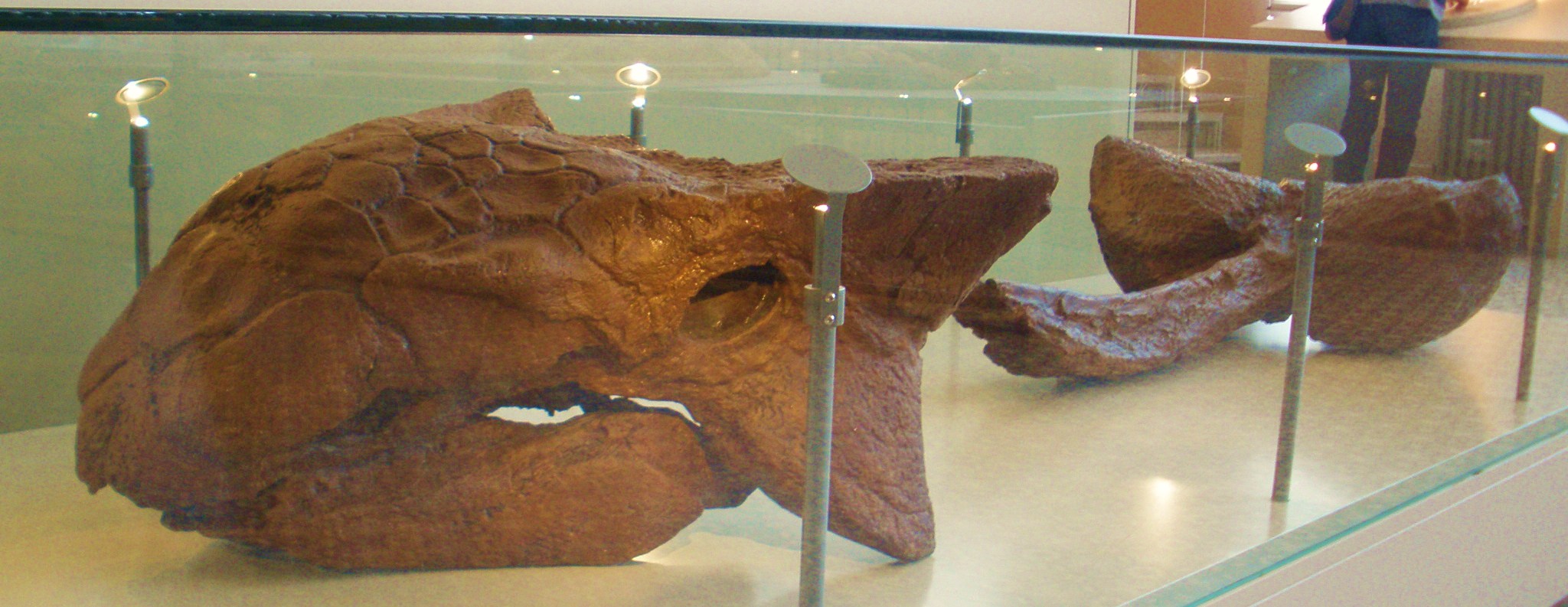
Image: File:Ankylosaurus magniventris.jpg - Wikimedia Commons (CC BY-SA)
About Ankylosaurus
Ankylosaurus magniventris, whose name translates to 'fused lizard with a great belly,' stands as one of the most iconic and formidable herbivores of the Mesozoic Era. As the quintessential armored dinosaur and the namesake for the entire Ankylosauria infraorder, this creature represents the zenith of defensive evolution among non-avian dinosaurs. It inhabited the floodplains and coastal lowlands of western North America during the very end of the Late Cretaceous period, specifically the late Maastrichtian age, from approximately 68 to 66 million years ago, making it one of the last dinosaurs to walk the Earth before the catastrophic Cretaceous-Paleogene extinction event.
The physical appearance of Ankylosaurus was that of a living fortress, a quadrupedal herbivore built for ultimate defense. Estimates of its size have varied over the years due to the incompleteness of fossil remains, but current consensus places it at around 8 meters (approximately 26 feet) in length, with some paleontologists suggesting it could have reached up to 10 meters. Its most striking feature was its incredibly wide, low-slung body, which may have been as broad as 2.5 meters, supported by four short, stout legs. This gave it a low center of gravity, making it exceptionally difficult for a predator to overturn. Its weight is estimated to have been between 4.8 and 8 metric tons, comparable to a large African elephant. The skull was short, broad, and triangular, measuring about 64.5 centimeters long and 74.5 centimeters wide, and was itself heavily armored with fused bony plates. Two prominent horns pointed backwards from the rear of the skull, and smaller jugal horns pointed down and back from below the eyes. The most distinctive characteristic of Ankylosaurus was its comprehensive body armor, composed of osteoderms—bony plates and nodules embedded directly into the skin. These formed a mosaic of protection across its back, neck, and flanks, with larger, keeled scutes interspersed with smaller ossicles, creating a flexible yet nearly impenetrable shield. This defensive array culminated in a massive, bony tail club, a feature unique to the most advanced ankylosaurids. This club, formed from the fusion of the last several caudal vertebrae and encased in large osteoderms, could weigh over 50 kilograms and was attached to a stiff, handle-like tail reinforced by interwoven ossified tendons.
The paleobiology of Ankylosaurus reveals a creature exquisitely adapted to its niche as a low-browsing herbivore. Its broad, shovel-like beak was ideal for cropping large quantities of low-lying vegetation, such as ferns, cycads, and early flowering plants. Unlike hadrosaurs or ceratopsians with their complex dental batteries, Ankylosaurus possessed relatively small, leaf-shaped teeth, suggesting it did little chewing and relied on a vast hindgut fermentation system within its 'great belly' to break down tough plant material. This is supported by its wide ribcage, which would have housed an extensive digestive tract. Its locomotion was ponderous and slow, a consequence of its immense weight and short limbs. It was not built for speed or agility but for steadfast endurance and defense. Inferred behavior suggests it was likely a solitary animal or lived in small, loosely associated groups, as its defensive strategy was individualistic rather than herd-based. The complex and convoluted nasal passages within its skull have been a subject of intense study. These passages may have served multiple functions, including warming and humidifying inhaled air, enhancing its sense of smell to locate food or detect predators, and potentially as a resonating chamber for producing low-frequency vocalizations for communication over long distances. Growth patterns, inferred from related ankylosaurs, suggest that the characteristic body armor and tail club developed relatively late in life, becoming fully formidable only as the animal reached sexual maturity and full size.
Ankylosaurus lived in the lush, subtropical coastal plain environment represented by the Hell Creek Formation of western North America. During the Late Maastrichtian, this region was a warm, humid floodplain crisscrossed by rivers and dotted with forests of conifers, ginkgoes, and flowering plants, bordering the Western Interior Seaway. This was a vibrant and dangerous ecosystem, teeming with a diverse array of dinosaurian fauna. Ankylosaurus shared its habitat with other large herbivores, including the famous Triceratops horridus, the dome-headed Pachycephalosaurus wyomingensis, and the duck-billed Edmontosaurus annectens. These herbivores formed the prey base for a suite of formidable predators. The undisputed apex predator of this environment was the colossal Tyrannosaurus rex, whose powerful bite would have been one of the few threats capable of testing the armor of a fully grown Ankylosaurus. Other predators included the smaller but agile dromaeosaurid Acheroraptor and the troodontid Pectinodon. In this predator-rich landscape, Ankylosaurus occupied the niche of a heavily defended, low-browsing bulk feeder. Its defensive strategy was likely passive deterrence through its armor, but when confronted, it could actively defend itself by swinging its powerful tail club with tremendous force, capable of shattering the bones of an attacking Tyrannosaurus.
The history of Ankylosaurus discovery began in the early 20th century during the "great dinosaur rush" in the American West. The holotype specimen (AMNH 5895) was unearthed in 1906 from the Hell Creek Formation in Montana by a field expedition from the American Museum of Natural History led by the legendary fossil hunter Barnaby Brown. This initial find was fragmentary, consisting of the top of a skull, two teeth, a scapula, several vertebrae, and more than thirty osteoderms. In 1908, Brown formally described the specimen, coining the name Ankylosaurus magniventris. He derived the generic name from the Greek words 'ankylos' (fused or crooked) and 'sauros' (lizard), referencing the fused nature of its bones, and the specific name from the Latin 'magnus' (great) and 'venter' (belly), alluding to the animal's immense width. Two years later, in 1910, Brown discovered another, more substantial specimen (AMNH 5214) in the Scollard Formation of Alberta, Canada. This find included a complete skull, the first known tail club, ribs, and limb bones, providing a much clearer picture of the animal's anatomy. For many decades, these two specimens, along with a handful of other fragmentary remains, formed the basis of all scientific and popular understanding of this iconic dinosaur.
Within the grand evolutionary tree of life, Ankylosaurus holds a key position as the type genus of the family Ankylosauridae and the larger infraorder Ankylosauria, a major group of thyreophoran, or armored, dinosaurs. The thyreophorans, which also include the stegosaurs, originated in the Early Jurassic and were characterized by the development of osteoderms. The ankylosaurs diverged and flourished during the Cretaceous period, splitting into two main families: the Nodosauridae, which were heavily armored but lacked tail clubs, and the Ankylosauridae, which were distinguished by their broader skulls, complex nasal passages, and the evolution of the iconic bony tail club. Ankylosaurus represents the culmination of the ankylosaurid lineage, being one of the largest and most recent members of the group. It showcases the most derived and extreme versions of ankylosaurid traits, including its incredibly wide, armored skull and a massive, well-formed tail club. Its evolutionary journey illustrates a clear trend towards increasingly robust armor and more specialized weaponry as a response to the evolution of larger and more powerful theropod predators like the tyrannosaurs. While dinosaurs have no direct modern relatives apart from birds, the convergent evolution of heavy armor and a defensive tail can be seen in animals like glyptodonts (extinct armored mammals) and, to a lesser extent, modern armadillos and thorny devil lizards.
Despite its fame, the extreme rarity of complete Ankylosaurus fossils has led to several scientific debates and revisions over the years. For a long time, its exact body plan was a matter of reconstruction based on more complete relatives like Euoplocephalus. The precise arrangement of its osteoderms, particularly on its flanks and underbelly, remains largely conjectural. Early reconstructions often depicted it with large spikes projecting from its sides, a feature now known to be characteristic of nodosaurids rather than ankylosaurids. The function of its tail club, while widely accepted as a defensive weapon, is also debated. Some researchers, such as Victoria Arbour, have conducted biomechanical studies suggesting it could generate immense, bone-shattering force, while others have proposed it may have also been used for intraspecific combat, such as flank-butting contests between males for territory or mates. The taxonomy of ankylosaurids has also been a subject of revision; for many years, several North American specimens were lumped into the genus Ankylosaurus, but later analysis has reassigned them to distinct genera like Anodontosaurus and Euoplocephalus, refining our understanding of ankylosaur diversity in Late Cretaceous North America.
The fossil record for Ankylosaurus magniventris is surprisingly sparse, a fact that belies its popular status. To date, all confirmed fossils have been found exclusively in latest Maastrichtian deposits of western North America, primarily the Hell Creek Formation of Montana, Wyoming, and South Dakota, and the Scollard Formation of Alberta, Canada. Unlike contemporaries such as Triceratops or Edmontosaurus, which are known from hundreds of specimens, there are fewer than a dozen significant fossil discoveries attributed to Ankylosaurus. No complete or even partially articulated skeleton has ever been found. The known material consists of the aforementioned skulls, a few limb bones, some vertebrae, parts of the pelvic girdle, and numerous isolated osteoderms and teeth. The famous tail club from the 1910 specimen remains the most complete example known. The scarcity of its remains may be due to its preferred habitat; it might have lived in upland areas away from the river systems where fossilization is more common, with its remains only occasionally washing down into the depositional basins. This rarity makes every new fragment of Ankylosaurus bone a scientifically valuable discovery, potentially holding new clues to its anatomy and lifestyle.
Despite its fragmentary fossil record, Ankylosaurus has had a profound cultural impact, cementing its place in the public consciousness as the archetypal "living tank." Its distinctive and formidable appearance makes it a staple in dinosaur books, documentaries, films, and toy lines, often depicted in dramatic showdowns with its contemporary, Tyrannosaurus rex. Major museum exhibits, such as those at the American Museum of Natural History in New York and the Royal Tyrrell Museum of Palaeontology in Alberta, feature impressive skeletal mounts and reconstructions that captivate visitors. As an educational tool, Ankylosaurus is invaluable for teaching concepts of adaptation, defense mechanisms, and predator-prey dynamics in prehistoric ecosystems, embodying the incredible evolutionary arms race that characterized the end of the Age of Dinosaurs.
Classification
Time Period
Discovery
Location
Montana, USA
Formation
Hell Creek Formation
Frequently Asked Questions
What is Ankylosaurus?
Ankylosaurus magniventris, whose name translates to 'fused lizard with a great belly,' stands as one of the most iconic and formidable herbivores of the Mesozoic Era. As the quintessential armored dinosaur and the namesake for the entire Ankylosauria infraorder, this creature represents the zenith o...
When did Ankylosaurus live?
Ankylosaurus lived during the cretaceous period of the mesozoic era approximately 68-66 million years ago.
Where was Ankylosaurus discovered?
Fossils of Ankylosaurus were discovered in Montana, USA in the Hell Creek Formation.
What did Ankylosaurus eat?
Ankylosaurus was a herbivore. It lived in terrestrial habitats.
What type of fossil is Ankylosaurus?
Ankylosaurus is preserved as a body fossil. The preservation quality is fair.
Related Specimens
From the mesozoic era · body fossils