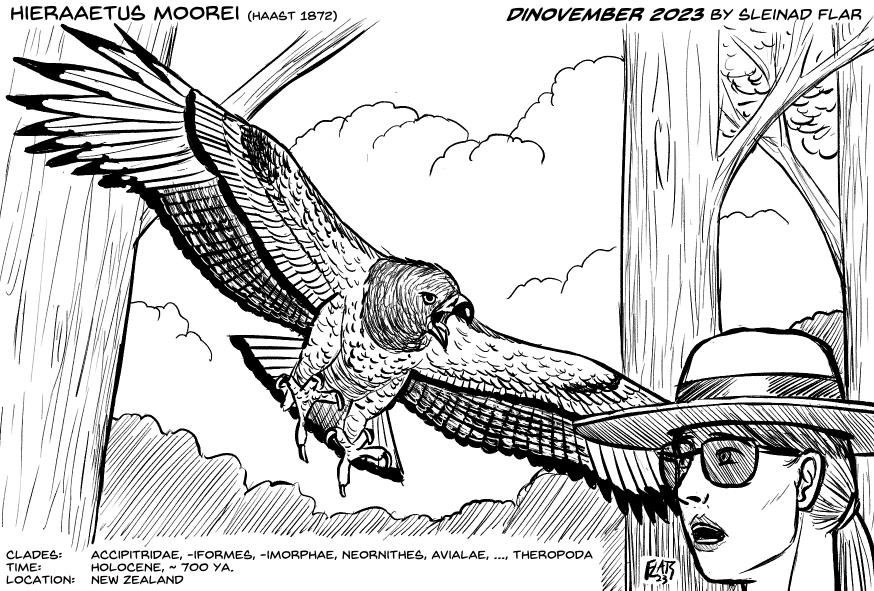
Haast's Eagle
Hieraaetus moorei
Image: Image sourced via web search (Fair use / Educational)
About Haast's Eagle
Haast's Eagle, scientifically known as Hieraaetus moorei (formerly Harpagornis moorei), represents one of the most spectacular and formidable avian apex predators to have ever existed on Earth. Endemic to the South Island of New Zealand, this colossal bird of prey dominated the skies and forests during the Late Pleistocene and Holocene epochs, surviving until approximately the 15th century. In the absence of terrestrial mammalian predators, which never naturally colonized the isolated landmass of New Zealand, Haast's Eagle evolved to fill the ecological niche typically occupied by large mammalian carnivores such as tigers or lions in other parts of the world. Its primary prey consisted of the massive, flightless moa, birds that could weigh up to fifteen times as much as the eagle itself. The existence of Haast's Eagle provides a profound and dramatic example of island gigantism, demonstrating how isolated ecosystems can drive extraordinary evolutionary adaptations. Its relatively recent extinction, driven by the arrival of the first human settlers (the Maori) and the subsequent overhunting of its primary food source, serves as a poignant reminder of the fragility of specialized island ecosystems and the profound impact of human expansion on prehistoric megafauna.
The physical proportions and anatomical features of Haast's Eagle were truly staggering, pushing the biomechanical limits of avian flight and predatory capability. Females, which were significantly larger than males due to the extreme sexual dimorphism common in raptors, are estimated to have weighed between 10 and 15 kilograms (22 to 33 pounds), with some exceptional estimates suggesting weights up to 18 kilograms. Males likely weighed between 9 and 12 kilograms. To put this into perspective, the largest living eagle, the Harpy Eagle, rarely exceeds 9 kilograms. The wingspan of Haast's Eagle was relatively short for its massive body weight, measuring approximately 2.6 to 3 meters (8.5 to 9.8 feet). This relatively short wingspan, combined with a broad wing chord, indicates that the bird was not adapted for prolonged soaring over open country, but rather for highly maneuverable flight within the dense, closed-canopy podocarp and beech forests of prehistoric New Zealand. The skeletal structure reveals a bird of immense power; its legs and pelvic girdle were incredibly robust, designed to withstand the massive impact forces generated when striking large prey at high speeds. The talons were perhaps its most terrifying feature, measuring up to 9 centimeters (3.5 inches) in length, comparable to the claws of a modern adult tiger. The beak was massive, heavily hooked, and designed for shearing through thick skin, muscle, and bone. Soft tissue inferences, based on its closest living relatives and the biomechanical requirements of its lifestyle, suggest powerful flight muscles anchored to a deep keel on the sternum, allowing for explosive bursts of speed and agility.
The paleobiology of Haast's Eagle reveals a highly specialized and incredibly lethal predator. Its hunting strategy was likely an ambush approach, utilizing the dense forest canopy to conceal its massive bulk before launching a devastating, high-speed strike on unsuspecting moa foraging on the forest floor. Biomechanical models suggest that Haast's Eagle could strike its prey with the force of a cinder block dropped from an eight-story building. The primary method of killing involved driving its massive, tiger-like talons into the pelvic region or the neck of the moa, utilizing its immense grip strength to crush bone and sever vital arteries or the spinal cord. This method allowed the eagle to incapacitate prey that weighed up to 200 kilograms, an extraordinary feat for a flying bird. Following the kill, the eagle's powerful beak would have been used to tear through the moa's tough hide to access the nutrient-rich internal organs and muscle tissue. The relatively short wingspan and heavy wing loading suggest that Haast's Eagle had a high stall speed and required significant effort to take off, particularly after gorging on a massive kill. It is highly probable that the eagle would remain with a large carcass for several days, defending it from scavengers and feeding until it could no longer consume more. Growth patterns, inferred from bone histology, suggest a rapid growth rate to reach its massive adult size, a necessary adaptation to quickly become the apex predator in its environment. Its metabolism would have been exceptionally high, requiring a substantial and consistent intake of calories, which made it highly vulnerable to fluctuations in the moa population.
The ecological context of Haast's Eagle is intrinsically tied to the unique evolutionary history of New Zealand. Having separated from the supercontinent of Gondwana approximately 80 million years ago, New Zealand evolved in near-total isolation, devoid of terrestrial mammals (save for a few species of bats). In this mammalian vacuum, birds radiated to fill almost every available ecological niche. The forests and scrublands were dominated by the moa, a diverse group of flightless birds ranging from the size of a turkey to towering giants over three meters tall. Haast's Eagle evolved specifically to exploit this abundant food source, sitting unchallenged at the very pinnacle of the food web. The climate during the eagle's existence fluctuated between the cooler, drier conditions of the Pleistocene glaciations and the warmer, wetter conditions of the Holocene, but the dense forest habitats remained relatively stable refuges. Co-existing species included a bizarre array of avian fauna, such as the massive, flightless adzebill, the predatory laughing owl, and the giant New Zealand raven. The predator-prey relationship between Haast's Eagle and the moa was an evolutionary arms race; as the moa grew larger to deter predation, the eagle evolved greater size and power to take them down. This delicate ecological balance was entirely dependent on the continued abundance of moa, making the entire system highly susceptible to disruption.
The discovery history of Haast's Eagle is a fascinating chapter in the annals of paleontology, beginning in the late 19th century. The first scientific recognition of the species occurred in 1871, when a taxidermist named Frederick Moore, working on the Glenmark estate in the Canterbury region of the South Island, unearthed several massive, unfamiliar bird bones from a swamp deposit. Moore presented these bones to Sir Julius von Haast, the founder and director of the Canterbury Museum in Christchurch. Haast, a prominent geologist and paleontologist, immediately recognized the significance of the find—the remains of an eagle of unprecedented size. In 1872, Haast formally described the species, naming it Harpagornis moorei. The genus name Harpagornis was derived from the Greek words 'harpax' (meaning grappling hook or bird of prey) and 'ornis' (bird), while the specific epithet 'moorei' honored Frederick Moore, the discoverer. Over the subsequent decades, numerous additional subfossil remains were discovered, primarily in caves, sinkholes, and swamp deposits across the South Island, with notable sites including Pyramid Valley and the Honeycomb Hill Cave system. These discoveries gradually allowed scientists to piece together the complete skeletal anatomy of the bird, confirming its status as the largest eagle known to science. The history of its discovery is also deeply intertwined with the early development of New Zealand paleontology and the growing realization of the extent of the country's lost prehistoric avifauna.
The evolutionary significance of Haast's Eagle is profound, particularly regarding its astonishingly rapid morphological divergence and the phenomenon of island gigantism. For over a century, the exact evolutionary relationships of Haast's Eagle remained a mystery, with its massive size leading many to assume it was closely related to other large eagles, such as the Wedge-tailed Eagle of Australia. However, a groundbreaking ancient DNA study conducted in 2005 by Dr. Michael Bunce and colleagues revolutionized our understanding of its lineage. By extracting and analyzing mitochondrial DNA from subfossil bones, the researchers discovered that Haast's Eagle was not closely related to the large eagles of the genus Aquila. Instead, its closest living relatives are some of the world's smallest eagles: the Little Eagle (Hieraaetus morphnoides) of Australia and the Booted Eagle (Hieraaetus pennatus) of Eurasia. This genetic evidence necessitated a taxonomic revision, moving the species from the monotypic genus Harpagornis into the genus Hieraaetus. Furthermore, the molecular clock analysis indicated that the ancestors of Haast's Eagle arrived in New Zealand relatively recently, between 700,000 and 1.8 million years ago. This means that the bird underwent a phenomenal increase in size—increasing its body mass by ten to fifteen times—in a remarkably short evolutionary timeframe. This rapid gigantism is one of the most extreme examples of morphological evolution known in vertebrates, highlighting the incredible selective pressures of an environment rich in large prey and devoid of competing predators.
Scientific debates surrounding Haast's Eagle have historically centered on its capabilities and taxonomy. Prior to the definitive ancient DNA studies, there was considerable debate regarding its classification, with some arguing for its placement within Aquila based on superficial morphological similarities driven by convergent evolution. Another significant historical debate revolved around its feeding behavior. Early in the 20th century, some researchers, noting the eagle's massive size and relatively short wings, hypothesized that it might have been a scavenger, incapable of active flight or hunting, and instead feeding on moa that had died of natural causes or become mired in swamps. This 'scavenger hypothesis' was systematically dismantled in the late 20th and early 21st centuries through rigorous biomechanical studies, particularly those led by researchers like Richard Holdaway. These studies demonstrated that the eagle's skeletal structure, talon morphology, and estimated flight muscle mass were unequivocally those of a highly active, powerful, and lethal apex predator. More recent debates have focused on the exact timing and mechanisms of its extinction. While it is universally accepted that human-induced moa extinction was the primary cause, researchers continue to refine the timeline, using high-precision radiocarbon dating to determine exactly how quickly the eagle vanished following the arrival of the Maori in the late 13th century.
The fossil record of Haast's Eagle is relatively robust for a prehistoric bird of prey, though it remains categorized as rare compared to the abundant remains of its moa prey. The vast majority of fossils have been discovered on the South Island of New Zealand, particularly in the eastern and southern regions. The preservation quality of these subfossils is often excellent, owing to the specific taphonomic conditions of the sites where they are found. Cave systems, such as those in the Mount Arthur region, have yielded beautifully preserved, three-dimensional bones, protected from weathering and scavenging. Swamp deposits, like those at Pyramid Valley, have also provided crucial articulated specimens. To date, the remains of several dozen individuals have been recovered, ranging from isolated bones to nearly complete skeletons. The most commonly preserved parts are the robust leg bones (tarsometatarsi and tibiotarsi), the massive talons, and portions of the skull and beak. These well-preserved elements have been instrumental in allowing paleontologists to conduct detailed morphometric and biomechanical analyses, providing a highly accurate picture of the bird's physical capabilities.
The cultural impact of Haast's Eagle is deeply rooted in the history and mythology of New Zealand. In Maori oral tradition, there are numerous accounts of a massive, terrifying bird known as the Pouakai or Hokioi. These legends describe a giant bird capable of swooping down from the mountains and carrying off human children. While mythologized, it is now widely accepted by historians and scientists that these stories are based on actual encounters between the early Maori settlers and Haast's Eagle. Today, the eagle captures the public imagination as a symbol of New Zealand's lost prehistoric wilderness. Spectacular life-sized mounts and skeletal reconstructions are prominently displayed in major institutions, including the Museum of New Zealand Te Papa Tongarewa in Wellington and the Canterbury Museum in Christchurch. It frequently features in documentaries and popular science literature, serving as a powerful educational tool to illustrate the concepts of evolution, island gigantism, and the devastating impact of human-driven extinction events.
Classification
Time Period
Discovery
Location
New Zealand
Formation
Various Holocene cave and swamp deposits
Frequently Asked Questions
What is Haast's Eagle?
Haast's Eagle, scientifically known as Hieraaetus moorei (formerly Harpagornis moorei), represents one of the most spectacular and formidable avian apex predators to have ever existed on Earth. Endemic to the South Island of New Zealand, this colossal bird of prey dominated the skies and forests dur...
When did Haast's Eagle live?
Haast's Eagle lived during the quaternary period of the cenozoic era approximately 0.07-0.0006 million years ago.
Where was Haast's Eagle discovered?
Fossils of Haast's Eagle were discovered in New Zealand in the Various Holocene cave and swamp deposits.
What did Haast's Eagle eat?
Haast's Eagle was a carnivore. It lived in terrestrial, aerial, arboreal habitats.
What type of fossil is Haast's Eagle?
Haast's Eagle is preserved as a body fossil. The preservation quality is excellent.
Related Specimens
From the cenozoic era · body fossils