Borealopelta
Borealopelta markmitchelli
Image: Image sourced via web search (Fair use / Educational)
About Borealopelta
Borealopelta markmitchelli was an exceptionally well-preserved nodosaurid ankylosaur that roamed the Earth during the Early Cretaceous period, approximately 112 to 110 million years ago. Discovered in Alberta, Canada, this dinosaur represents one of the most complete and exquisitely preserved armored dinosaur specimens ever found, offering unprecedented insights into the life appearance, coloration, and defensive strategies of these ancient herbivores. Its significance in paleontology stems from the remarkable preservation of not only its skeleton but also extensive soft tissues, including skin, keratinous scutes, and even remnants of organic compounds that reveal its original camouflage patterns.
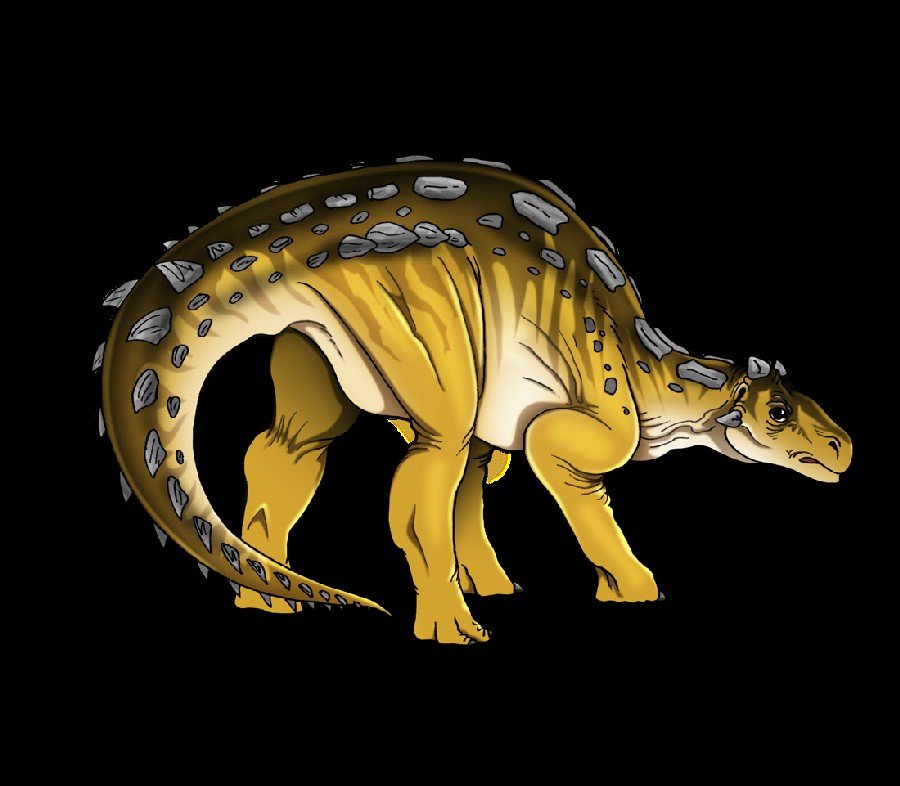
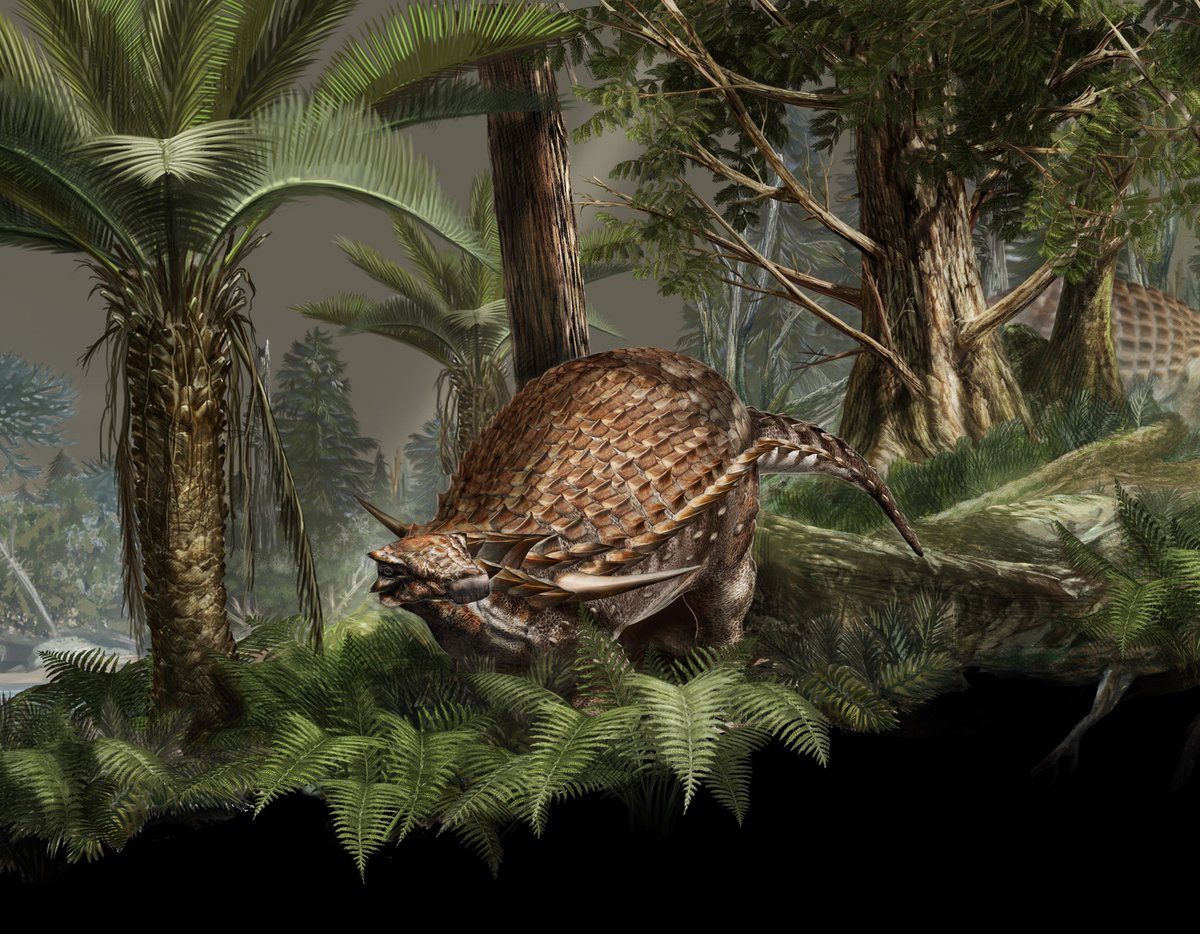
Borealopelta was a medium-sized nodosaurid, estimated to have measured around 5.5 meters (18 feet) in length and weighed approximately 1,300 kilograms (2,866 pounds), making it roughly the size of a modern rhinoceros or a large American bison, though considerably more robust and heavily armored. Its most striking feature was its elaborate dorsal armor, composed of hundreds of osteoderms (bony plates embedded in the skin) ranging in size from small, pebble-like ossicles to large, flattened scutes and prominent, spiky shoulder osteoderms. These osteoderms were arranged in rows and covered its entire back, flanks, and even parts of its limbs, forming a formidable defensive shield. The specimen reveals that the armor was not merely bone but was covered by a layer of keratin, similar to a turtle's shell or a crocodile's scutes, which would have further enhanced its protective capabilities. The shoulder region featured particularly large, forward-pointing spikes, which likely served as a deterrent against predators. Unlike its ankylosaurid relatives, Borealopelta lacked a tail club, relying instead on its overall heavy armor and possibly passive defense. Its skull was relatively small and triangular, with a broad snout indicative of its herbivorous diet. The limbs were robust and pillar-like, supporting its massive body, and its feet were broad, suggesting a terrestrial existence. The exceptional preservation allowed for the reconstruction of its external appearance with remarkable fidelity, revealing a reddish-brown coloration on its dorsal side, transitioning to a lighter underside, a form of countershading that suggests camouflage in its forested habitat.
As a nodosaurid, Borealopelta was an obligate herbivore, likely browsing on low-lying vegetation such as ferns, cycads, and conifers. Its broad, shovel-like snout and small, leaf-shaped teeth were well-suited for cropping and processing fibrous plant material. The absence of a tail club, typical of ankylosaurids, suggests that Borealopelta relied primarily on passive defense, hunkering down and presenting its heavily armored back to potential threats, rather than actively swinging its tail. Its robust, pillar-like limbs indicate a slow, deliberate gait, consistent with a large, heavily armored animal. While direct evidence of social behavior is scarce, nodosaurs are generally thought to have been solitary or lived in small family groups, given their large size and specialized defensive adaptations. Growth patterns in ankylosaurs suggest a relatively slow growth rate, allowing for the development of their extensive armor. Metabolic estimates for large dinosaurs like Borealopelta typically place them as mesotherms, maintaining a body temperature higher than their environment but not as high or as tightly regulated as modern endotherms, a strategy that would have been aided by its large body mass (gigantothermy) and potentially its dark coloration for absorbing solar radiation.
During the Early Cretaceous, the region now known as Alberta, Canada, was part of a vast, subtropical to temperate inland seaway known as the Western Interior Seaway, which extended across North America. Borealopelta lived on the western landmass, Laramidia, in a coastal or near-coastal environment characterized by lush forests and floodplains. The climate was generally warm and humid, supporting a diverse array of plant life, including conifers, ferns, and early flowering plants. This environment would have provided ample food for large herbivores like Borealopelta. Co-existing species in this ecosystem likely included other dinosaurs such as ornithopods, smaller theropods, and potentially large predatory tyrannosauroids or carcharodontosaurids, though specific predator-prey relationships for Borealopelta are inferred rather than directly observed. Its primary predators would have been large theropods, against which its formidable armor provided its main defense. The exceptional preservation of the Borealopelta specimen, found in marine sediments, suggests that its carcass was washed out to sea, where it rapidly sank and was buried, protecting it from scavengers and decomposition on land.
The discovery of Borealopelta markmitchelli is a remarkable tale of serendipity and scientific dedication. The specimen, nicknamed the 'Suncor Nodosaur' or 'Mark Mitchell Nodosaur,' was unearthed on March 21, 2011, by a heavy equipment operator named Shawn Funk at the Suncor Millennium Mine near Fort McMurray, Alberta, Canada. Funk was working in the oil sands, excavating rock from the Clearwater Formation, when his shovel struck an unusually hard object. Recognizing it as potentially significant, he alerted the Royal Tyrrell Museum of Palaeontology. The subsequent excavation, led by museum technician Mark Mitchell, was an arduous process, taking over 7,000 hours of painstaking work over six years to fully expose and prepare the fossil from its surrounding rock. Mitchell's meticulous work led to the species being named in his honor. The fossil is extraordinary not only for its completeness but also for the three-dimensional preservation of its soft tissues, including skin and armor, which retain their original positions relative to the skeleton. This level of preservation is exceedingly rare for dinosaurs and has been compared to the mummified remains of ancient animals, providing an unparalleled window into the dinosaur's life appearance.
Borealopelta's position within the tree of life is firmly established within the Nodosauridae, a family of armored dinosaurs belonging to the larger group Ankylosauria. Nodosaurs are characterized by their robust, heavily armored bodies, lack of a tail club, and often prominent shoulder spikes. Borealopelta's exceptional preservation has provided critical data for understanding the evolution of dinosaurian integument and defensive strategies. The discovery of preserved melanosomes, the organelles responsible for pigment, in its skin has allowed scientists to infer its original coloration, a reddish-brown countershaded pattern. This finding is revolutionary because it provides direct evidence of camouflage in a dinosaur, suggesting that even large, heavily armored animals needed to conceal themselves from predators. This challenges previous assumptions that such large, armored creatures were invulnerable. Furthermore, the detailed study of its armor morphology and arrangement offers insights into the biomechanics of defense against large theropod predators, contributing to our understanding of co-evolutionary arms races between predators and prey in the Mesozoic. Its unique preservation also serves as a benchmark for understanding taphonomy—the processes of fossilization—for large terrestrial animals.
Despite the wealth of information provided by the Borealopelta specimen, several scientific debates and areas of ongoing research persist. One significant area of discussion revolves around the precise function and effectiveness of its countershading. While countershading is typically associated with camouflage, some researchers debate its primary role in such a large, heavily armored animal. It has been proposed that the dark dorsal coloration might also have aided in thermoregulation, absorbing solar radiation to help maintain body temperature in a cool environment, or conversely, that the countershading was simply a vestigial trait from smaller, more vulnerable ancestors. Another debate centers on the exact mechanism of its death and transport to the marine environment; while a river flood carrying the carcass out to sea is the leading hypothesis, the specific conditions that led to such rapid and complete burial are still being modeled. Furthermore, the precise phylogenetic relationships within Nodosauridae are continually refined with new discoveries, and Borealopelta's unique features contribute to these ongoing taxonomic revisions. The study of its preserved organic compounds is also an active field, pushing the boundaries of what can be learned from fossilized soft tissues, including the potential for identifying original biomolecules.
The fossil record of Borealopelta is currently limited to the single, magnificent specimen discovered in the Clearwater Formation of Alberta, Canada. This specimen, cataloged as TMP 2011.033.0001, is often referred to as the 'Suncor Nodosaur' or 'Mark Mitchell Nodosaur' and is housed at the Royal Tyrrell Museum of Palaeontology in Drumheller, Alberta. The preservation quality of this fossil is truly exceptional, making it one of the best-preserved dinosaur fossils ever found globally. It includes not only the complete skeleton from the snout to the hips but also extensive three-dimensional preservation of the skin, keratinous armor, and even remnants of organic compounds. This level of preservation is so rare that it provides an almost lifelike representation of the animal, allowing scientists to study its external appearance, including its coloration, in unprecedented detail. The fossil was found in marine sediments, specifically a turbidite deposit, indicating that the carcass was rapidly buried after being washed out to sea, protecting it from decomposition and scavenging. While other nodosaur fossils are known from various parts of the world, no other specimen approaches the completeness and soft-tissue preservation of Borealopelta markmitchelli.
Borealopelta markmitchelli has rapidly achieved significant cultural impact due to its stunning preservation and the insights it offers into dinosaur life. The 'Suncor Nodosaur' is a star attraction at the Royal Tyrrell Museum of Palaeontology, where its meticulously prepared fossil is displayed, drawing visitors from around the world. Its lifelike appearance has made it a popular subject for documentaries, books, and scientific articles, captivating both the public and the scientific community. The discovery has been featured in National Geographic and numerous other media outlets, highlighting the incredible potential of the fossil record. Its educational importance is immense, serving as a prime example of exceptional fossilization and demonstrating how paleontologists can reconstruct not just the bones but also the external appearance and even coloration of extinct animals. It stands as a testament to the rich paleontological heritage of Alberta and the ongoing discoveries that continue to reshape our understanding of prehistoric life.
Classification
Time Period
Discovery
Location
Canada
Formation
Clearwater Formation
Frequently Asked Questions
What is Borealopelta?
Borealopelta markmitchelli was an exceptionally well-preserved nodosaurid ankylosaur that roamed the Earth during the Early Cretaceous period, approximately 112 to 110 million years ago. Discovered in Alberta, Canada, this dinosaur represents one of the most complete and exquisitely preserved armore...
When did Borealopelta live?
Borealopelta lived during the cretaceous period of the mesozoic era approximately 112-110 million years ago.
Where was Borealopelta discovered?
Fossils of Borealopelta were discovered in Canada in the Clearwater Formation.
What did Borealopelta eat?
Borealopelta was a herbivore. It lived in terrestrial habitats.
What type of fossil is Borealopelta?
Borealopelta is preserved as a body fossil. The preservation quality is exceptional.
Related Specimens
From the mesozoic era · body fossils