Hamites
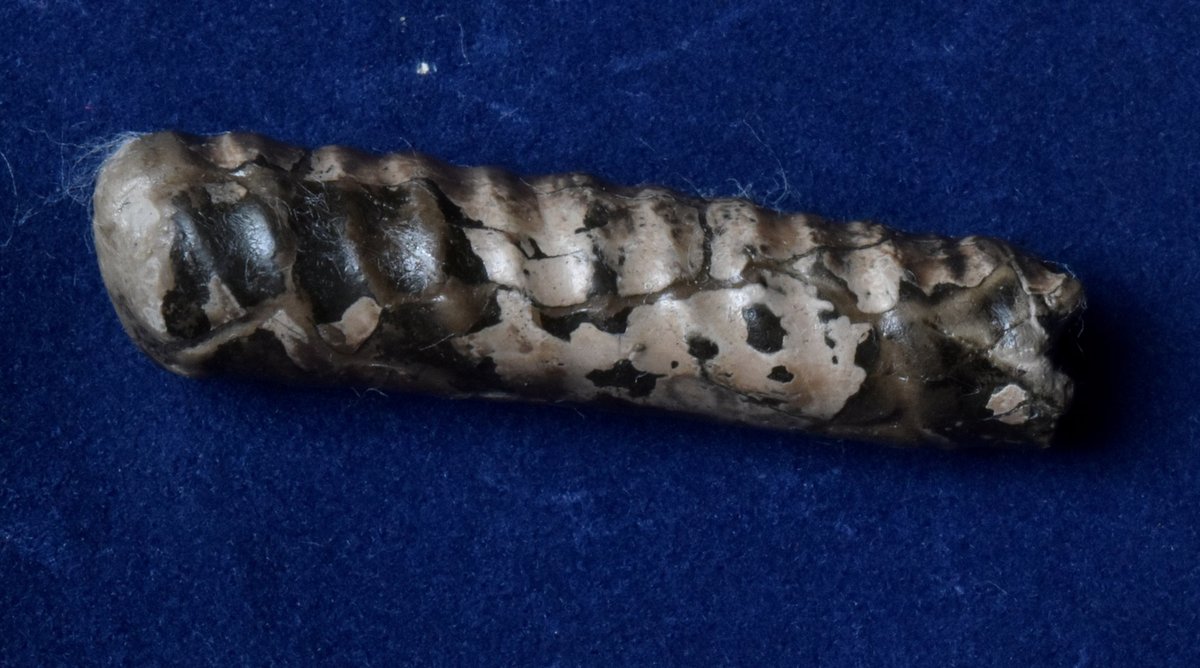
Hamites attenuatus
Image: Image sourced via web search (Fair use / Educational)
About Hamites
Hamites is a genus of heteromorph ammonite, a type of extinct marine cephalopod, that thrived in oceans worldwide during the Albian and Cenomanian stages of the Cretaceous Period, approximately 113 to 94 million years ago. Unlike the more familiar, tightly coiled ammonites, Hamites possessed an uncoiled, hook-shaped shell, making it a striking example of the diverse and sometimes bizarre evolutionary paths taken by this successful group of mollusks. Its widespread distribution and distinct morphology make it an important index fossil, helping geologists date and correlate rock layers from this critical period of Earth's history.
The most defining characteristic of Hamites is its unique shell morphology, which deviates significantly from the typical planispiral (flat-coiled) shape of most ammonites. The shell, or conch, of Hamites consists of three parallel shafts connected by two 180-degree bends, creating a distinctive open, hook-like or paperclip-like form. The species Hamites attenuatus typically reached lengths of 15 to 30 centimeters, though some species within the genus could be larger. The shell was chambered, a feature common to all ammonites, with the animal living in the final, largest chamber (the body chamber). The preceding chambers, known as the phragmocone, were filled with gas and fluid, regulated by a tube called a siphuncle, allowing the animal to control its buoyancy. The shell's exterior was often adorned with fine, dense, transverse ribs that ran across its surface, which may have provided structural reinforcement or served a hydrodynamic function. While no soft tissues have been preserved, paleontologists infer from its modern relatives, the nautilus and coleoids (squid, octopus, cuttlefish), that a head with large eyes and a ring of tentacles would have protruded from the shell's aperture. The uncoiled shape would have made the animal a less efficient swimmer than its coiled counterparts, suggesting a different lifestyle and ecological niche.
The paleobiology of Hamites is a subject of considerable scientific interest, largely due to its unconventional shell shape. The open, hook-like form was hydrodynamically inefficient for rapid, jet-propelled locomotion. This suggests that Hamites was not an active, fast-swimming predator like many modern squid. Instead, it is widely believed to have been a planktonic or nektonic drifter, passively floating in the water column. Its buoyancy control system, via the siphuncle, would have allowed it to maintain a specific depth with minimal energy expenditure. This drifting lifestyle would have positioned it as a slow-moving or ambush predator, likely feeding on small crustaceans, zooplankton, and other small organisms that it could snatch with its tentacles as they drifted by. Its orientation in the water is debated; some reconstructions show it hanging vertically with the aperture facing downwards, while others suggest a more horizontal orientation. This vertical posture would have been stable and allowed it to use its tentacles as a dangling net to ensnare prey from below. Growth patterns, visible as sutures on internal molds, show the incremental addition of new chambers as the animal grew, a process common to all shelled cephalopods. Its metabolism was likely slower than that of modern coleoids, reflecting a less active lifestyle adapted to the open-ocean environment.
Hamites lived during the mid-Cretaceous, a time of significant global warmth and high sea levels. The world's oceans were expansive, forming vast epicontinental seas that covered large portions of modern continents, including the Western Interior Seaway in North America and extensive shallow seas across Europe. Hamites was a cosmopolitan genus, with fossils found globally, indicating it inhabited these warm, temperate to tropical waters. The marine ecosystem was rich and complex. Hamites shared its environment with a diverse array of life, including other ammonites (both coiled and heteromorph), belemnites, large marine reptiles like plesiosaurs and mosasaurs (which appeared later in the Cretaceous), various species of fish, and microscopic plankton such as foraminifera and coccolithophores, which formed the base of the food web. As a mid-sized carnivore, Hamites would have occupied a middle trophic level. It preyed on smaller invertebrates and was, in turn, prey for larger marine predators. Fossil evidence, such as shells with puncture marks, suggests that marine reptiles were a significant threat. The abundance of Hamites in certain geological layers, like the Gault Formation, indicates it was a successful and integral component of the mid-Cretaceous marine ecosystem, thriving in the pelagic zone alongside a flourishing community of other cephalopods.
The genus Hamites was first described by the British naturalist James Parkinson in his 1811 publication "Organic Remains of a Former World." The name "Hamites" is derived from the Latin "hamus," meaning "hook," a direct reference to its characteristic shell shape. The type species for the genus is Hamites attenuatus, which was formally described by another prominent British paleontologist, James Sowerby, in 1814. The earliest and most significant discoveries of Hamites fossils were made in the Cretaceous rock layers of southern England, particularly the Gault Clay and Upper Greensand formations exposed along the coast of Kent, near Folkestone. These sites have yielded a wealth of beautifully preserved specimens, often as three-dimensional internal molds made of phosphate or pyrite. These early discoveries in the 19th century were crucial in establishing the biostratigraphy of the Cretaceous period in Europe, with specific Hamites species used to define and correlate different rock zones. Unlike dinosaurs, individual ammonite fossils are not typically given nicknames, but the sheer number and quality of specimens from classic localities like Folkestone have made the Gault Formation a world-renowned site for Cretaceous marine paleontology, with Hamites being one of its most recognizable fossils.
Hamites and other heteromorph ammonites represent a fascinating chapter in cephalopod evolution. They belong to the suborder Ancyloceratina, a group that experimented with a wide array of uncoiled and unconventionally shaped shells during the Cretaceous. This evolutionary radiation away from the ancestral, tightly coiled form demonstrates the adaptability of ammonites and their ability to exploit new ecological niches. The uncoiling trend is thought to be an example of iterative evolution, appearing independently in several ammonite lineages. While the exact selective pressures driving this change are debated, it is likely linked to a shift in lifestyle, moving from more active, bottom-dwelling (nektobenthic) or fast-swimming (nektonic) habits to a more passive, planktonic existence. The uncoiled shell, while sacrificing hydrodynamic efficiency, may have offered advantages in stability, maneuverability at low speeds, or a better orientation for ambush predation in the water column. Hamites does not have any direct modern descendants, as all ammonites, including the heteromorphs, went extinct during the Cretaceous-Paleogene extinction event 66 million years ago. Their closest living relatives are the coleoids (squid, octopus, cuttlefish) and, more distantly, the shelled nautilus, which provides the best, albeit imperfect, modern analogue for understanding their basic biology.
Despite being known to science for over two centuries, Hamites is still the subject of scientific debate, primarily concerning its mode of life and the functional morphology of its bizarre shell. The primary controversy revolves around its orientation and locomotion. While the passive, vertically-oriented drifter model is widely accepted, some researchers have proposed alternative hypotheses. One idea suggests a more active, though slow, jet-propelled movement, with the U-bends in the shell potentially helping to direct the jet for better maneuverability. Another debate concerns taxonomy; the genus Hamites historically became a "wastebasket taxon," with many superficially similar hook-shaped ammonites being assigned to it. Modern paleontological work, using more detailed analysis of suture lines, ribbing patterns, and shell cross-sections, has led to a significant revision of the Hamitidae family. Many species once placed in Hamites have now been reassigned to other genera, refining our understanding of the group's diversity and evolutionary relationships. These ongoing studies highlight how new analytical techniques continue to reshape our view of even long-established fossil groups.
The fossil record of Hamites is robust and geographically widespread, making it a common and important fossil. Specimens are found on every continent except Antarctica, attesting to its cosmopolitan distribution in the Cretaceous oceans. The most famous and productive fossil sites are in Europe, particularly the Albian-age Gault Formation of Folkestone, England, and the Vocontian Basin in southeastern France. In these locations, fossils are often exceptionally well-preserved as three-dimensional pyritic or phosphatic internal molds (steinkerns) that reveal intricate details of the shell's internal chambers and the complex, frilled suture lines. North American occurrences are also notable, with specimens found in the Cretaceous deposits of Texas, California, and the Western Interior Seaway. Typically, it is the durable shell that is preserved; no fossilized soft parts of Hamites have ever been discovered. The abundance of these fossils and their relatively short species-level durations make them excellent biostratigraphic markers, or index fossils, allowing geologists to precisely date the rock layers in which they are found.
While not as famous as dinosaurs or trilobites, Hamites and other heteromorph ammonites hold a special fascination for fossil collectors and paleontologists due to their strange and elegant forms. Their unique, uncoiled shapes challenge the popular conception of what an ammonite looks like and serve as a powerful educational tool for illustrating the concept of evolutionary diversity and adaptation. Major natural history museums around the world, including the Natural History Museum in London and the American Museum of Natural History in New York, feature specimens of Hamites in their Cretaceous marine life exhibits. They are particularly prized by amateur fossil hunters in classic localities like the English coast, where their distinctive shapes are eagerly sought. Their aesthetic, almost sculptural quality has also led to their appearance in art and design, representing the beautiful and often bizarre forms that life in the ancient past could take.
Classification
Time Period
Discovery
Location
England, United Kingdom
Formation
Gault Formation
Frequently Asked Questions
What is Hamites?
Hamites is a genus of heteromorph ammonite, a type of extinct marine cephalopod, that thrived in oceans worldwide during the Albian and Cenomanian stages of the Cretaceous Period, approximately 113 to 94 million years ago. Unlike the more familiar, tightly coiled ammonites, Hamites possessed an unco...
When did Hamites live?
Hamites lived during the cretaceous period of the mesozoic era approximately 113-100 million years ago.
Where was Hamites discovered?
Fossils of Hamites were discovered in England, United Kingdom in the Gault Formation.
What did Hamites eat?
Hamites was a carnivore. It lived in marine habitats.
What type of fossil is Hamites?
Hamites is preserved as a body fossil. The preservation quality is good.
Related Specimens
From the mesozoic era · body fossils