Asteroceras
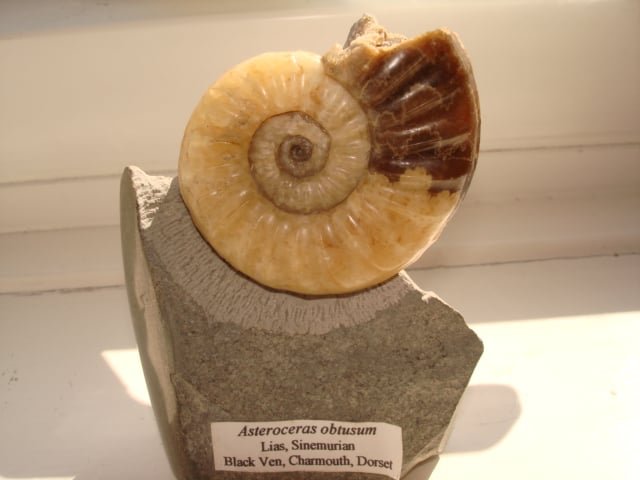
Asteroceras obtusum
Image: Image sourced via web search (Fair use / Educational)
About Asteroceras
Asteroceras obtusum is an extinct species of ammonite cephalopod that thrived during the Sinemurian stage of the Early Jurassic period, approximately 196 to 190 million years ago. Found predominantly in the shallow, warm marine deposits of Europe, particularly along the famous Jurassic Coast of southern England, this organism serves as a crucial and highly reliable index fossil for biostratigraphy. Because it evolved rapidly and was widely distributed across the epicontinental seas of the Mesozoic, its presence allows geologists to date specific sedimentary rock layers with remarkable precision. Its beautifully preserved, heavily ribbed, and tightly coiled shells have made it a cornerstone of paleontological study, helping scientists understand the rapid recovery and diversification of marine ecosystems following the devastating end-Triassic mass extinction. As a prominent member of the Early Jurassic marine fauna, Asteroceras provides an invaluable window into the evolutionary dynamics of cephalopods during a time when the world's oceans were undergoing significant biological and chemical transformations.
The physical anatomy of Asteroceras obtusum is characterized primarily by its robust, evolute shell, which typically measures between 8 and 20 centimeters in diameter, though some exceptional specimens can grow slightly larger. The shell is distinctly planulate, meaning it is relatively flat and coiled in a single plane, with a wide umbilicus that exposes the inner whorls of the shell. One of its most distinctive features is the presence of strong, widely spaced radial ribs that curve gently across the flanks of the shell, often terminating before reaching the rounded venter (the outer edge), which bears a prominent, solid keel flanked by shallow sulci (grooves). In life, this shell was composed of aragonite, a form of calcium carbonate, and was divided internally into a series of chambers (camerae) by complex, frilly walls known as septa. The animal itself lived only in the largest, outermost chamber, known as the body chamber. A specialized tube called the siphuncle ran through the septa, allowing the animal to regulate its buoyancy by pumping gas and fluid in and out of the empty chambers, much like a modern Nautilus or a submarine. While the soft tissues of Asteroceras are not preserved, inferences drawn from modern coleoids (squid, octopus, and cuttlefish) and nautiluses suggest it possessed a distinct head with highly developed, camera-like eyes, a ring of grasping tentacles likely numbering around ten, and a sharp, parrot-like chitinous beak used for crushing prey. The weight of the living animal, including its shell, would have been roughly a few hundred grams to over a kilogram, depending on its exact size and the fluid content of its phragmocone.
In terms of paleobiology, Asteroceras obtusum was an active, free-swimming (nektonic) predator that navigated the water column of the shallow Jurassic seas. Its diet consisted primarily of small, slow-moving marine organisms, including zooplankton, small crustaceans, ostracods, and perhaps smaller or juvenile cephalopods. It captured its prey using its prehensile tentacles, drawing the food toward its mouth where the powerful beak and a radula (a toothed, tongue-like ribbon) would tear and process the flesh. Locomotion was achieved through a combination of buoyancy control and jet propulsion. By drawing water into its mantle cavity and expelling it forcefully through a muscular funnel (the hyponome), Asteroceras could dart backward to escape predators or move forward to intercept prey. However, due to the hydrodynamic drag created by its ribbed, un-streamlined shell, it was likely not a particularly fast or agile swimmer compared to modern squid or co-existing belemnites, suggesting it relied more on ambush tactics or foraging for slower prey. Growth patterns analyzed from the closely spaced growth lines on well-preserved shells indicate that Asteroceras grew relatively quickly in its early life stages, reaching sexual maturity within a few years. Like many modern cephalopods, it is highly probable that they exhibited a fast-paced life history, characterized by rapid growth, a single massive reproductive event (semelparity), and a relatively short overall lifespan, perhaps living only three to five years before dying shortly after spawning.
The ecological context of the Early Jurassic world in which Asteroceras lived was vastly different from today. During the Sinemurian stage, the supercontinent of Pangaea was beginning to fracture, leading to the formation of shallow, warm epicontinental seas across much of what is now Europe. The climate was generally warm and humid, with no permanent polar ice caps, leading to high global sea levels. Asteroceras inhabited the relatively shallow, sunlit waters of the continental shelf, an environment teeming with life. The seafloor was carpeted with crinoids (sea lilies), bivalves, brachiopods, and early reef-building sponges and corals. In the water column, Asteroceras shared its habitat with a diverse array of other ammonites, belemnites (squid-like cephalopods with internal skeletons), and various bony fishes. It occupied a middle tier in the complex Jurassic marine food web. While it was a formidable predator to smaller invertebrates, Asteroceras was itself a primary food source for the apex predators of the era. The oceans were patrolled by massive marine reptiles, most notably the dolphin-like ichthyosaurs and the long-necked plesiosaurs, whose fossilized stomach contents occasionally reveal the crushed remains of ammonite shells. The heavily ribbed shell of Asteroceras may have evolved partially as a defensive adaptation, providing structural reinforcement against the crushing bites of these marine reptiles, though it was evidently not an impenetrable defense.
The discovery history of Asteroceras obtusum is deeply intertwined with the birth of modern paleontology in the early 19th century. The species was formally described and named by the English naturalist and illustrator James Sowerby in 1817, in his seminal work 'The Mineral Conchology of Great Britain.' However, the actual discovery of many of the finest early specimens is attributed to Mary Anning, the pioneering fossil collector from Lyme Regis in Dorset, England. Anning scoured the dangerous, eroding cliffs of the Blue Lias formation, uncovering countless ammonites, belemnites, and the first complete ichthyosaur and plesiosaur skeletons. The specific epithet 'obtusum' refers to the blunt or obtuse nature of the shell's keel compared to other closely related species. During this Victorian era, fossils were often collected as curiosities, but figures like William Smith, the 'Father of English Geology,' began to recognize that specific fossils, including Asteroceras, were consistently found in specific rock layers. This realization led to the development of the principle of faunal succession, making Asteroceras one of the very first fossils used to correlate and map geological strata across different geographic regions. Today, spectacular specimens collected during this golden age of discovery are housed in major institutions worldwide, including the Natural History Museum in London.
The evolutionary significance of Asteroceras obtusum lies in its position within the complex and highly successful lineage of the Ammonoidea. Ammonoids first appeared in the Devonian period, evolving from straight-shelled bactritoid nautiloids. They survived several mass extinctions, including the Permian-Triassic extinction, which wiped out over 90% of marine species. Asteroceras belongs to the family Arietitidae, a group that radiated explosively during the Early Jurassic after the ammonite lineage was nearly extinguished at the end of the Triassic. The rapid diversification of shell forms, suture patterns, and ecological niches seen in Asteroceras and its relatives provides evolutionary biologists with a textbook example of adaptive radiation. Furthermore, the intricate, fractal-like suture patterns (the lines where the internal septa meet the outer shell) of Asteroceras demonstrate an evolutionary trend toward increasing structural complexity, which likely allowed their shells to withstand greater hydrostatic pressure without requiring thicker, heavier walls. Although the entire ammonite subclass eventually went extinct during the Cretaceous-Paleogene (K-Pg) mass extinction 66 million years ago, studying genera like Asteroceras helps scientists understand the evolutionary constraints and innovations of cephalopods. Their closest living relatives are the coleoids (squid, octopus), while the externally shelled Nautilus is a more distant cousin, having diverged much earlier in evolutionary history.
Despite centuries of study, Asteroceras and its kin remain the subject of ongoing scientific debates and revisions. One of the most prominent controversies involves sexual dimorphism. Paleontologists have long noted that ammonite fossils often come in two distinct size classes within the same species: a large form (macroconch) and a small form (microconch). It is now widely accepted that the macroconchs represent the females, which needed larger body chambers to produce and store eggs, while the microconchs represent the males. However, matching the correct microconch to the Asteroceras obtusum macroconch remains a challenge due to differing morphological features. Another debate centers on the exact swimming capabilities and lifestyle of heavily ribbed ammonites. While traditional models suggest they were poor swimmers that bobbed in the water column, recent hydrodynamic modeling and computational fluid dynamics suggest that the ribs may have actually reduced drag by creating micro-turbulences, similar to the dimples on a golf ball, potentially making Asteroceras a more efficient swimmer than previously assumed. Additionally, the exact nature of their diet is debated; while generally considered carnivorous, some researchers propose that certain ammonites may have been filter feeders, consuming plankton through a specialized web of tentacles, though this is less likely for the robust-beaked Asteroceras.
The fossil record of Asteroceras obtusum is exceptionally rich and geographically widespread, though the most famous and perfectly preserved specimens hail from the Jurassic Coast of Dorset, England, specifically from the Charmouth Mudstone Formation (historically part of the Blue Lias). Thousands of specimens have been collected over the centuries. The preservation quality is often exceptional due to the taphonomic conditions of the Jurassic seafloor. When the animals died, their shells sank into the anoxic (oxygen-poor) mud, which prevented scavenging and bacterial decay. Over millions of years, the original aragonite of the shell was frequently replaced by other minerals. In many spectacular Asteroceras specimens, the shell has been replaced by iron pyrite (fool's gold), giving the fossils a stunning, metallic golden luster. In other cases, the empty chambers of the phragmocone were filled with crystalline calcite, creating beautiful geodes when the fossils are sliced in half and polished. Typically, only the hard shell is preserved; the soft tentacles, eyes, and internal organs decay too rapidly to fossilize, though rare discoveries of fossilized ink sacs and jaw structures (aptychi) in related genera provide vital clues to their soft-tissue anatomy.
The cultural impact of Asteroceras and similar ammonites is profound and deeply rooted in human history. Long before they were understood as extinct cephalopods, these coiled fossils were known in folklore as 'snakestones.' In medieval England, legend held that the Saxon saint Hilda of Whitby turned a plague of snakes into stone to clear the land for her convent, and local artisans would even carve snake heads onto the openings of ammonite shells to sell as religious relics. Today, Asteroceras remains an icon of paleontology. Its aesthetically pleasing, mathematically perfect logarithmic spiral makes it a favorite among private collectors, artists, and jewelers. Museums around the world, notably the Lyme Regis Museum and the Natural History Museum in London, feature prominent displays of Asteroceras obtusum, using them to educate the public about deep time, evolution, and the dynamic history of the Earth's oceans. The enduring public fascination with these beautiful, golden spirals ensures that Asteroceras continues to inspire future generations of scientists and fossil enthusiasts.
Classification
Time Period
Discovery
Location
United Kingdom
Formation
Blue Lias Formation
Frequently Asked Questions
What is Asteroceras?
Asteroceras obtusum is an extinct species of ammonite cephalopod that thrived during the Sinemurian stage of the Early Jurassic period, approximately 196 to 190 million years ago. Found predominantly in the shallow, warm marine deposits of Europe, particularly along the famous Jurassic Coast of sout...
When did Asteroceras live?
Asteroceras lived during the jurassic period of the mesozoic era approximately 196-190 million years ago.
Where was Asteroceras discovered?
Fossils of Asteroceras were discovered in United Kingdom in the Blue Lias Formation.
What did Asteroceras eat?
Asteroceras was a carnivore. It lived in marine habitats.
What type of fossil is Asteroceras?
Asteroceras is preserved as a body fossil. The preservation quality is excellent.
Related Specimens
From the mesozoic era · body fossils