Fuxianhuia
Fuxianhuia protensa
Image: Image sourced via web search (Fair use / Educational)
About Fuxianhuia
Fuxianhuia protensa is an extinct arthropod from the early Cambrian period, approximately 520 million years ago, whose exquisitely preserved fossils provide a crucial window into the early evolution of one of Earth's most successful animal phyla. Discovered in the celebrated Chengjiang biota of Yunnan Province, China, this organism is renowned for its remarkably detailed soft-tissue preservation, including one of the oldest and most complex nervous systems ever found in the fossil record. Its unique combination of primitive and advanced features makes Fuxianhuia a cornerstone for understanding the origins and diversification of arthropods during the Cambrian explosion.
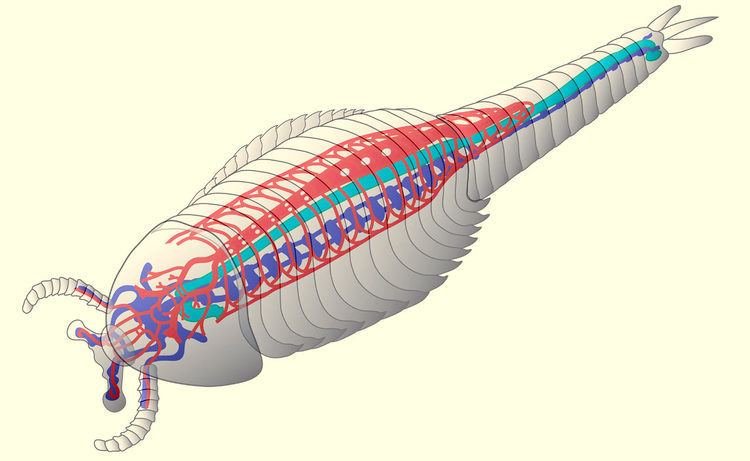
Fuxianhuia protensa was a relatively small, elongated arthropod, typically measuring between 3 and 10 centimeters in length, comparable to a medium-sized modern shrimp. Its body was segmented and divided into three main sections: a distinctive head shield, a trunk, and a tail section. The head shield was broad and semicircular, covering the anterior part of the body. Protruding from beneath this shield were a pair of prominent, stalked eyes, providing a wide field of vision, and a pair of long, slender antennae used for sensory perception. The most unusual feature of the head was a specialized anterior sclerite, a plate-like structure that extended forward, covering the mouthparts and giving the animal its specific name, 'protensa', meaning 'outstretched'. Beneath the head, a complex feeding apparatus, including a hypostome (a plate covering the mouth) and associated limbs, was present. The trunk consisted of numerous segments, each bearing a pair of biramous (two-branched) limbs, a characteristic feature of early arthropods. These limbs had a walking leg (endopod) and a flap-like gill branch (exopod) for respiration. The body terminated in a paddle-like tail fan, or telson, likely used for steering or propulsion. The exoskeleton was unmineralized, which is why its preservation required the exceptional conditions of the Chengjiang Lagerstätte.
The paleobiology of Fuxianhuia is inferred from its morphology and the sedimentary context of its fossils. Its numerous, relatively undifferentiated limbs suggest it was a benthic creature, walking along the muddy seafloor. The biramous limbs, with their gill-like exopods, confirm it was a fully aquatic, water-breathing animal. Its feeding strategy is a subject of some debate, but the position of its mouth and the nature of its head appendages suggest it was likely a detritivore or a scavenger. It probably used its walking legs to stir up sediment and its specialized anterior limbs to manipulate food particles, such as organic debris or carcasses, and guide them towards its mouth. Fuxianhuia was not equipped for active predation. The stalked eyes would have been advantageous for spotting potential predators from above while foraging on the substrate. Evidence of social behavior is non-existent, and they were likely solitary animals. Growth would have occurred through ecdysis (molting), a hallmark of arthropods, though direct fossil evidence of molts is rare. Its metabolism was likely comparable to that of modern cold-water crustaceans, relatively slow and efficient in a low-oxygen Cambrian environment.
Fuxianhuia lived in a shallow, tropical marine environment that characterized the South China Plate during the early Cambrian. The world at this time was vastly different, with most continental landmasses clustered in the Southern Hemisphere. The Chengjiang ecosystem was a vibrant, complex community teeming with newly evolved life forms. Fuxianhuia shared its habitat with a diverse array of organisms, including the iconic apex predator Anomalocaris, various trilobites like Eoredlichia, priapulid worms, and enigmatic creatures such as Hallucigenia and Wiwaxia. As a detritivore, Fuxianhuia occupied a crucial lower tier in the food web, recycling nutrients from the seabed. It was likely prey for larger, more mobile predators. Its primary defense would have been its exoskeleton, though unmineralized and thus offering limited protection, and perhaps camouflage against the muddy bottom. Its existence highlights the rapid establishment of complex ecological niches, including decomposers, shortly after the initial burst of animal diversification.
The discovery of Fuxianhuia is intrinsically linked to the unveiling of the Chengjiang biota. The first specimens were found in the Maotianshan Shale near the town of Chengjiang in Yunnan Province. While fossils were known from the area earlier, the site's global significance was cemented in 1984 with the discovery of the exceptionally preserved soft-bodied fossil Naraoia by paleontologist Hou Xianguang. Shortly thereafter, Fuxianhuia protensa was formally described in 1987 by Hou. The name 'Fuxianhuia' honors the nearby Fuxian Lake. The Chengjiang discoveries were a watershed moment in paleontology, providing a view of Cambrian life with a fidelity rivaling the famous Burgess Shale of Canada but from an even earlier time. No single specimen has achieved a popular nickname, but the wealth of complete, articulated fossils, some numbering in the hundreds, has made Fuxianhuia one of the best-understood early arthropods. The holotype specimen, and many other key fossils, are housed at institutions like the Yunnan Key Laboratory for Palaeobiology.
Fuxianhuia's evolutionary significance is profound, as it sits near the very base of the arthropod family tree. Its anatomy presents a mosaic of primitive and derived traits that helps bridge the gap between lobopodians (worm-like animals with legs, considered arthropod ancestors) and more advanced arthropod groups like trilobites and crustaceans. The most groundbreaking discovery related to Fuxianhuia came in 2012 when a team led by Nicholas Strausfeld and Ma Xiaoya described a specimen with its brain and optic nerves preserved in stunning detail as carbon films. This fossilized nervous system, the oldest and most complex of its kind, showed a three-part brain structure remarkably similar to that of modern malacostracan crustaceans (like crabs and shrimp) and insects. This finding suggested that the complex brain architecture of modern arthropods evolved very early and has been conserved for over half a billion years. Fuxianhuia, therefore, is not just an ancient relative but a direct testament to the deep evolutionary roots of the arthropod body plan and neuroanatomy, pushing back the origins of complex brains to the very dawn of the animal kingdom.
The precise phylogenetic placement of Fuxianhuia remains a subject of scientific debate, highlighting the challenges of classifying early Cambrian animals. While universally accepted as a stem-group arthropod (an early offshoot from the main lineage leading to modern groups), its relationship to other major clades is contentious. Some researchers place it deep within the arthropod stem, predating the split between chelicerates (spiders, scorpions) and mandibululates (crustaceans, insects). The 2012 brain discovery strongly supported a position closer to the mandibululates. However, other analyses focusing on different anatomical features have yielded conflicting results. Another area of discussion involves the function of its unique anterior sclerite; whether it was a sensory organ, a protective shield for the mouth, or a tool for digging remains uncertain. As new imaging techniques and analytical methods are applied to the wealth of Chengjiang fossils, our understanding of Fuxianhuia's anatomy and evolutionary position continues to be refined, making it a dynamic subject of ongoing research.
Fuxianhuia is known exclusively from the early Cambrian (Series 2, Stage 3) Maotianshan Shale of the Yu'anshan Formation in Yunnan Province, China. This geological deposit, known as the Chengjiang biota, is a Konservat-Lagerstätte, a site of exceptional fossil preservation. The fossils are typically preserved as flattened carbonaceous compressions in the fine-grained shale, often with mineral replacements (like pyrite or aluminosilicates) that highlight soft tissues in incredible detail. This allows for the study of not just the exoskeleton but also internal organs like the gut, circulatory system, and nervous tissue. Fuxianhuia is one of the more common arthropods found in this formation, with hundreds of specimens collected, ranging from juveniles to adults. This abundance of well-preserved material has been crucial for reconstructing its anatomy, life habits, and evolutionary context, making the Chengjiang fossil beds one of the most important paleontological sites in the world.
Despite its scientific importance, Fuxianhuia has not achieved widespread fame in popular culture in the same way as dinosaurs or the more bizarre-looking Anomalocaris. However, it is a staple in paleontological textbooks and documentaries about the Cambrian explosion, often featured as a prime example of early arthropod evolution and the phenomenon of exceptional preservation. Major natural history museums around the world, particularly those with exhibits on early life, often display casts or original fossils of Fuxianhuia. The Beijing Museum of Natural History and the Chengdu Natural History Museum in China hold significant collections. Its primary cultural impact lies in its educational value, serving as a key piece of evidence for scientists explaining the rapid diversification of life over 500 million years ago and the ancient origins of complex biological systems like the brain.
Classification
Time Period
Discovery
Location
Yunnan Province, China
Formation
Chengjiang biota (Maotianshan Shale)
Frequently Asked Questions
What is Fuxianhuia?
Fuxianhuia protensa is an extinct arthropod from the early Cambrian period, approximately 520 million years ago, whose exquisitely preserved fossils provide a crucial window into the early evolution of one of Earth's most successful animal phyla. Discovered in the celebrated Chengjiang biota of Yunn...
When did Fuxianhuia live?
Fuxianhuia lived during the cambrian period of the paleozoic era approximately 520-515 million years ago.
Where was Fuxianhuia discovered?
Fossils of Fuxianhuia were discovered in Yunnan Province, China in the Chengjiang biota (Maotianshan Shale).
What did Fuxianhuia eat?
Fuxianhuia was a detritivore or scavenger. It lived in marine (benthic) habitats.
What type of fossil is Fuxianhuia?
Fuxianhuia is preserved as a body fossil. The preservation quality is exceptional.
Related Specimens
From the paleozoic era · body fossils