Platecarpus
Platecarpus tympaniticus
Image: Image sourced via web search (Fair use / Educational)
About Platecarpus
Platecarpus was a medium-sized mosasaur, a type of extinct marine reptile, that thrived in the shallow epicontinental seas of the Late Cretaceous period. Living approximately 84 to 81 million years ago, its fossils are predominantly found in the Western Interior Seaway that once covered central North America. As a member of the Plioplatecarpinae subfamily, Platecarpus is significant for representing a highly specialized and successful lineage of aquatic predators that showcases key adaptations for a fully marine existence.
Platecarpus tympaniticus was a moderately sized mosasaur, typically reaching an average length of around 5.7 meters (about 19 feet), comparable to a large great white shark. Its body was streamlined and fusiform, an ideal shape for efficient movement through water. The skull was relatively short and kinetic, meaning it had mobile joints that allowed for a wider gape to swallow large prey, a feature shared with its modern relatives, snakes and monitor lizards. The jaws were lined with sharp, conical teeth, well-suited for grasping slippery prey like fish and squid. One of the most distinctive features of Platecarpus, and the source of its name meaning 'flat wrist', was its highly derived flipper structure. The bones of the wrist (carpals) and ankle (tarsals) were flattened and block-like, forming a rigid, paddle-like hydrofoil. Unlike earlier mosasaurs, Platecarpus had a more advanced tail fluke. Fossil evidence, including exceptionally preserved skin impressions, reveals a bilobed, crescent-shaped caudal fin, similar to that of sharks, which would have provided powerful propulsion. Its vertebrae were also specialized, with a high degree of flexibility in the posterior tail section to facilitate this powerful, side-to-side swimming motion. Skin impressions show that its body was covered in small, diamond-shaped scales, which would have reduced drag in the water.
As an active predator, the paleobiology of Platecarpus is a subject of intense study. Its diet consisted primarily of small to medium-sized fish and cephalopods, such as squid and ammonites, which were abundant in the Western Interior Seaway. The structure of its teeth, designed for piercing and holding rather than shearing, supports this interpretation. Stomach contents from some specimens have confirmed the presence of fish remains. The locomotion of Platecarpus has been a key area of research that has evolved over time. Early interpretations suggested an eel-like, undulatory swimming motion, but the discovery of its shark-like tail fluke has led to a revised understanding. It is now believed that Platecarpus was a thunniform swimmer, meaning it used powerful oscillations of its tail for propulsion, while the rest of its body remained relatively stiff. This method is energetically efficient and allows for sustained, high-speed cruising, suggesting it was an active pursuit predator rather than an ambush hunter. There is little direct evidence for social behavior, but the abundance of fossils in certain areas might suggest they congregated in productive feeding grounds. Like other mosasaurs, Platecarpus was likely viviparous, giving birth to live young in the water, as a return to land for egg-laying would have been impossible for such a specialized marine animal.
Platecarpus lived during the Santonian and Campanian stages of the Late Cretaceous, a time when Earth's climate was significantly warmer than today, with high sea levels creating vast, shallow inland seas. Its primary habitat was the Western Interior Seaway, a warm, subtropical body of water that stretched from the Arctic Ocean to the Gulf of Mexico, dividing North America into two landmasses, Laramidia and Appalachia. This seaway was a vibrant and dangerous ecosystem teeming with life. Platecarpus occupied a mid-level trophic position as a mesopredator. It would have hunted a variety of fish, including the fast-swimming Enchodus and the large, 5-meter-long Xiphactinus, as well as numerous species of ammonites and squid. However, Platecarpus was not an apex predator and would have been prey for larger marine reptiles. Its primary threats would have come from the giant mosasaur Tylosaurus, which could reach lengths of over 13 meters, and large sharks like Cretoxyrhina mantelli, the 'Ginsu shark'. The ecosystem also included other marine reptiles like the long-necked plesiosaur Elasmosaurus, sea turtles such as Protostega, and the flightless diving bird Hesperornis. Platecarpus was a key component of this complex food web, helping to control populations of smaller marine animals.
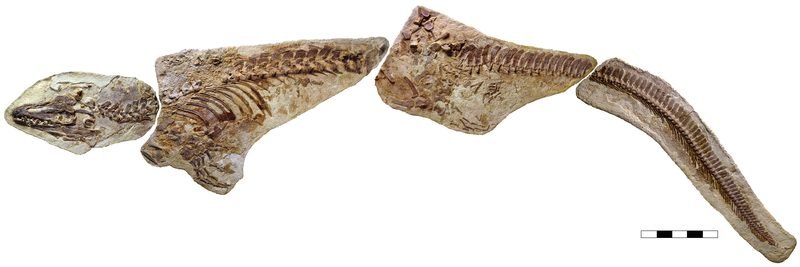
The discovery history of Platecarpus dates back to the 'Bone Wars' of the late 19th century, a period of intense fossil hunting rivalry between paleontologists Edward Drinker Cope and Othniel Charles Marsh. The type species, Platecarpus tympaniticus, was named by Cope in 1869 based on a fragmentary skull and vertebrae discovered in the Smoky Hill Chalk of Kansas. The name reflects the flattened carpal bones and the prominent quadrate bone in the skull, which reminded Cope of an eardrum (tympanum). Throughout the following decades, numerous additional specimens were unearthed from the Niobrara Formation by collectors like Charles Sternberg, providing a much more complete picture of the animal's anatomy. One of the most significant specimens is LACM 128319, housed at the Natural History Museum of Los Angeles County. This remarkably complete and articulated skeleton, discovered in Kansas, includes not only bones but also preserved skin impressions, tracheal rings, and the outline of the tail fluke, which fundamentally changed scientific understanding of mosasaur locomotion. This specimen, often nicknamed 'the Platecarpus mummy', provided the first definitive evidence for the shark-like tail in this group, revolutionizing how we visualize these ancient marine reptiles.
Platecarpus holds considerable evolutionary significance as a prime example of the rapid adaptation and diversification of mosasaurs. Mosasaurs themselves are part of the Squamata, the order that includes modern lizards and snakes, and their closest living relatives are thought to be monitor lizards. The transition from a terrestrial lizard ancestor to a fully pelagic marine predator like Platecarpus occurred over a relatively short geological timescale of about 25 million years. Platecarpus, belonging to the Plioplatecarpinae subfamily, showcases a suite of advanced adaptations for marine life. Its highly modified limbs, which evolved from walking legs into stiff, wing-like hydrofoils, demonstrate a high degree of specialization for steering and stability. The evolution of the hypocercal tail fluke, where the lower lobe is larger, represents a classic case of convergent evolution with ichthyosaurs and sharks, highlighting the physical principles that govern efficient swimming. Studying Platecarpus and its relatives provides invaluable insight into how terrestrial vertebrates can recolonize marine environments and evolve to fill apex and mesopredator niches previously occupied by other groups like the ichthyosaurs and plesiosaurs.
Despite being a well-known genus, Platecarpus has been at the center of several scientific debates, primarily concerning its taxonomy and locomotion. For many years, the genus became a 'wastebasket taxon', with numerous species from around the world being assigned to it, often based on fragmentary remains. A major revision by paleontologists Takuya Konishi and Michael W. Caldwell in the early 21st century re-examined the genus and reassigned many species, significantly cleaning up its taxonomy. The most profound shift in understanding came with the re-examination of specimen LACM 128319. For decades, mosasaurs were depicted with long, eel-like tails. The discovery of the distinct, bilobed tail fluke on this specimen, published by Johan Lindgren, Caldwell, and others in 2010, forced a complete paradigm shift. This finding demonstrated that at least some advanced mosasaurs were not serpentine swimmers but powerful, fast-cruising predators akin to sharks, a revelation that has reshaped nearly all modern reconstructions and paleobiological interpretations of the group.
Fossils of Platecarpus are abundant and widespread, making it one of the best-represented mosasaurs in the fossil record. The vast majority of specimens have been unearthed from the Smoky Hill Chalk Member of the Niobrara Formation in Kansas, USA. This geological unit represents sediments deposited at the bottom of the Western Interior Seaway and is world-renowned for its exceptional preservation of marine vertebrates. Complete and articulated skeletons are relatively common, a rarity for many prehistoric animals. In addition to Kansas, Platecarpus fossils have also been found in other parts of North America, including South Dakota, Nebraska, and Alabama, as well as in Belgium and parts of Africa, indicating a wide geographic distribution. The quality of preservation is often excellent, with some specimens, like LACM 128319, preserving not just the skeleton but also soft tissues like skin impressions, cartilage, and organ outlines. These exceptionally preserved fossils provide an unparalleled window into the biology of these ancient marine reptiles.
While not as famous as its larger cousin Tylosaurus or the iconic Tyrannosaurus rex, Platecarpus is a staple in major museum collections worldwide. Its manageable size and the frequency of complete skeletons make it an excellent display specimen. Notable mounts can be seen at the Natural History Museum of Los Angeles County, the Sternberg Museum of Natural History in Kansas, and the American Museum of Natural History in New York. Platecarpus helps educate the public about the diversity of life in the Cretaceous seas and serves as a powerful example of convergent evolution and the adaptation of land animals to a marine environment. It has appeared in various documentaries about prehistoric life, often used to illustrate the vibrant but perilous ecosystem of the Western Interior Seaway.
Classification
Time Period
Discovery
Location
Kansas, USA
Formation
Niobrara Formation (Smoky Hill Chalk Member)
Frequently Asked Questions
What is Platecarpus?
Platecarpus was a medium-sized mosasaur, a type of extinct marine reptile, that thrived in the shallow epicontinental seas of the Late Cretaceous period. Living approximately 84 to 81 million years ago, its fossils are predominantly found in the Western Interior Seaway that once covered central Nort...
When did Platecarpus live?
Platecarpus lived during the cretaceous period of the mesozoic era approximately 84-81 million years ago.
Where was Platecarpus discovered?
Fossils of Platecarpus were discovered in Kansas, USA in the Niobrara Formation (Smoky Hill Chalk Member).
What did Platecarpus eat?
Platecarpus was a carnivore. It lived in marine habitats.
What type of fossil is Platecarpus?
Platecarpus is preserved as a body fossil. The preservation quality is excellent.
Related Specimens
From the mesozoic era · body fossils