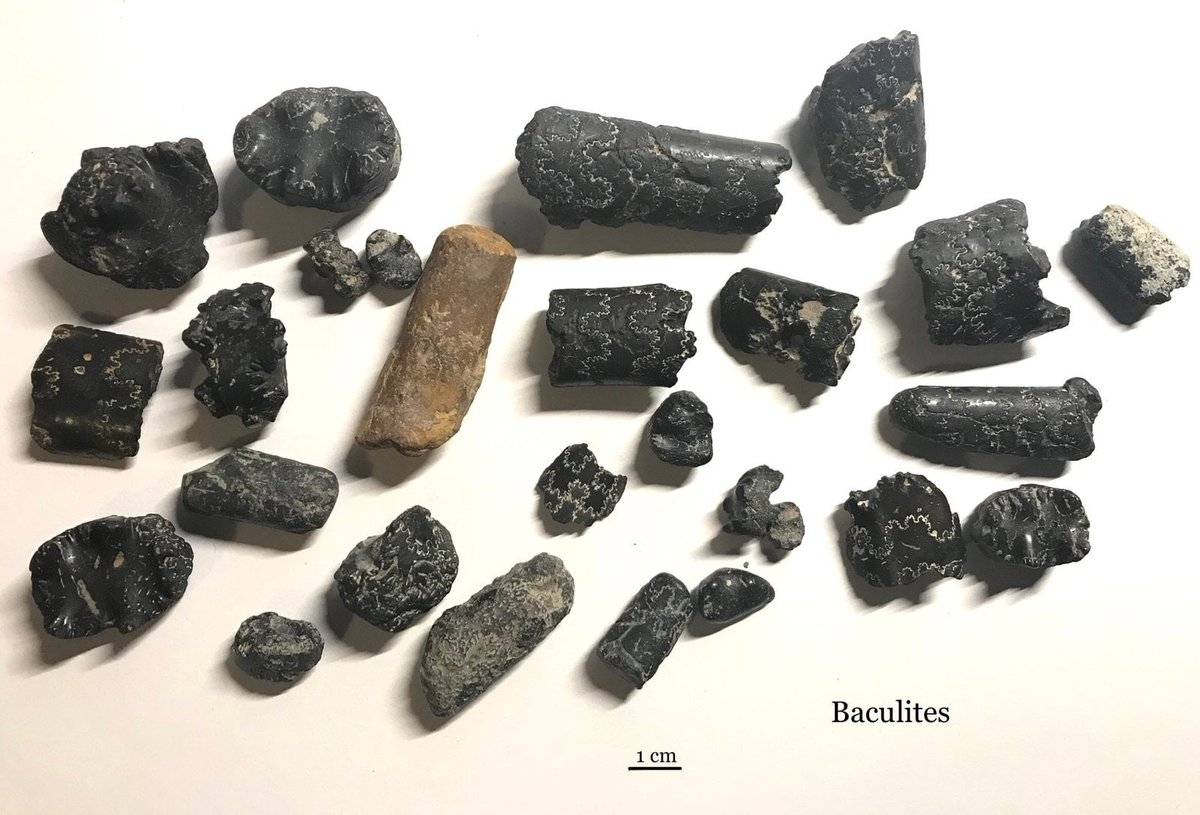
Baculites
Baculites compressus
Image: Image sourced via web search (Fair use / Educational)
About Baculites
Baculites is a genus of extinct ammonoid cephalopods that thrived during the Late Cretaceous period, from approximately 84 to 66 million years ago. These marine mollusks are renowned for their uniquely straight, or nearly straight, shells, a stark contrast to the familiar coiled shells of most other ammonites. As index fossils, their widespread distribution and rapid evolution make them invaluable tools for dating the geological strata in which they are found, particularly within the Western Interior Seaway of North America.
Baculites possessed an elongated, conical shell that resembled a staff or walking stick, from which its name, derived from the Latin 'baculum' (staff), originates. While the initial, embryonic portion of the shell, known as the protoconch, was minutely coiled, the vast majority of the shell grew in a straight line. The shell itself was chambered, much like its coiled relatives and modern nautiluses. These chambers, or camerae, were separated by intricate, folded walls called septa. The lines where these septa met the inner wall of the shell created complex, dendritic patterns known as suture lines, a key diagnostic feature for ammonoids. The living animal occupied only the final, largest chamber, the body chamber. The empty preceding chambers were filled with gas and fluid, which the animal could regulate to control its buoyancy in the water column. The shell's exterior was often adorned with ribs, nodes, or other ornamentation that varied between species. Complete specimens of *Baculites compressus* could reach lengths of up to 2 meters, though most are found in smaller, fragmented sections. The shell's aperture, or opening, was often complex, sometimes featuring a long dorsal projection called a rostrum. Like modern cephalopods, Baculites had a head with large eyes and a ring of tentacles surrounding a beak-like mouth, though soft tissues are not preserved.
As active carnivores, Baculites likely preyed upon small fish, crustaceans, and other invertebrates swimming or drifting in the mid-water column. Their powerful, parrot-like beak would have been effective at crushing the shells of small crustaceans or grasping soft-bodied prey. The arrangement of their tentacles, inferred from modern relatives like squid and octopus, would have been used to capture and manipulate food. Locomotion in Baculites is a subject of some debate. The traditional view held that their straight, rigid shell oriented them vertically in the water column, with the head and tentacles pointing downwards. In this model, they would have moved primarily by jet propulsion, expelling water through a siphon, allowing them to ascend or descend to track prey or evade predators. However, isotopic analysis of their shells, conducted by researchers like Neil Landman, suggests a more horizontal orientation, similar to modern cuttlefish or squid. This posture would have made them more efficient swimmers, capable of more dynamic, forward movement. Their complex suture lines provided structural reinforcement to the shell, allowing it to withstand the immense pressures of the deep sea and the stresses of rapid buoyancy changes. Growth patterns, visible as lines on the shell, indicate they grew relatively quickly, likely reaching maturity within one or two years, a life history strategy common in modern cephalopods.
Baculites lived in the vast epicontinental seas of the Late Cretaceous, most notably the Western Interior Seaway, a shallow sea that divided North America into two landmasses, Laramidia to the west and Appalachia to the east. This seaway was a warm, productive marine environment teeming with life. The climate was generally warmer and more equable than today, with high sea levels flooding continental interiors worldwide. Baculites shared this ecosystem with a diverse array of marine fauna. It occupied a mid-trophic level position in the food web, preying on smaller organisms while being a food source for larger predators. These predators included formidable marine reptiles such as mosasaurs (like *Tylosaurus* and *Platecarpus*), long-necked plesiosaurs, and large predatory fish like *Xiphactinus*. The fossil record often shows Baculites shells with circular boreholes, evidence of predation attempts by mosasaurs, whose conical teeth match the puncture marks perfectly. Other co-existing species included other ammonites (such as *Placenticeras*), belemnites, bivalves like the giant *Inoceramus*, sharks (*Squalicorax*, *Cretoxyrhina*), and various bony fishes. The seafloor was composed of fine mud and ooze, which contributed to the excellent preservation of their shells in formations like the Pierre Shale.
Baculites was first formally described by the French naturalist Jean-Baptiste Lamarck in 1799, making it one of the earliest recognized genera of extinct cephalopods. The name was established based on fossils found in the Maastrichtian-age chalk deposits near Maastricht, Netherlands. However, the most prolific and well-studied discoveries of Baculites have come from North America. In the 19th century, geologists and paleontologists exploring the American West, such as Fielding B. Meek and Ferdinand V. Hayden during their surveys of the upper Missouri River country, collected vast numbers of Baculites fossils from the Pierre Shale and Bearpaw Formation. The species *Baculites compressus* was named by the American naturalist Thomas Say in 1820, based on specimens collected during the Stephen H. Long expedition. These early discoveries were crucial for establishing the stratigraphy of the Late Cretaceous in North America. Unlike dinosaurs, individual Baculites fossils are not given popular nicknames, but entire fossil beds, known as 'Baculites zones', are famous among paleontologists and are used to define specific subdivisions of geologic time within the Campanian and Maastrichtian stages of the Cretaceous.
As a member of the subclass Ammonoidea, Baculites represents a highly specialized lineage within the heteromorph ammonites. Heteromorphs are a group of ammonoids that deviated from the typical planispiral coiling, experimenting with a variety of uncoiled, partially coiled, or bizarrely shaped shells during the Cretaceous. The evolution of a straight shell in Baculites and related families is thought to be an adaptation to a specific mode of life, possibly related to optimizing vertical movement or achieving a more streamlined, horizontal swimming posture. This evolutionary trend towards uncoiling occurred multiple times in ammonite history, but Baculitidae were by far the most successful and widespread of the straight-shelled forms. Their closest relatives are other heteromorphs like *Sciponoceras* and *Eubaculites*. Baculites, along with all other ammonites and non-avian dinosaurs, went extinct during the Cretaceous-Paleogene (K-Pg) mass extinction event 66 million years ago. Their closest living relatives are the coleoids (octopus, squid, cuttlefish) and, more distantly, the nautiloids, which survived the extinction and persist to this day.
While the general biology of Baculites is well-understood, several scientific debates persist. The primary controversy revolves around its life orientation and locomotion. As mentioned, the classic vertical model, proposed by researchers like Wilhelm Waagen in the 19th century, has been challenged by more recent isotopic and hydrodynamic studies suggesting a horizontal posture. The exact function of the complex suture patterns is also debated; while their role in strengthening the shell against hydrostatic pressure is accepted, some paleontologists argue they also related to the attachment points of the animal's soft tissues. Another area of active research is the possibility of sexual dimorphism. Some fossil assemblages show two distinct size classes of adult shells, which may represent larger females (macroconchs) and smaller males (microconchs), a pattern observed in other ammonite groups. This hypothesis, however, requires more definitive evidence to be universally accepted.
The fossil record of Baculites is exceptionally rich and geographically widespread. Fossils are found in Late Cretaceous marine deposits around the globe, including North America, Europe, Asia, Africa, and Antarctica. They are particularly abundant and well-preserved in the Western Interior Seaway of North America, with famous sites in the Pierre Shale of South Dakota, Wyoming, and Montana, and the Bearpaw Formation of Alberta, Canada. In these locations, their aragonitic shells are often preserved with their original nacreous mother-of-pearl luster, creating iridescent fossils of stunning beauty. Preservation is often so good that entire ecosystems are preserved in concretions, with Baculites found alongside other marine animals. Because the shells are hollow and chambered, they are often found as fragments, but complete or near-complete specimens are not uncommon. The sheer abundance of these fossils makes them one of the most common invertebrates found in Upper Cretaceous marine rocks.
Despite not being a dinosaur, Baculites has a notable cultural presence, especially among fossil collectors and geology enthusiasts. Its distinctive, rod-like shape and often beautifully iridescent preservation make it a highly sought-after fossil. Museums worldwide with marine paleontology exhibits, such as the American Museum of Natural History, the Yale Peabody Museum, and the Black Hills Institute of Geological Research, feature prominent displays of Baculites. They serve as excellent educational tools to teach about ammonite diversity, index fossils, stratigraphy, and the ancient marine ecosystems of the Cretaceous period. Their unique form captures the public imagination, representing the strange and wonderful evolutionary experiments that occurred in Earth's ancient oceans.
Classification
Time Period
Discovery
Location
North America (specifically the Western Interior Seaway region)
Formation
Pierre Shale
Frequently Asked Questions
What is Baculites?
Baculites is a genus of extinct ammonoid cephalopods that thrived during the Late Cretaceous period, from approximately 84 to 66 million years ago. These marine mollusks are renowned for their uniquely straight, or nearly straight, shells, a stark contrast to the familiar coiled shells of most other...
When did Baculites live?
Baculites lived during the cretaceous period of the mesozoic era approximately 84-66 million years ago.
Where was Baculites discovered?
Fossils of Baculites were discovered in North America (specifically the Western Interior Seaway region) in the Pierre Shale.
What did Baculites eat?
Baculites was a carnivore. It lived in marine habitats.
What type of fossil is Baculites?
Baculites is preserved as a body fossil. The preservation quality is excellent.
Related Specimens
From the mesozoic era · body fossils