Pentacrinites
Pentacrinites fossilis
Image: Image sourced via web search (Fair use / Educational)
About Pentacrinites
Pentacrinites fossilis is an extinct species of crinoid, commonly referred to as a sea lily, that thrived in the shallow, warm marine environments of the Early Jurassic period, approximately 200 to 175 million years ago. Despite its plant-like common name and appearance, Pentacrinites was a marine invertebrate animal belonging to the phylum Echinodermata, making it a relative of modern starfish, sea urchins, and sea cucumbers. This organism is of immense significance in the field of paleontology because its exquisitely preserved fossils have provided critical insights into the complex marine ecosystems of the Mesozoic era, specifically regarding the unique pseudopelagic lifestyles adopted by certain benthic lineages. By attaching themselves to floating debris rather than the ocean floor, these crinoids were able to colonize vast swaths of the Jurassic oceans, leaving behind spectacular fossil assemblages that continue to captivate scientists and the public alike.
The physical anatomy of Pentacrinites fossilis was both delicate and highly complex, characterized by the classic pentameral, or five-fold, symmetry that defines most echinoderms. The animal consisted of three primary anatomical regions: the stem (or column), the calyx (the cup-like body containing the internal organs), and the branching arms (brachia) used for feeding. The stem was composed of numerous stacked, star-shaped or pentagonal calcite plates called ossicles. These stems could grow to extraordinary lengths, often reaching between one and three meters, allowing the animal to extend far from its attachment point. Extending from the stem at regular intervals were whorls of flexible appendages known as cirri, which the animal used to anchor itself to substrates. At the top of the stem sat the calyx, from which extended a magnificent crown of highly branched arms. These arms were lined with tiny, feather-like structures called pinnules, creating a dense, net-like filtration system. The entire skeleton was made of a highly porous form of calcium carbonate known as stereom, which was lightweight yet structurally sound. In life, this skeletal framework would have been covered by a thin layer of living tissue (epidermis), and the animal likely exhibited vibrant colors, similar to the brilliant reds, yellows, and purples seen in modern crinoids. Compared to modern stalked crinoids, which are largely restricted to the deep sea and rarely exceed a meter in length, Pentacrinites was a giant of its kind, forming massive, trailing colonies that would have looked like spectacular, floating underwater gardens.
In terms of paleobiology, Pentacrinites fossilis was an obligate suspension feeder, relying entirely on ocean currents to deliver its food. The animal would orient its expansive, feathery crown of arms to face into the prevailing water currents. As water flowed through the dense network of pinnules, microscopic plankton, detritus, and organic particles were captured by specialized tube feet. These tube feet were covered in a sticky mucus that trapped the food particles, which were then passed down a ciliated ambulacral groove running along the center of each arm, directly to the mouth located on the upper surface of the calyx. Because they were attached to floating driftwood—a lifestyle known as pseudopelagic—Pentacrinites colonies were constantly moving through the upper layers of the water column, which were rich in oxygen and planktonic food. This mobile lifestyle meant they did not have to expend energy on locomotion, allowing them to dedicate their metabolic resources to rapid growth and reproduction. Growth occurred through the continuous addition of new ossicles just below the calyx, pushing the older parts of the stem downward. It is inferred that they reproduced through broadcast spawning, releasing vast quantities of eggs and sperm into the water column to be fertilized externally, a strategy that ensured the wide dispersal of their larvae across the Jurassic oceans.
The ecological context of the Early Jurassic was defined by the aftermath of the devastating End-Triassic mass extinction, which had wiped out a significant portion of marine life. As the oceans recovered, they became vibrant, dynamic ecosystems dominated by marine reptiles such as ichthyosaurs and plesiosaurs, while the water column teemed with ammonites, belemnites, and diverse fish species. Pentacrinites occupied a unique niche in this recovering world. The seafloor in many regions, such as the areas that would become the Blue Lias of England and the Posidonia Shale of Germany, was frequently anoxic (depleted of oxygen) and toxic, making it uninhabitable for benthic (bottom-dwelling) organisms. To survive, Pentacrinites adapted to live upside-down, attaching its cirri to the undersides of large logs and driftwood that had been washed out to sea from terrestrial forests during massive storms. A single floating log could host a massive colony of hundreds of individual crinoids, creating a localized, floating micro-ecosystem. These floating colonies provided shelter for small fish and invertebrates, while the crinoids themselves may have been preyed upon by specialized shell-crushing predators, such as certain fish or cephalopods. Eventually, as the driftwood became waterlogged or the weight of the massive crinoid colony became too great, the entire structure would sink to the anoxic seafloor, where the lack of scavengers and oxygen ensured their perfect preservation.
The discovery history of Pentacrinites is deeply intertwined with the birth of modern paleontology in the early 19th century. Some of the most spectacular and scientifically significant specimens were discovered by the legendary fossil hunter Mary Anning along the treacherous, crumbling cliffs of Lyme Regis in Dorset, England. In the 1820s, Anning excavated massive slabs of dark shale covered in hundreds of perfectly articulated Pentacrinites fossils. These stunning finds were purchased by wealthy collectors and studied by prominent geologists of the era, such as William Buckland and Conybeare. The genus Pentacrinites was formally established, and its name, derived from the Greek words 'penta' (five) and 'krinon' (lily), perfectly described its five-sided stem and flower-like appearance. Early naturalists initially struggled to understand the nature of these fossils, with some ancient scholars believing them to be the petrified remains of actual plants or even mystical artifacts. The star-shaped stem ossicles were commonly found loose on beaches and were known in local folklore as 'star stones' or 'fairy coins.' It was the meticulous excavation of complete, articulated colonies attached to fossilized wood by pioneers like Anning that finally proved their true nature as marine animals and revealed their extraordinary floating lifestyle.
The evolutionary significance of Pentacrinites lies in its representation of a highly successful, albeit temporary, evolutionary strategy within the class Crinoidea. Crinoids have an ancient lineage stretching back to the Ordovician period, over 480 million years ago. They suffered catastrophic losses during the Permian-Triassic mass extinction, the most severe extinction event in Earth's history, which wiped out over 90% of marine species. Pentacrinites represents one of the major lineages that not only survived this bottleneck but subsequently radiated and diversified during the Mesozoic marine revolution. Their adaptation to a pseudopelagic lifestyle was a brilliant evolutionary innovation that allowed them to exploit the rich food resources of the open ocean while avoiding the dangerous, predator-filled, or anoxic conditions of the seafloor. However, this lifestyle was ultimately an evolutionary dead end. As the Mesozoic progressed, the evolution of wood-boring bivalves (such as shipworms) drastically reduced the availability of floating driftwood, destroying the very habitat Pentacrinites relied upon. Today, their closest living relatives are the deep-sea stalked crinoids and the highly mobile, unstalked feather stars, both of which have retreated to specific niches to avoid the intense predation pressures of modern shallow oceans.
Scientific debates surrounding Pentacrinites have historically centered on their mode of life and taphonomy (the processes of fossilization). For many decades, paleontologists debated whether these massive crinoid colonies were truly pseudopelagic (floating attached to wood) or if they were benthic (living on the seafloor) and merely happened to be preserved alongside sunken logs. The 'benthic vs. pelagic' debate was largely settled in the late 20th century through detailed taphonomic studies. Researchers demonstrated that the anoxic nature of the shales in which they are found could not have supported benthic life. Furthermore, the orientation of the crinoids radiating outward from the logs, combined with the lack of any root-like holdfasts adapted for soft mud, definitively proved their floating lifestyle. More recent debates have focused on the hydrodynamics of the colonies. Some biomechanical studies suggest that the massive drag created by hundreds of large crinoids would have caused the logs to sink much faster than previously thought, leading to questions about how long these colonies actually lived and whether they had accelerated growth rates compared to modern deep-sea crinoids, which are known to grow very slowly.
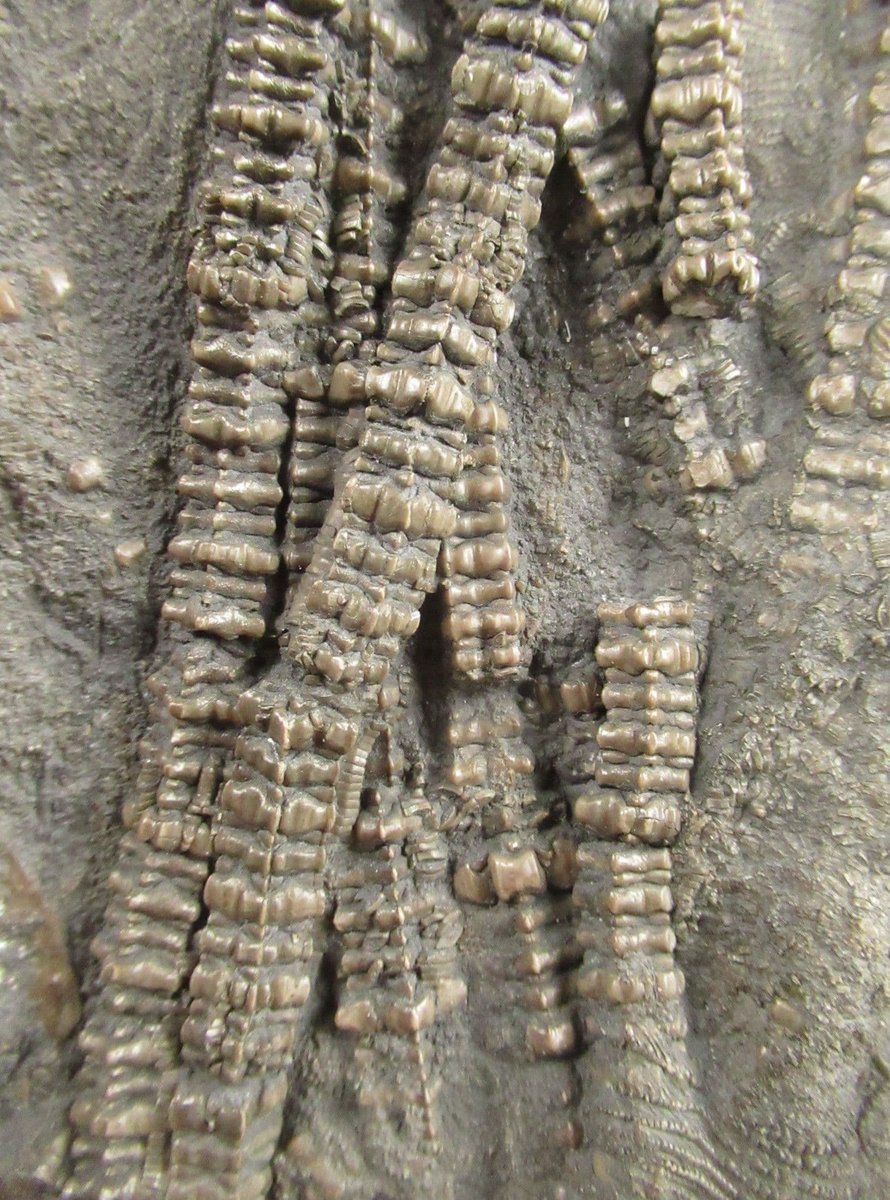
The fossil record of Pentacrinites is nothing short of spectacular, offering some of the most visually stunning invertebrate fossils in the world. Geographically, they are predominantly found in Europe, with the most famous sites being the Blue Lias Formation of the Jurassic Coast in Dorset, England, and the Posidonia Shale in Holzmaden, Germany. Thousands of specimens have been recovered, ranging from isolated stem ossicles to massive slabs containing entire, undisturbed colonies. The preservation quality is frequently exceptional. Because the colonies sank into stagnant, anoxic muds devoid of scavenging bottom-dwellers or disruptive currents, the delicate, multi-plated skeletons were buried intact before the connective tissues could completely decay. In some extraordinary cases, the fossils are preserved in shiny, golden iron pyrite (fool's gold), creating a striking contrast against the dark grey or black shale matrix. Preparing these fossils requires immense skill and patience, often involving hundreds of hours of meticulous work using air scribes and micro-sandblasters to expose the delicate, feathery arms from the surrounding rock.
The cultural impact of Pentacrinites is profound, bridging the gap between scientific inquiry and aesthetic appreciation. During the Victorian era, large slabs of Pentacrinites were highly prized status symbols, displayed in the curiosity cabinets and drawing rooms of the European elite. Today, these magnificent fossils are the centerpieces of major natural history museums worldwide, including the Natural History Museum in London and the Royal Ontario Museum. They serve as powerful educational tools, instantly capturing the public's imagination and illustrating the complex, alien beauty of prehistoric marine life. The striking visual of a 'sea lily' cast in golden pyrite remains one of the most iconic and recognizable images in paleontology, continuing to inspire awe and curiosity about the ancient oceans of our planet.
Classification
Time Period
Discovery
Location
United Kingdom
Formation
Blue Lias Formation
Frequently Asked Questions
What is Pentacrinites?
Pentacrinites fossilis is an extinct species of crinoid, commonly referred to as a sea lily, that thrived in the shallow, warm marine environments of the Early Jurassic period, approximately 200 to 175 million years ago. Despite its plant-like common name and appearance, Pentacrinites was a marine i...
When did Pentacrinites live?
Pentacrinites lived during the jurassic period of the mesozoic era approximately 200-175 million years ago.
Where was Pentacrinites discovered?
Fossils of Pentacrinites were discovered in United Kingdom in the Blue Lias Formation.
What did Pentacrinites eat?
Pentacrinites was a filter-feeder. It lived in marine habitats.
What type of fossil is Pentacrinites?
Pentacrinites is preserved as a body fossil. The preservation quality is exceptional.
Related Specimens
From the mesozoic era · body fossils