Sanctacaris
Sanctacaris uncata
Image: Image sourced via web search (Fair use / Educational)
About Sanctacaris
Sanctacaris uncata is an extinct marine arthropod that lived approximately 508 million years ago during the Middle Cambrian period. Its exceptionally preserved fossils, found in the renowned Burgess Shale of British Columbia, Canada, offer a crucial window into the early evolution of chelicerates, the major arthropod group that today includes spiders, scorpions, and horseshoe crabs. As one of the earliest known chelicerates, Sanctacaris provides vital anatomical information that helps paleontologists trace the origins and diversification of one of the most successful animal lineages on Earth.
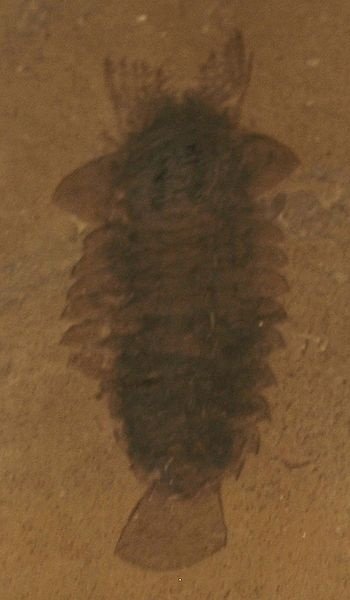
Sanctacaris was a moderately sized arthropod for its time, with a body length ranging from 4.6 to 9.3 centimeters. Its overall body plan was elongated and segmented, capped by a distinctive, wide head shield or carapace. This carapace was broader than the subsequent trunk segments and lacked the prominent dorsal eyes seen in many other Cambrian arthropods like Anomalocaris. The most striking features were located on its head. It possessed five pairs of grasping appendages, each terminating in a small, pincer-like claw, and a sixth, larger pair of appendages that were more robust and also ended in claws. These appendages were uniramous, meaning they consisted of a single branch, a key characteristic of chelicerates. Behind the head, the trunk was composed of eleven segments, each bearing a pair of biramous limbs. These limbs had a lower, leg-like walking branch (endopod) and an upper, flap-like gill-bearing branch (exopod), suggesting a dual function in both locomotion along the seafloor and respiration. The body terminated in a broad, paddle-shaped telson, or tail fan, which likely aided in steering and propulsion. Compared to a modern animal, its size was roughly equivalent to a large shrimp or a small crayfish, but its unique combination of features makes direct comparison difficult.
The specialized anatomy of Sanctacaris provides strong clues about its paleobiology. The array of clawed appendages on its head strongly indicates a carnivorous or predatory lifestyle. It is hypothesized that Sanctacaris was a benthic predator, using its biramous trunk limbs to walk or scuttle across the muddy seafloor. Upon encountering prey, likely small, soft-bodied invertebrates such as worms or other arthropods, it would have used its formidable head appendages to grasp and manipulate the food. The five smaller pairs may have been used for delicate handling, while the sixth, larger pair could have delivered a more powerful grip or served to tear prey apart before passing it to a mouth located on the underside of the head. The broad telson suggests it was also a capable swimmer, possibly using sharp, upward flexes of its tail to generate thrust for rapid escape or short bursts of speed during pursuit, similar to modern lobsters. There is no fossil evidence to suggest social behavior, and like most early arthropods, it was likely a solitary hunter. Growth would have occurred through a series of molts, shedding its exoskeleton to accommodate an increase in size, a process common to all arthropods.
Sanctacaris inhabited a warm, shallow marine environment on a continental shelf off the coast of the ancient continent of Laurentia. During the Middle Cambrian, this region was situated near the equator. The seafloor was a soft, muddy substrate, periodically subject to submarine mudslides that would rapidly entomb entire communities of organisms, leading to the exceptional preservation seen in the Burgess Shale. This ecosystem was teeming with a bizarre and diverse array of life, a snapshot of the Cambrian explosion. Sanctacaris shared its habitat with a host of other famous creatures, including the apex predator Anomalocaris, the armored trilobites such as Olenoides, the enigmatic Hallucigenia, and the chordate ancestor Pikaia. Within this complex food web, Sanctacaris likely occupied the role of a mid-tier predator or scavenger. It would have preyed upon smaller, less-defended animals while potentially falling victim to larger predators like Anomalocaris. Its existence highlights the establishment of complex, multi-level trophic structures very early in the history of animal life.
The discovery of Sanctacaris is credited to the paleontologist Desmond Collins of the Royal Ontario Museum. In 1983, Collins and his team were exploring the Mount Stephen fossil beds, a site near the original Walcott Quarry of the Burgess Shale. While the area was known for its trilobites, Collins's work uncovered a new, exceptionally preserved fossil layer, which yielded Sanctacaris and other novel species. The initial informal name given to the creature was 'Santa Claws' due to its prominent, hook-like head appendages and its timely discovery near Christmas. The formal scientific name, Sanctacaris uncata, was published in 1988 by Derek Briggs and Desmond Collins. The genus name translates to 'saintly crab' (from Latin 'sanctus' and Greek 'caris'), a nod to its discovery on Mount Stephen, which is part of the St. Stephen Formation. The species name 'uncata' is Latin for 'hooked' or 'clawed,' directly referencing its most distinctive anatomical feature. The primary specimen, the holotype, is housed at the Royal Ontario Museum in Toronto, Canada, which holds the most significant collection of Sanctacaris fossils.
The evolutionary significance of Sanctacaris cannot be overstated, as it represents one of the earliest and most complete fossils of a stem-chelicerate. Its discovery provided a crucial anchor point for understanding the origins of Chelicerata, the arthropod subphylum that includes arachnids, sea spiders, and horseshoe crabs. Before Sanctacaris, the early fossil record of this group was sparse. The anatomy of Sanctacaris, particularly its uniramous, claw-tipped head appendages (chelicerae-like structures), provided strong evidence for the chelicerate affinity. It demonstrates that the key body plan of this group—a body divided into a prosoma (head/thorax) with specialized appendages and an opisthosoma (abdomen)—was established by the Middle Cambrian. It sits near the very base of the chelicerate family tree, helping to bridge the gap between more primitive, unspecialized arthropods and the later, more derived forms like scorpions and eurypterids. It shows a transitional state, retaining primitive biramous trunk limbs while exhibiting the derived, specialized head appendages that would come to define one of the most successful arthropod lineages.
Despite its importance, the precise phylogenetic placement of Sanctacaris has been a subject of scientific debate. When first described by Briggs and Collins in 1988, its chelicerate affinities were immediately proposed, but some paleontologists questioned this interpretation, suggesting it might belong to a separate, extinct arthropod lineage or be more closely related to other groups. The main point of contention was whether its grasping appendages were truly homologous to the chelicerae of modern chelicerates. However, subsequent detailed analyses, including cladistic studies that mathematically compare hundreds of anatomical features across different arthropod groups, have consistently reinforced its position as a stem-group chelicerate. A 2014 study by Legg and colleagues, for example, placed it firmly within the chelicerate lineage. These ongoing analyses refine our understanding of early arthropod relationships and highlight how new analytical methods can re-evaluate and confirm initial hypotheses based on fossil evidence.
The fossil record of Sanctacaris is geographically restricted but paleontologically significant. All known specimens have been recovered from the Burgess Shale fossil deposits in Yoho National Park, British Columbia, Canada, specifically from the Mount Stephen Trilobite Beds. It is considered a rare component of the Burgess Shale fauna; far fewer specimens of Sanctacaris have been found compared to more common organisms like the trilobite Olenoides or the brachiopod Diraphora. The preservation, however, is exceptional. The fine-grained sediment and anoxic (low-oxygen) burial conditions preserved not only the tough exoskeleton but also delicate structures like the gill flaps, gut traces, and fine details of the limbs. This high fidelity of preservation is what allows for such detailed reconstructions of its anatomy and lifestyle. The Royal Ontario Museum in Toronto holds the most important collection of these fossils, which continue to be a vital resource for researchers studying the Cambrian explosion.
While not as widely recognized by the public as Tyrannosaurus rex or Triceratops, Sanctacaris holds a special place in paleontological circles and among enthusiasts of Cambrian life. Its memorable nickname, 'Santa Claws,' has helped it gain some minor recognition in popular science books and articles about the Burgess Shale. Reconstructions and fossil casts of Sanctacaris are featured in museum exhibits that focus on the Cambrian explosion, most notably at the Royal Ontario Museum, which discovered it, and the Smithsonian National Museum of Natural History. Its primary cultural impact is educational, serving as a key example of the bizarre yet foundational life forms that emerged during this critical period of evolutionary innovation and demonstrating the deep ancestral roots of familiar modern animals like spiders and scorpions.
Classification
Time Period
Discovery
Location
Canada
Formation
Burgess Shale (specifically the Mount Stephen fossil beds)
Frequently Asked Questions
What is Sanctacaris?
Sanctacaris uncata is an extinct marine arthropod that lived approximately 508 million years ago during the Middle Cambrian period. Its exceptionally preserved fossils, found in the renowned Burgess Shale of British Columbia, Canada, offer a crucial window into the early evolution of chelicerates, t...
When did Sanctacaris live?
Sanctacaris lived during the cambrian period of the paleozoic era approximately 508-505 million years ago.
Where was Sanctacaris discovered?
Fossils of Sanctacaris were discovered in Canada in the Burgess Shale (specifically the Mount Stephen fossil beds).
What did Sanctacaris eat?
Sanctacaris was a carnivore. It lived in marine, benthic habitats.
What type of fossil is Sanctacaris?
Sanctacaris is preserved as a body fossil. The preservation quality is exceptional.
Related Specimens
From the paleozoic era · body fossils