Berlin Archaeopteryx (HMN 1880)
Archaeopteryx lithographica
Image: Image sourced via web search (Fair use / Educational)
About Berlin Archaeopteryx (HMN 1880)
Archaeopteryx lithographica, specifically the world-renowned Berlin specimen designated as HMN 1880, represents one of the most iconic, visually striking, and scientifically significant fossils ever discovered in the history of paleontology. Living approximately 150 to 148 million years ago during the Tithonian stage of the Late Jurassic period in what is now the Bavarian region of southern Germany, this remarkable creature serves as the premier transitional fossil bridging the evolutionary gap between non-avian feathered theropod dinosaurs and modern birds. Its discovery in the mid-nineteenth century provided the first clear, undeniable fossil evidence supporting Charles Darwin's then-recently published theory of evolution by natural selection, effectively cementing its status as the quintessential "missing link" in the public and scientific consciousness. The Berlin specimen in particular, with its perfectly articulated skeleton and breathtakingly detailed feather impressions, remains the standard by which all other transitional fossils are measured, offering an unparalleled window into the evolutionary origins of avian flight and the deep history of the dinosaurian lineage.
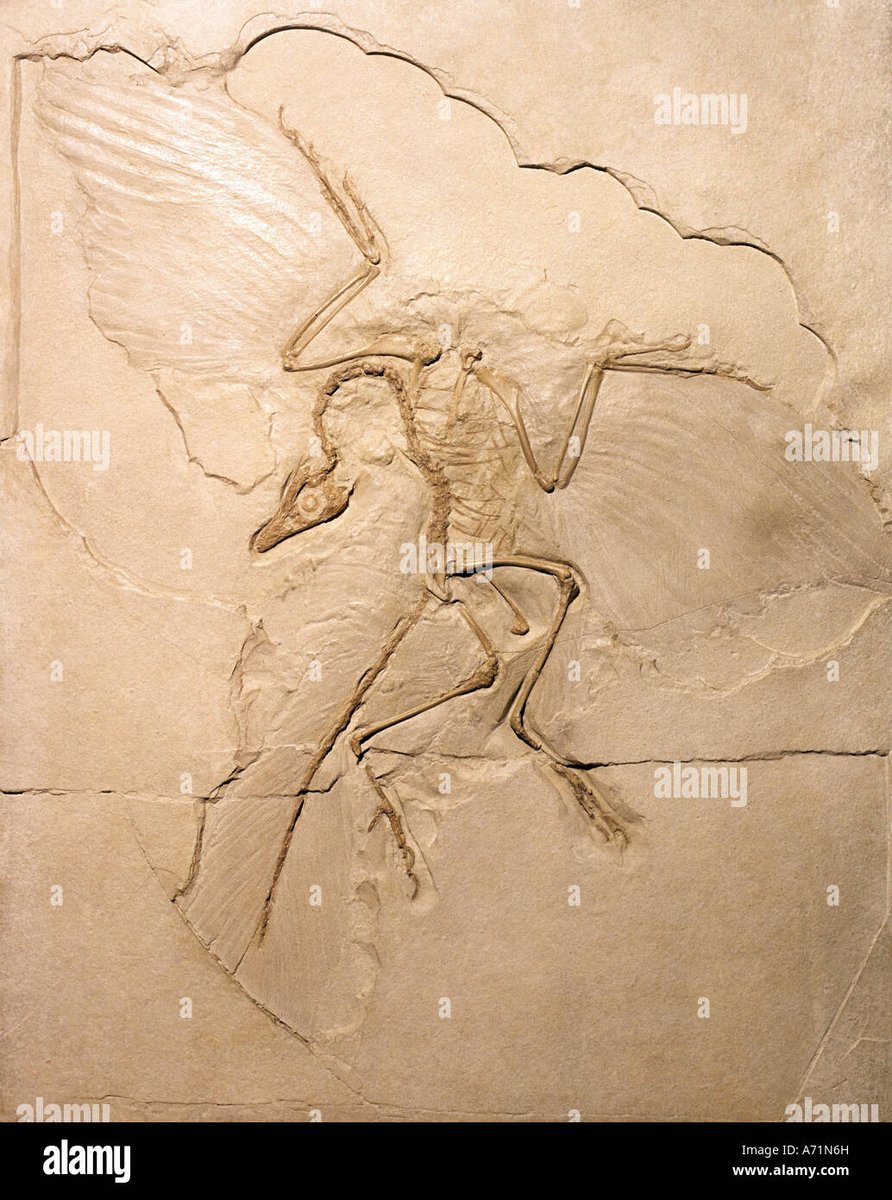
In terms of physical description, Archaeopteryx was a relatively small animal, roughly comparable in size and overall proportions to a modern Eurasian magpie or a large raven. The Berlin specimen indicates an approximate body length of 50 centimeters from the tip of its snout to the end of its long, bony tail, with an estimated living weight ranging between 0.8 and 1 kilogram. Unlike modern birds, which possess a fused tailbone known as a pygostyle, Archaeopteryx retained a long, reptilian tail composed of numerous unfused caudal vertebrae, which was fringed with stiff, aerodynamic feathers. Its skull was distinctly dinosaurian, featuring a jaw lined with small, sharp, conical teeth rather than the toothless keratinous beak seen in extant avians. The forelimbs were highly modified into wings, yet they retained three distinct, unfused fingers equipped with sharp, curved claws, which were likely used for grasping prey or clambering up the rough bark of trees. The skeletal structure lacked several key adaptations found in modern flying birds; for instance, it possessed a flat sternum rather than a deeply keeled breastbone, suggesting that its flight muscles were not as massive or powerful as those of today's active fliers. However, the soft tissue inferences drawn from the Berlin specimen's exceptional preservation reveal a fully developed plumage identical in microscopic structure to the flight feathers of modern birds, including asymmetrical vanes on the primary feathers, which is a definitive hallmark of aerodynamic capability. Recent studies utilizing advanced imaging techniques have even suggested that at least some of these feathers were black in color, based on the discovery of fossilized melanosomes within the feather impressions.
The paleobiology of Archaeopteryx has been a subject of intense study and reconstruction for over a century. Based on its dentition and overall morphology, it is widely accepted that Archaeopteryx was a carnivorous predator, likely an insectivore or a hunter of small vertebrates such as lizards, early mammals, and amphibians that inhabited its environment. Its hunting strategies may have involved a combination of active pursuit on the ground and ambush tactics from low branches. The locomotion of Archaeopteryx is one of the most heavily researched aspects of its biology. While its asymmetrical flight feathers clearly indicate some capacity for aerial movement, the lack of a keeled sternum and the specific structure of its shoulder joint suggest that it was not capable of sustained, powered flapping flight in the manner of modern birds. Instead, it likely engaged in short bursts of powered flight, gliding from tree to tree, or utilizing its wings to assist in running up steep inclines—a behavior observed in modern ground birds known as wing-assisted incline running (WAIR). Growth patterns analyzed from the bone histology of various Archaeopteryx specimens indicate a growth rate that was slower than that of modern birds but faster than that of contemporary reptiles, suggesting an intermediate metabolic rate. This points to a creature that was likely endothermic (warm-blooded) to some degree, a necessary physiological trait for the energy-demanding activities of even rudimentary flight.
The ecological context of the Late Jurassic world inhabited by Archaeopteryx was vastly different from the modern European landscape. During the Tithonian stage, the region of Bavaria was part of the Solnhofen Archipelago, a chain of small, low-lying coral islands situated in a shallow, warm, tropical sea at the edge of the ancient Tethys Ocean. The climate was generally arid to semi-arid, with distinct dry and wet seasons, and the islands were likely covered in sparse, scrubby vegetation, including cycads, bennettitales, and early conifers, though large forests were probably absent. Archaeopteryx shared this island ecosystem with a diverse array of organisms. The skies and coastal cliffs were dominated by pterosaurs like Rhamphorhynchus and Pterodactylus, which were the primary aerial predators of the time. The shallow lagoons teemed with marine life, including horseshoe crabs, ammonites, and a vast variety of bony fishes. On land, Archaeopteryx would have occupied a mid-level position in the food web, preying on small arthropods and vertebrates while needing to remain vigilant against larger terrestrial predators, such as the small theropod dinosaur Compsognathus, which is also found in the Solnhofen deposits. The harsh, hypersaline, and anoxic conditions of the lagoon bottoms surrounding these islands were devoid of scavenging life, which is precisely what allowed for the pristine preservation of organisms that washed or fell into the waters.
The discovery history of the Berlin Archaeopteryx is a fascinating tale of nineteenth-century paleontology, commerce, and scientific intrigue. The very first fossil evidence of Archaeopteryx—a single fossilized feather—was discovered in 1861, followed shortly by the London specimen, which lacked a complete skull. However, it was the discovery of the Berlin specimen (HMN 1880) that truly captivated the world. Found between 1874 and 1876 by a farmer named Jakob Niemeyer in the Blumenberg quarry near Eichstätt, Germany, the slab and counterslab were initially traded to an innkeeper named Johann Dörr for a cow. The fossil eventually made its way into the hands of Ernst Häberlein, a local fossil collector and dealer. Recognizing the immense scientific and monetary value of the perfectly preserved, fully articulated skeleton complete with a skull and exquisite feather impressions, Häberlein offered it for sale for a staggering sum. The fossil was almost sold to the Yale Peabody Museum in the United States, but German industrialist Werner von Siemens intervened, purchasing the specimen in 1881 for 20,000 gold marks to ensure it remained in Germany. He subsequently transferred it to the Humboldt Museum für Naturkunde in Berlin, where it resides today. This specimen provided the definitive proof that Archaeopteryx possessed both a dinosaurian skull with teeth and fully developed avian feathers.
The evolutionary significance of Archaeopteryx cannot be overstated; it is arguably the most important single fossil in the study of vertebrate evolution. Situated at the very base of the avian family tree, Archaeopteryx represents the classic transitional form, exhibiting a perfect mosaic of primitive (plesiomorphic) reptilian traits and derived (apomorphic) avian characteristics. Its dinosaurian features—such as the long bony tail, the three clawed fingers on each wing, the gastralia (belly ribs), and the toothed jaw—firmly anchor it within the Theropoda, specifically within the clade Paraves, which includes dromaeosaurids like Velociraptor. Conversely, its avian features—most notably the fully developed, asymmetrical pennaceous flight feathers, the furcula (wishbone), and the retroverted pubis—demonstrate the evolutionary steps taken toward modern birds (Neornithes). By proving that birds are the direct, living descendants of theropod dinosaurs, Archaeopteryx fundamentally reshaped our understanding of the tree of life. It demonstrated that major evolutionary transitions do not occur overnight but are the result of the gradual accumulation of adaptations, with features like feathers evolving initially for insulation or display before being co-opted for aerodynamic purposes.
Despite its long history of study, Archaeopteryx remains the subject of vigorous scientific debates and ongoing controversies. One of the most enduring debates concerns the origin of avian flight: did flight evolve from the "trees down" (arboreal hypothesis), with animals gliding from high branches, or from the "ground up" (cursorial hypothesis), with running animals using wings to leap and catch prey? Archaeopteryx has been used to support both models, though recent biomechanical studies lean toward a complex combination of behaviors, including wing-assisted incline running. Taxonomy is another contentious issue. Over the decades, up to twelve skeletal specimens have been discovered, and researchers have debated whether they all represent a single species (Archaeopteryx lithographica) or if the variations in size and morphology warrant the creation of new species or even genera, such as Wellnhoferia or Jurapteryx. Furthermore, discoveries of older or contemporaneous feathered dinosaurs in China, such as Anchiornis and Xiaotingia, have occasionally threatened to displace Archaeopteryx from its foundational position at the very base of the Avialae clade, prompting complex phylogenetic re-evaluations of what truly defines the "first bird."
The fossil record of Archaeopteryx is highly restricted geographically and stratigraphically, making it an incredibly rare and precious scientific resource. To date, only twelve skeletal specimens and one isolated feather have been definitively assigned to the genus, all originating from the Solnhofen Limestone formation in Bavaria, Germany. The preservation quality of these fossils is categorized as exceptional, representing a classic Konservat-Lagerstätte. The ultra-fine-grained lithographic limestone, originally deposited as carbonate mud in stagnant, anoxic lagoons, captured details of unprecedented fidelity. While the bones are typically flattened, the true marvel lies in the preservation of the soft tissues, specifically the feathers, which are preserved as incredibly detailed impressions that show the microscopic structure of the barbs and barbules. Famous fossil sites within the Solnhofen region, such as the quarries around Eichstätt and Langenaltheim, continue to be carefully monitored by paleontologists, though discoveries of new Archaeopteryx specimens remain exceedingly rare, occurring perhaps once every few decades.
The cultural impact of the Berlin Archaeopteryx extends far beyond the confines of academic paleontology. The image of the Berlin specimen, with its dramatically thrown-back head and spread wings in the classic "death pose," is one of the most recognizable scientific images in the world, reproduced in countless textbooks, encyclopedias, and documentaries as the ultimate symbol of evolution. It has played a crucial educational role in explaining the concept of transitional fossils to the general public and has frequently been a focal point in debates defending evolutionary theory against creationist challenges. Housed in the Museum für Naturkunde in Berlin, the original specimen is displayed in a custom-built, climate-controlled vault, drawing millions of visitors who seek to witness firsthand the legendary "Urvogel"—the ancient bird that forever changed our understanding of life on Earth.
Classification
Time Period
Discovery
Location
Bavaria, Germany
Formation
Solnhofen Limestone
Frequently Asked Questions
What is Berlin Archaeopteryx (HMN 1880)?
Archaeopteryx lithographica, specifically the world-renowned Berlin specimen designated as HMN 1880, represents one of the most iconic, visually striking, and scientifically significant fossils ever discovered in the history of paleontology. Living approximately 150 to 148 million years ago during t...
When did Berlin Archaeopteryx (HMN 1880) live?
Berlin Archaeopteryx (HMN 1880) lived during the jurassic period of the mesozoic era approximately 150-148 million years ago.
Where was Berlin Archaeopteryx (HMN 1880) discovered?
Fossils of Berlin Archaeopteryx (HMN 1880) were discovered in Bavaria, Germany in the Solnhofen Limestone.
What did Berlin Archaeopteryx (HMN 1880) eat?
Berlin Archaeopteryx (HMN 1880) was a carnivore. It lived in terrestrial, arboreal, aerial habitats.
What type of fossil is Berlin Archaeopteryx (HMN 1880)?
Berlin Archaeopteryx (HMN 1880) is preserved as a body fossil. The preservation quality is exceptional.
Related Specimens
From the mesozoic era · body fossils