Thylacoleo
Thylacoleo carnifex
Image: Image sourced via web search (Fair use / Educational)
About Thylacoleo
Thylacoleo carnifex, commonly known as the marsupial lion, was the largest carnivorous marsupial to have ever lived in Australia, dominating the continent's ecosystems during the Pleistocene epoch from approximately 2 million to 30,000 years ago. As a highly specialized apex predator, it represents one of the most remarkable examples of evolutionary adaptation in the fossil record, having descended from a lineage of primarily herbivorous marsupials related to modern wombats and koalas. Its existence and subsequent extinction are central to our understanding of Australia's lost megafauna, offering profound insights into the unique evolutionary trajectories that occur in isolated island continents. The marsupial lion's highly unusual anatomy, particularly its specialized dentition and powerful forelimbs, has fascinated paleontologists for over a century and a half, making it a cornerstone species for studying mammalian biomechanics and convergent evolution.
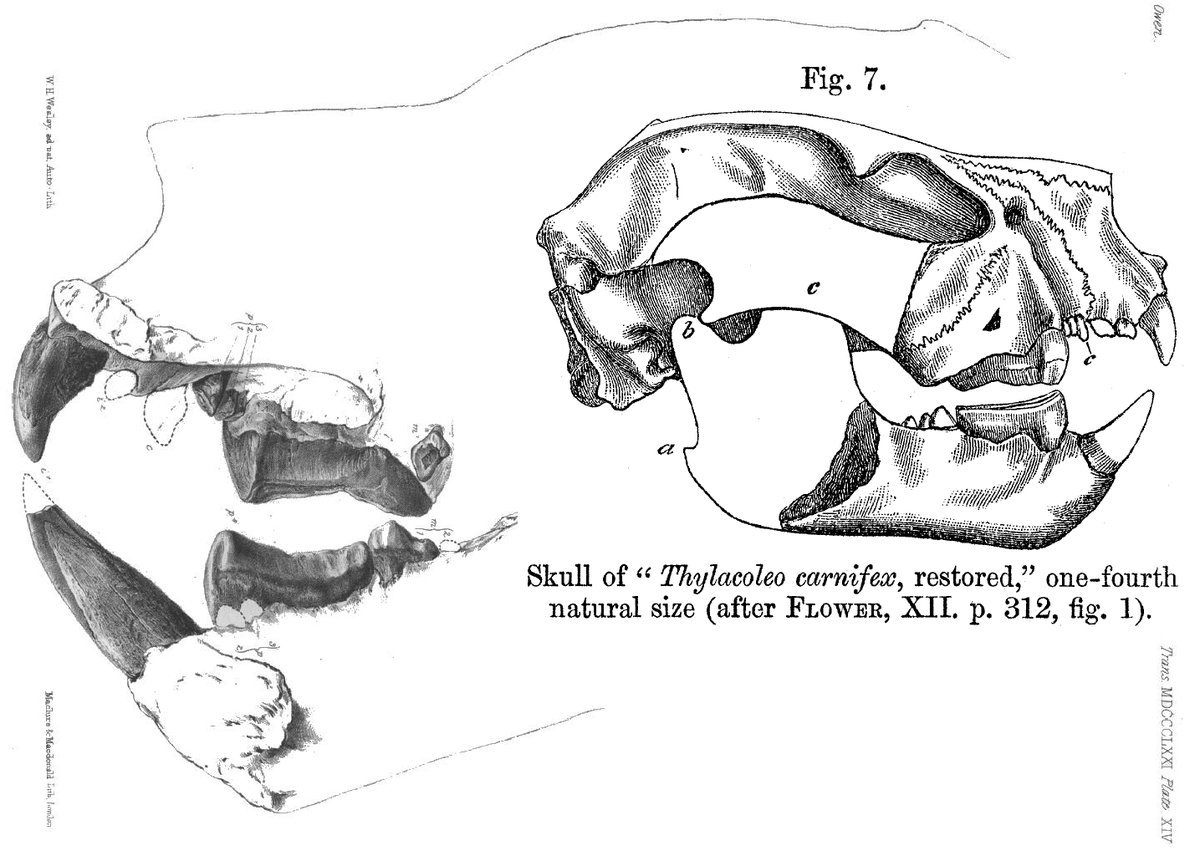
In terms of physical description, Thylacoleo carnifex was a formidable animal, though its proportions were entirely unlike those of any living mammalian carnivore. It measured approximately 1.5 meters in length and stood about 75 centimeters tall at the shoulder, giving it a robust, heavily muscled build comparable to a modern leopard or a small African lioness. Weight estimates for adult individuals typically range from 100 to 160 kilograms, with some exceptionally large specimens potentially reaching up to 164 kilograms. The skull of Thylacoleo was broad, heavy, and vaulted, housing massive jaw muscles that delivered an extraordinary bite force. Unlike placental carnivores such as wolves or big cats, which use large canine teeth to puncture and kill their prey, Thylacoleo possessed enlarged, protruding incisors that functioned like a pair of deadly bolt cutters. Its most distinctive dental feature, however, was the enormous, blade-like carnassial premolars located on both the upper and lower jaws. These teeth operated like a pair of heavy-duty shears, capable of slicing through flesh and bone with devastating efficiency. The postcranial skeleton was equally bizarre and highly specialized. The forelimbs were incredibly powerful and equipped with a pseudo-opposable thumb bearing a massive, retractable, hooded claw. This thumb allowed the animal to grapple with and secure large, struggling prey. The hindlimbs were also strong, and the presence of a robust tail suggests it could use it as a tripod for balance, much like modern kangaroos, freeing its formidable forelimbs to slash and grasp. The skeletal characteristics strongly infer a heavily muscled, ambush predator rather than a pursuit runner, with soft tissue reconstructions depicting a stocky, powerful beast with a broad snout and muscular neck.
The paleobiology of Thylacoleo carnifex reveals a highly specialized hypercarnivore, an animal whose diet consisted almost entirely of meat. Biomechanical studies, notably those conducted by paleontologist Stephen Wroe, have demonstrated that Thylacoleo possessed the strongest bite force of any known mammalian predator relative to its body weight, rivaling or exceeding that of the modern African lion despite its smaller size. This immense bite force, combined with its shearing premolars and stabbing incisors, indicates a feeding strategy focused on rapid, catastrophic trauma to its prey. It is believed that Thylacoleo killed by severing the spinal cord or crushing the windpipe and major blood vessels of its victims in a single, devastating bite. Its locomotion and hunting strategies have been the subject of intense study. The anatomy of its forelimbs, particularly the pseudo-opposable thumb and retractable claws, strongly suggests scansorial (climbing) capabilities. It is highly probable that Thylacoleo was an ambush predator that utilized trees or rocky outcrops to drop onto unsuspecting prey, using its powerful forearms to grapple and pin the victim while delivering a fatal bite. This strategy would have been highly effective against the large, slow-moving megafauna of Pleistocene Australia. Growth patterns inferred from bone histology suggest a relatively slow growth rate compared to placental carnivores, typical of many marsupials, though its metabolism was likely high enough to sustain its active, predatory lifestyle. Social behavior remains largely speculative, but the distribution of fossils occasionally suggests they may have been solitary hunters, coming together primarily for mating or perhaps occasionally sharing large kills, similar to modern leopards.
The ecological context of Pleistocene Australia provided a unique and dynamic environment for Thylacoleo carnifex. During its reign, the Australian continent was undergoing significant climatic shifts, gradually transitioning from widespread lush forests to more open woodlands, scrublands, and increasingly arid deserts. Despite this drying trend, the landscape supported a diverse and spectacular array of megafauna that served as the primary prey base for the marsupial lion. Thylacoleo shared its habitat with giant, rhinoceros-sized marsupial herbivores like Diprotodon optatum, massive short-faced kangaroos such as Procoptodon goliah, and large flightless birds like Genyornis newtoni. As the apex mammalian predator, Thylacoleo occupied the very top of the terrestrial food web. Its unique anatomy allowed it to tackle prey much larger than itself, filling an ecological niche similar to that of the saber-toothed cats (Machairodontinae) in the Americas and Eurasia. However, it was not the only formidable predator on the continent. Thylacoleo would have competed for resources with the giant monitor lizard Megalania (Varanus priscus), the terrestrial crocodile Quinkana, and smaller marsupial predators like the thylacine (Tasmanian tiger) and the Tasmanian devil. The predator-prey dynamics of this ecosystem were complex, with Thylacoleo likely specializing in hunting the large, thick-skinned herbivores that other predators could not easily dispatch. The gradual shift in climate, coupled with the eventual arrival of the first human populations (Aboriginal Australians) around 65,000 to 50,000 years ago, drastically altered this ecological balance, placing immense pressure on the megafauna and the predators that relied upon them.
The discovery history of Thylacoleo carnifex is a fascinating chapter in the annals of paleontology, marked by early confusion and intense scientific debate. The first fossil remains, consisting of fragmentary skull and jaw pieces, were discovered in the early 1830s in the Wellington Caves of New South Wales by the explorer Major Thomas Mitchell. These specimens were eventually sent to England, where they were examined by the eminent Victorian anatomist Sir Richard Owen. In 1859, Owen formally described and named the species Thylacoleo carnifex, which translates to 'murderous pouched lion.' Owen astutely recognized the animal's carnivorous nature based on its formidable shearing teeth, declaring it one of the fiercest and most destructive predatory beasts to have ever lived. However, this conclusion was highly controversial at the time. Because Thylacoleo belonged to the order Diprotodontia—a group that includes modern kangaroos, wombats, and koalas, which are almost exclusively herbivorous—many of Owen's contemporaries, including the prominent paleontologists Hugh Falconer and William Henry Flower, vehemently disagreed. They argued that the animal must have been a specialized herbivore, perhaps using its large teeth to slice tough roots or melons. It was not until much later, with the discovery of more complete skeletal material in the 20th century, that Owen's initial assessment was entirely vindicated. Key discoveries in the late 20th and early 21st centuries, particularly the unearthing of nearly complete articulated skeletons in the limestone caves of the Nullarbor Plain (such as the famous 'Thylacoleo Caves' discovered in 2002) and the Naracoorte Caves in South Australia, provided the definitive evidence of its hypercarnivorous adaptations and highly specialized postcranial anatomy.
The evolutionary significance of Thylacoleo carnifex is profound, offering a spectacular example of convergent evolution and evolutionary plasticity. Taxonomically, it belongs to the suborder Vombatiformes, making its closest living relatives the wombats and the koala. The evolutionary journey from a slow-moving, plant-eating ancestor to a highly specialized, bone-crushing apex predator is one of the most dramatic dietary shifts documented in mammalian history. Because the ancestors of Thylacoleo had already lost their large canine teeth—the primary weapons of most mammalian carnivores—evolution had to improvise. The lineage repurposed its incisors into stabbing weapons and heavily modified its premolars into massive carnassials, a completely different dental solution to the same predatory problem faced by placental carnivores like wolves and big cats. This demonstrates how natural selection can mold available anatomical structures into new, highly effective forms to exploit vacant ecological niches. Furthermore, the specialized anatomy of its forelimbs, particularly the pseudo-opposable thumb, highlights the retention and modification of arboreal adaptations inherited from its possum-like ancestors, repurposed for grappling prey. The extinction of the Thylacoleonidae family, which included several smaller, earlier species of Thylacoleo, marked the end of a unique and highly successful evolutionary experiment, leaving Australia without a large mammalian apex predator until the introduction of the dingo thousands of years later.
Scientific debates surrounding Thylacoleo carnifex have evolved significantly since the initial arguments over its diet in the 19th century. While its status as a hypercarnivore is now universally accepted, debates in recent decades have focused on its hunting behavior and habitat preferences. Some researchers previously suggested it might have been a specialized scavenger, using its powerful jaws to crack bones left by other predators, but biomechanical analyses of its teeth and skull indicate they were optimized for slicing flesh, not crushing bone like a hyena. The extent of its arboreality is also a subject of ongoing discussion. While its forelimb anatomy clearly indicates climbing ability, its large body mass has led some paleontologists to argue it was primarily terrestrial, using trees only for refuge or caching kills, similar to a leopard. The most contentious debate, however, surrounds the cause of its extinction. Scientists continue to argue the relative impacts of severe climate change (increased aridity and loss of forest cover) versus human-induced pressures (hunting and landscape alteration through fire) in the late Pleistocene megafaunal extinction event. Recent consensus suggests a synergistic effect, where climate stress made megafaunal populations vulnerable, and human impacts provided the final push to extinction.
The fossil record of Thylacoleo carnifex is surprisingly robust for a large predator, with specimens found across much of the Australian continent. Fossils have been recovered from every Australian state, indicating it was a highly adaptable species capable of surviving in a variety of environments, from the forested eastern coast to the more arid interior. The quality of preservation varies, but several sites have yielded exceptional material. The Wellington Caves in New South Wales remain historically significant for the first discoveries. However, the Naracoorte Caves in South Australia, a UNESCO World Heritage site, have provided a wealth of well-preserved cranial and postcranial material, acting as natural pitfall traps that accumulated bones over millennia. The most spectacular discoveries occurred in 2002 beneath the Nullarbor Plain, where cavers discovered completely articulated, perfectly preserved skeletons of Thylacoleo lying on the cave floor, providing unprecedented insights into its complete anatomy, including the delicate bones of the paws and tail. These exceptional sites have yielded dozens of individuals, allowing for detailed studies of intraspecific variation, sexual dimorphism, and ontogeny.
The cultural impact of Thylacoleo carnifex extends from ancient indigenous history to modern popular culture. It is highly likely that early Aboriginal Australians encountered these formidable predators, and some researchers believe that ancient rock art in the Kimberley region of Western Australia depicts striped, cat-like animals that may represent Thylacoleo. Today, the marsupial lion is a staple of Australian museum exhibits, with impressive skeletal mounts displayed at the Australian Museum in Sydney and the South Australian Museum in Adelaide, capturing the public's imagination. It frequently appears in documentaries about prehistoric life and has even influenced modern cryptozoology; some speculate that the mythical 'drop bear' of Australian folklore or unconfirmed sightings of the 'Queensland tiger' are cultural memories or modern myths inspired by this remarkable, extinct predator.
Classification
Time Period
Discovery
Location
Australia
Formation
Wellington Caves
Frequently Asked Questions
What is Thylacoleo?
Thylacoleo carnifex, commonly known as the marsupial lion, was the largest carnivorous marsupial to have ever lived in Australia, dominating the continent's ecosystems during the Pleistocene epoch from approximately 2 million to 30,000 years ago. As a highly specialized apex predator, it represents ...
When did Thylacoleo live?
Thylacoleo lived during the quaternary period of the cenozoic era approximately 2-0.03 million years ago.
Where was Thylacoleo discovered?
Fossils of Thylacoleo were discovered in Australia in the Wellington Caves.
What did Thylacoleo eat?
Thylacoleo was a carnivore. It lived in terrestrial habitats.
What type of fossil is Thylacoleo?
Thylacoleo is preserved as a body fossil. The preservation quality is excellent.
Related Specimens
From the cenozoic era · body fossils