Redlichia
Redlichia rex
Image: File:Redlichia rex.jpg - Wikimedia Commons (CC BY-SA)
About Redlichia
Redlichia rex, whose name appropriately translates to 'King Redlichia,' was a formidable trilobite and one of the largest known arthropods of the early Cambrian Period. This species is significant for its immense size, which challenged previous notions about the limits of animal gigantism during the dawn of complex life, and for its likely role as an apex predator in its ecosystem. It lived approximately 513 to 501 million years ago in the shallow marine environments of what is now South Australia, with its remains exquisitely preserved in the Emu Bay Shale Lagerstätte on Kangaroo Island.
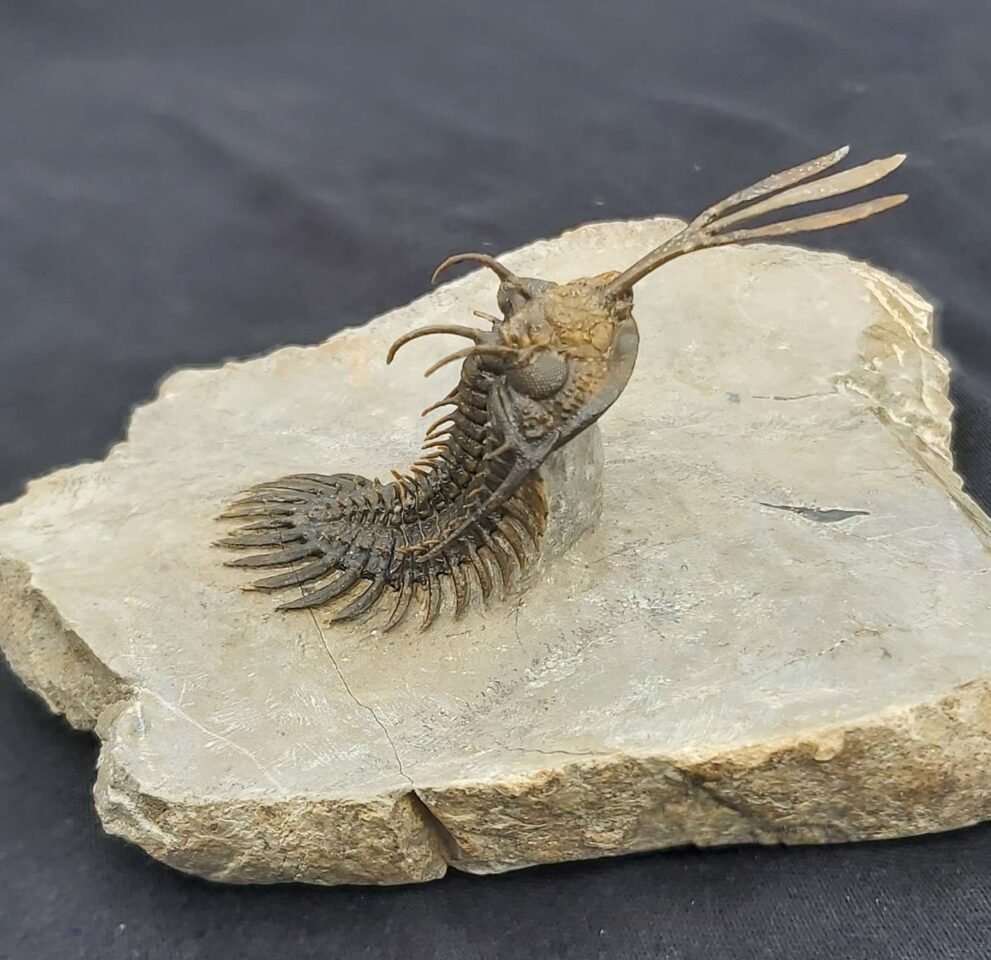
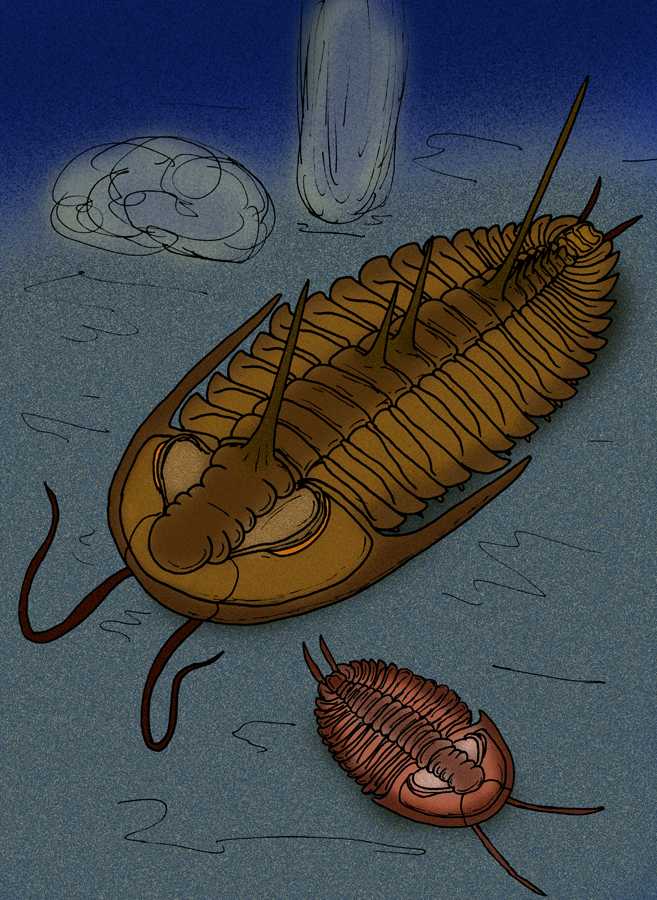
The physical anatomy of Redlichia rex was both impressive and characteristic of the trilobite body plan, albeit on a much grander scale. Reaching lengths of 25 to 35 centimeters (approximately 10 to 14 inches), it was a true giant, dwarfing the vast majority of its contemporaries which typically measured only a few centimeters. Its robust exoskeleton, composed of non-mineralized cuticle that would have been tough and leathery in life, was divided into three main sections: the cephalon (head), thorax (body), and pygidium (tail). The cephalon was large and semicircular, dominated by a pair of prominent, crescent-shaped holochroal eyes, each composed of thousands of individual lenses, granting it a wide field of view crucial for detecting both prey and threats. A central raised area on the cephalon, the glabella, housed the stomach. The thorax was composed of at least 11 articulating segments, allowing for a degree of flexibility. Each thoracic segment bore a pair of spiny legs, which were not only used for walking but also likely for grasping and manipulating food. The entire dorsal shield was adorned with genal spines extending backward from the cheeks and axial spines running down its back, providing formidable defense. Its size and armor would have made it a visually intimidating creature, comparable in ecological role, if not direct form, to a large modern crustacean like a king crab or a lobster.
The paleobiology of Redlichia rex points strongly towards an active, predatory lifestyle. Its large size, robust limbs, and excellent vision are all adaptations consistent with a carnivore that actively hunted its prey. Fossil evidence provides compelling, albeit indirect, support for this interpretation. Numerous trilobite fossils from the Emu Bay Shale, including other species of Redlichia and the smaller Estaingia, exhibit distinctive W-shaped bite marks and crushing injuries that perfectly match the mouthparts and predatory capabilities attributed to R. rex. Furthermore, some specimens of R. rex itself show healed injuries, suggesting it engaged in dangerous encounters, possibly with members of its own species in acts of cannibalism or territorial disputes. Its feeding strategy likely involved using its powerful, spiny walking legs (endopods) to grasp and crush the exoskeletons of smaller arthropods and other invertebrates. It would have scoured the muddy seafloor, using its large eyes to spot prey before ambushing it. Locomotion was achieved through the coordinated movement of its numerous legs, allowing it to crawl efficiently across the substrate. While direct evidence of its growth is limited, like all arthropods, it would have undergone a series of molts, shedding its exoskeleton to grow larger, a vulnerable process that would have required it to hide until its new cuticle hardened.
Redlichia rex inhabited a shallow, temperate marine environment during the Cambrian Period, Stage 4. At this time, the landmass that would become Australia was part of the supercontinent Gondwana, situated at a much lower latitude than today. The Emu Bay Shale represents a relatively deep, quiet-water basin adjacent to a carbonate platform, an environment teeming with life. This ecosystem was a product of the Cambrian Explosion, a period of rapid evolutionary diversification. The fauna was diverse, featuring a complex food web with R. rex positioned at or near the top. Its prey likely included smaller trilobites such as Estaingia bilobata and Balcoracania dailyi, as well as various soft-bodied organisms. Co-existing with this giant trilobite were other remarkable creatures, including the enigmatic Vetulicolians like Nesonektris, and early anomalocaridids, such as Anomalocaris briggsi and a larger, yet-unnamed species that may have been the only predator capable of challenging R. rex. The presence of multiple large predators suggests a sophisticated ecological structure with intense competition, driving the evolutionary arms race that characterized the era, leading to the development of both formidable predatory adaptations and robust defensive armor among prey species.
The discovery of Redlichia rex is a relatively recent chapter in the history of paleontology, highlighting the ongoing potential for major finds. The fossils were unearthed from the Emu Bay Shale on Kangaroo Island, a world-renowned fossil Lagerstätte known for its exceptional preservation of both hard and soft tissues. While the Emu Bay Shale has been known to science since the late 19th century, the exceptionally large specimens that would be designated as a new species were found in the early 21st century. The formal description of the species was published in 2014 by a team of paleontologists led by James D. Holmes, John R. Paterson, and Diego C. García-Bellido. They named it Redlichia rex, combining the existing genus name, which honors geologist Karl August Redlich, with the Latin "rex," meaning "king," to emphasize its massive size and presumed dominance in its ecosystem. The holotype and other key specimens are housed at the South Australian Museum in Adelaide, where they form a centerpiece of its Cambrian fossil collection. The discovery was significant because it pushed back the timeline for the appearance of gigantism in marine arthropods, demonstrating that complex, high-tier predatory roles were established much earlier in the Paleozoic than previously documented.
In the grand tapestry of evolution, Redlichia rex occupies an important position within the phylum Arthropoda, the most diverse animal phylum on Earth today. It belongs to the class Trilobita, an extinct group of marine arthropods that flourished throughout the Paleozoic Era before vanishing in the Permian-Triassic mass extinction. Specifically, R. rex is classified within the order Redlichiida, one of the earliest and most primitive orders of trilobites. The Redlichiids are characterized by their numerous thoracic segments, a small pygidium, and prominent genal spines, all features clearly visible in R. rex. These trilobites are considered basal members of the group, providing crucial insights into the ancestral body plan from which more derived trilobite lineages evolved. While trilobites have no direct living descendants, their closest modern relatives are the chelicerates, a group that includes horseshoe crabs, spiders, and scorpions. The exceptionally preserved fossils from Emu Bay, including related species showing antennae and digestive tracts, help scientists reconstruct the neuroanatomy and internal physiology of these early arthropods, bridging the gap between ancient fossil forms and their distant modern kin. Redlichia rex serves as a spectacular example of early arthropod evolution, showcasing the rapid radiation and ecological specialization that occurred during the Cambrian Explosion.
Despite its clear significance, Redlichia rex is not entirely free from scientific debate, primarily concerning its precise ecological role and taxonomic classification. While the evidence for predation is strong, including bite marks on prey and healed wounds, the exact nature of its predatory behavior remains a subject of interpretation. Some researchers argue it was an active pursuit hunter, while others suggest it was more of an ambush predator or even a scavenger, using its size to intimidate competitors from carcasses. Another area of discussion revolves around its status as a distinct species versus a potential example of extreme intraspecific size variation within another known Redlichia species, such as Redlichia takooensis, which is also found in the Emu Bay Shale. However, subtle morphological differences, in addition to its consistently gigantic size, have led most paleontologists to support its designation as a separate species, R. rex. Ongoing research into the taphonomy and paleoecology of the Emu Bay Shale continues to refine our understanding of this remarkable animal and its interactions within one of the world's most important Cambrian fossil sites.
The fossil record of Redlichia rex is geographically restricted but scientifically priceless. All known specimens have been recovered from a single geological formation: the Emu Bay Shale on the north coast of Kangaroo Island, South Australia. This site is a Lagerstätte, a sedimentary deposit that exhibits extraordinary fossil richness and quality of preservation. The fine-grained sediments of the shale created an anoxic environment that limited decay, allowing for the fossilization of not just the hard exoskeleton but, in some related Cambrian fossils from the site, soft tissues like guts, nerves, and eyes. While the total number of complete R. rex specimens is not large, the fossils that have been found are often remarkably well-preserved, providing detailed anatomical information. The site has yielded disarticulated parts as well as several nearly complete individuals, which are crucial for understanding the animal's overall morphology and size. The fame of the Emu Bay Shale, alongside other Cambrian sites like the Burgess Shale in Canada and the Chengjiang biota in China, rests on its ability to provide a rare and detailed window into the structure of early animal communities.
Although a relatively recent discovery, Redlichia rex has quickly captured the public and scientific imagination. Its impressive size and "king" moniker make it a charismatic example of Cambrian life, often featured in museum exhibits on early evolution and the Cambrian Explosion. The South Australian Museum prominently displays specimens of R. rex, using them as a powerful educational tool to illustrate the ancient history of the region and the concept of evolutionary arms races. It has been featured in popular science articles, documentaries, and online media, serving as a poster child for the surprising complexity and scale of life just after the dawn of the animal kingdom. For students of paleontology, it is a key case study in early predator-prey dynamics and the emergence of complex ecosystems.
Classification
Time Period
Discovery
Location
Emu Bay, Kangaroo Island, South Australia
Formation
Emu Bay Shale
Frequently Asked Questions
What is Redlichia?
Redlichia rex, whose name appropriately translates to 'King Redlichia,' was a formidable trilobite and one of the largest known arthropods of the early Cambrian Period. This species is significant for its immense size, which challenged previous notions about the limits of animal gigantism during the...
When did Redlichia live?
Redlichia lived during the cambrian period of the paleozoic era approximately 513-501 million years ago.
Where was Redlichia discovered?
Fossils of Redlichia were discovered in Emu Bay, Kangaroo Island, South Australia in the Emu Bay Shale.
What did Redlichia eat?
Redlichia was a carnivore. It lived in marine habitats.
What type of fossil is Redlichia?
Redlichia is preserved as a body fossil. The preservation quality is exceptional.
Related Specimens
From the paleozoic era · body fossils