Radiolites
Radiolites squamosus
Image: Image sourced via web search (Fair use / Educational)
About Radiolites
Radiolites squamosus represents a highly specialized and ecologically significant species of extinct marine bivalve mollusks known colloquially as rudists. Flourishing during the Late Cretaceous period, approximately 100 to 66 million years ago, this organism was a primary reef-building species in the shallow, warm waters of the ancient Tethys Ocean. Unlike modern bivalves such as clams or oysters, Radiolites squamosus evolved a highly asymmetrical shell morphology that allowed it to grow vertically from the sea floor, mimicking the ecological role of modern scleractinian corals. Its significance in paleontology is immense, as it provides crucial insights into the dynamics of Mesozoic marine ecosystems, the evolution of extreme morphological adaptations in mollusks, and the devastating impact of the Cretaceous-Paleogene extinction event that abruptly ended their reign as the dominant reef builders of the world.
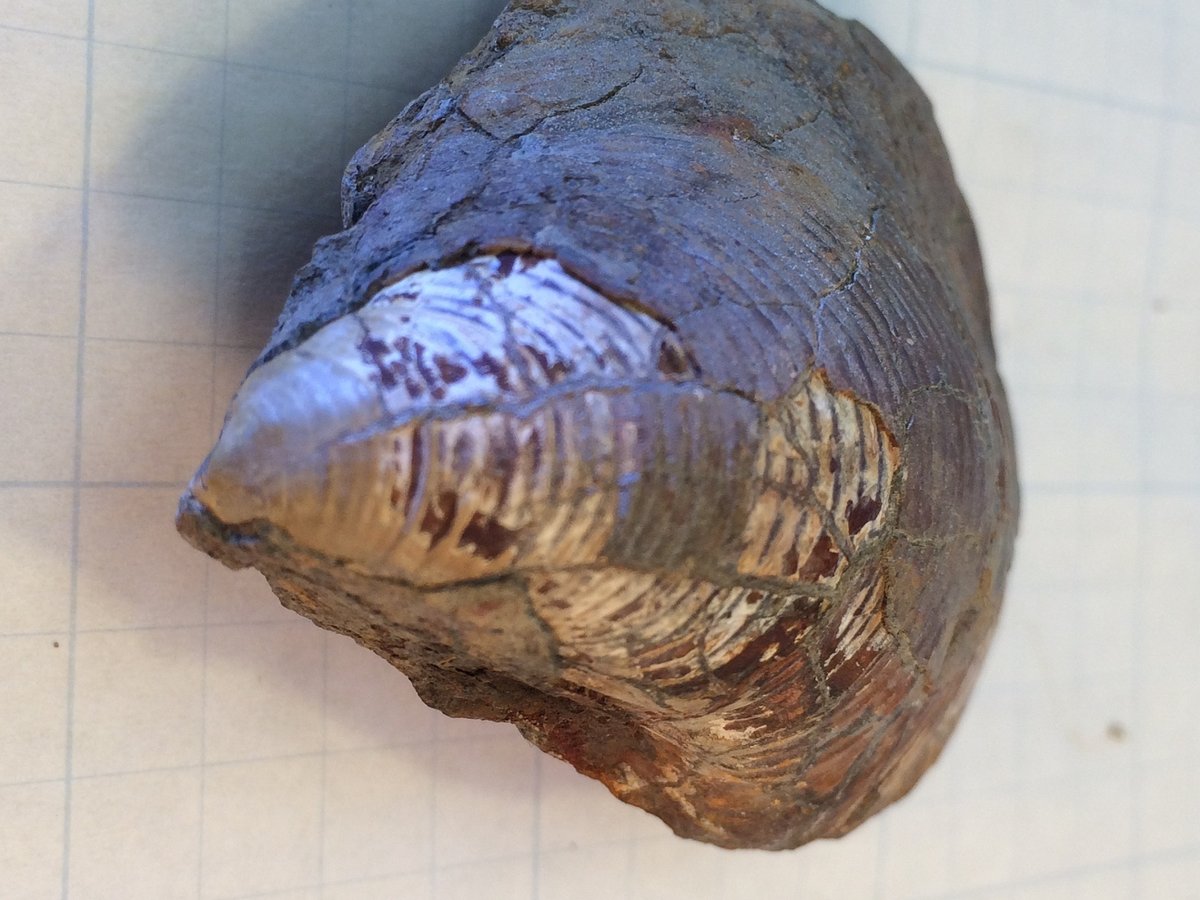
The physical anatomy of Radiolites squamosus is a fascinating departure from the typical bilateral symmetry associated with most bivalves. The organism possessed two highly unequal valves. The lower, or right, valve was elongated, conical, and robust, anchoring the animal securely to the marine substrate or to the shells of neighboring rudists. This conical valve could reach lengths of 15 to 30 centimeters, though some related species grew much larger. The upper, or left, valve was significantly smaller, acting as a flattened, cap-like lid that could open and close to protect the soft internal tissues. One of the most distinctive skeletal characteristics of Radiolites squamosus was the thick wall of its lower valve, which was constructed of a complex, cellular, honeycomb-like network of calcite. This unique structural adaptation provided immense strength while minimizing the metabolic cost and weight of secreting solid calcium carbonate. The exterior of the shell was often adorned with prominent longitudinal ribs and scaly growth lamellae, giving the species its specific epithet 'squamosus' (meaning scaly). Soft tissue inferences suggest a highly modified mantle that not only secreted the massive shell but also facilitated specialized feeding and respiratory functions, though the soft parts themselves are not preserved in the fossil record. Compared to modern bivalves, a living Radiolites would have looked more like a rugged, solitary horn coral or a heavily armored tube sponge than a traditional clam.
In terms of paleobiology, Radiolites squamosus was primarily a benthic, sessile suspension feeder. It utilized its gills to filter microscopic plankton and organic detritus from the surrounding water column. However, the immense success and rapid growth rates of rudists in nutrient-poor, shallow tropical waters have led paleontologists to infer a highly specialized metabolic strategy: photosymbiosis. Much like modern reef-building corals and giant clams (Tridacna), it is widely hypothesized that the expanded mantle tissues of Radiolites squamosus hosted symbiotic, photosynthetic dinoflagellates (zooxanthellae). These microscopic algae would have provided the rudist with supplemental nutrition in the form of photosynthates, fueling the rapid calcification required to build massive reef structures. Locomotion was entirely absent in the adult stage; after a brief, free-swimming larval phase, the juvenile rudist would permanently cement itself to the substrate. Socially, or rather ecologically, these organisms were highly gregarious. They grew in dense, tightly packed aggregations, forming extensive biostromes and bioherms. This clustering behavior provided mutual support against strong ocean currents and wave action, creating a complex, three-dimensional habitat that supported a diverse array of other marine organisms.
The ecological context of Radiolites squamosus is inextricably linked to the unique environmental conditions of the Late Cretaceous world. During this time, the Earth experienced a pronounced greenhouse climate, characterized by high atmospheric carbon dioxide levels, elevated global temperatures, and sea levels that were up to 200 meters higher than today. The Tethys Ocean, a vast equatorial seaway separating the northern continents of Laurasia from the southern continents of Gondwana, provided the perfect incubator for rudist evolution. In these warm, shallow, hypersaline waters, rudists like Radiolites squamosus outcompeted traditional corals to become the dominant reef-building organisms globally. They formed massive, fringing reef complexes that stretched from present-day Mexico and the Caribbean, across southern Europe and North Africa, to the Middle East. These rudist reefs were vibrant, bustling ecosystems, serving as the foundation of a complex food web. They provided shelter and grazing grounds for a multitude of co-existing species, including early teleost fishes, echinoids, gastropods, and crustaceans. Predation pressure on adult rudists was likely low due to their thick, heavily armored shells, though specialized shell-crushing predators, such as certain species of mosasaurs, ptychodontid sharks, and large ammonites, may have occasionally preyed upon them or the organisms sheltering within the reef matrix.
The discovery history of Radiolites squamosus is deeply intertwined with the birth of modern paleontology and stratigraphy in 19th-century Europe. The genus Radiolites was first established by the pioneering French naturalist Jean-Baptiste Lamarck in 1801, recognizing the distinct, radiating structural patterns of the shell. As geological surveys expanded across the limestone-rich regions of southern France, Italy, and the Mediterranean basin, countless rudist fossils were unearthed. The specific identification and naming of Radiolites squamosus occurred during the mid-19th century, a period characterized by intense taxonomic classification of the European fossil record by figures such as Alcide d'Orbigny. Early paleontologists were initially baffled by the bizarre morphology of rudists, frequently misclassifying them as corals, barnacles, or even unusual brachiopods before their true identity as highly modified bivalve mollusks was firmly established. Key specimens of Radiolites squamosus are housed in historical collections across Europe, notably in the Muséum National d'Histoire Naturelle in Paris, where they serve as critical reference material for understanding the biostratigraphy of the Late Cretaceous Tethyan realm.
The evolutionary significance of Radiolites squamosus lies in its demonstration of extreme morphological plasticity and evolutionary convergence. Within the tree of life, rudists belong to the order Hippuritida, a specialized offshoot of the bivalve class that underwent a massive evolutionary radiation during the Jurassic and Cretaceous periods. Radiolites squamosus exemplifies a radical departure from the ancestral bivalve body plan, showcasing how environmental pressures can drive a lineage to adopt a completely different ecological niche—in this case, transitioning from burrowing or surface-dwelling filter feeders to massive, sessile reef builders. This evolutionary trajectory represents a classic example of convergent evolution, where rudists independently evolved a coral-like growth form to exploit the shallow, sunlit waters of the Cretaceous oceans. Tragically, the extreme specialization that made rudists so successful also sealed their fate. They left no modern descendants; the entire order Hippuritida was completely wiped out during the Cretaceous-Paleogene (K-Pg) mass extinction event 66 million years ago. The sudden disappearance of Radiolites and its kin provides a stark evolutionary lesson on the vulnerability of highly specialized, reef-building organisms to rapid environmental perturbations, such as the ocean acidification and global cooling triggered by the Chicxulub asteroid impact.
Scientific debates surrounding Radiolites squamosus and other rudists continue to stimulate paleontological research. One of the most enduring controversies involves the extent and necessity of their proposed photosymbiotic relationship. While the rapid growth rates and environmental distribution strongly imply symbiosis with zooxanthellae, direct fossil evidence of these soft-bodied microbes is inherently lacking. Some researchers argue that the unique cellular shell structure alone could account for their rapid growth without the need for photosymbionts, pointing to isotopic studies of the shell carbonate that yield ambiguous results regarding photosynthetic activity. Additionally, there are ongoing taxonomic disputes regarding the precise classification and evolutionary relationships within the family Radiolitidae, as the high degree of morphological variation within individual species—often influenced by local environmental conditions like crowding and water flow—makes defining strict species boundaries challenging. Recent high-resolution geochemical analyses of Radiolites shells are also being used to reconstruct ancient climate data, leading to debates over the exact temperature and salinity profiles of the Late Cretaceous oceans.
The fossil record of Radiolites squamosus is exceptionally robust, primarily due to the massive, heavily calcified nature of their lower valves. Fossils are geographically widespread across the former Tethyan realm, with spectacular concentrations found in the Cretaceous limestone formations of the Mediterranean region, the Middle East, and the Caribbean. Millions of specimens are known, often preserved in life position within fossilized reef structures. The preservation quality is generally good to excellent, particularly for the calcitic outer layer of the lower valve, which resists dissolution better than the aragonitic inner layers that are frequently lost to diagenesis. The cellular, honeycomb structure of the shell is often beautifully preserved, allowing for detailed microstructural analysis. Famous fossil sites include the spectacular rudist biostromes of the Apennine Mountains in Italy, the massive carbonate platforms of the Arabian Peninsula, and the extensive Cretaceous outcrops of the Charentes region in France, where dense thickets of Radiolites provide a window into the ancient reef environments.
The cultural and economic impact of Radiolites squamosus extends beyond the walls of natural history museums. While they may not possess the cinematic fame of dinosaurs, rudists are of immense economic importance to modern society. The massive, porous reef structures built by Radiolites and other rudists in regions like the Middle East and the Gulf of Mexico have been buried and transformed over millions of years into some of the world's most productive petroleum reservoirs. The highly porous nature of their cellular shells and the complex reef matrix make excellent traps for hydrocarbons. Educationally, museum displays featuring large clusters of Radiolites serve as powerful tools for teaching concepts of convergent evolution, paleoecology, and the dramatic shifts in Earth's biosphere caused by mass extinctions, highlighting a time when bizarre, giant clams ruled the world's reefs.
Classification
Time Period
Discovery
Location
France
Formation
Tethyan Carbonate Platforms
Frequently Asked Questions
What is Radiolites?
Radiolites squamosus represents a highly specialized and ecologically significant species of extinct marine bivalve mollusks known colloquially as rudists. Flourishing during the Late Cretaceous period, approximately 100 to 66 million years ago, this organism was a primary reef-building species in t...
When did Radiolites live?
Radiolites lived during the cretaceous period of the mesozoic era approximately 100-66 million years ago.
Where was Radiolites discovered?
Fossils of Radiolites were discovered in France in the Tethyan Carbonate Platforms.
What did Radiolites eat?
Radiolites was a filter-feeder. It lived in marine reef habitats.
What type of fossil is Radiolites?
Radiolites is preserved as a body fossil. The preservation quality is good.
Related Specimens
From the mesozoic era · body fossils